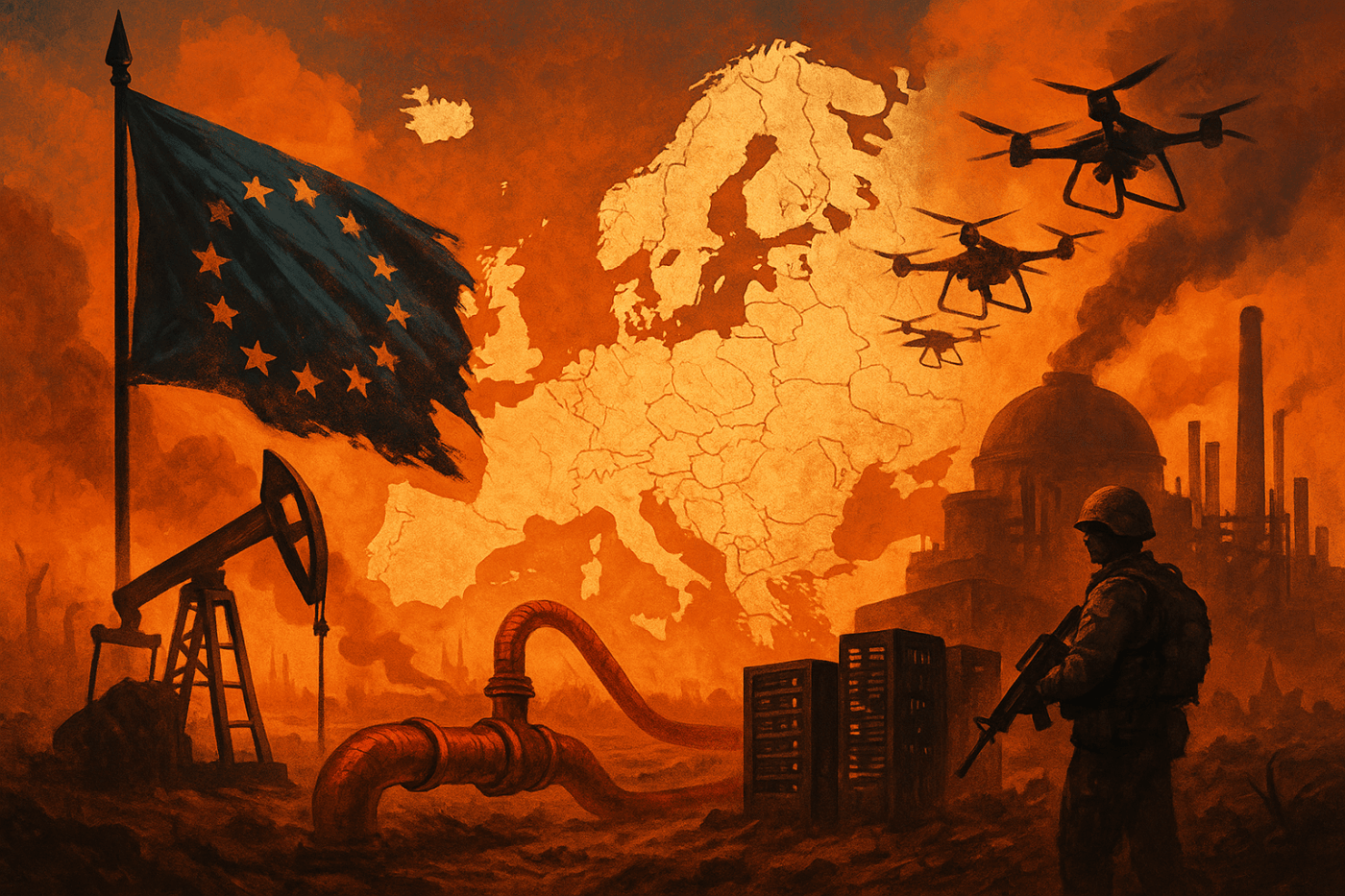
Brussels calls it “Resilience 2.0.” In reality it is a manual for managing imperial decline: shifting Europe from Russian pipelines to U.S. LNG, seizing assets through lawfare, codifying dependence on American cloud and chips, militarizing budgets, and policing speech. Across the Global South, a multipolar counter-project points toward another horizon—cooperation, sovereignty, and solidarity. The choice before us is stark: resilience for monopolies, or resilience for the people.
By Prince Kapone | Weaponized Information | September 12, 2025
Resilience 2.0: The Empire’s New Buzzword
Earlier this September the European Commission dropped its latest Strategic Foresight Report, a slick package called “Resilience 2.0.” It comes wrapped in the language of hope—promises that Europe will “bounce forward” from turbulence by making itself more secure, more innovative, more fair. The document lists all the usual suspects: security, technology, the economy, education, democracy, and intergenerational fairness. It reads like a self-help manual for an empire nervous about its own heartbeat. Behind the polished prose lies a basic truth: “resilience” is not about protecting people, it’s about protecting power. It’s the new word they use when they mean militarization, surveillance, and austerity.
Scratch beneath the surface and you see the cracks. The Commission admits—though never quite in these words—that Europe’s prosperity depends on systems it doesn’t really control. American tech giants own most of Europe’s cloud. The Union is scheming to siphon off profits from frozen Russian assets to pay for war. Even the statistics they parade as success—like youth trust in the EU supposedly standing at 59%—feel less like triumph than reassurance. This is a nervous empire trying to convince itself that the ground beneath it isn’t shifting.
Let’s be clear: this is not foresight in the heroic sense. It’s an admission that the empire is running on fumes. “Resilience 2.0” is a manual for how to squeeze a little more rent, a little more control, out of a system that is falling apart. It braids together the military and the civilian, turns law into a weapon of finance, and dresses dependency up as “sovereignty.” The words are soft, but the politics are steel: centralize the bloc, police what people say and think, and keep the arms factories turning. If this is resilience, it’s resilience for capital, not for the people.
That’s why this essay digs in the way it does. We start with energy, where “diversification” just means swapping one leash for another. We move to finance, where frozen assets and clearinghouses become tributary streams feeding a war economy. We take up cloud and artificial intelligence, where Brussels writes rules but Washington holds the servers. We look at the democracy-and-disinformation plank, which is less about defending democracy than about managing dissent. We study rearmament, the fiscal spine of this whole project, where budgets for schools and hospitals are turned into missiles and drones. And finally we come back to the social question—the young, the workers, the households—who are told to carry the burden while the empire “bounces forward.” My conclusion is simple: “Resilience 2.0” is the EU’s confession that the imperial order can only survive through permanent mobilization. Our task is to take their confession and turn it against them—to use the very chokepoints they depend on as leverage for internationalist mass power.
Energy as the Empire’s Leash
When Brussels talks about “energy resilience,” it sells the fantasy that dependency is strategy. The Strategic Foresight Report claims that Europe can “diversify supply” and “shield citizens from shocks,” but the record is plain: Europe has been maneuvered into a position where its very lifeblood—fuel—flows on terms dictated from Washington. The decisive break came not just from market shifts, but from geopolitical sabotage. The destruction of the Nord Stream pipelines in September 2022 has been credibly linked to U.S. involvement, a covert operation that removed once and for all the possibility of a cheap, long-term Russian energy partnership. With the pipes blown apart on the floor of the Baltic, the U.S. had cleared the path for its liquefied natural gas armada to sail in as Europe’s “rescuer.”
None of this was accidental. Years before the blasts, U.S. officials were already saying the quiet part out loud. In 2019, the Trump administration signed the PEESA sanctions law to kill Nord Stream 2, and Senator Ted Cruz boasted that sanctions were working to “save Europe from dependency on Russia” by forcing it to buy American gas. Think tanks like the Atlantic Council and the Center for Strategic and International Studies published reports mapping how U.S. LNG could replace Russian flows and lock in Europe’s reliance on U.S. infrastructure. In 2022, President Biden himself declared “If Russia invades, there will be no Nord Stream 2. We will bring an end to it”. Less than a year later, the pipelines were rubble.
The result has been a massive restructuring of Europe’s energy map, not for the benefit of its people but for the balance sheet of U.S. multinationals. By 2023, the United States had become the EU’s largest LNG supplier, with ExxonMobil, Cheniere, and Chevron pocketing record profits. Brussels calls this “diversification.” But what kind of diversification is it when one hegemon is swapped for another, and the new supplier charges triple the price? What kind of resilience is it when German factories close, French households ration heat, and the European working class pays the bill for Washington’s grand strategy?
This is not just economics; it is politics enforced at gunpoint. The U.S. used sanctions, sabotage, and propaganda to force Europe off Russian gas and onto American tankers, turning an entire continent into a captive market. It is the renegotiation of the old trilateral imperial arrangement—Washington, Brussels, and Tokyo as “partners”—but now rewritten under duress. Europe is no longer a junior partner bargaining for its share; it is a client state told what to buy, from whom, and at what price. For the U.S., this is victory: energy rents secured, industrial rivals weakened, NATO more tightly bound. For the people of Europe, it is disaster: higher bills, shuttered industries, and austerity dressed up as resilience.
The contradiction is stark. European leaders speak of sovereignty, but their energy sovereignty was blown up in the Baltic Sea. They talk of partnership, but their so-called ally is bleeding them dry. And while the Strategic Foresight Report promises a “green transition,” it is clear that the primary transition under way is from one leash to another. True resilience will never come from dependency enforced by sabotage and sanctions. It can only come when energy is reclaimed as a commons, liberated from imperial geopolitics, and placed under the control of the very people who now shiver in unheated homes while tankers sail from Texas. Until then, “resilience” is nothing more than the empire’s leash, tightened with every shipment of LNG.
Lawfare and the Looting of Wealth
If energy is the empire’s leash, finance is its crowbar. The Strategic Foresight Report treats “economic security” as a pillar of resilience, promising to shield Europe from shocks by mobilizing its financial power. But what that means in practice is not protection for working people—it is the normalization of lawfare, the weaponization of contracts, clearinghouses, and custody against those the empire designates as enemies. The clearest case is the seizure of Russian state assets parked in European accounts. Through the clearing giant Euroclear, profits generated on frozen securities are now being diverted to Ukraine, with the EU Council greenlighting the use of these windfalls to bankroll war and reconstruction.
The sums are staggering. In 2023, Euroclear alone reported €4.8 billion in interest income from immobilised Russian assets. Belgium, where Euroclear is headquartered, skimmed off nearly two billion in taxes, while Brussels promised the rest would be funneled east. This is celebrated as ingenuity: making Moscow pay without touching the principal. But behind the spin lies a dangerous precedent—that Europe’s financial custodians can become looters in pinstripes, repurposing other people’s money under the banner of legality. Even Belgian officials admit the risks: fears have been raised that such moves could undermine trust in Europe’s financial system, drive capital flight, and boomerang against the euro itself.
Yet for Washington and Brussels, this is precisely the point. By demonstrating that Western custody is conditional—assets can be frozen, interest siphoned, profits seized—they turn the financial system itself into a weapon. What began as “targeted sanctions” has become a permanent tributary system: trillions immobilized, interest flows redirected, financial chokepoints repurposed as tools of war. The imperial triad now wields clearinghouses and payment rails as aggressively as it does aircraft carriers. In the language of the Strategic Foresight Report, this is “resilience.” In plain terms, it is looting with a legal brief attached.
For the people of Europe, this resilience comes at a cost. Every euro siphoned through Euroclear is a euro not invested in hospitals, schools, or wages. Every legal contortion to justify confiscation erodes the credibility of the very system European workers’ pensions and savings depend on. The EU calls this “responsibility.” But for anyone watching from the Global South, it looks like confirmation of what they have long known: that Western finance is not a neutral marketplace but an instrument of domination, one that can seize and siphon at will. It is lawfare elevated to principle, the heist of the century dressed up as humanitarian duty.
This is why the Global South pushes so hard for alternatives—new payment systems, de-dollarization, and sanctions-proof reserves. The more Brussels boasts of its financial resilience, the more the rest of the world learns the lesson: never trust your wealth to an empire in decline. For Europe’s rulers, lawfare is a tool to manage crisis. For the people of Europe, it is a slow erosion of stability and credibility. And for the global working class, it is one more reason to build a financial order not ruled by looters in pinstripes but by solidarity, reciprocity, and sovereignty.
Digital Sovereignty or Digital Subordination?
Another pillar of “resilience” is technology. The European Commission claims it will secure sovereignty in artificial intelligence, cloud, and compute, framing this as the key to Europe’s competitiveness and autonomy. The Strategic Foresight Report tells us Europe must “harness frontier technologies safely” and “reduce dependencies in critical infrastructure.” On paper, this is a rallying cry for independence. In reality, it is the paperwork of subordination, a façade draped over a digital empire where the servers, chips, and standards are firmly in U.S. hands.
The numbers are not a secret.
Roughly 70% of Europe’s cloud market is controlled by three American corporations—Amazon, Microsoft, and Google. European providers hover around 15%, fragmented and fragile. Every promise of “data sovereignty” floats on this dependency. Even as Brussels drafts the AI Act to regulate risk, and rolls out funds like “Digital Europe,” the physical infrastructure—the data centers, the chips, the energy-hungry GPUs that train frontier models—remains imported and leased. This is not sovereignty; it is a tenant pretending to be a landlord.
Washington knows this. Under Trump 2.0, the mask has slipped even further. The White House’s America’s AI Action Plan launched in July 2025 makes clear that the U.S. will export its tech stack abroad while tearing down what it calls “barriers” to innovation at home. Vice President JD Vance has openly denounced Europe’s AI regulation as “excessive” and a drag on innovation, signaling that Washington now sees Brussels less as a partner than as a problem to be disciplined. The EU still drafts regulations, but the U.S. owns the infrastructure; Brussels is reduced to the role of bureaucrat, while Washington plays landlord and Silicon Valley remains gatekeeper. This is how empire operates in the digital age: the junior partner is tasked with writing the rules, while the hegemon controls the road itself, extracts the rents, and calls it cooperation.
The Strategic Foresight Report frames these efforts as defense against “weaponised interdependence.” But the interdependence is already weaponised—by the U.S. giants who lock Europe into their platforms, by the export controls that throttle access to advanced chips, by the standards bodies dominated by U.S. corporate and security interests. Europe talks about AI sovereignty while quietly begging Washington for exemptions on semiconductor sanctions that hit its own industries. It boasts of investment in frontier AI while depending on chips from Taiwan, fabs from Korea, and cloud infrastructure rented from Seattle and Mountain View.
For Europe’s rulers, resilience means managing this dependency with rules and dashboards. For workers and households, it means footing the bill for digital infrastructure while remaining locked out of its control. And for the Global South, it is a warning: the same Europe that preaches sovereignty is itself a client in the U.S. tech empire, too busy writing compliance manuals to notice the chains around its wrists. True digital sovereignty will not be built through regulation in Brussels, but through the dismantling of monopolies, the creation of public compute and open cloud infrastructures, and the forging of South–South technological solidarity. Until then, “resilience” in the digital domain is nothing more than subordination wearing the mask of autonomy.
The Security–Speech Regime
In its foresight vision, Brussels puts “democracy” and “trust” on the list of resilience pillars, warning about polarization, manipulation, and disinformation. The Strategic Foresight Report makes it sound like the EU is simply defending debate and protecting citizens from lies. But what’s really being built is a security–speech regime: a system where speech itself is treated as a battlefield, and where dissent is managed as if it were an insurgency. Platforms are deputized as police, encryption is framed as a threat, and “values” are weaponized to justify surveillance.
The groundwork is already visible. Brussels has rolled out the Code of Practice on Disinformation and the European Media Freedom Act, while Council debates on so-called “chat control” would require platforms to scan private messages and undermine end-to-end encryption. Civil liberties groups like EDRi warn that this amounts to mass surveillance cloaked in child protection rhetoric. In France, the mask has already slipped: laws justified in the name of “Republican values” now criminalize protest and ban symbols of dissent, showing how liberal ideals are flipped into ideological cover for repression. France’s so-called values reveal what Brussels is too careful to say out loud.
And it isn’t just Europe. Across the Atlantic, the U.S. has long used emergency law to gut civil liberties. My analysis in “The Suspension of Freedom” shows how habeas corpus was eroded under the permanent state of exception created by the War on Terror. That machinery of domestic war—secret designations, indefinite detention, militarized policing—has been normalized inside the Triad. What Washington pioneered with Guantánamo and Patriot Acts, Europe now adapts with its own laws, its own platforms, its own speech-policing infrastructure. The result is convergence: a Triad-wide system where civil liberties are subordinated to the logic of counterinsurgency.
For the ruling class, this is called resilience. For the people, it is repression dressed as protection. Workers, migrants, and youth already facing economic precarity now find themselves living in a world where their private messages are potential evidence, their protests potential terrorism, their dissent potential disinformation. Europe waves the banner of freedom even as it installs the infrastructure of technofascism—permanent surveillance, automated censorship, and emergency powers ready to be triggered at will.
The contradiction here is blunt. You cannot strengthen democracy by criminalizing dissent. You cannot build trust by spying on the very citizens you claim to protect. What the Strategic Foresight Report calls democratic resilience is in reality a playbook for silencing opposition in the name of stability. It is the same method whether in Washington, Paris, or Brussels: take the language of liberty, flip it, and use it as the mask for repression. Resilience in this form is not the shield of democracy—it is the sword of empire turned inward on its own people.
Resilience as War Economy
The Strategic Foresight Report places “security” at the very center of Europe’s future, declaring that resilience requires a stronger military-industrial foundation and tighter integration with NATO. It is presented as common sense: an unstable world demands higher defense spending, and Europe must do its part. But what we are witnessing is not a measured adjustment; it is a historic shift in the political economy of the Union. The old NATO benchmark of 2% of GDP for defense has been discarded. Now leaders in Brussels and allied capitals talk openly of pushing spending toward 3% and beyond, with proposals circulating to dedicate another 1.5% to “security-related” spending—a de facto five percent war tax on every economy in the bloc.
This upward spiral is not abstract. In London, the government unveiled a new defense industrial strategy designed to guarantee contracts for arms manufacturers and to expand domestic weapons production. Across the continent, Europe’s arms monopolies—Airbus, BAE Systems, Rheinmetall—are flooded with subsidies and long-term procurement deals. Meanwhile, SIPRI confirms that global military spending has reached record highs, with NATO countries at the front of the surge. Europe is not simply spending more; it is hardwiring permanent war-readiness into its budgetary architecture, fusing fiscal policy with defense procurement in the name of resilience.
Nowhere is this shift clearer than in Germany. As I examined in “The Ghost Marches Again: German Rearmament and the Rise of Militarized Europe”, Berlin has cast off the last restraints of its postwar pacifist posture. Its defense budget has surged past €90 billion, overtaking the UK, while contracts for F-35 fighter jets, new armored divisions, and expanded deployments stretch from the Arctic to Africa. What is framed as “resilience” in Brussels is, in Berlin, a wholesale militarization of the republic, with the past ghost of German militarism marching once more under the EU and NATO banner. This is not just German rearmament—it is the spearhead of a militarized Europe.
What this means for workers and households is clear. Every euro poured into tanks and drones is a euro cut from social investment. The Strategic Foresight Report frames this as “resilience” because it supposedly shields Europe from external threats. But the true effect is austerity turned into strategy: public services pared back, wages stagnating, and the welfare state cannibalized so that the arms industry can thrive. As I argued in “The Arsenal of Austerity”, this is the militarized funeral march of the European social compact, a funeral conducted with full honors by Brussels and NATO.
The synthesis is unavoidable: Europe’s path of resilience fuses directly with military Keynesianism. In the absence of real engines of growth, arms production becomes the economic stimulus. Hyper-imperialism internalizes this logic, ensuring that the war budget is not an emergency measure but the new baseline for economic governance. For the ruling class, resilience means a booming arms sector and a permanent seat at NATO’s table. For the people, it means austerity, militarization, and the normalization of war as the organizing principle of society.
Resilience for the Few, Austerity for the Many
Beyond energy, finance, digital sovereignty, and defense, the Strategic Foresight Report makes repeated reference to “education, skills, and intergenerational fairness” as pillars of Europe’s future. It acknowledges that young people face mounting pressures—precarious work, rising housing costs, and political alienation—but frames these challenges as questions of competitiveness rather than justice. The report insists that “upskilling,” “lifelong learning,” and “social cohesion” are the keys to resilience, as if training programs alone could offset the structural drain of austerity and militarization. The numbers tell another story: the 2025 Eurobarometer shows trust in the EU highest among youth (59% for ages 15–24), but other surveys capture democratic fatigue, declining turnout, and growing skepticism about institutions’ ability to address inequality. The gap between optimism and lived reality is widening.
The pressures on Europe’s youth are not abstract—they are material and measurable. OECD data identify poor and declining mental well-being among children and young people across the EU/EEA (with adolescents 15–19 bearing the highest burden), and UNICEF estimates over 11 million under-19s in the EU—about 13%—live with a mental health condition, with suicide now the second leading cause of death among 15–19-year-olds.
These crises are not treated as emergencies but as “resilience challenges,” folded into dashboards alongside energy supply and fiscal stability. When resilience is defined by balance sheets rather than by human flourishing, the well-being of entire generations becomes collateral damage.Meanwhile, EU budgets are reallocated toward defense and border policing, leaving schools, hospitals, and social housing strapped. What is presented as intergenerational fairness looks, in practice, like intergenerational debt: the young paying today for the militarization and austerity that will define tomorrow.
As I argued in “The Suspension of Freedom”, the machinery of counterinsurgency does not stop at borders; it is turned inward on populations, disciplining dissent and normalizing emergency law. Across the Triad, the same pattern appears: in Washington through habeas corpus erosion, in Paris through “Republican values” masking repression, and in Brussels through surveillance and austerity disguised as fairness. Europe’s youth are told they are the future, while being governed as a potential threat to stability.
This is the colonial contradiction turned inwards. Just as the EU imposes extractive arrangements on the Global South through trade, finance, and supply chains, it now reproduces similar logics at home—shifting systemic costs onto households, communities, and especially young people. Families are expected to absorb shocks, women to shoulder unpaid care labor, and the next generation to pay for permanent militarization with both their taxes and their futures. Resilience in this form is not shared strength but managed inequality: the working class turned into shock absorbers for a system that insists its own survival matters more than their lives.
The contradiction could not be clearer. Resilience for Brussels means war budgets, arms contracts, and technocratic dashboards. Resilience for Europe’s youth means precarity, anxiety, and austerity. If resilience is to mean anything real, it must be reclaimed from the language of empire and rebuilt as the capacity of people—not corporations or armies—to live, work, and thrive. Until then, the EU’s “intergenerational fairness” is little more than a slogan masking the redistribution of crisis downward onto the very generations it claims to protect.
The Multipolar Counter-Project
While the Strategic Foresight Report maps out how Europe can harden itself through militarization, lawfare, and digital dependency management, the rest of the world is charting another course. Across Africa, Asia, and Latin America, states grouped in the BRICS and G77 have been advancing a counter-project grounded in multipolarity, sovereignty, and cooperation. Their declarations are not abstract. In Johannesburg in 2023, in Kazan in 2024, and most recently in Rio de Janeiro in 2025, leaders reaffirmed their commitment to build new payment systems, reform the United Nations, and resist the stranglehold of unilateral coercive measures. The G77/China has condemned sanctions as illegal and rights-eroding, while the UN General Assembly went so far as to establish an International Day against Unilateral Coercive Measures. The contrast is clear: where Europe treats financial seizure and energy weaponization as tools of resilience, the Global South names them as crimes.
This resistance is not limited to statements. In practice, BRICS members have moved to expand their New Development Bank, launched pilots for cross-border settlements in local currencies, and pursued energy and infrastructure deals outside the dollar system. Russia and China have already settled the majority of their bilateral trade in rubles and yuan, while India pays for Russian oil in rupees. These are not full ruptures yet, but they are cracks in the edifice of Triad-controlled finance. For Europe, dependent on U.S.-dominated clearinghouses like Euroclear, this is a direct challenge: every alternative payment system erodes the leverage Brussels claims as part of its resilience doctrine.
The theoretical map of this moment has already been charted by voices like Samir Amin and institutions like the Tricontinental Institute. They remind us that the Triad—U.S., Europe, Japan—operates as collective imperialism, extracting rents globally to maintain its social order at home. Hyper-imperialism, in this view, is not just about raw force but about controlling standards, finance, and chokepoints. The Global South’s push for cooperative multipolarity represents an attempt to escape precisely this rentier logic. When Lula of Brazil calls for a “new architecture of international cooperation,” he is pointing to a path where resilience is measured not by war budgets and seized assets, but by the capacity of peoples to trade, grow, and live free of coercion.
For Europe’s ruling class, this multipolar movement is a threat to its survival. For the peoples of the South, it is a horizon of hope. And for workers and youth inside Europe, it is a reminder that their rulers are clinging to a decaying imperial order, while the rest of the world experiments with alternatives. The Strategic Foresight Report claims to secure the future by tightening the bloc’s grip on war, finance, and digital control. The Global South points instead toward a different resilience: cooperation, sovereignty, and solidarity against empire’s chokehold. Which path prevails will determine not only the fate of Europe but the future of the world system.
Toward a Higher Synthesis
Taken as a whole, the 2025 Strategic Foresight Report is less a map of Europe’s future than a confession of its present: a bloc in decline, clinging to rentier power through militarization, surveillance, and dependency management. What Brussels calls “Resilience 2.0” is not a new horizon of strength, but a crisis-management manual for a weakening imperial core. The report tries to imagine Europe as sovereign, but its very pillars—energy, finance, technology, and defense—expose the opposite: subordination to U.S. hydrocarbons and LNG standards, reliance on U.S. hyperscalers and semiconductors, entanglement in NATO’s permanent war economy, and lawfare that undermines its own financial credibility.
This is the strategic contradiction of the Triad in the multipolar age. To stabilise itself, the EU intensifies the very dependencies it claims to be escaping, while exporting costs outward through sanctions and asset seizures, and inward through austerity and militarization. For the ruling class, resilience is a shield against decline. For workers, youth, and migrants, resilience is another word for cuts, precarity, and repression. The European project, once sold as peace and prosperity, now doubles as a war economy and security state, its legitimacy fraying even as its propaganda grows more shrill.
The counterpoint comes from the South. BRICS, the G77, and a constellation of popular movements are not perfect alternatives, but they signal that the imperial monopoly on defining the future is broken. Multipolarity is not yet liberation, but it creates cracks in the edifice of hyper-imperialism through which revolutionary forces can maneuver. The lesson of the Global South is simple: resilience without sovereignty is submission; sovereignty without solidarity is vulnerability. Only cooperative multipolarity, rooted in decolonization and material self-determination, offers a horizon beyond the empire’s chokehold.
For us, the task is to seize this moment of fracture and make it count. That means building what I have elsewhere called the material sovereignty stack: energy as commons, compute as public infrastructure, finance that is sanctions-proof and South–South anchored, and an information order that defends rights rather than policing dissent. It means rejecting the austerity-war tradeoff and demanding a peace dividend for social reproduction. And it means treating every crack in imperial control—from Euroclear’s looting to NATO’s war tax—as proof that the old order is brittle and the new order is already struggling to be born.
Resilience for whom? For Brussels, it means monopolies, militaries, and managed speech. For us, it must mean the collective power of people to live free from empire’s violence—whether in Gaza, Kinshasa, Caracas, or Berlin. The Strategic Foresight Report shows us the empire’s plan. Our task is to make another plan: a revolutionary one, grounded in solidarity, rooted in struggle, aimed at emancipation. Only then will resilience cease to be the empire’s buzzword and become the people’s strength.
 Weaponized Information
Leave a comment