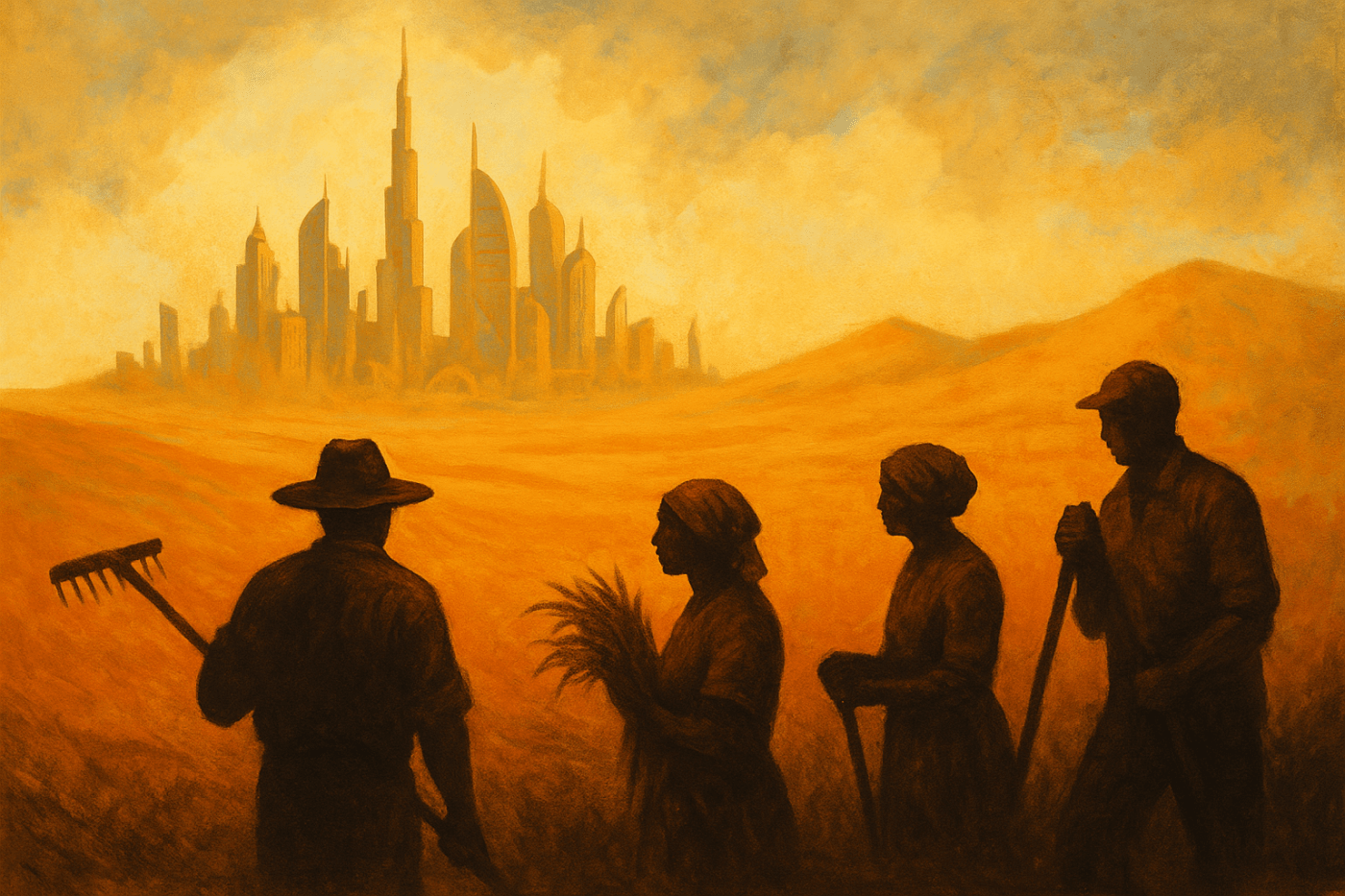
How Gulf petrodollars, comprador elites, and imperial decay converge in Harare — and why the struggle of workers and peasants remains the only true investment in liberation.
By Prince Kapone | Weaponized Information | August 26, 2025
The Mirage of a $19 Billion Turning Point
On August 23, 2025, Business Times Zimbabwe ran with a headline designed to dazzle: Qatar’s Sheikh Mansour Bin Jabor Bin Jassim Al Thani, “cash-rich” and royal, had jetted into Harare to pledge a staggering US$19 billion in investment. The article paints the scene as a historic breakthrough—a triumphant moment where Zimbabwe finally claws its way out of economic isolation and reclaims a place at the banquet table of global capital. Over three days of photo-ops, MoU signings, and a promised 5-star hotel, readers are told to believe that a new dawn is breaking. This is the script: hope on arrival, destiny in the making, and salvation draped in Qatari robes.
But propaganda always has a class author, and this one is no different. The reporters at Business Times are not neutral scribes. They are courtiers of the Zimbabwean elite, earning access by parroting the “Zimbabwe is Open for Business” mantra first crafted by ZANU-PF’s re-engagement spin doctors. Their class allegiance is not to workers queuing for bread in Bulawayo but to the comprador strata who sell off sovereignty for contracts and ribbon-cuttings. The journalistic career ladder here is greased not by hard questions but by smiling coverage of investment fairs and presidential handshakes.
The outlet itself is part of the same machinery. Business Times Zimbabwe masquerades as a business daily, but its oxygen comes from advertising contracts with parastatals and state-aligned corporations. Its function is less to inform the public than to launder the regime’s talking points in a suit-and-tie format palatable to bankers, diplomats, and foreign investors. Its readership is the boardroom, not the street. Its fidelity is to capital, not to the class struggle erupting beneath its pages. Like much of the so-called “independent press” in Africa, it survives by walking lockstep with the state-capital nexus while mimicking the aesthetics of Western business journalism.
This narrative is not only circulated domestically. Amplifiers range from Gulf PR firms tied to sovereign wealth funds to regional think tanks that package elite investment tours as proof of “Africa rising.” Their role is simple: present the pomp of private jets and palace entourages as though they were harbingers of industrial revolutions. They do not measure the thickness of the smoke, only the shine of the mirrors.
Once you cut through the theater, the propaganda mechanics of this article come into view. First, it deploys the framing trick of inevitability: the Sheikh “will” invest, as if pledges were the same as capital inflows. Second, it wipes away inconvenient history: Zimbabwe’s record of failed mega-deals—Chinese steel that never smelted, Russian platinum that never poured—is nowhere to be found. Third, it leans hard on emotional manipulation, declaring this a “turning point,” a “historic moment,” precisely because the material evidence is absent. Fourth, it substitutes spectacle for substance: the reader is invited to confuse Mnangagwa’s cultural tours and Qatari delegations with genuine transformation. Fifth, it flirts with false equivalence: by citing billions pledged in Burundi, Zambia, and Botswana, the article smuggles in the idea that promises are as good as delivery. And finally, it reproduces a familiar colonal trope, where Zimbabwe is cast as the passive recipient of Gulf benevolence, grateful to be blessed by foreign wealth rather than authoring its own path of development.
What we are left with is a mirage, a desert hallucination of wealth shimmering on the horizon. The propaganda works by presenting crisis dependency as a historic opportunity, by inflating pledges into destiny, and by scripting sovereignty as something to be handed down from monarchs in Doha. But mirages do not quench thirst, and the working people of Zimbabwe—miners, farmers, street traders—cannot eat promises. The real task is to excavate this narrative, expose its omissions, and reframe it not as a turning point but as another act in the long-running theater of neocolonial dependency.
Promises, Precedents, and the Politics of Pledges
Strip away the theater of Sheikh Mansour’s three-day visit and we are left with a ledger of promises. According to Business Times Zimbabwe, the Qatari royal pledged an eye-watering US$19 billion across a spectrum of sectors—oil, agriculture, food security, tourism, housing, cybersecurity, ports, airports. Similar packages were trumpeted in Burundi (US$12bn), Zambia (US$19bn), and Botswana (US$12bn). The delegation mapped out a whirlwind itinerary: business-to-government meetings, memoranda of understanding, a five-star hotel announcement, cultural tours, and a private session with President Emmerson Mnangagwa.
The record of “historic” mega-deals in Zimbabwe is a graveyard of unbuilt factories and vanished billions. The much-hyped revival of Zisco Steel with Chinese partners collapsed into dust, while Russian-backed platinum ventures never reached production. Against this backdrop, it is no surprise that skepticism lingers. Zimbabwe’s external debt—over US$14 billion in arrears—has barred access to concessional finance from the IMF and World Bank since the early 2000s. Cut off from multilateral lenders, Harare has been forced into the arms of alternative financiers. When Gulf monarchies showered Egypt with pledges after the 2013 coup, much of it evaporated or came with austerity strings.
Zimbabwe’s domestic climate adds to the uncertainty. Chronic currency instability, policy inconsistency, and entrenched corruption have historically scared off serious investors. Business Times papers over these contradictions, but the reality is clear: capital flight, exchange-rate chaos, and shifting rules of the game remain central obstacles. These are not minor glitches—they are structural features of a political economy where the ruling class treats the state as a feeding trough.
The expanding role of Qatar and the UAE in Africa is also connected to the imperialist recalibration underway under Trump 2.0. Gulf sovereign funds recycle petrodollars through Wall Street while presenting themselves as independent actors in the Global South. This creates a pathway for U.S.-aligned capital at the same moment many states are turning to China and other multipolar blocs for investment and trade.
At the same time, “Summits Without Strings” documented that multipolar blocs from ASEAN to BRICS+ are experimenting with currency swaps, yuan settlements, and South–South trade corridors that bypass the IMF’s chokehold. For Zimbabwe to receive billions in pledges outside Western IFIs places it within this wider context of shifting global finance.
There is also the deregulation trap. In “Trump’s Gulf Tribute and Wall Streets War” I laid out how Gulf petrodollars are systematically linked to the neoliberal conditionalities demanded by Wall Street. Capital has often arrived with requirements: loosening land ownership rules, slashing labor protections, privatizing infrastructure, and guaranteeing investor arbitration. For Zimbabwe, these conditions would shape how any pledged funds are actually deployed.
Sheikh Mansour’s visit thus sits at the intersection of multiple dynamics: a government in need of liquidity, Gulf investors expanding their African footprint, and a global financial order under strain. Whether the $19 billion materializes as concrete projects, evaporates like earlier pledges, or arrives attached to policy concessions remains to be seen.
From Spectacle Investment to Sovereignty Theater
Once the smoke clears from the pomp of Sheikh Mansour’s visit, what remains is not the dawn of a new Zimbabwean century but the familiar shadow of neocolonial extraction. The US$19 billion pledge, spread across oil, agriculture, tourism, and infrastructure, is presented as a gift. But in practice, these sectors are reorganized for export flows that serve Gulf food security and global markets, not the survival of Zimbabwean peasants or the dignity of its workers. The so-called “food security” projects are less about feeding families in Masvingo and more about ensuring steady supply chains for Doha. This is the old colonial equation in a new register: the land and labor of Africa converted into external lifelines while the domestic majority survives on scraps.
Beneath the numbers is the logic of financial piracy. Gulf sovereign wealth funds appear as friendly partners, but their function is to operate as proxies for Wall Street and the City of London, laundering hydrocarbon rents into speculative circuits. What Business Times calls “investment” functions instead as a debt-and-equity trap: deregulation packages, land guarantees, and privatization schemes that lock Zimbabwe’s economy into external control. This is plunder not by gunboats but by contracts and arbitration courts. It is imperial robbery with a fountain pen.
The structural backdrop is hyper-imperialism. Zimbabwe’s exclusion from IMF and World Bank credit is no accident; it is the enforcement arm of a global sanctions-finance blockade designed to discipline “defiant” nations. This blockade pushes states into dependency on Gulf capital, which is itself aligned with U.S. and European finance. Thus, the Gulf pledge is not a sovereign alternative but a downstream function of the same imperial architecture. It illustrates the decadent stage of empire: not direct colonial conquest, but spasmodic reliance on Gulf intermediaries to extend domination across Africa’s resource base.
And here lies the deeper contradiction: Qatar and the UAE present themselves as South–South partners, but in reality they are instruments of imperialist recalibration. Their capital plays the part of a Trojan horse. On the surface, they appear to offer African states a pathway out of Western dependency, but beneath the surface they function as a buffer—delivering capital tethered to Wall Street while blocking a full pivot toward Beijing and the multipolar camp. What looks like autonomy becomes another layer of dependency; what appears as defection is in fact containment. Gulf petrodollars thus serve both as a mask of South–South solidarity and as a disguised backdoor for U.S. hegemony.
Yet contradictions abound. Even as the pledge tightens the circuits of imperial finance, it also illustrates the erosion of unipolar dominance. For Zimbabwe to seek billions outside of Washington and Brussels is, at least nominally, a gesture toward South–South cooperation and an indirect step toward multipolarity. These flows do not constitute liberation, but they expose cracks in the imperial wall: the IMF cannot command alone, the World Bank cannot dictate unchallenged. What appears as comprador entanglement is also evidence of imperial decay. Whether this contradiction becomes an opening for anti-imperialist sovereignty or another round of elite profiteering depends on the class forces that seize it.
Reframed in this light, the “historic breakthrough” that Business Times trumpets is nothing but sovereignty theater: a staged performance of autonomy where local elites repeat the language of partnership while the script is written abroad. The “Vision 2030” development plan, held up as the horizon of progress, becomes an ideological mask for continuity of exploitation. And the Qatari investment package, paraded as evidence of rebirth, reveals itself as spectacle investment—photo-ops and luxury hotels substituting for industrial transformation.
From the standpoint of the global proletariat and peasantry, what is being promised is not jobs or sovereignty but enclosure. From the standpoint of colonized nations, Zimbabwe is not liberated but repurposed as a node in Gulf capital’s expansion. From the vantage of socialist and multipolar forces, the contradiction is sharper: Gulf money may temporarily bypass Western institutions, but only popular struggle can transform that bypass into a revolutionary rupture. And for workers in the Global North, the connection is not abstract—these same petrodollars that strip Zimbabwe’s land also fuel speculative bubbles, gentrification, and privatization in New York and London. It is the same circuit of dispossession, stretched across continents, binding the poor of Harare to the poor of Detroit.
To call this investment a “turning point” is propaganda. The real turning point is whether Zimbabwe’s workers, peasants, and youth can seize these contradictions—between unipolar decay and comprador capture, between multipolar possibilities and financial piracy, between Trojan horses and revolutionary ruptures—and redirect them toward liberation. Only then does South–South cooperation become more than a slogan. Only then does multipolarity move from theater to power. And only then does the mirage of billions become water for the parched.
Turning Mirage into Struggle
If the Business Times narrative is a mirage, then the task before us is not to admire the shimmer but to organize in the desert. Sheikh Mansour’s arrival has been staged as an act of deliverance, yet the real deliverance lies in the hands of the masses who refuse to be props in sovereignty theater. Across Zimbabwe, workers still strike against starvation wages, farmers fight to hold onto land seized and resold under the banner of “investment,” and students march for a future not mortgaged to comprador elites. These are not scattered outbursts but living proof that beneath every billion-dollar pledge burns a class struggle waiting to erupt.
The pledge also ties Zimbabwe’s fate to wider battles already unfolding across Africa. In Zambia and Botswana, where Mansour made similar promises, skepticism grows as people ask who will benefit when Gulf capital meets state elites. In Nigeria and Kenya, movements are already mobilizing against the privatization of ports and power grids—projects nearly identical to those now pitched for Zimbabwe. And in the Sahel, popular uprisings have expelled imperial garrisons while rejecting the hollow “development aid” that came tethered to foreign extraction. Zimbabwe’s story is not isolated. It is another front in a continental fight to turn resources toward life instead of profit.
Beyond Africa, the contradictions stretch into the Middle East itself. In Qatar, the wealth that bankrolls pledges abroad is extracted from migrant laborers confined to dormitories and robbed of wages. Across Palestine, that same Gulf capital finds its way into normalization deals and real-estate speculation while Gaza lies in ruins. The struggle is unified: the dispossession of Zimbabwe’s farmers is tied to the bulldozed homes of Palestinians, the underpaid miner in Hwange linked to the South Asian laborer building towers in Doha. The circuits of capital that suffocate one are the same that suffocate all.
To mobilize, then, is to connect these struggles—not in abstraction, but in practice. Zimbabwean unions confronting layoffs must see their reflection in Kenyan port workers resisting privatization. Student movements in Harare must find allies in Cairo, Beirut, and Ramallah who understand that sovereignty cannot be subcontracted to Gulf monarchies. The farmers who keep planting maize despite floods and forex shortages must link arms with peasants in the Sahel fighting to reclaim food sovereignty from both French soldiers and Gulf financiers. And those of us in the Global North must act as partisans, not spectators—joining campaigns that expose the contracts, break the financial pipelines, and support the organizations already on the ground.
The billions promised by Mansour may or may not arrive. What matters is that the masses are already arriving—at factory gates, in fields, in lecture halls, in the streets. They carry no jet-set entourage, but they carry the only force that has ever made history: organized struggle. The mirage is fading; the desert remains. It is ours to decide whether it remains barren or becomes the ground where a new horizon is built, not by sheikhs or presidents, but by workers, peasants, and the oppressed united across continents.
 Weaponized Information
Leave a comment