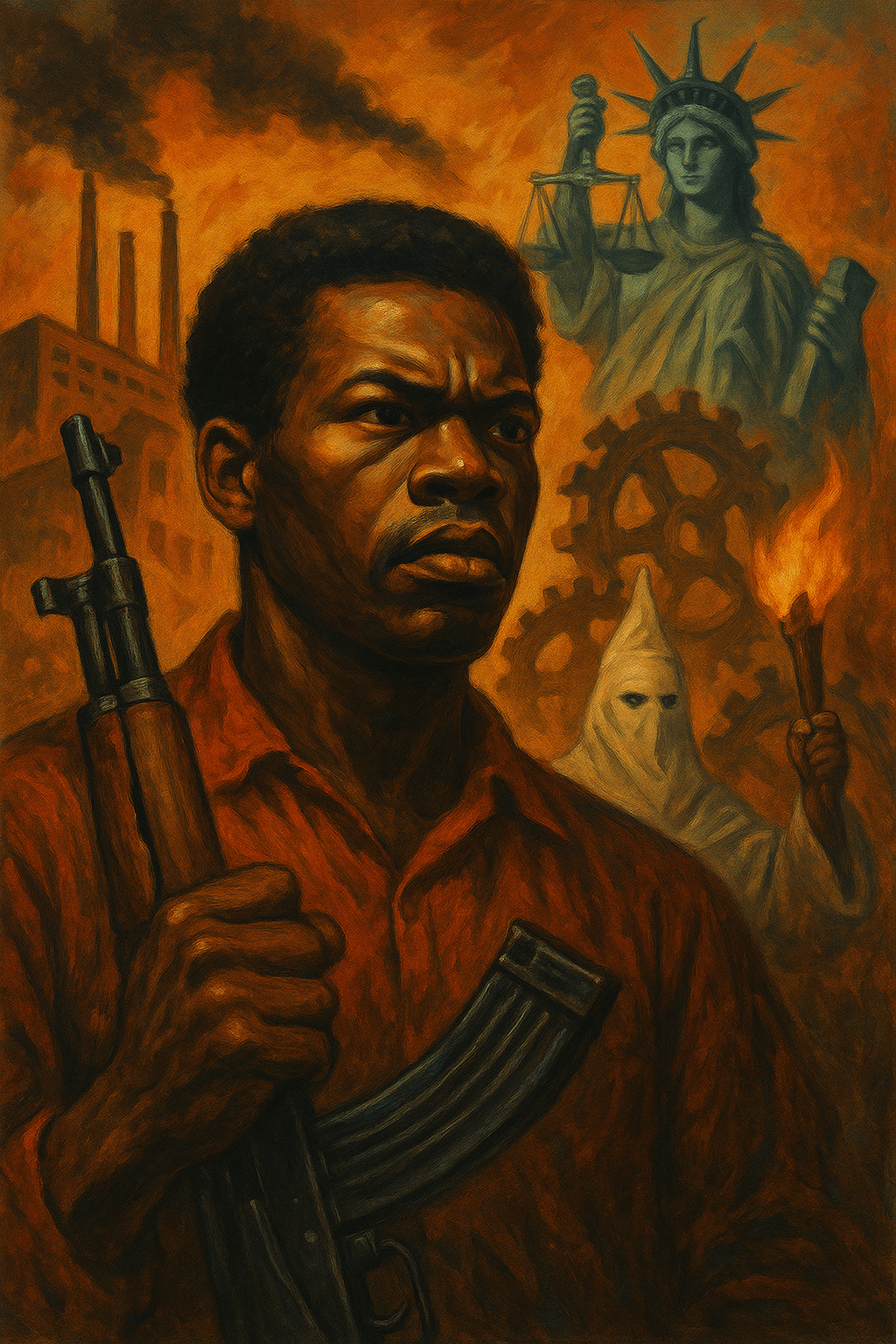
Originally published in 1970 at the height of Black radical insurgency, James Boggs’s Racism and the Class Struggle delivers a merciless indictment of American capitalism as a settler-colonial system sustained by the racial division of labor. Drawing from his own experience as a Black autoworker and Marxist theorist, Boggs exposes the limitations of white Marxism, the treachery of liberal integrationism, and the necessity of a revolutionary nationalism rooted in the historical and material conditions of the Black working class. Half a century later, in an age of automation, technofascism, and counterinsurgency, this text remains not just relevant—but dangerous. A weapon. A warning. A call to defect.
By Prince Kapone | Weaponized Information | August 8, 2025
Beyond Black and White: The Dialectic of Labor and Race in Amerika
James Boggs didn’t come to clean up Marxism—he came to rupture it. Not from outside, but from within, at the point where it refused to see clearly. In Racism and the Class Struggle, Boggs doesn’t offer us a balanced fusion of “race and class.” He offers something sharper: a dialectic forged in the unique conditions of the U.S. empire, where capitalism was not merely racialized—it was born from racial domination. Slavery wasn’t capitalism’s original sin. It was its original engine. And the factory floor in Detroit, where Boggs spent his days, wasn’t just a site of production—it was a battlefield layered atop centuries of colonial violence.
Boggs knew that the liberal imagination loved to separate racism from economics—as if the former was a cultural residue, fixable by laws, while the latter was a neutral terrain of class struggle. But what he shows, with cutting precision, is that American capitalism has never functioned without racial hierarchy. From cotton to steel to finance, Black labor was essential not just as a source of surplus value—but as the very “other” against which whiteness, citizenship, and productivity were defined. Race wasn’t an overlay on class—it was its scaffolding.
This is the political break Boggs forces. He rejects both the liberal call for racial harmony and the white left’s fantasy of economic unity. He asks: What is the actual relationship between Black people and the American system of production? Not in theory. In history. In concrete, material terms. And the answer he arrives at is unforgiving: the Black worker has been necessary to capital accumulation and simultaneously denied recognition as part of the working class. Exploited when needed, exiled when not. And always placed outside the boundary of whiteness—America’s proxy for humanity itself.
This contradiction doesn’t dissolve under civil rights. It intensifies. Because as the legal apartheid of Jim Crow begins to fray, the system finds new ways to manage Black labor—through automation, through policing, through welfare bureaucracies and prison cages. Boggs sees it happening in real time. He tracks how the Black industrial worker becomes the Black unemployed, the Black hustler, the Black prisoner. And he insists that if we are to understand class struggle in America, we cannot start from the union hall or the ballot box—we must start from the ghetto, the street corner, the cell block. From the places the white working class has abandoned—or helped police.
Boggs doesn’t flatten struggle into slogans. He confronts the complexity head-on. Yes, there is a working class. But it is fractured by race, structured by settler colonialism, and saturated with contradiction. Any theory that speaks of “the workers” without accounting for the racial regime that determines who gets to be seen as a worker—isn’t theory. It’s betrayal. Boggs offers us no easy comfort. What he offers is clarity. And from that clarity, the chance to finally begin.
The “Worker” Was Always White: Capitalism’s Racial Division of Labor
James Boggs didn’t waste ink on euphemisms. When he spoke of the working class in America, he didn’t mean some mythical rainbow coalition in overalls. He meant what it actually was: a racial formation. “Worker,” in the lexicon of American capital, was never a neutral category—it was white by default. And that wasn’t accidental. It was strategic. Boggs maps the history of U.S. capitalism as a racial division of labor where Black people were not simply “left out” of the working class—they were positioned beneath it. Subordinated. Criminalized. Hyper-exploited. And then discarded.
This is what made Boggs dangerous to the white left. He refused to let Marxist rhetoric conceal settler reality. While white radicals were busy abstracting about class, Boggs was laying bare the material truth: the American worker, as organized and mythologized, was a white settler figure—born of genocide, nourished by slavery, and protected by the state. White workers didn’t just suffer exploitation; they often policed the plantation. They guarded the border. They defended the shop floor from “Negro encroachment.” They weren’t simply allies delayed—they were beneficiaries of empire.
Boggs doesn’t argue that all white workers are rich or unexploited—he argues that their exploitation is fundamentally different. It’s mitigated, buffered, and rewarded by a system that constantly reminds them: you may be poor, but you are not Black. This racial bribe wasn’t just ideological—it was institutional. From labor unions to job markets, public housing to public schooling, the white worker’s identity was forged in opposition to Black labor. And that identity came with real perks: seniority, stability, political access, and the moral capital of being seen as “the backbone” of the nation.
But Boggs flips the script. He doesn’t center the white worker’s pain—he interrogates its function. He asks: what is the strategic role of whiteness in U.S. capitalism? And he answers it ruthlessly. Whiteness, he shows, is the ideological glue that keeps the working class fractured and empire intact. It is what allows the ruling class to extract, repress, and expand—while blaming the victims and pacifying the collaborators. It is the deal offered to every poor white person in America: “Join the working class, but leave your solidarity at the door.”
This is why Boggs’s analysis still stings. Because it exposes not just racism, but the structural necessity of racial hierarchy to capitalist order. It’s not that America failed to integrate the Black worker into its economy—it never intended to. The system was designed with racial division in its blueprint. And every attempt to unify the working class without confronting that design—every call for “colorblind” socialism, every appeal to “economic justice” that ignores colonial history—is not revolutionary. It’s reaction in disguise.
Boggs doesn’t plead for inclusion into this fraud. He arms us with theory to destroy it. His critique is not some moral scolding of the white worker—it’s a strategic disqualification. You cannot build revolution on a foundation that was constructed to exclude the colonized. You cannot speak of class while dodging the question of who was allowed to become “worker” and who was condemned to remain slave, servant, surplus. To rebuild, you must first admit what was built—and for whom.
Black Labor Built the Empire—And Must Be the Hammer That Destroys It
James Boggs didn’t plead for inclusion in the American project—he planned its overthrow. And the weapon he wielded wasn’t just protest or policy—it was the historic, collective power of Black labor. Not the idealized “hard work” celebrated in capitalist myth, but the forced labor that built the very infrastructure of U.S. wealth: cotton, steel, railroads, weapons, surplus. From plantation to factory, from convict lease to GM plant, Black labor was never abstract—it was brutal, bloody, and central to the expansion of empire. And Boggs knew what the Marxists refused to say out loud: the capitalist state cannot function without the violent subordination of Black people. It never has. It never will.
Boggs understood labor not simply as an economic category, but as a political relationship. It’s not just about wages or jobs—it’s about who gets defined as productive and who gets discarded. In America, the Black worker was always both indispensable and disposable. You’re hired to fill the gaps when war calls the white man to the front, then dumped when he returns. You’re allowed on the line when capital needs bodies, then targeted when machines can replace them. You become a “problem,” a statistic, a pathology. But Boggs flips the script: what if this very position—excluded from full participation in a decaying system—wasn’t a tragedy, but a revolutionary advantage?
Here’s the sharp edge of Boggs’s argument: it is precisely because Black people have been denied consistent access to the fruits of American capitalism that they are best positioned to destroy it. They have less to lose and more to gain from total rupture. Not reform. Not equity. Not representation in a genocidal order—but the end of that order. Boggs doesn’t mourn automation. He doesn’t romanticize the old union jobs. He sees in the collapse of industrial work the opening for something greater: a revolution rooted not in nostalgia, but in necessity. A revolution led by the very people capitalism has marked as expendable.
That’s the revolutionary core of this text. It’s not a call for policy reform. It’s not an appeal for better bosses or more humane management of decay. It’s a map of material power—drawn from the lived experience of those at the bottom. Boggs saw Black labor as the backbone of both the economy and the insurgency. That’s why the state feared Black organizing more than any strike led by white workers. That’s why every rebellion from Watts to Detroit was met with military-grade repression. The state knows what many socialists still don’t: when the Black working class moves independently, it threatens the whole system—not just the bosses, but the illusions that keep the white settler class aligned with power.
Boggs didn’t theorize revolution from the outside. He lived it. He watched Black autoworkers go from hope to betrayal as the union bureaucracy colluded with management and the state. He saw integration weaponized to defang militancy. He saw joblessness used to criminalize entire communities. And through it all, he never confused the tactics of survival with the terms of liberation. He made clear: the fight is not for a seat at the table—it’s to flip the table, burn it, and build something worthy of human life in its ashes.
So let’s stop pretending we can read Boggs and stay neutral. His theory demands a side. If you are white, if you are working class, and if you claim to be a revolutionary, then you must locate yourself in the contradiction he exposes. Are you a collaborator with empire, or an accomplice to its destruction? Because if Black labor built this empire, then only Black-led struggle can bring it down. And your role isn’t to speak over that struggle—it’s to get behind it, to learn from it, and to risk something real for it. That’s what defection looks like. That’s what solidarity means. That’s what Boggs called for—not as an ally, but as a co-conspirator in the final act of this dying order.
White Marxism Is Dead: Long Live Revolutionary Nationalism
James Boggs didn’t write to win the approval of white radicals. He wrote to bury their illusions. In Racism and the Class Struggle, Boggs dissects the myth of class unity with the precision of a factory mechanic and the political clarity of a guerrilla general. He makes it plain: white Marxism in the United States was never equipped to understand the Black condition, because it was never designed to. From the CPUSA to the New Left, from labor unions to socialist newspapers, the entire architecture of white radicalism was built on an unspoken truth—that their stake in empire, though precarious, was still a stake.
Boggs torches the fantasy that American workers are one revolutionary class. He tracks how white labor has historically sided with capital when it came time to choose between wages and justice. The American labor aristocracy wasn’t a bug in the system—it was its operating logic. White workers were offered a deal: racial status in exchange for class loyalty. They took it. Again and again. From lynch mobs to housing covenants, from strikebreaking to red-baiting, they chose whiteness over solidarity. And the white left? They covered for it. They softened it. They insisted on “universal” demands that erased the very structure of internal colonialism.
Boggs doesn’t spare the liberals either. Black mayors, Black executives, Black police chiefs—he saw them for what they were: agents of empire in Blackface. He understood how easily the system could manufacture “Black leaders” who would pacify rebellion and manage decline. Integration was not the end of racism—it was its rebranding. And civil rights without economic power was just another leash. Boggs names this betrayal with surgical clarity. He exposes the Black bourgeoisie as the domestic wing of the counterinsurgency—a class whose job is to keep the Black masses tethered to a system that will never free them.
This is why Boggs returns to nationalism—not as a cultural posture, but as a political necessity. For Boggs, revolutionary nationalism wasn’t about waving flags or celebrating heritage—it was about power. It was about Black people seizing control over their own labor, their own land, their own communities, and their own destiny. It was about rejecting the settler state—not asking for a seat at its table. Boggs saw that a colonized people must fight as a nation if they are to ever be free. And he saw that any “socialism” that sidesteps this reality is not socialism at all—it is settler revisionism dressed in red.
There’s a reason Boggs still makes white radicals uncomfortable. He doesn’t give them an escape hatch. He doesn’t let them claim brotherhood while hoarding benefits. He doesn’t let them pretend their struggle is the same. Instead, he demands rupture. He demands that white revolutionaries confront the colonial relation, not just rhetorically—but materially. That they sever ties with white power, abandon fantasies of leadership, and commit to a revolution led by the very people this empire was built to destroy. That is the meaning of solidarity. That is the price of defection.
Boggs didn’t call for a coalition. He called for a reckoning. The liberal dream is dead. The white Marxist project has collapsed. What remains is the truth: Black people in America are a colonized nation. Their liberation will not come from alliance with empire. It will not come from representation within empire. It will come from the destruction of empire. And if the white left cannot unite with that, then it has no future. It is already a ghost.
Revolution Is Not a Program—It’s a Break With Empire
James Boggs was done with the dogma. He had no use for borrowed blueprints or imported revolutions. In Racism and the Class Struggle, he doesn’t just criticize the system—he indicts the entire intellectual architecture of the U.S. left. The problem wasn’t that revolutionaries had no answers. The problem was they were asking the wrong questions. Boggs knew that every theory has a birthplace, every analysis a location. And too much of what passed for Marxism in America was just a copy of a copy—detached from history, divorced from conditions, and deaf to the rhythms of the people.
Boggs rejected the notion that revolution is a fixed program. He saw revolution as a rupture—a process that emerges from contradictions in motion, not from manifestos frozen in time. He refused to flatten the U.S. into the same terrain as 19th-century Europe. This wasn’t Manchester or Berlin—it was Mississippi. It was Detroit. It was a settler colony built not on industrial wage labor, but on genocide, chattel slavery, and racial apartheid. Any theory that ignored that was not just wrong—it was complicit. And any revolutionary who refused to think from here—from the concrete suffering and resistance of the colonized—was already speaking from the side of the state.
That’s why Boggs was such a threat. He didn’t just call for political action—he called for intellectual insurgency. He demanded that revolutionaries think differently, because the moment demanded it. He understood that the Black struggle in America was not a variation on the European workers’ movement—it was a fundamentally different contradiction. Black people weren’t exploited in the same way. They were excluded, criminalized, and annihilated. Their labor was extracted violently, then rendered obsolete. Their communities were not just poor—they were policed. Their rebellion was not just suppressed—it was surveilled, infiltrated, and targeted for extinction.
So Boggs said: stop trying to fit the Black struggle into a preexisting model. Tear up the model. Build from the ground. He warned against clinging to old frameworks out of habit or fear. He saw clearly that revolution demands creativity, that the oppressed must generate new theory from their own lives. It’s not enough to quote Lenin. It’s not enough to invoke dialectics. The people are not waiting for you to get your ideological citations in order. They are waiting for analysis that speaks to the conditions of their oppression—and a strategy to overturn it.
For Boggs, that strategy had to be rooted in the self-activity of the colonized. Not directed from above, not steered by white radicals, not shaped by electoral calculation—but forged in struggle by the people most abandoned by the system. That meant not tailing after movements already absorbed by the state. Not mimicking foreign revolutions. Not fantasizing about a vanguard with no base. It meant building something new. From the ghetto. From the shop floor. From the prison. From the street. Revolution wasn’t a script—it was a leap. A break. A process that begins when the people refuse to live one day longer under the terms set by their enemies.
Boggs didn’t leave us a step-by-step plan. He gave us something sharper—a method. Study your conditions. Listen to the people. Think for yourself. And when the time comes, move decisively. That’s not program—it’s praxis. That’s not dogma—it’s discipline. And in a time when so much of the left is paralyzed by nostalgia, chasing the ghosts of past revolutions, Boggs’s words hit like a hammer: You cannot liberate the future by worshipping the past.
Automation, Obsolescence, and the Future of Struggle
James Boggs saw the future—and he knew it wasn’t industrial. Long before Silicon Valley draped its algorithms in hoodie-leftist branding, Boggs was already mapping the collapse of industrial labor and the rise of a new capitalist logic: one that rendered Black workers obsolete and fed surplus populations into the machinery of mass incarceration. While white radicals still fantasized about factories as revolutionary sites, Boggs had already clocked the layoffs, the plant closures, the racialized automation wave designed to discard the Black proletariat once it had built the empire’s infrastructure.
He didn’t romanticize the assembly line. He knew the work was brutal, alienating, and often deadly. But he also knew that for Black communities, the factory had represented a foothold—a source of income, of dignity, of struggle. And so when automation came, it wasn’t just a shift in technique—it was a war strategy. A technological counterinsurgency. The empire no longer needed Black labor in the same way, and so it made the ghettos unlivable, flooded the communities with heroin and police, and began the slow-motion genocide we now call the War on Drugs.
Boggs was one of the first to name this shift. He warned that we were moving from an economy of exploitation to an economy of exclusion. And that warning hits harder now than ever. In today’s technofascist order, automation is no longer just industrial—it is total. It is predictive policing, facial recognition, Amazon warehouses, surveillance grids, and biometric borders. The state no longer waits for rebellion—it anticipates it. It no longer contains Black labor in the factory—it warehouses Black life in prisons, shelters, psych wards, and morgues. And still, much of the left clings to outdated frameworks, waiting for a Fordist working class that’s never coming back.
Boggs gives us the tools to move forward. He insists that we analyze not just what labor was, but what labor is becoming. And more importantly—who is being left behind. He saw the rise of what we now call the lumpen-proletariat, not as a deviation from the class struggle, but as its logical development under racial capitalism. These weren’t the “underclass” the liberals pitied—they were the dispossessed, criminalized, radical potential. The sons and daughters of sharecroppers and autoworkers, now deemed surplus by an empire in decay. They weren’t organized yet—but they were watching. Waiting. Surviving.
Today, they are us. And we must stop pretending that revolution will come from the places capitalism has already automated, digitized, and outsourced. The new frontline is where life is most precarious—where cops replace coworkers, where algorithms decide who eats, where evictions and overdoses and ankle monitors form the rhythm of everyday life. This is where Boggs points us. Not toward nostalgia. Not toward romantic visions of the “good union job.” But toward the fire—the contradiction, the crisis, the camp.
Boggs didn’t just predict automation. He predicted its political consequences. He saw that a system that no longer needs your labor has no incentive to keep you alive. And he knew that this would require a new kind of movement—one not rooted in wages, but in survival; not demanding a fair share, but seizing power. This is not a future we can afford to wait for. It is already here. And Boggs left us a compass, if we’re willing to use it.
Defection or Death: A Note from a White Revolutionary
I wasn’t born into revolution. I was born into its opposite. Into comfort built on conquest, education built on erasure, democracy built on genocide. I was taught to call this “freedom.” I was taught that the world owed me something. That my job was to study hard, follow rules, maybe criticize the system—so long as I never threatened it. But James Boggs helped me understand what no classroom ever could: that if I remained loyal to whiteness, to settler identity, to the illusions of shared struggle—I would always be standing on the wrong side of the barricade.
Boggs didn’t write to people like me. And that’s precisely why I trust him. He didn’t waste time pandering to white progressives or begging for cross-racial unity. He issued a challenge—a choice. Not a moral one, but a material one. He exposed how whiteness itself is not just a racial identity, but a class position—one constructed through the superexploitation of Black labor and sustained through complicity. And he made it plain: if the white working class refuses to break with empire, then it is not working class at all—it is a junior partner in oppression. An accomplice to the counterrevolution.
This isn’t guilt. This is responsibility. Because when Boggs traces the history of American labor, he shows again and again how white workers were given chances to defect—and didn’t. During slavery, they policed plantations. During Reconstruction, they joined lynch mobs. During the Great Migration, they locked Black families out of housing and jobs. During the civil rights era, they fled to the suburbs. And today? They cling to the fantasy that their suffering is the same. That their grievance justifies their silence. That the enemy is “elites” or “Wall Street” or “globalists”—anything but the settler colony they continue to uphold.
But a different choice is possible. It’s the one I’m trying to make now—not as a savior, not as an ally, but as a traitor. A defector. Because Boggs makes clear: if you are white, and you claim to be revolutionary, then your task is not to lead the movement. Your task is to destroy the structures that keep your people loyal to power. To sabotage the myths that seduce them. To forfeit the wages of whiteness, not just in word, but in action. That means taking risks. That means burning bridges. That means losing status, income, comfort—and doing so without applause.
Boggs doesn’t ask us to feel bad about history. He demands we act on its lessons. If white radicals cannot organize their own people away from empire, then they have no business lecturing the colonized. If they cannot cut ties with settler institutions, cannot abandon the fantasy of “uniting the 99%,” cannot subordinate themselves to a Black-led struggle for national liberation—then they will always end up where white radicals have always ended up: back in the arms of the system they claimed to oppose.
This is what Boggs left us: not comfort, but clarity. Not a blueprint, but a warning. Revolution is coming—not as a rhetorical flourish, but as a consequence of contradiction. And when it does, every one of us will be asked a question: are you with the people trying to build a new world? Or are you with the old one, trying to preserve your place in the wreckage? There is no middle. No neutral ground. Just two sides. And one chance to decide which you’re on.


Leave a comment