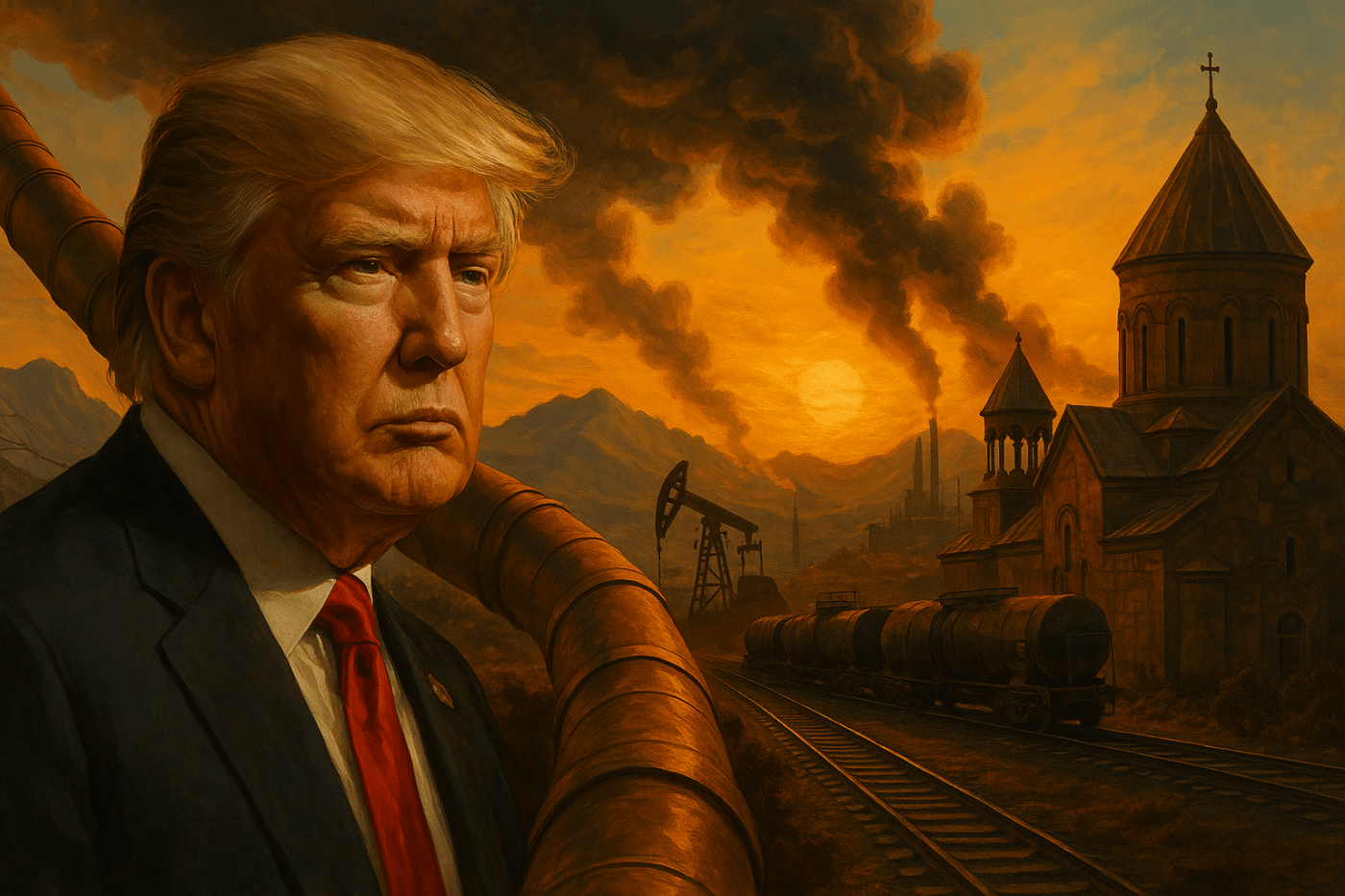
Courthouse News calls it diplomacy. The White House calls it prosperity. But the Zangezur deal hands a 99-year U.S. lease to a private consortium of rail, oil, gas, and fiber profiteers—tightening the imperial chokehold from the Caucasus to Wall Street.
By: Prince Kapone | Weaponized Information
Date: August 8, 2025
The Corridor as Consent: Excavating the Propaganda Form
On August 8, 2025, Courthouse News Service published a story with a headline that practically writes itself: “Trump expands US reach into South Caucasus with Armenia-Azerbaijan deals.” The article, written by Cain Burdeau, claims that Donald Trump helped secure a so-called “peace agreement” between Armenia and Azerbaijan, anchored by a U.S.-controlled corridor across southern Armenia. Branded the “Trump Route for International Peace and Prosperity”—yes, that’s the real name—the project is rolled out like a ribbon-cutting at an imperial Costco. Smiles, handshakes, and no mention of who foots the bill or gets buried under the tracks.
The author, posted up somewhere in the European Union, plays the part of the reliable stenographer. He doesn’t challenge the choreography. He reports it. No hard questions. No real investigation. Just a relay runner passing the torch from press release to public perception. That’s the function of Courthouse News Service in this moment—not to inform, but to sedate. Not to interrogate, but to domesticate the narrative so that the corridor looks less like occupation and more like opportunity.
The word choice is textbook: “historic peace summit,” “strategic corridor,” “prosperity.” This isn’t language—it’s tranquilizer. It doesn’t describe reality; it constructs it. By the end of the first paragraph, empire has already won the propaganda war. It’s not a military installation—it’s a bridge to tomorrow. Not a concession—it’s cooperation. Not a leash—it’s leadership. The technique is simple: blur the violence with optimism, and silence the people with a flood of diplomatic perfume.
The piece slides forward in passive voice, like a train with no conductor. Things are “agreed upon,” deals are “expected to be signed,” land is “leased.” But who signs, who resists, who profits, who pays? That’s not up for discussion. This is politics without fingerprints—just enough detail to mimic journalism, but too little to spark resistance. By the time you reach the bottom of the article, it feels like reading the minutes of a meeting you were never invited to.
Ordinary people don’t exist in this story. No farmers. No workers. No one living along that 27-mile stretch of land that’s just been handed over for 99 years like it’s a vacant lot. The only voices quoted are professors, politicians, and officials. A narrow choir of acceptable opinion sings the chorus: trust the process. Trust the development. Trust the branding. And if you don’t trust it—well, that part doesn’t make it into print.
The corridor isn’t explained; it’s asserted. Repetition does the work of persuasion. Connectivity, cooperation, trade—all nice words that float above the dirt, never touching the ground. No history. No contradiction. Just forward motion. The article offers no real context, just coordinates. A map without memory. A future with no past.
In the end, what this piece delivers isn’t analysis—it’s narrative management. The goal isn’t to convince you with facts. It’s to lock you into a framework where empire is always reasonable, and anyone who says otherwise is invisible. This is how imperial propaganda works in the era of polite journalism. No blood. No barbed wire. Just a corridor of words leading you to nowhere—paved with euphemisms, built on silence.
Facts, Forces, and the Geopolitical Furnace
On August 8, 2025, a formal agreement was signed at the White House by Donald Trump, Armenian Prime Minister Nikol Pashinyan, and Azerbaijani President Ilham Aliyev. Under this deal, Armenia granted the United States a 99-year lease over a 27-mile land corridor—known as the Zangezur Corridor—linking Azerbaijan to its Nakhchivan exclave via southern Armenia.
The corridor, renamed the “Trump Route for International Peace and Prosperity,” will be subleased by the U.S. to a private consortium tasked with developing rail lines, oil and gas pipelines, fiber-optic infrastructure, and possibly an electricity grid extension across the corridor.
While the agreement was marketed as a diplomatic breakthrough, it represents a major shift in regional power. The deal effectively inserts U.S. logistical control into a contested geopolitical chokepoint between Iran and Russia—two powers historically opposed to Western militarization of the South Caucasus.
The arrangement comes at a moment of strategic vacuum, as Russia’s peacekeeping failure in Nagorno-Karabakh and its entanglement in Ukraine have weakened its leverage in the region. Iran, meanwhile, has publicly condemned the deal, calling it a direct security threat and accusing Washington of attempting to encircle it through soft militarism.
Armenian Diaspora organizations and opposition groups condemned the agreement, accusing Pashinyan of betraying national sovereignty and effectively legitimizing Azerbaijan’s 2023 ethnic cleansing of Nagorno-Karabakh, in which over 100,000 Armenians were displaced with little response from international institutions.
In parallel with the corridor agreement, the U.S. also lifted restrictions on defense cooperation with Azerbaijan, effectively dismantling the OSCE Minsk Group’s mediating role and clearing a path for U.S. security presence to be woven into the infrastructure of the corridor.
Pashinyan faces rising domestic unrest. Following the 2023 Azerbaijani military assault and the perceived capitulation of Nagorno-Karabakh, large-scale protests erupted across Yerevan and other cities, with demonstrators accusing Pashinyan of surrendering Armenian sovereignty. Many opposition figures were jailed or accused of coup plotting, including senior leaders in the Armenian Apostolic Church.
Historically, the Zangezur Corridor was part of Soviet transit planning, with railway lines linking Armenia and Nakhchivan through Syunik. After the Second Nagorno-Karabakh War in 2020, Article 9 of the Russian-brokered ceasefire agreement called for Azerbaijan to gain overland access to Nakhchivan, monitored by Russian forces. However, the current U.S.-Armenia deal excludes Russian oversight entirely.
Turkish and Azerbaijani officials have long sought to realize a southern energy and trade corridor that links Azerbaijan to Turkey through Armenia, forming a pan-Turkic logistical axis. The U.S. lease accelerates that vision—but redirects profits and control through American-led financial and legal structures.
This development fundamentally alters Eurasian infrastructure politics. As EU and Iranian alternatives to the corridor have stalled, Washington now possesses a physical wedge in the region—a strategic chokepoint disguised as a development deal.
The Corridor as Command: Infrastructure and the Imperialist Recalibration
This is not a peace deal. It is a logistical coup. The Trump-brokered lease of the Zangezur Corridor is not a diplomatic breakthrough but a brutal example of Imperialist Recalibration—the shift from shock-and-awe warfare to infrastructural capture. Empire no longer needs to topple governments; it signs leases. It no longer waves flags on tanks; it installs fiber lines and oil valves under corporate charters. The corridor isn’t named after Trump by accident—it’s branded in his image because it is fascism in a boardroom suit. Empire has gone modular, and the Zangezur Corridor is a prefab node in a transcontinental kill-chain.
What this corridor represents is the new face of Weaponized Infrastructure: the embedding of Western control into the physical, digital, and energy architecture of a region under the guise of development. The rail lines, pipelines, and cables are not neutral. They’re coded to flow capital and data toward Atlantic interests. The contract’s sublease clause makes this even clearer: it’s not Armenia building this, nor Azerbaijan managing it—it’s a transnational finance bloc operating behind a legal firewall. Washington claims sovereignty was respected. But sovereignty leased for 99 years is sovereignty in hospice.
And what of Pashinyan? The liberal technocrat now criminalizing clergy and jailing dissenters in the name of progress? He is the lead actor in a classic case of Sovereignty Theater. Empire writes the script, the EU provides the lighting, and Pashinyan delivers the lines in English for the press corps. The spectacle is staged: Armenia as a willing partner, Azerbaijan as a reconciled ally, and the United States as benevolent peacemaker. But look beneath the stage and you’ll find counterinsurgency budgets, exit clauses that bypass local labor laws, and strategic mapping that aligns this corridor with NATO’s long-standing encirclement doctrines.
That’s where the final piece clicks into place: this corridor is not a standalone project. It is a node in the Forward Containment Architecture that spans from the South China Sea to the Persian Gulf to the Black Sea. It mirrors the U.S. C5+1 strategy in Central Asia—where empire binds post-Soviet republics through logistics cooperation, elite training, and securitized data corridors. Zangezur completes a southern pincer, allowing the U.S. to bypass Iranian and Russian routes while positioning itself for direct energy and data extraction from Central Asia through Turkish and Caucasian conduits. This is not just about regional rivalry—it’s about empire clawing back relevance in the age of multipolarity.
Multipolar corridors like China’s Belt and Road or Russia’s Eurasian Economic Union seek to construct sovereignty through integration. The Trump Route, by contrast, dismembers sovereignty through dependency. It pretends to build peace while fracturing the material basis of independent development. It reduces Armenia to a rentier statelet and elevates Azerbaijan from pariah to proxy. This is the dialectic of modern imperialism: connect to control, lease to dominate, develop to surveil. And every fiber optic cable laid beneath Syunik soil now buzzes with that logic.
But contradiction breeds resistance. Just as rail workers in Kazakhstan have begun unionizing across border zones, just as Turkmen engineers are renegotiating project wages on Chinese BRI routes, so too can this corridor become a contested space. The rails will be laid—but who will drive the trains? The cables will hum—but who will guard the data? Empire may sign the lease, but only class struggle decides who lives in the house. The Trump Route is a corridor of command—but the proletariat can make it a corridor of refusal.
Follow the Steel and the Money: Organizing at the Corporate Nodes
Resistance to the Trump Corridor can’t stop at symbolic protest or moral outrage. The real fight is with the corporate machinery that will build it, profit from it, and use it to deepen U.S. control over Eurasian trade routes. This is not just a deal between politicians—it’s a procurement pipeline for engineering conglomerates, logistics giants, pipeline contractors, and telecom firms that will turn a 27-mile strip of Armenian land into a privatized artery of empire.
The White House has already said it will sublease the corridor to a private consortium to lay rail, oil, gas, fiber, and power infrastructure. Those contracts won’t go to random bidders. They’ll land in the portfolios of U.S.-linked firms and their transatlantic partners, whose boardrooms and shareholders are anchored in New York, Washington, Houston, London, and Brussels. Behind them stand the asset management behemoths—BlackRock, Vanguard, State Street—quietly holding controlling stakes across the sector.
Our task is to map these corporate nodes. Which companies will bid for the rail construction? Which EPC contractors have experience in the Caucasus? Which pipeline firms already work with Azerbaijan’s SOCAR? Which telecom giants are expanding fiber networks along NATO’s preferred trade corridors? Each of these firms has headquarters, offices, and supply chain choke points inside the U.S. and Europe—places where they are visible, legally accountable, and sensitive to public scrutiny.
Mobilization means connecting the dots and naming names. It means publishing clear, sourced exposés showing how a firm’s profit from the Trump Route ties directly to displacement in Armenia and military encirclement of Russia and Iran. It means holding teach-ins at union halls, community centers, and campuses to politicize workers whose pensions are invested in the very firms driving this project. It means building local committees that can monitor and challenge these companies through shareholder activism, public hearings, and pressure campaigns—always within the law, but always aimed at the core of imperial power.
The corridor is not just an Armenian issue. The same firms profiting from it build oil terminals in Louisiana, freight rail in the Midwest, and fiber optic cables through working-class neighborhoods across the U.S.—projects that bring precarious jobs, wage cuts, and environmental damage. By tracing the imperial network from Tavush to Texas, from Yerevan to Wall Street, we can transform a distant geopolitical maneuver into a tangible, winnable fight.
Empire builds its power through corridors—steel, oil, fiber, finance. We can build our own through networks of education, politicization, and coordinated action at the corporate nodes. No illusions, no NGO gloss, no shortcuts. Just organized, targeted pressure on the machinery that makes the Trump Route possible.
 Weaponized Information
Leave a comment