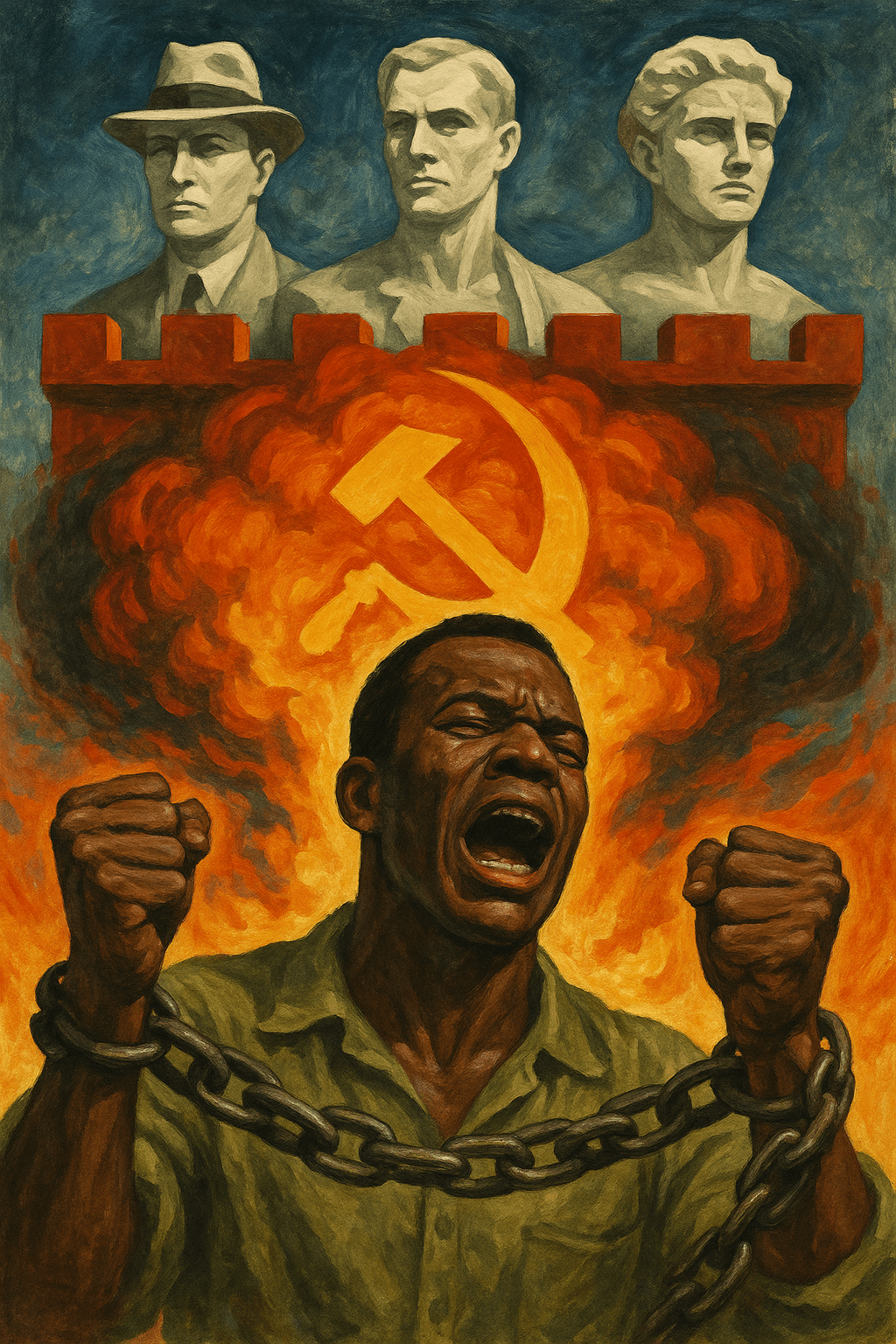
Charisse Burden-Stelly’s Scientific Autopsy of U.S. Empire and Its Racial Counterinsurgency Logic
By Prince Kapone | Weaponized Information | August 3, 2025
Capitalist Racism Is Not a Bug—It’s the Operating System
There are books that describe the system, books that critique the system, and then there are books that make you realize you were still living inside the system’s head. Charisse Burden-Stelly’s Black Scare / Red Scare doesn’t just analyze capitalist racism—it detonates the polite liberal fictions we’ve been fed about what racism is, how it works, and why it persists. And it does so with the calm, surgical rigor of a revolutionary scholar who has no illusions about what we’re up against. This is not a moral indictment. It’s a strategic autopsy. She is not scolding the ruling class. She’s naming its weapons, tracing its blueprints, and preparing a counteroffensive.
The book’s central thesis hits like a brick through the stained-glass window of U.S. exceptionalism: racism in the United States has never been incidental, cultural, or irrational. It is a rational, evolving mechanism of capitalist class rule—designed, implemented, and constantly upgraded to manage the contradictions of an empire built on slavery, genocide, extraction, and enclosure. Burden-Stelly terms this “capitalist racism,” and in doing so, she does what the Western left has refused to do for decades: theorize race as a material force of counterinsurgency. Not a social attitude. Not a discursive field. A weapon.
Capitalist racism, she shows us, is not the residue of slavery—it is its political continuation by other means. The plantation gave way to the prison, the slave patrol to the police, the auction block to the labor market. But the logic remained constant: racialization as class discipline, Blackness as a managed threat, whiteness as subsidized loyalty. This isn’t some abstract theory—Burden-Stelly walks us through it, decade by decade, as the U.S. ruling class built a national identity on anti-Blackness and fortified it through anti-communism. What emerges is a historical materialist map of repression that connects the ghetto, the gulag, and Guantánamo.
She doesn’t just expose how race props up capitalism—she exposes how liberalism props up racism. Every time the U.S. system came under threat from below—whether through radical labor, Black internationalism, or communist organizing—the state responded by fusing racial terror with ideological panic. That’s the Black Scare and the Red Scare—not two separate campaigns, but a single, integrated strategy of class war. The state didn’t just repress revolutionaries. It racialized them. It didn’t just criminalize Black people. It made their very existence a proxy for sedition.
What Burden-Stelly offers here is nothing less than a revolutionary grammar for decoding American political history. She slices through the fog of liberal myth-making to reveal a nation governed by terror and engineered by law. Her method is precise, dialectical, and totalizing—refusing the academic compartmentalization of race, class, and ideology. She understands that these are not fields of study. They are fields of fire. The bourgeoisie doesn’t fear ideas—they fear praxis. And what this book offers is a praxis-ready framework for understanding the enemy and building its undoing.
From the standpoint of Weaponized Information, we read this not as theorists, but as insurgents. We approach this work not to debate it, but to deploy it. We see in Burden-Stelly’s analysis a sharpened tool to strip the white masks off empire’s loyal opposition. To expose the NGOs, the foundations, the “diversity” experts, the academic gatekeepers and state-approved rebels who manage rebellion so it never becomes revolution. This book does not flatter the left. It indicts it. And it invites those of us in the belly of the beast to do the only thing left worth doing: defect from whiteness, defect from empire, and join the war against the world they’ve built.
Repression Is the Reform: How the State Evolved to Crush the Class That Built It
The genius of U.S. capitalism is that it never wastes a crisis. From the ashes of the plantation and the factories of Reconstruction, it engineered a system of racialized labor control so sophisticated, it could be repackaged as progress. Burden-Stelly peels back the patriotic sheen to show what actually emerged: a surveillance state built not despite emancipation, but because of it. This is not the usual liberal narrative of two steps forward, one step back. This is a dialectical dissection of how every step forward for Black people was met with a counterstep by the ruling class—coded not in overt violence, but in policy, procedure, and propaganda.
Her history begins where most textbooks end: with the death of slavery and the birth of something even more insidious. Through the convict lease system, Jim Crow apartheid, Black Codes, vagrancy laws, and lynch mobs deputized by the state, the American ruling class retooled its apparatus. Freedom was criminalized. Mobility was policed. And labor was re-enslaved through law. But this wasn’t just southern brutality. It was a national program, federally subsidized and ideologically justified by the same bourgeois liberalism that preached liberty to Europe and bullets to Africa.
In Burden-Stelly’s analysis, repression is not a deviation from American democracy—it is its core function. This is where she breaks completely from the dominant frameworks of both liberal race studies and Western Marxism. For liberals, racism is an unfortunate stain on an otherwise noble project. For Western Marxists, race is a distraction from “real” class struggle. But for Burden-Stelly, capitalist racism is the very architecture of U.S. class formation. There is no American working class that isn’t constructed through racial stratification. No democracy that doesn’t rely on colonial dispossession and the violent containment of Black and Indigenous life. And no capitalist development that doesn’t use repression as its forward engine.
What she documents, with unflinching clarity, is how the U.S. state restructured itself around a racialized logic of anti-subversion. This was not just about maintaining order—it was about preempting insurgency. The state came to see Black communities not simply as sites of poverty, but as incubators of rebellion. Every public policy—urban renewal, education funding, welfare, housing, immigration, labor law—was calibrated through the twin lenses of race and risk. And when rebellion erupted, whether through the Communist Party, the Garveyites, the Black Panthers, or everyday proletarian survival, the state cracked down not as a liberal state correcting injustice, but as a colonial regime defending its territory.
This is the connective tissue Burden-Stelly exposes: how the state’s reaction to Black resistance wasn’t incidental—it was anticipatory. The American legal, bureaucratic, and ideological infrastructure evolved not to accommodate freedom, but to contain it. And this was always a bipartisan affair. From Wilson to Roosevelt, from Truman to Reagan, from Obama to Biden—the real continuity is not the party but the project: make sure the colonized never escape their prescribed class function.
What we learn from this is deadly simple: the American state does not fear chaos. It fears coherence. It fears when the oppressed understand their place in a system and begin to move as a class. That is why Burden-Stelly’s work is not just historical—it is strategic. It provides us with the X-ray vision needed to expose how every liberal reform has functioned as a surgical act of repression. Every welfare program a temporary pacification. Every rights discourse a repackaged leash. Every concession a wager that the rebellion will not return.
And from our standpoint—here in the metropole, behind enemy lines—this clarity is priceless. Because it means that nothing short of rupture will suffice. No ballot will reverse this machinery. No policy tweak will dismantle the carceral state. No DEI training will undo centuries of racialized class war. If repression is the reform, then our job is not to reform the system. It is to expose it, resist it, and replace it. Not with better managers. But with revolutionary power rooted in the very class it was built to crush.
The Twin Specters: How Blackness and Communism Became the Empire’s Code Words for Insurrection
There’s a reason every struggle in this country eventually gets painted red and black—and not in the colors of the people’s flag, but in the hues of criminal suspicion. What Burden-Stelly reveals with surgical precision is how the U.S. state learned to fuse the racial panic of the “Black Scare” with the ideological paranoia of the “Red Scare” into a single, seamless doctrine of domestic counterinsurgency. This wasn’t rhetorical sloppiness. It was strategic alignment. When the oppressed began to demand not just rights, but revolution—when Black militants connected their oppression to capitalism, colonialism, and empire—the full might of the state came down to snuff it out. And it did so not just through force, but through framing.
The genius of the American counterrevolution is its ability to criminalize dissent while pretending to defend democracy. Under this regime, the mere convergence of Blackness and radical politics was treated as a subversive conspiracy. Burden-Stelly walks us through the archives: the deportations of Black Caribbean radicals under the 1918 Sedition Act, the surveillance of Black internationalists by the FBI and Military Intelligence Division, the classification of the NAACP and the Urban League as suspect during the Red Scare years. Her documentation is not just a chronicle of repression—it’s a forensic report on the ideological software that still runs the empire’s operating system.
The categories themselves—“Black agitator,” “un-American,” “subversive,” “communist sympathizer”—are all linguistic camouflage for the same basic anxiety: the fear that the colonized might organize. Might connect the dots. Might see that lynching and low wages, segregation and starvation, police bullets and poverty are all symptoms of a system—and that system has a name: capitalist imperialism. And once that recognition takes root, it spreads like wildfire through tenements, shipyards, classrooms, prisons, and labor halls. That’s what the state feared. That’s what it still fears.
But Burden-Stelly goes further. She doesn’t just expose the mechanics of this twin scare—she shows how they relied on each other. The Red Scare needed the Black Scare to justify its breadth, and the Black Scare needed the Red Scare to defang solidarity. This ideological feedback loop allowed the state to isolate Black radicalism from the broader labor movement while also purging the labor movement of its most militant, internationalist voices. It was a two-for-one deal in the discount aisle of empire: crush Black power and class power in the same operation.
What emerges is not a conspiracy theory, but a theory of how conspiracy gets constructed. The state doesn’t need you to commit sedition—it only needs you to think the wrong thoughts, talk to the wrong people, read the wrong books, show up at the wrong meeting, or stand next to someone on a government watchlist. In a society where Blackness is already presumed guilty and Marxism is already presumed foreign, the overlap becomes a political death sentence. This is what happened to Claudia Jones, to W.E.B. Du Bois, to Paul Robeson. These weren’t outliers—they were early warnings.
From the vantage point of Weaponized Information, this is where Burden-Stelly’s intervention hits hardest. She doesn’t romanticize the past. She makes it relevant to the counterinsurgency we live under now. Because today, the labels have changed, but the architecture has not. The “Black identity extremist,” the “antifa domestic terrorist,” the “foreign disinformation asset”—these are just updated tags on the same old files. The old COINTELPRO offices may have closed, but the logic is still humming inside the hard drives of Homeland Security and Meta’s content moderation teams.
That’s why we can’t afford nostalgia. The lessons here are not about glorifying the martyrs or commemorating the fallen. They’re about learning how the state thinks, how it neutralizes threats, and how it maps the terrain of revolt. And if we learn those lessons well, then perhaps we can do what Burden-Stelly is daring us to do: stop being afraid of the twin specters, and become them. Not as ghosts, but as organizers. Not as symbols, but as strategists. Not as victims of repression, but as its vanishing point.
Weaponized Liberalism: The Counterinsurgency Logic Behind Rights, Reform, and Representation
What Burden-Stelly rips open with academic precision and revolutionary fury is a truth so dangerous that most of the left still refuses to face it: liberalism is not the alternative to repression—it is its most effective delivery system. The Black Scare and Red Scare were not carried out by jackbooted fascists in some far-off dystopia. They were orchestrated by Ivy League bureaucrats, Supreme Court justices, bipartisan legislators, think tank technocrats, and respectable liberals in foundation-funded nonprofits. This is the sinister genius of empire—it doesn’t crush you with its fists. It disarms you with its smiles, its scholarships, its grants, and its inclusion campaigns. It doesn’t murder the revolution. It absorbs it, mangles it, and regurgitates it in the image of capital.
Burden-Stelly is unsparing on this point. She identifies liberalism not as a neutral political tradition, but as a counterinsurgency formation. Its historical function has been to de-radicalize demands, to convert collective insurgency into individual grievance, to trade the language of liberation for the language of legality. What was once “the dictatorship of capital” becomes “income inequality.” What was once “imperialism” becomes “foreign policy concerns.” What was once “mass incarceration of colonized people” becomes “criminal justice reform.” All of it is euphemism. All of it is whitewash. All of it is war.
The very categories of liberal thought—freedom, rights, representation, equality—have been weaponized not to dismantle domination, but to stabilize it. These aren’t neutral values. They are coded instruments of statecraft. Burden-Stelly traces how every expansion of rights in the U.S. was contingent on defanging rebellion. The right to vote was extended to prevent insurrection. The right to assemble was permitted as long as it remained symbolic. Representation became the golden carrot for an emerging Black bourgeoisie whose function, from day one, was to manage dissent and pacify the ghetto. What emerged was not empowerment, but a caste of professional intermediaries between the colonized masses and the colonial state.
And this is where the analysis cuts deepest. Because Burden-Stelly is not just calling out the old white supremacists—she’s indicting the new Black managers of empire. The mayors, the prosecutors, the professors, the TV pundits, the DEI consultants, the “movement” celebrities who get flown to Davos and Aspen to discuss liberation over cocktails with the same people who fund prisons and drone strikes. These are not allies. These are custodians of capital in brownface. They are what Fanon warned us about. They are what Du Bois feared. They are what every real revolutionary must learn to recognize—not as victims of co-optation, but as active agents of imperial maintenance.
From the perspective of Weaponized Information, this is not a question of moral purity. It’s a question of class war. The liberal language of diversity and inclusion has become the ideological lubricant for the most violent systems on earth. There is no liberation in being included in a police department. No justice in sitting on the board of a weapons contractor. No freedom in getting elected to oversee austerity. And no dignity in being allowed to speak truth to power at a TED Talk funded by the same billionaires who own the media, the banks, and the prisons.
This is what Burden-Stelly arms us to see: the smooth integration of repression into the fabric of liberal governance. How the Black bourgeoisie, cultivated by philanthropy and credentialed by white institutions, became the firewall against proletarian Black revolt. How “civil rights” became the acceptable substitute for decolonization. How “Black excellence” was weaponized to obscure Black exploitation. And how the language of reform became the velvet glove around the iron fist of empire.
To wage war against this system, we must stop trying to redeem its vocabulary. We must develop our own grammar of struggle—rooted in the concrete realities of class, colonialism, and coercion. Burden-Stelly does not merely provide that grammar—she models it. And in doing so, she helps us strip the costume off liberalism once and for all. What remains is not a dream deferred. It’s a dream exposed as diversion. And what rises in its place is not despair, but clarity. Clarity that speaks in the language of rupture, not reform. The language of seizure, not access. The language of revolution, not representation.
Weaponized Identity, Defanged Resistance: Neoliberalism’s Counterrevolution
The long war against Black liberation did not end with COINTELPRO or the collapse of the Soviet Union. It did not end with the election of a Black president, the celebration of Juneteenth, or the hiring of corporate “diversity consultants.” No, the war simply changed uniforms. As Burden-Stelly makes devastatingly clear, the repression of Black communism and anti-imperialist struggle gave way not to emancipation—but to absorption. The revolutionary was replaced by the reformer. The comrade by the brand ambassador. The insurrectionary tradition of the Black radical left was recoded, sterilized, and sold back to the public as “representation.” This is the counterrevolution of neoliberalism: the weaponization of identity and the defanging of resistance.
What Burden-Stelly exposes, with the scalpel of a revolutionary surgeon, is that the current discourse of “anti-racism” is not a continuation of the Black radical tradition—it is its suppression. Stripped of its class content, emptied of anti-imperialism, and framed entirely in the language of trauma and recognition, this identity regime does not challenge capitalist racism—it perfects it. It identifies bodies, not systems. It punishes speech, not power. It elevates a managerial caste of Black elites whose material interests are tied to the preservation, not the dismantling, of empire.
And this co-optation was no accident. It was the direct outcome of the counterinsurgency campaigns that Burden-Stelly documents throughout her book. The liquidation of Black internationalism, the assassination and imprisonment of revolutionary leaders, the crushing of communist organizations—all of it paved the way for this new class of racial spokespersons who serve as the face of inclusion while the system of exclusion marches on. This is how capitalism survives crisis: it does not only crush its enemies—it appropriates them, rebrands them, and markets them back to the masses.
From the standpoint of Weaponized Information, this moment is not one of progress but of profound political disorientation. We live in the aftermath of the defeat of organized revolutionary movements, where the aesthetics of dissent cloak the logistics of domination. Where the language of struggle is now owned by institutions that exist to suppress it. Where identity functions not as a pathway to solidarity, but as a managerial instrument to divide and domesticate. Liberal “anti-racism” today does not challenge the state—it partners with it. It is not a threat to capitalism—it is a strategy of its renewal.
Burden-Stelly does not mourn this betrayal—she anatomizes it. And by doing so, she reclaims the ground on which revolutionary clarity can be rebuilt. She reminds us that the enemy is not only the open fascist, but the smiling liberal who offers recognition instead of liberation. She shows us that the class politics of racial identity are not incidental—they are essential. That any “anti-racism” which does not confront capitalism, imperialism, and the state is not a politics of freedom—it is a politics of containment.
This is the task before us now: to unmask the ideological apparatus of neoliberal counterinsurgency masquerading as anti-racism. To disarm the co-opted language of justice. To rebuild revolutionary internationalism and class struggle from the wreckage of symbolic inclusion. To say without apology: we are not here for representation—we are here for revolution. And if the state has learned to speak our slogans, we must learn to speak in the voice of our enemies’ nightmares.
Toward a Science of Liberation: Reclaiming Revolutionary Theory and Practice
In the ashes of liberal reform and the rubble of co-opted resistance, Burden-Stelly offers us something rare: not despair, not nostalgia, but a rigorous reorientation toward revolutionary clarity. Her final chapters are not just conclusions—they are a call to arms. They demand that we return to the study of political economy, of state power, of race and class as fused apparatuses of rule. They ask us to abandon the sentimentalism of moral outrage and embrace what she calls “a science of liberation.” Not the therapeutic babble of recognition politics, but the sharpened dialectic of historical materialism. Not branding, but organizing. Not allyship, but allegiance—to the working class, the colonized, the insurgent.
Burden-Stelly is not inventing this science—she is retrieving it. From the wreckage of counterrevolution, she resurrects the communist tradition of Black radicalism, the praxis of Du Bois, Claudia Jones, William Patterson, and Paul Robeson. These were not activists looking for representation. They were revolutionaries waging war on empire. They understood the U.S. not as a “democracy with flaws,” but as a settler-colonial dictatorship. They did not ask to be included in the American project—they sought to destroy its colonial foundation and construct an international socialist order in its place. They knew that racism was not an ideology that could be deconstructed—it was an infrastructure that had to be demolished.
This is the lineage Burden-Stelly recovers, and it is the one we must rejoin. Not out of romanticism, but out of necessity. The capitalist order is not just unjust—it is unsustainable. Climate catastrophe, permanent war, mass surveillance, carceral expansion, imperial backlash—these are not signs of a system reforming itself. They are signs of a ruling class digging in. And the only antidote is revolutionary theory tied to revolutionary practice. Theory that does not flinch from naming enemies. Practice that does not beg for crumbs. Organization that is built not on visibility or viral aesthetics, but on strategy, discipline, and political clarity.
From our standpoint—as white defectors from the empire of lies, from the wages of whiteness and the seduction of patriotism—this science of liberation means more than solidarity. It means treason to the settler state. It means building principled alliances under the leadership of the colonized and oppressed, not flattering ourselves with borrowed struggle. It means studying the mistakes of our traditions, refusing the temptations of guilt and saviorism, and confronting the real material conditions of class collaboration and racial hegemony that structure our lives. It means choosing a side—and staying there when it’s no longer easy, popular, or safe.
Burden-Stelly offers no shortcuts. She dismantles the entire scaffolding of liberal fantasy and challenges us to build from scratch—armed not with hashtags, but with history. She reminds us that the task of revolution is not to feel good, but to understand. And that understanding is only useful when it prepares us to act. This book is not a museum piece—it is a field manual. And her insistence on materialist totality, on centering the colonial contradiction, on connecting racial capitalism to global imperialism—this is the arsenal we need to wage ideological war in the 21st century.
Let the academics write their obituaries for communism. Let the NGOs give their grants for symbolic “justice.” We are not here for reconciliation. We are here to remember what was tried, why it was crushed, and how we will rise again. The science of liberation has not disappeared—it has simply been buried. Burden-Stelly has handed us a shovel. Now dig.
Capitalist Racism Is the War—We Must Be the Counteroffensive
There are books that inform, books that persuade, and books that decorate the shelves of well-meaning progressives who’ve mistaken consumption for commitment. Black Scare / Red Scare is none of these. It is a weapon. It does not ask for your agreement—it demands your transformation. It does not ask you to admire the dead—it asks you to avenge them. It does not seek inclusion in the liberal canon—it spits in its face. Charisse Burden-Stelly has done more than write a brilliant historical and theoretical work. She has detonated a charge beneath the ideological foundations of U.S. empire, and she has done so from the place it fears most: the convergence of Black freedom and communism.
Her thesis is not just persuasive—it is irrefutable: the United States has always governed through capitalist racism, and it has always repressed liberation through the dual instruments of the Black Scare and the Red Scare. These are not parallel tracks, but interlocking gears. The racialization of communism and the criminalization of Blackness are not aberrations—they are the architecture of counterinsurgency. The liberal state does not correct these contradictions—it relies on them. Its legitimacy is built on their denial. Its survival depends on our forgetting.
But this book does not forget. It remembers the lynch mobs and the labor camps, the secret files and the midnight raids. It remembers Robeson and Claudia, Du Bois and Patterson—not as icons to be quoted, but as comrades in a struggle yet unfinished. It remembers the dreams buried beneath propaganda and the alliances shattered by infiltration. It remembers what was lost—and it tells us exactly why. And that memory, weaponized and clear-eyed, is the foundation of our counteroffensive.
What Burden-Stelly restores is the principle that theory must be accountable to struggle. That history must be excavated for the purpose of rearming the present. That knowledge is not neutral, and neither are we. Black Scare / Red Scare is not a retrospective—it is a reorientation. It reminds us that the task is not to critique racism, but to overthrow the system that generates it. Not to humanize empire, but to dismantle it. Not to beg capital to be kind, but to build a force capable of defeating it.
At Weaponized Information, we do not read books like this for inspiration. We read them for instructions. We read them because they sharpen our analysis, expose our enemies, and remind us of our duties. We read them because they point us toward the revolutionary horizon—the place where our cowardice must be buried and our courage must be born. This is not a book to cite—it is a book to join. If we understand its lessons, we will reject the myths of white innocence, the seductions of Western Marxism, and the fatal comforts of neutrality. We will choose a side—and we will fight like hell.
Capitalist racism is the war. The classroom won’t save us. The algorithm won’t save us. Your job title, your identity category, your moral high ground—none of these will save us. Only organization will. Only clarity will. Only a strategy forged in study and tested in struggle will. Black Scare / Red Scare shows us the terrain. The rest is up to us.
The book is not a mirror. It is a torch. Grab it. Burn the illusions. Light the way.
No Exit, No Apology, No Reform—Only Revolution
What Charisse Burden-Stelly has done in Black Scare / Red Scare is nothing short of explosive. She has written a manual for understanding empire from the inside—and more than that, for dismantling it from below. This is not a book of suggestions. It is an indictment. A battle map. A ruthless accounting of how the U.S. empire—liberal, bipartisan, and blood-soaked—has used capitalist racism as its prime engine of domestic control. And it refuses the soothing balm of reformism at every turn. If you are looking for hope without struggle, this book offers none. But if you are looking for a guide to revolutionary clarity, it delivers like thunder.
Burden-Stelly has performed a necessary heresy—she has destroyed the liberal myth of American progress and replaced it with the hard truths of dialectical history. She does not chase justice through the courts of empire. She does not measure freedom by the color of faces on TV. She doesn’t call for better reforms, fairer prisons, or more inclusive capital. She calls for power—Black power, proletarian power, decolonial power—the kind that builds outside the circuits of the state, the kind that abolishes the conditions of its own oppression.
For those of us in the belly of the beast, especially white comrades who dare to defect from empire’s comfort and complicity, this book must be read not as a window, but as a mirror. It shows us how whiteness, anti-Blackness, and imperial power are not historical accidents but structured logics of capitalist domination. It teaches us that solidarity cannot mean assimilation into the liberal order—it must mean its destruction. There is no ethical consumption, no neutral citizenship, and no innocent distance. The only way out is through rupture. Through refusal. Through the strategic alignment of our lives with the revolutionary project of the colonized and the dispossessed.
This is the standpoint of Weaponized Information. We do not seek to interpret the world merely more accurately—we seek to burn away the illusions that prevent us from changing it. And Burden-Stelly provides the flint and steel for that fire. Her work does not end in critique—it ends in invitation. An invitation to study differently. To organize differently. To speak in the voice of the oppressed and act in the interests of the exploited. To build a politics that sees race not as identity but as imperial infrastructure. To see class not as income but as relation to power, to land, to violence, to the state.
Black Scare / Red Scare is a book to be read with others. With comrades. With working people. With those whose lives have been rendered expendable by the same machinery she dissects. It is not a text for the bookshelf—it is a weapon to be sharpened and deployed. And if we dare to wield it, then perhaps we will come to see that the enemy is not just the fascist. It is also the reformer. That the danger is not just repression—it is reconciliation on imperial terms. That the future will not be found in appeals to reason, but in the organization of power.
This is not pessimism. This is clarity. The state will not save us. Capital will not loosen its grip. Liberalism will not give back what it stole. And justice will not arrive with the next election. But it can arrive with us—if we study, struggle, and organize with the precision, discipline, and revolutionary commitment that Burden-Stelly models. There is no exit from capitalist racism. But there is an end to it. And it will not be negotiated. It will be won.
 Weaponized Information
Leave a comment