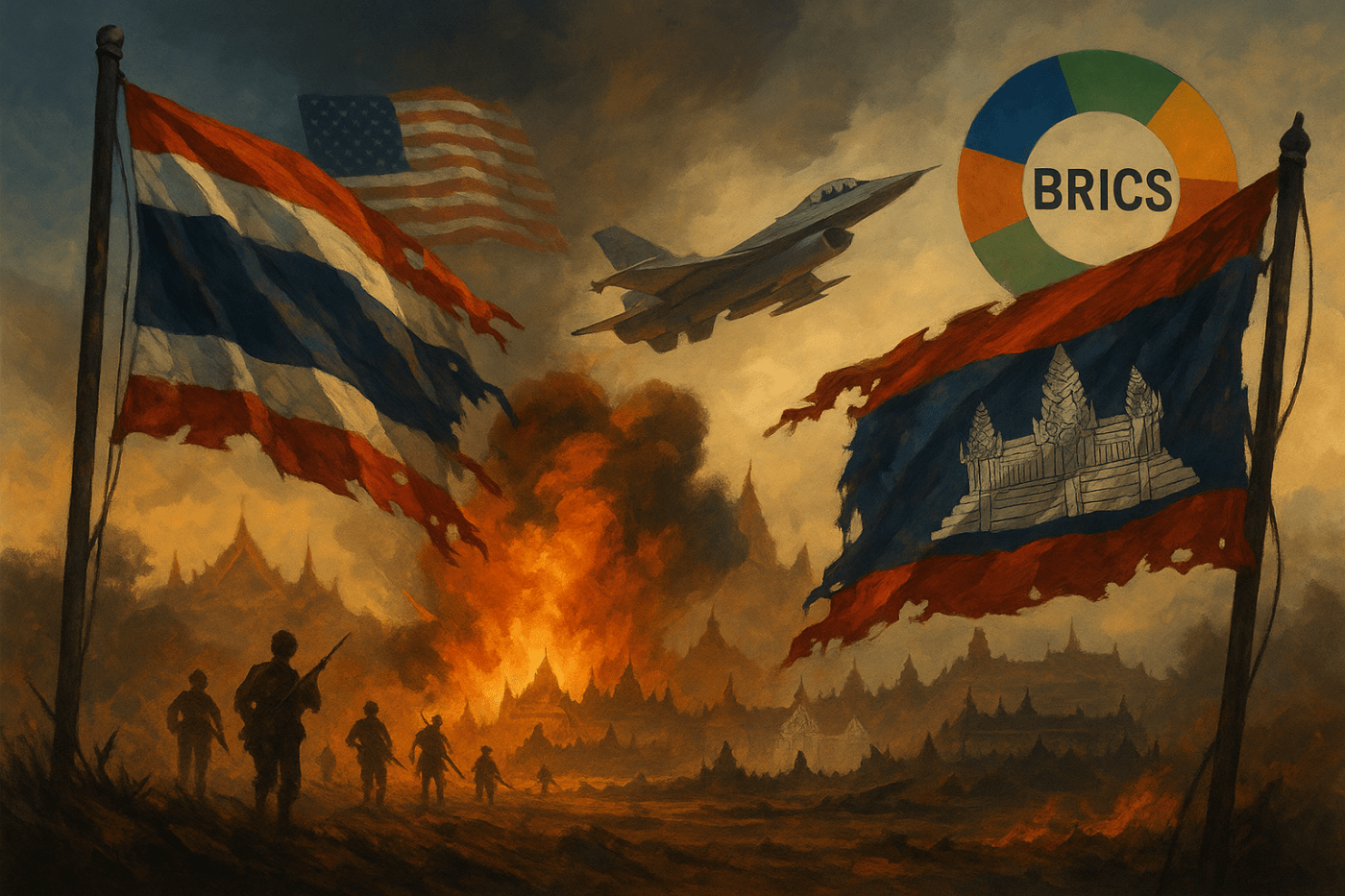
Behind the Thai-Cambodian Conflict Lies a U.S.-Orchestrated Counterinsurgency—Masked by Multipolar PR
By Prince Kapone | Weaponized Information | July 31, 2025
Fractured Flags: The PsyOp Beneath the BRICS Banner
In late July 2025, an article titled “New Winds, Old Battles: Thailand’s Strategic Crossroads in a Fracturing Global Order” was published on the Substack platform Think BRICS, a media outlet that bills itself as a voice for multipolar analysis and economic realignment. The piece arrived just days after the Thai-Cambodian border conflict intensified, presenting itself as a sober, centrist take on the unfolding crisis. It employed the familiar language of regional diplomacy, economic repositioning, and strategic complexity—precisely the kind of narrative that neutralizes political agency while laundering imperial coercion through the lexicon of multipolar progress. But beneath the calm tone and institutional polish lies a sophisticated propaganda operation: one that masks counterinsurgency as caution, and portrays U.S.-aligned aggression as unfortunate miscommunication. This is not a simple case of ideological bias—it is a textbook case of psychological warfare disguised as analysis. What follows is a forensic excavation of that narrative.
There’s no named author, only an editorial “we” that speaks from nowhere and everywhere. But the class position is clear: managerial, technocratic, and deferential to the polite norms of multilateral diplomacy. This is not the voice of the village or the factory floor. It’s the voice of the think tank corridor, the conference side panel, the regional integration workshop. It is written not to inform the oppressed, but to reassure the investor. Its target audience is not the people in the crossfire—it’s the ones who read policy briefings before approving arms shipments.
As for the outlet itself, it wears the colors of multipolarity while speaking the language of centrist realism. Think BRICS styles itself as a bridge between the old world order and the new, but its ideological loyalty remains unspoken and consistent. It avoids naming empire, avoids calling coercion by its name, and consistently frames regional struggle as unfortunate turbulence rather than deliberate design. In article after article, it praises development corridors, avoids naming sponsors, and reduces geopolitical conflict to elite personality clashes and bureaucratic speedbumps. It offers the language of change without the engine of rupture.
The amplification chain is equally familiar. Within hours of publication, the same narrative structure—crisis-neutral framing, emotional flattening, strategic ambiguity—was echoed across a range of official and semi-official platforms. Analysts repackaged the same storylines in new fonts. The article didn’t just travel—it marched, in formation, with others like it, deploying consensus where conflict demanded clarity.
The manipulation unfolds through precision framing. A military conflict is presented not as aggression, but as an unfortunate chain of reactions. Responsibility is blurred, sequences are rearranged, and power disappears into the fog of ambiguity. Each actor is portrayed as equally aggrieved, equally provoked, equally misunderstood. The machinery of war becomes a diplomatic misunderstanding. No one is named. No one is blamed.
Omission functions as a second weapon. Key background is deleted. The forces in play are rendered invisible. What remains is a vacuum where structure should be. We’re told there is history—but none of it appears. We’re told this is complex—but none of the complexity is shown. Instead, we get a guided tour of surface-level facts—conveniently selected, calmly arranged, and framed to suggest that all parties are navigating uncertainty with equal confusion and equal goodwill.
Emotion, when it arrives, is carefully rationed. The reader is guided to feel pity, not anger. To mourn loss, not interrogate power. Death appears, but never the machinery that causes it. Displacement is mentioned, but never traced. The story feels human, but only in the way that detaches humans from systems. The writing soothes, even when it describes violence. It pacifies, even while narrating conflict.
The final move is the soft neutralization of political agency. The article presents multipolar economic projects not as contested terrains, but as technocratic strategies. Actors don’t resist—they “reposition.” States don’t defy—they “diversify.” Conflicts are not structural—they’re interpersonal. And where rupture threatens to emerge, the narrative quietly rebrands it as “complexity.” It is an old trick: to translate struggle into miscommunication, and then offer diplomacy as the cure for everything except injustice.
This is not journalism. It’s not even bad analysis. It is narrative warfare disguised as sober commentary. It takes sides by pretending not to. It erases lines by redrawing them in soft focus. It serves power, not by applauding it, but by rendering its enemies indistinguishable from its friends. That is its genius—and its danger.
Facts in Exile: Mapping the Real Terrain
Let’s stop the psyop mid-sentence and ground ourselves in what actually happened. The Think BRICS article presented a sanitized timeline of events that conveniently erases the fingerprints of imperial coordination, reverses the chronology of aggression, and reduces the Thai-Cambodian confrontation to the level of a personal feud. The facts they do include are thin, selective, and stripped of context. But even those few details, once juxtaposed with the suppressed material record, expose the outlines of a much more deliberate—and dangerous—game.
First, here are the verifiable claims embedded in the original piece:
- Conflict between Thailand and Cambodia reignited in May 2025 after a Cambodian soldier was killed in the disputed Preah Vihear zone.
- Thai soldiers were injured in two separate landmine incidents on July 16 and 23, which Thai officials blamed on Cambodian forces.
- On July 24, Cambodia allegedly launched Grad rockets, prompting Thai F-16 airstrikes.
- Thailand responded with diplomatic and logistical sanctions: sealing borders, recalling its ambassador, and advising Thai citizens to evacuate Cambodia.
- Cambodia’s former Prime Minister Hun Sen gave a televised speech declaring readiness for war, while Phnom Penh filed an appeal for UN intervention.
- The UN reported 131,000 displaced in Thailand and over 4,000 in Cambodia.
- Thailand joined BRICS as a partner state on January 1, 2025, and is seeking full membership.
- Thailand’s stated BRICS objective is economic diversification—especially de-dollarization and connectivity to the New Development Bank.
- The Kra Canal project is mentioned as a long-term maritime infrastructure plan to reduce dependence on the Malacca Strait.
Now let’s examine the omissions—the silences that scream.
Omitted Fact #1: Thailand hosted U.S.-led Cobra Gold exercises in July 2025, mere days before the escalation. These war games are not ornamental—they are strategic rehearsals for hybrid warfare, amphibious landings, and power projection in the South China Sea. According to I Marine Expeditionary Force, the 2025 iteration of Cobra Gold featured expanded cyber warfare components and strategic simulations targeting “unknown adversaries,” a euphemism often used for China and its regional allies.
Omitted Fact #2: The Thai government publicly downgraded diplomatic ties with Cambodia the night before the alleged Cambodian rocket attack. According to Al Jazeera, the downgrade was accompanied by internal military alerts and a brief power vacuum caused by the suspension of Prime Minister Paetongtarn Shinawatra. This sequence strongly suggests a pre-meditated escalation, not a reactive defense.
Omitted Fact #3: Cambodia has been a repeated target of U.S.-backed regime change attempts. As exposed by Warwick Powell, the National Endowment for Democracy (NED) and USAID have poured funds into Cambodian opposition media and NGOs for years. This low-intensity subversion parallels tactics used in Venezuela, Belarus, and Syria, combining diplomatic isolation with information warfare.
Omitted Fact #4: Thailand is an imperial relay state deeply embedded in U.S. military architecture. The post‑SEATO U.S.–Thailand Defense Cooperation Agreement, last reaffirmed in 2023, guarantees logistical support for U.S. naval deployments and intelligence‑sharing. As reported by the U.S. State Department, Thailand remains a “Major Non‑NATO Ally” with access to U.S. weapons platforms and regional military aid packages.
Omitted Fact #5: The crackdown on Chinese-run “scam syndicates” in the Thai-Cambodian border region is not just law enforcement—it’s geopolitical sabotage. According to The GeoPolitics, these criminal networks often operate with implicit cooperation from state-linked actors. By targeting them now, Thailand is disrupting flows of capital that Cambodia’s political elites—and by extension, Beijing—depend on for regional stability.
Omitted Fact #6: Cambodian migrant labor is essential to Thailand’s economy. As documented in ILO‑referenced reporting, between roughly 500,000 and 1 million Cambodians work in Thai construction, agriculture, and low‑wage service jobs, and their remittances—which totaled around USD 2.6 billion in 2022—accounted for approximately 9 % of Cambodia’s GDP. Any mass deportation or forced return would devastate both economies—making escalation economically irrational unless driven by external pressures.
Layered beneath these factual omissions are the structural contradictions that define the moment. We are not witnessing a random border flare-up. We are witnessing the convergence of imperial coercion, multipolar sabotage, and domestic class antagonisms playing out through regional conflict. Thailand’s military elite are not neutral players—they are armed managers of an imperial relay system. Their membership in BRICS is not a betrayal of the West; it’s a calculated hedge to extract maximum leverage from both sides of the global order. This is strategic dualism in action—playing the field while staying on the payroll.
The article’s final misdirection lies in its treatment of BRICS. Rather than analyzing how U.S. strategy is actively targeting BRICS-aligned economies for destabilization, the piece presents BRICS as a benign logistics club. The reality is that Cambodia, like many small states moving toward multipolar partnerships, is being boxed in—militarily, economically, and narratively—by its U.S.-aligned neighbors. What we are seeing is not a border conflict. It is a miniature theater in the larger war of imperial containment.
Borderlines and Battlefronts: Thailand as Imperial Relay State
Strip away the emotional varnish and technocratic varnish from the Think BRICS article, and what emerges isn’t a sovereign state managing a regional squabble—it’s a proxy, a polished vessel of empire, executing orders with plausible deniability. This is not about temples or topography. It’s about containment. Cambodia is a BRICS-aligned state with Belt and Road infrastructure, strategic Chinese partnerships, and a stubborn refusal to play the game by Washington’s rules. Thailand, on the other hand, plays its dual role with finesse: publicly entering BRICS while privately fulfilling the duties of an imperial relay state.
The very structure of the border conflict reveals this logic. Thailand’s escalation was not impulsive—it was choreographed. The Cobra Gold exercises, the diplomatic downgrade, the F-16s—these were not accidents of regional miscommunication. They were steps in a tightly managed sequence of hybrid warfare. This is how the U.S. executes its strategy in the Indo-Pacific: through counterinsurgency-by-proxy, not just with drones and aircraft carriers, but through “partner states” whose militaries, economies, and information systems are all plugged into the imperial grid.
This model is nothing new. In Latin America, it’s Colombia. In West Africa, it was France’s Sahel corridor until it broke. In Southeast Asia, it’s Thailand. The task of these relay states is not to lead—it is to neutralize. Neutralize rising sovereignties. Neutralize Belt and Road influence. Neutralize the kind of multipolar momentum that makes BRICS dangerous to the dollar. That’s why this is not just a Thai-Cambodian dispute—it’s a live-fire demonstration of multipolar capture, where BRICS participation is permitted only if it comes without the politics of emancipation.
Look at the contradictions embedded in the narrative. The article frames Thailand’s BRICS alignment as economic foresight—a smart move for trade and tourism. But that framing collapses under scrutiny. What kind of BRICS partner participates in Cobra Gold? What kind of de-dollarizing ally signs exclusive arms deals with the Pentagon while dropping U.S.-made bombs on a neighboring BRICS-aligned country? This isn’t economic hedging. It’s strategic double-entry bookkeeping: one page for public consumption, the other for imperial auditors.
Thailand’s behavior is not a deviation from its historical path—it’s the continuation of a counterinsurgency framework. Its military isn’t just a national institution; it is an extension of U.S. Indo-Pacific command. Its media isn’t just misinformed; it is trained in State Department talking points. Its participation in BRICS is not a rupture—it is a controlled insertion, a way to slow down the bloc from the inside. This is the essence of multipolar capture: when BRICS grows without revolution, it becomes a sandbox for comprador diplomacy, not a battlefield for decolonial power.
What, then, is Cambodia’s crime? It’s not the landmines or the rhetoric. It’s that it refuses to act like a small power. It refuses to allow the U.S. or its regional allies to dictate its path toward sovereignty. It refuses to give up Chinese infrastructure, to dismantle its state-led economic model, or to offer itself as a market for Western NGOs and third-tier tech platforms. For that defiance, it has been targeted. And the task of enforcement has been outsourced to Bangkok.
That’s the real story. The border conflict is camouflage. The talk of BRICS “gambles” and “economic repositioning” is the diplomatic sheen applied over imperial muscle. Thailand has not left the unipolar order—it’s been reassigned. While the West screams about “Chinese aggression,” it quietly deploys its clients to surround and destabilize those who refuse to kneel. And it does so with the help of narratives like this one—calculated essays that transform empire into etiquette and counterinsurgency into concern.
To understand the full stakes, we have to speak from the standpoint of the global proletariat and peasantry. These are not just border disputes—they are control points in the global architecture of coercion. Thailand’s actions are not clumsy missteps; they are precise maneuvers in a game that seeks to re-domesticate the Global South into predictable economic behavior. What’s framed as “instability” is, in fact, the violent suppression of autonomous development. And what’s sold as “moderation” is nothing but loyalty to the declining imperial core.
This is the dialectic of the moment: as the crisis of imperialism deepens, so too do the lengths it will go to project coherence. That means turning every BRICS partner into a border cop, every multipolar state into a data point, and every resistance into a footnote. But what they don’t realize is that the more they tighten their grip, the more visible the empire becomes. Cambodia’s resistance may be small, but it is strategically luminous. It unmasks the lie that BRICS can expand without rupture, without risk, without war. It reminds us that multipolarity must be fought for, not merely managed.
Expose the Relay: Dismantling U.S. Proxy Control in Asia
What emerges from this confrontation is not just a war between neighbors. It is the sharpening edge of a global contradiction—the contradiction between imperialist containment and anti-imperialist sovereignty. While Cambodia resists encirclement and preserves its right to align with China and BRICS, Thailand functions as an imperial relay node, enforcing discipline on behalf of Washington and Wall Street. And yet, the media spectacle surrounding the conflict offers only murky theater, detaching global audiences from the material battlelines. That is precisely why our task is to cut through the narrative fog and name the enemy clearly.
We stand in full solidarity with Cambodia’s sovereign right to self-determination—politically, economically, and militarily. This does not mean romanticizing the Cambodian state or ignoring its contradictions. It means understanding that Cambodia’s alignment with multipolar infrastructure, especially the Belt and Road Initiative and BRICS+ coordination, makes it a direct target of imperial counterinsurgency. It is not Cambodia’s corruption that has drawn the ire of empire—it is its defiance.
In refusing to surrender its strategic orientation, Cambodia has stepped into a broader historical pattern: that of the small state forced to carry the burden of global contradiction. But even under pressure, it has not backed down. The decision to request a closed-door UN Security Council session, the refusal to submit to Thai airpower, and its longstanding partnership with China’s infrastructural vision all represent real forms of resistance against recolonization. These actions deserve not only acknowledgment but defense.
What, then, can those of us in the imperial core do? First, we must identify and target the institutions that enable the Thai state’s dual role as BRICS partner and U.S. enforcer. This begins with academic and policy networks. Many U.S. universities and think tanks—like the Asia Foundation, RAND, and Johns Hopkins SAIS—partner directly with Thai military officers, police units, and foreign service bureaucrats. These relationships must be severed. A coordinated divestment campaign aimed at ending academic complicity in Thai militarism would send a clear signal that empire’s polite handmaidens will no longer operate unchallenged.
Second, we can support grassroots media and mutual aid in Cambodia. Outlets like Cambodianess and VOA Khmer offer non-Western coverage and platforms for Cambodian laborers, displaced villagers, and cultural workers to tell their own stories. Funding their operations—not in a paternalistic NGO fashion, but through revolutionary internationalist solidarity—will help counter the disinformation churned out by pro-Thai, pro-U.S. media.
Third, our digital spaces must be turned into sites of counterattack. We recommend launching a coordinated social media campaign to disrupt hashtags like #ThailandBRICS and #IndoPacificSecurity, which have been colonized by psyops accounts and bots promoting Thai military narratives. Deploying memetic warfare, citation threads, and guerrilla video clips that expose the contradictions of Thai foreign policy can cut through the noise and sharpen the edges of political education for broader audiences. This is proletarian cyber resistance, not clicktivism.
Finally, we need to deepen political education around the historic function of imperial relay states. Teach-ins, reading groups, and multimedia explainers focused on SEATO, Cobra Gold, U.S.-Thai defense agreements, and the current hybrid war landscape must be organized across student groups, tenants unions, Black and Indigenous organizations, and antiwar collectives. The goal isn’t just awareness—it’s recruitment into a revolutionary internationalist line.
The time for soft-branded neutrality is over. Multipolarity without rupture will only replicate the existing power structure under new management. That is not liberation—it is recolonization in dialect-neutral tones. Let us therefore be clear: standing with Cambodia is not an endorsement of its government, but a refusal to accept the normalization of U.S.-aligned proxy warfare against any Global South state that refuses to submit. Exposing the relay means dismantling the lie. And dismantling the lie is the first step in making revolution possible.
 Weaponized Information
Leave a comment