By Prince Kapone
July 13, 2025
Trial by Headline: When Empire Writes the Verdict Before the Crime
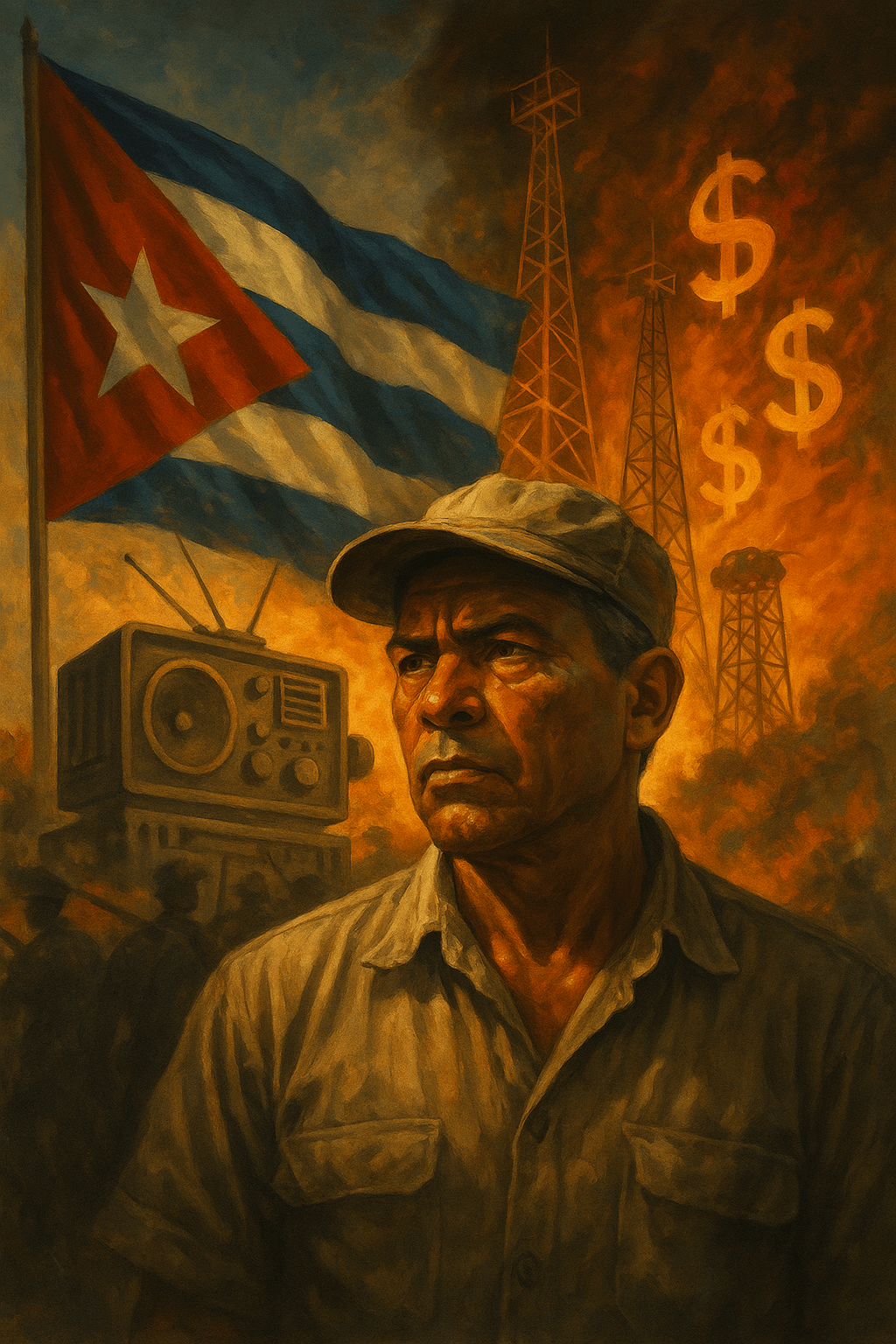
On July 12, 2025, the Chicago Tribune ran a wire-fed dispatch headlined “US sanctions Cuban President Díaz-Canel and other officials for human rights violations”. The byline belongs to Andrea Rodriguez, an old hand at the Associated Press whose name often graces stories where the State Department holds the pen and the reporter fills in the punctuation. This time, the target is Cuba—again. The piece reports that the U.S. slapped new sanctions and visa bans on President Miguel Díaz-Canel and top officials, timed conveniently to land on the anniversary of the July 11, 2021 protests. Dressed up as a defense of “human rights,” the piece stars Marco Rubio as the moral compass, strings together vague charges of “repression,” and hands Washington the gavel. The headline does what imperialism always does—convicts first, explains later. Actually, it never explains.
So who is Andrea Rodriguez, and who signs her paychecks? She writes for the Associated Press, a global amplifier for U.S. empire dressed in the neutral robes of “objective journalism.” Rodriguez might live in Havana, but she writes like her editors are sitting in Langley. Her stories rarely, if ever, interrogate U.S. policy, and when Cuban voices do appear, they’re either ridiculed, selectively quoted, or stripped of any real context. Her job isn’t to report—it’s to translate imperial doctrine into palatable copy. What we get is not journalism, but stenography for empire. Power speaks, and Rodriguez takes dictation.
The Tribune, for its part, is no innocent conduit. What used to be a pillar of Midwest journalism has been gutted and repackaged as a zombie paper under the ownership of Alden Global Capital, a hedge fund that treats newsrooms like garage sales. Investigative desks get slashed, reporters get axed, and what’s left is filler—cheap wire copy, flashy headlines, and enough clickbait to keep the ad dollars flowing. The AP story runs unedited, unexamined, unchallenged—not because it’s true, but because it’s profitable. In this racket, the Tribune isn’t informing the public—it’s vending ideological fast food, reheated from yesterday’s talking points.
Then there’s Marco Rubio, Florida’s very own imperial ventriloquist dummy. In this piece, he isn’t just quoted—he scripts the whole narrative. His words function as gospel, his worldview never questioned. But let’s be clear: Rubio speaks for the hardline exile class—the old Cuban oligarchy exiled by the Revolution, now repackaged as respectable lobbyists in the halls of U.S. power. These are the same forces that backed Batista, cheered the Bay of Pigs, and now push regime change through sanctions, lies, and weaponized media. Rubio doesn’t just comment on the story—he is the story, with Rodriguez playing the role of publicist.
Structurally, this piece runs the classic playbook of imperial propaganda. It quotes only U.S. officials. It offers no Cuban perspectives. It tosses around emotionally charged accusations—“torture,” “repression”—without so much as a shred of evidence. It stages the sanctions as a righteous response to the July 11 protests but omits the context: the blockade, the economic warfare, the destabilization campaigns. And perhaps most revealing, it includes a photo of Díaz-Canel attending the BRICS summit—but never mentions the summit. That’s not an oversight. That’s omission as ideology.
What we’re seeing is not journalism—it’s performance. A drama called sovereignty theater, where the U.S. plays the role of high-minded enforcer and countries like Cuba are cast as disobedient pupils. There’s no real dialogue here, no engagement of equals. Cuba isn’t treated as a nation with its own history and politics—it’s treated like a case file. And the trial doesn’t happen in a courtroom. It unfolds in the media, where the sentence is delivered before the accused even speaks.
That’s why we call this a trial by headline. The judgment comes baked into the headline, the evidence is never produced, and the only voices heard are those who issue the sentence. The context—the roots of the protests, the legacy of the blockade, the basic facts of Cuban governance—isn’t left out by accident. It’s scrubbed out with intent. And exposing that intent is exactly what we’ll do in Parts II and III.
Manufactured Crisis, Manufactured Consent
The Chicago Tribune article packages U.S. sanctions on Cuba as if they were a moral reflex—automatic, obvious, and beyond question. It flatly reports that President Miguel Díaz-Canel and senior officials Álvaro López Miera and Lázaro Álvarez Casas were sanctioned on July 12, 2025, in response to the July 2021 protests. It parrots claims about visa bans on anonymous Cuban judges and prison officials, notes that 790 people were investigated after those protests, and adds that some were conditionally released in 2024. No sources outside the U.S. government are cited. No context is provided. The piece simply lists imperial actions as if they were items on a grocery receipt, expecting readers to nod along dutifully. But every sentence leans on omissions—each one warps the facts to hide the hands behind the crisis.
First, the article pretends the blockade doesn’t exist—the longest-running economic siege of the modern era. Initiated in 1960 by the Eisenhower administration and hardened by the Helms‑Burton Act of 1996, the U.S. blockade on Cuba has choked trade, frozen financial access, and restricted technology transfers for over six decades. The cost to the Cuban economy? Estimated at more than $144 billion in cumulative losses. And each year, the world speaks—with the 2024 UN General Assembly voting 187 to 2 to end the embargo—the only dissenters being the U.S. and Israel. Yet this entire context is scrubbed from the Tribune’s coverage, letting Cuban hardship be portrayed as self-inflicted.
Second, the article deliberately erases the long‑standing U.S. campaign to destabilize Cuba—initiated in the 1980s and fueled by tens of millions of dollars from outfits like USAID and the National Endowment for Democracy, which bankroll dissident networks, shadow media, and online influence operations. One of the most infamous examples is Zunzuneo—a covert, Twitter‑style platform funded by U.S. agencies to manipulate Cuban youth and foment unrest. Ironically, this program was exposed by the same media machinery now repackaging Rodriguez’s narrative with no historical memory.
The July 2021 protests are framed as spontaneous—as if frustration simply boiled over. But missing from that story is the siege that made those frustrations unbearable. The protests erupted during a global pandemic, amid fuel shortages and a collapsing medical supply chain. But those weren’t natural shortages—they were engineered. U.S. sanctions blocked oil deliveries, banned critical parts for Cuba’s aging power grid, and even prevented the shipment of syringes and COVID-19 test kits. This wasn’t just a public health crisis. It was slow-motion warfare.
The article also manages to ignore what was happening just days before the sanctions were announced in July 2025. On July 6, Díaz‑Canel stood at the BRICS Summit in Rio de Janeiro, where leaders from across the Global South reaffirmed their commitment to reforming global governance, financial systems, and reducing reliance on the U.S. dollar. Cuba actively backed new mechanisms—like regional currencies and alternative payment platforms—to challenge dollar dominance. This wasn’t rhetoric—it was a direct strategic refutation of imperial financial order. Yet none of this appears in the Tribune’s version. In their telling, the sanctions are simply punitive measures for past “misconduct.” In reality, they’re a signal: align with BRICS, and empire will hit back.
The article scolds Cuba for arresting protesters—but never reflects on how the U.S. handled its own uprisings. In 2020, during the George Floyd rebellion, over 18,000 people were arrested across the United States. Protesters were gassed, beaten, kettled, and tracked by surveillance drones. Cities like Portland and Minneapolis became test labs for domestic counterinsurgency. Meanwhile, the U.S. still holds political prisoners—Mumia Abu-Jamal and others—and yet poses as the hemisphere’s moral compass. As Al Jazeera and other Global South media highlighted, U.S. authorities’ violent crackdown prompted charges of hypocrisy from abroad. Propaganda doesn’t allow for mirrors.
Finally, the article buries the truth of Cuba’s resilience. Despite the blockade and sustained sabotage, Cuba remains a living example of socialist achievement. It boasts one of the world’s highest literacy rates — nearly 99.7% among adults — while exporting more medical personnel to the Global South than the WHO: over 20,000 doctors currently serve international missions. It developed five COVID‑19 vaccines independently. These aren’t failures of socialism — they’re its vindication. And that’s precisely why they must be erased. Because if people saw Cuba clearly, the whole imperial fairytale might collapse under the weight of its own lies.
The Long War on the Cuban Revolution: Empire’s Fear of a Sovereign South
The sanctions announced on July 12, 2025, are not a sudden reaction—but the latest salvo in a decades-long war dating back to 1959, when the Cuban people overthrew Batista and declared their independence. This war was never about “human rights.” It was about punishment—punishment for defiance, for self-determination, for the audacity of a formerly colonized nation to chart its own course just 90 miles from Miami. As documented in an April 1960 memo by U.S. State Department official Lester D. Mallory, Washington understood that “the majority of Cubans support Castro” and concluded that “the only foreseeable means of alienating internal support is through disenchantment and disaffection based on economic dissatisfaction and hardship.” The memo recommended that the U.S. “make the greatest inroads in weakening the economic life of Cuba,” even if it meant “bringing about hunger, desperation and the overthrow of the government.”
From the bay of pigs to biochemical warfare, from car bombs to propaganda blitzes, the U.S. campaign to destroy the Cuban Revolution has shifted tactics but never objectives. The goal has always been to reverse the revolution and reinstall a comprador regime loyal to U.S. capital. The faces have changed—Kennedy, Reagan, Bush, Obama, Trump, Biden—but the mission hasn’t. It’s imperialism 101. Where they once cried “communism,” they now moan “authoritarianism.” But as Vijay Prashad reminds us in Washington Bullets, sanctions aren’t diplomacy. They’re economic warfare—designed not to change behavior but to break resistance. And Cuba’s resistance remains unbroken.
These tactics don’t stop at Cuba’s shores. They’re part of a broader arsenal aimed at disciplining the entire Global South. The Monroe Doctrine has been reborn, and this time it’s digital, financial, and transnational. Venezuela is sanctioned for trying to build socialism from the barrio up. Nicaragua is punished for not letting Washington pick its president. Bolivia was nearly hijacked in a lithium coup. Even Brazil, under Lula, has felt the sting for flirting with BRICS. The message is as old as empire itself: obey or suffer. Try to build a world outside the dollar, outside NATO, outside IMF diktats—and the sanctions will come knocking. This is Imperialist Recalibration: a shape-shifting empire adapting its tools, but never its mission.
So let’s be clear: it wasn’t the protests of 2021 that triggered the 2025 sanctions. It was Cuba’s rising leadership in the Global South. When Díaz-Canel stood shoulder to shoulder with leaders from China, South Africa, and Brazil at the BRICS Summit in Rio—calling for regional currencies, de-dollarization, and sovereign development—he wasn’t breaking any law. He was breaking rank. He was refusing to play the role of the quiet subordinate. And that’s the real crime in Washington’s eyes. Because every Cuban doctor trained for free, every child vaccinated without a Western patent, every solidarity mission to Africa and the Caribbean—it all makes neoliberalism look like the scam it is. And empire cannot afford that comparison.
That’s why Cuba has been embedded into what we call the Sanctions Architecture—a suffocating web of legal blockades, insurance bans, banking blacklists, and digital silencing, enforced not just by the U.S. government but by Visa, PayPal, Google, Amazon Web Services, and Wall Street asset managers. This isn’t just an embargo—it’s a siege of global dimensions. It’s Hyper-Imperialism: where power is exercised not only through troops or bases, but through algorithms, payment systems, and shipping codes. Cuba doesn’t just face trade restrictions—it’s cut off from SWIFT, ghosted by app stores, demonized on search engines, and slandered across the imperial press. It’s the same system that froze Venezuela’s gold, blacklisted Huawei, and blocked Iranian medicine. The means evolve. The mission stays the same.
And the suffering isn’t accidental—it’s strategic. Sanctions are designed to make life unbearable, to turn daily survival into an indictment of socialism. Block fuel, then blame the power outages on government mismanagement. Restrict medicine, then portray the health system as collapsed. Choke the economy, then televise the breadlines. The aim is to force surrender not through military invasion, but through economic exhaustion and moral defamation. It’s punishment dressed as policy. Starve the revolution into silence—and then sell the silence as proof it never worked.
This is not just an economic assault. It’s also a psychological one. Welcome to the battlefield of Cognitive Warfare. Here, the goal is to erase Cuba ideologically—to turn a living revolution into a cautionary tale. The media doesn’t need to lie outright. It just needs to omit. When the Chicago Tribune publishes a photo of Díaz-Canel at the BRICS summit but refuses to mention the summit itself, that’s not journalism—it’s sabotage. When it amplifies Rubio’s soundbites without critique and casts Cuban leaders as erratic or irrational, that’s not analysis—it’s narrative control. The revolution isn’t debated. It’s dismissed.
And yet—65 years later—it still stands. Cuba’s revolution, under siege for six decades, remains alive. That’s not just survival. It’s defiance. It’s a beacon. A signal to every shackled nation that sovereignty is not only imaginable—it’s achievable. Across the Global South, cracks are forming in the imperial edifice. In Venezuela, communal councils run neighborhoods. In Burkina Faso, land and gold resources are reclaimed from foreign mining firms. And in Iran, trade routes increasingly bypass the U.S. dollar. These aren’t accidents. They’re ruptures. Coordinated and growing. And in this global rebellion against empire, Cuba is not alone. It’s leading the way.
Disrupting the Siege: Tasks for the Global North
Cuba is not alone—and never has been. But solidarity can’t be sentimental. It has to be organized, material, and rooted in internationalism. For those of us living in the heart of empire, the task is not just to cheer Cuba on from the sidelines—it’s to sabotage the siege from the inside. That means hitting the systems, firms, and narratives that uphold U.S. domination. It means breaking the blockade not just at the port, but at the point of production—finance, media, logistics, and ideology. Cuba’s resistance is not just a symbol. It’s a strategy. And it calls for action, not applause.
The most obvious fault line is finance. Firms like BlackRock and Fidelity quietly bankroll the lobbying infrastructure that keeps the sanctions alive. Groups like the U.S.-Cuba Democracy PAC are underwritten by institutional investors with deep links to Wall Street, K Street, and the Miami exile class. These same firms manage university endowments, public pensions, and municipal funds across the Global North. That makes them vulnerable. Launch targeted divestment campaigns—starting on campuses and in city halls. Demand disclosures. Expose portfolios. Name and shame. Force them to choose: profit from blockade, or face a political cost. If capital is the terrain, then make it contested.
Second, get resources directly to the frontlines. Organizations like Puentes de Amor and Pastors for Peace have been defying the embargo for decades through grassroots aid caravans and people-to-people diplomacy. These are not charity drives—they are strategic breaches in the imperial blockade. Send funds. Organize shipments. Coordinate logistics. Help build autonomous supply chains to get essential goods—medical devices, agricultural tools, school equipment—into Cuban hands without passing through compromised NGOs or hostile intermediaries. Every successful delivery is a crack in the empire’s armor.
Third, rupture the narrative. Create an open-source digital archive documenting the real impact of the blockade. Track fuel shortages, medicine embargoes, frozen bank accounts, SWIFT bans. Use platforms like GitHub or Notion to make it transparent, translatable, and secure. Crowdsource testimonies from Cuban doctors, engineers, artists, students. Pull data from BRICS-aligned media, diaspora outlets, and primary sources. Design it visually—timelines, infographics, network maps. Then weaponize it. Use social media to swarm disinformation in real time. When a Rubio or an AP flack spreads lies, flood the zone with facts. Make narrative warfare collective.
Fourth, organize political education grounded in revolutionary history. Launch a teach-in series titled “Cuba Under Siege: 65 Years of Revolutionary Defiance.” Pair foundational texts—Che’s Socialism and Man in Cuba, Fidel’s History Will Absolve Me, Prashad’s Washington Bullets—with current analysis of sanctions, BRICS realignment, and multipolar strategy. Host film screenings. Invite Cuban speakers. Hold dialogues with Global South comrades. Make it a campaign, not a weekend event. Embed Cuba’s story into the political formation of a new generation. Link it to Palestine, Venezuela, Burkina Faso. Show the continuity of struggle.
The blockade isn’t just a foreign policy—it’s a total system of repression: economic, cultural, psychological. But no system is eternal. It is staffed, funded, reproduced. Which means it can be disrupted, defunded, dismantled. Cuba’s endurance is not just a miracle of resilience. It is a call to action. To study. To organize. To strike. To help build the kind of militant internationalism that can finally bury the Monroe Doctrine—beneath the rubble of its own decline.
 Weaponized Information
Leave a comment