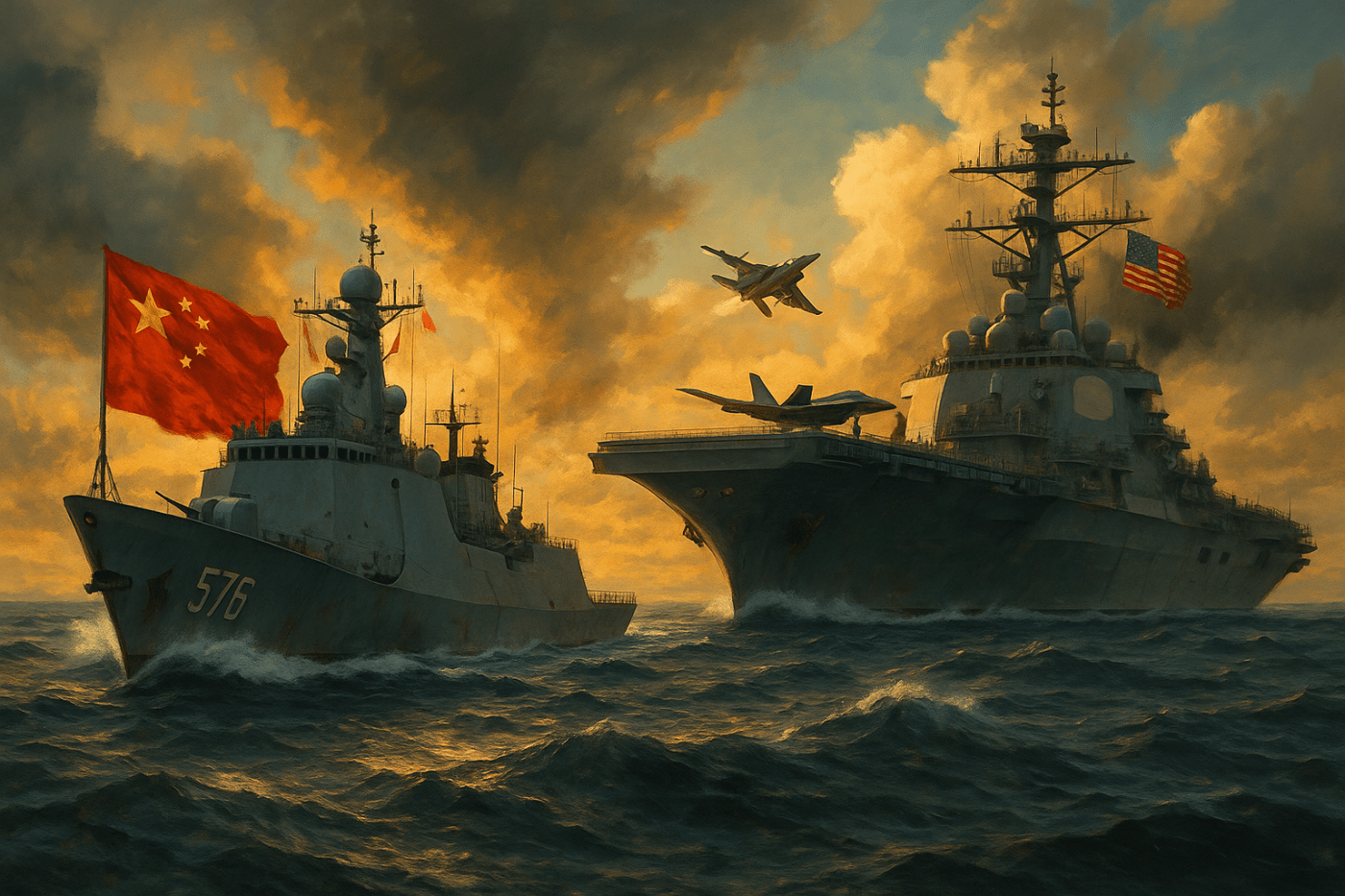
By Prince Kapone | Weaponized Information | July 14, 2025
Disciplining the Horizon: How Empire Manufactures Maritime Panic
On July 6, 2025, the National Security Journal published an article titled “A US Navy Nightmare? China’s Navy Just Did Something It’s Never Done Before”, written by Steve Balestrieri—a former U.S. Special Forces officer turned full-time Pentagon scribe. Posing as objective defense journalism, the piece is calibrated to reassure empire’s stakeholders—defense contractors, military planners, and national security think tanks—that U.S. naval supremacy remains unshaken. The “nightmare” in question? China’s first dual-carrier drill, conducted near its own coastline. But Balestrieri doesn’t engage the implications of that development. Instead, he deploys a familiar PSYOP: amplify fear, then neutralize it with patriotic reassurance.
From the start, Balestrieri mocks China’s carriers for using “ramped” launch systems and steam propulsion—details meant to downplay technological progress and uphold a narrative of American superiority. But these dismissals are not neutral facts; they’re strategic devices. The intent is not to inform but to distract—to redirect anxiety about rising parity into smug complacency. What’s offered here is not analysis, but a Pentagon-friendly script designed to keep imperial nerves calm and military contracts flowing.
The performance follows a set routine. First, express alarm at China’s activity. Then, swiftly reframe it as amateurish. Finally, reaffirm U.S. invincibility. Balestrieri reminds readers that the U.S. fleet remains “unmatched,” repeating a line that’s less insight than incantation. This is not news reporting. It’s narrative containment. A rhetorical perimeter meant to isolate any event that might challenge the fantasy that the oceans still belong to the United States.
What makes this framing so effective is what it omits. Nowhere does Balestrieri ask the most basic geopolitical question: Why is China’s military activity near its own waters considered provocative, while U.S. warships operating thousands of miles from home are treated as peacekeeping missions? Why is U.S. global reach presumed natural, while any assertion of sovereignty by another nation is treated as deviant? The article relies on the audience not asking these questions—because doing so would crack the foundation of maritime empire itself.
The real function of this piece isn’t to explain China’s naval development. It’s to reaffirm America’s role as sole guardian of the seas. That reassurance isn’t aimed at the informed reader—it’s aimed at the insecure official, the unsettled defense analyst, the empire whose grip is loosening. In this light, Balestrieri’s article becomes less about China’s navy and more about U.S. anxiety. A public-relations balm for a ruling class unprepared for parity.
This is how ideological discipline is performed on the page: by mocking your rival’s capabilities, erasing the legitimacy of their advancements, and framing any challenge to dominance as a temporary glitch. The empire’s panic isn’t shouted—it’s smoothed over. But the surface is already shifting. And what they fear most isn’t confrontation—it’s a horizon that no longer answers to them.
Steel and Sovereignty: What the Headlines Distort, the Facts Reveal
Once Balestrieri’s narrative sleight is stripped away, what remains is a simple and significant development: in early July 2025, China conducted its first publicly acknowledged dual‐carrier naval drill in the Philippine Sea, deploying the CNS Shandong and CNS Liaoning in coordinated exercises. According to Japan’s Defense Ministry—which reported spotting both vessels operating simultaneously and confirmed the PLA Navy described the drills as “routine training” to test “far seas defense and joint operations”—the carriers participated in combat drills, flight operations, and tactical maneuvering.
Each carrier launched a full suite of air wing assets, including up to 24 J-15 fighters per vessel, plus support helicopters. The Shandong is China’s first domestically built carrier, launched in 2017 and commissioned in 2019. The Liaoning was acquired as a derelict Soviet hulk from Ukraine and rebuilt over a decade of domestic retrofitting. Both employ ski-jump ramps for aircraft launch—a design choice that Balestrieri mocks as outdated. In truth, it reflects China’s current airframe requirements, not a technological deficiency.
These drills are part of a much larger shift. The U.S. Navy currently operates 11 nuclear-powered aircraft carriers; China has three, including the yet-to-be‑commissioned Type 003 Fujian. But the gap is narrowing. The Fujian, launched in 2024, is an 80,000‑ton flattop equipped with electromagnetic aircraft launch technology (EMALS)—once exclusive to the U.S. Navy’s newest carrier, the USS Gerald R. Ford. It is expected to carry over 36 J‑35 stealth fighters, as confirmed by the PLA Navy’s technical specifications noted in “China Begins Production of J‑35 Stealth Fighter for Naval Operations.”
According to a 2023 U.S. Department of Defense report, China’s navy surpassed the U.S. in battle force fleet size by 2020, and by 2025 operated approximately 340 platforms—including major surface combatants, submarines, aircraft carriers, and auxiliaries—compared to around 296 vessels in the U.S. Navy. This includes destroyers, submarines, missile boats, and a growing auxiliary and logistics fleet. Unlike the U.S., which prioritizes global reach, China’s modernization is oriented toward regional defense and strategic deterrence.
But this modernization isn’t just quantitative. It’s qualitative. Absent from Balestrieri’s write‑up are developments like China’s long‑range anti‑ship ballistic missiles—the DF‑21D and DF‑26—designed to keep carrier groups away from its coastline. Also missing are autonomous drone-swarm tactics under PLA development, satellite‑guided targeting systems integrated into missile command networks, and digitized command-and-control infrastructure developed in island-defense drills. These aren’t borrowed technologies. They’re credible deterrents.
Balestrieri also avoids the most basic geographic and legal context. The drills took place just east of China’s coastline, within its Exclusive Economic Zone, as defined by UNCLOS Article 57—a treaty that China officially ratified in June 1996, while the U.S.—despite participating in drafting—has never ratified the treaty. And yet it is China, not the U.S., that is portrayed as the violator.
Meanwhile, the U.S. continues to project force far beyond its shores. At the same time as China’s exercise, the USS Gerald R. Ford and USS George H.W. Bush were operating in the Atlantic with little fanfare. The Gerald R. Ford Carrier Strike Group departed Norfolk on June 24, 2025. The Indo-Pacific Command fields over 375,000 personnel, operates around 200 ships and 1,100 aircraft across more than 300 facilities in Japan, South Korea, the Marianas, and beyond — and yet it is China that is portrayed as the intruder.
The regional response tells a different story. In 2024, Xinhua reported that China and Vietnam coast guards completed their first joint patrol of 2024 in the Beibu Gulf—part of ongoing maritime cooperation. In 2025, Malaysia, as ASEAN Chair, promoted a regional strategy for maritime surveillance and interoperability under its leadership—a key agenda item in the “.ASEAN 2045: Our Shared Future” strategic framework presented that year. While Washington doubles down on confrontation, regional actors are opting for diplomacy and cooperation.
Even Chinese media coverage reflects a vastly different framing. According to the Global Times, the drill was presented not as provocation but as a sovereign defense measure meant to “safeguard national sovereignty and unity” and serve as a “stern warning and forceful deterrent” against secessionist forces.
The facts, taken together, don’t point to belligerence. They signal maturity. The exercise marks a shift from coastal defense to credible regional deterrence—backed by steel, software, and self-determination. For Washington’s security class, this isn’t a tactical problem. It’s a symbolic one. Another navy is standing up—and it didn’t ask permission.
From Sea to System: The Panic of a World No Longer Theirs
What Balestrieri cannot admit—what empire as a whole dare not say—is that the true nightmare isn’t China’s dual-carrier drill. It’s the erosion of a maritime world order where only one flag dictated who could sail, surveil, and strike. The panic surging through the U.S. security establishment has less to do with propulsion systems and flight decks than with losing its monopoly on mobility, presence, and definition. China’s growing naval capability doesn’t just crowd the map—it destabilizes the narrative. A world in which U.S. dominance is no longer presumed is a world that must be repressed.
This is the logic of hyper-imperialism—a stage of capitalist control in which U.S. sea power doesn’t exist to hold territory but to regulate planetary logistics. In this system, “peace” becomes a euphemism for deterrence, “law” becomes selective enforcement, and “freedom of navigation” becomes shorthand for capitalist overflight and strike capacity. Any attempt by Global South powers to navigate independently is read as a threat not because it endangers stability, but because it pierces the veil of inevitability.
Western media and officials often accuse China of never having “renounced the use of force to reclaim Taiwan”—as if a sovereign state under siege must preemptively surrender the right to defend its territorial integrity. But the hypocrisy is staggering. It is the United States—not China—that has repeatedly and openly asserted its readiness to use military force to block reunification, based on longstanding policy and military planning. This approach stems not from popular will or regional stability, but from Washington’s geopolitical interests and the Taiwan Relations Act—which requires the U.S. “to maintain the capacity … to resist any resort to force or coercion” against Taiwan . Meanwhile, the U.S. does not demand that the Republic of China (Taiwan) renounce its claim over mainland China under its constitution: Washington’s One‑China policy expressly “acknowledges” Beijing’s position but stops short of recognising PRC sovereignty—leaving Taiwan’s constitutional claim legally unresolved. In the colonial imagination, only the subordinate must disarm, while the empire arms to the teeth.
The panic also reflects the spectacle of sovereignty theater—wherein the U.S. performs legalism while practicing coercion: Stephen M. Walt has argued that Washington instrumentalizes “rules-based order” rhetoric to justify coercive practices, selectively applying norms to adversaries while shielding its own violations. As a Chatham House report confirms, U.S. use of sanctions, freedom of navigation operations, and Security Council vetoes reveals a pattern of legal performance masking geopolitical coercion. It docks nuclear submarines in allied ports, conducts “freedom patrols” off foreign coasts, and stocks strategic zones with strike-capable platforms. Yet when another nation mobilizes for basic defense, it’s framed as escalation. This isn’t inconsistency. It’s performance. A geopolitical ritual where empire plays global guardian and casts any rival as rogue.
But China’s naval buildup is not a bid for imperial reach. It is an act of multipolar recalibration—a strategic adjustment to resist encirclement and assert sovereign capacity in a world still governed by U.S.-led coercion. With its supply routes shadowed by surveillance drones and its ports flanked by U.S. bases, China is not building fleets for conquest—it is building buffers against isolation. The goal is not domination, but survival in an order designed to deny Global South autonomy.
That recalibration, however, is not without contradiction. China remains structurally embedded in the capitalist-imperialist world system. It hosts billionaires, trades in dollars, and negotiates with the same financial institutions that bankroll U.S. empire. But these contradictions don’t erase the geopolitical reality: while the U.S. Navy enforces capital’s maritime chokepoints, China’s navy seeks to ensure it cannot be blockaded, sanctioned, or excluded without consequence.
What unnerves Washington isn’t that China is becoming another empire—it’s that China refuses to follow the imperial blueprint: no permanent foreign bases, no maritime garrisons, no regime‑change campaigns launched from carriers. China’s embassy in Fiji has rejected speculation about overseas bases as “false narratives… baseless and driven by ulterior motives,” insisting that its global presence centers on development, not domination. Instead, China builds alternative infrastructure: trade corridors, port partnerships, energy routes, and information cables. This refusal to mimic makes the challenge existential. If the Global South begins to see that security doesn’t require occupation and trade doesn’t require U.S. blessing, the whole ideological keel of maritime supremacy begins to crack.
Each carrier that launches fighters from home waters, each drone fleet that operates beyond Western control, each naval exercise that proceeds without NATO coordination—these are not provocations. They are fractures in the fantasy that the U.S. is the axis of global order. The crisis is not a rising adversary. It’s a declining ability to dictate.
For now, the U.S. fleet remains larger, faster, and more experienced. But it is no longer alone. And for a maritime empire built on the illusion of eternal superiority, the sight of another flag sailing freely—without permission, without apology—is not just a disruption. It’s a signal. The waters are no longer theirs.
Unmooring the War Machine: Four Ways to Strike Back from the Shore
The U.S. Navy does not merely patrol the sea—it polices the planet. Its carriers, submarines, and destroyers enforce a global system of extraction, debt, and domination that serves the interests of Wall Street, Silicon Valley, and the military-industrial elite. But empire’s grip is not inevitable. China’s naval modernization marks a shift in the balance, not because another superpower rises, but because the tides of technological sovereignty are no longer flowing in one direction. The question facing those of us in the belly of the beast is no longer whether this matters—but how we intervene.
We don’t need aircraft carriers. We need sabotage, solidarity, intelligence, and education. The frontline is not in the South China Sea—it’s in our universities, our unions, our ports, our servers. Below are four concrete strategies for militants, workers, students, and organizers in the imperial core who are ready to strike—not symbolically, but materially—against the maritime architecture of U.S. hegemony.
1. Block the Blueprint: Sabotage Naval R&D and its Academic Pipeline
Identify and disrupt the research infrastructure that feeds sea power. Universities like MIT, Stanford, and Texas A&M are incubators for EMALS development, autonomous drone logistics, and maritime AI systems. Defense contractors such as Raytheon and Huntington Ingalls fund entire departments and labs. Map these links. Demand divestment. Occupy engineering facilities. Shut down the research-to-warfare pipeline at its source.
2. Fund the Fractures: Redirect Support to Indo-Pacific Resistance
Support movements in Southeast Asia and the broader Indo-Pacific that resist naval expansion, base construction, and imperial extraction. In Vietnam, fisher cooperatives and tech unions are organizing against port militarization. In Indonesia, student groups are tracking foreign naval activity. Use platforms like Open Collective or Mutual Aid Disaster Relief to deliver direct support. Build multilingual translation collectives, legal aid networks, and resource exchanges. Treat solidarity as logistics.
3. Map the Machine: Crowdsource Naval Intelligence
Use publicly available tools like MarineTraffic or Live UA Map to track U.S. carrier deployments, fuel depots, logistics hubs, and drone surveillance patterns. Share this data securely using encrypted platforms like Signal or Matrix. Cross-reference with shipping registries, defense budgets, and port records. Every docked vessel, every resupply route is a pressure point. Expose them. Name them. Target them.
4. Reclaim the Narrative: Break Naval Supremacy’s Ideological Grip
Launch study groups, media campaigns, and curriculum projects under banners like “Who Rules the Waves?” or “Naval Supremacy ≠ Security.” Distribute materials through unions, Telegram collectives, and classrooms. Pair essays like Monthly Review’s Indo-Pacific report with documentaries such as Pacific Resistance. Use encrypted apps like Briar to share media and strategies under surveillance conditions. Teach others how maritime power works—so we can dismantle it together.
U.S. naval power doesn’t only operate on water—it operates on belief. It survives through the normalization of dominance, the myth that warships equal peace, and that sea lanes are empty space until filled with American steel. But if we see the ocean as contested terrain—if we treat ports, data cables, research centers, and regional struggles as interconnected fronts—then we begin to see the battlefield clearly. Our task is not to build a rival navy. Our task is to interrupt the empire’s circulation, erode its legitimacy, and help birth a world where the sea belongs to the people—not to power.
 Weaponized Information
Leave a comment