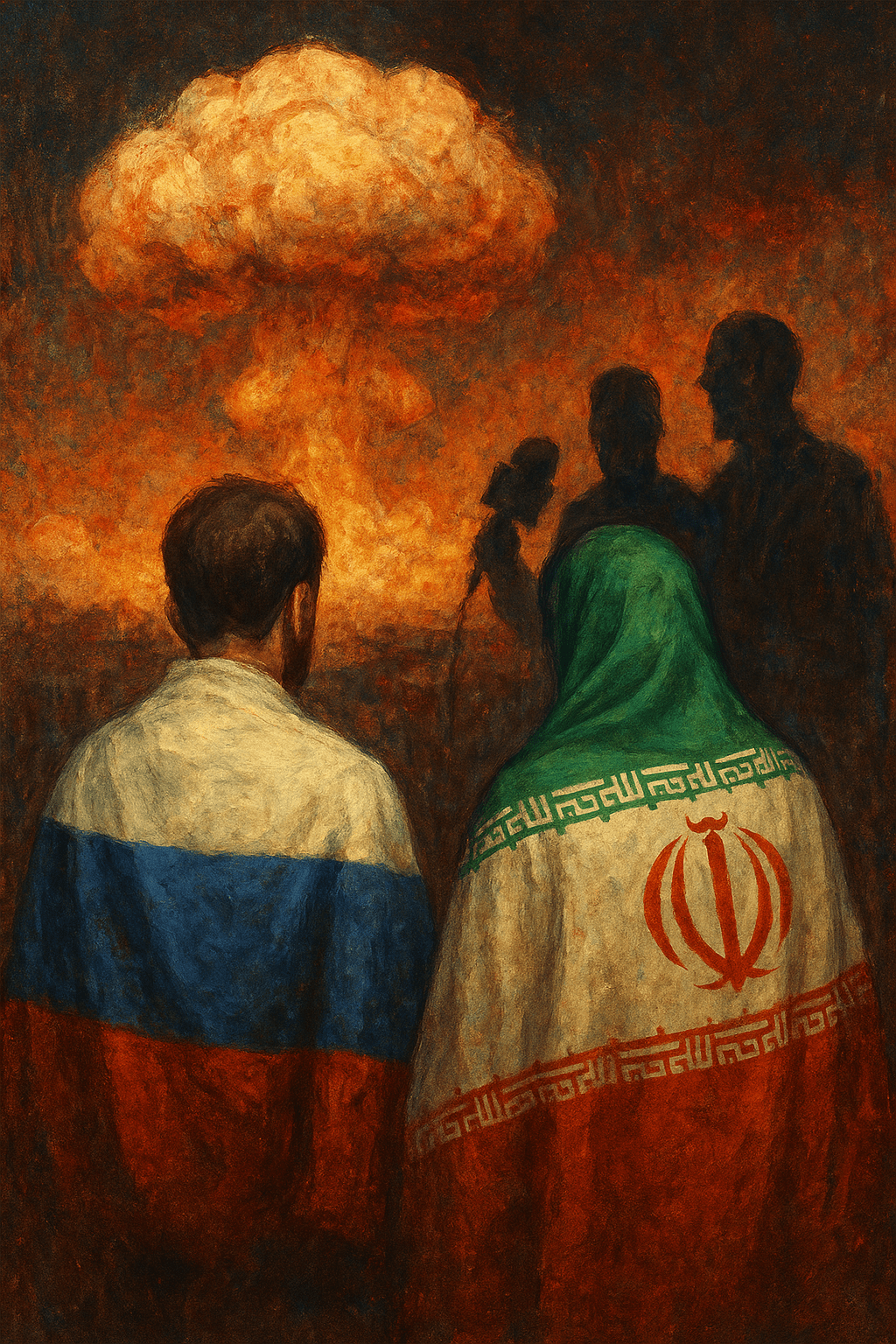
When propaganda is printed as journalism, and nuclear sovereignty is framed as provocation, the goal isn’t truth — it’s obedience.
By Prince Kapone | Weaponized Information | July 12, 2025
Anonymous Tongues, Imperial Scripts
On July 12, 2025, Axios published a story headlined “Putin urges Iran to take ‘zero enrichment’ nuclear deal with U.S., sources say,” which rattled the multipolar bloc. That phrase — sources say — ought to be printed in invisible ink, because what follows is less news than narrative engineering. Barak Ravid, the Israeli journalist behind the piece, offers no quotes, documents, or video clips — only a familiar quartet of “European and Israeli officials” alleged to know Putin’s private message to the Iranians. That’s not journalism. It’s espionage posing as a scoop.
Ravid’s credentials warrant scrutiny. He is a former diplomatic correspondent for Haaretz and Channel 13 News, served in the IDF’s Unit 8200 (signals intelligence), and currently contributes to CNN and Axios. His work consistently aligns with the Israeli security establishment and with Western think tanks like the Washington Institute for Near East Policy, a pro-Israel policy forum based in Washington, DC, as detailed in this Vanity Fair profile highlighting his intelligence background and close proximity to elite diplomatic circles.
Axios itself is no neutral platform. Initially funded by venture firms including Lerer Hippeau, Emerson Collective, NBCUniversal, and Greycroft, the outlet promotes a “smart brevity” model that prioritizes fast, repeatable narratives over investigative depth.
The article was quickly amplified by mainstream media and policy circles — cited by Reuters and CNN via Reuters (reporting on U.S. intelligence related to the issue), and echoed through briefing notes from the Atlantic Council and the Washington Institute (via Jerusalem Post coverage). These are not independent verifications but narrative harmonizations — designed to simulate consensus and mobilize diplomatic pressure.
The article relies on familiar tactics of imperial propaganda: anonymous sourcing, manufactured urgency, and strategic ambiguity. But it also deploys a subtler device — the orientalist frame. Iran is cast as irrational, emotional, and volatile — a trope common in Western narratives. Ravid describes Iran as “disappointed” and “mistrustful” of Russia without evidence, reducing geopolitical strategy to emotional drama. This is projection cloaked as news.
Then there’s the linguistic sleight of hand. Ravid writes “we know,” “Putin told,” “Russians have made clear.” But who is “we”? Who made it “clear”? Why does clarity always arrive in the shadows of anonymity? This is narrative ventriloquism — empire speaking through many tongues, but always with one voice. The goal is not to persuade with evidence, but to assert through repetition.
Finally, the piece performs a crucial ideological maneuver: it repositions Russia not as a besieged, sanctioned capitalist state outside the Western order, but as a willing subcontractor to empire. Amid rising multipolar alliances like BRICS+ and SCO, U.S. media seeks to fracture emerging solidarities. The Axios report is a calculated fracture, rolled out not with facts but with plausible deniability.
Behind the Leak: Facts Buried, Context Stripped, and Empire’s Long Memory
If Part I was the whisper campaign, then here we uncover the megaphone behind it. Axios claims — without evidence — that Russian President Vladimir Putin privately encouraged Iran to accept a “zero enrichment” nuclear deal with the United States. The article anchors this revelation in anonymous leaks from European and Israeli officials, but offers no documentation, no direct quotes, and no acknowledgement of conflicting public records. This is not an oversight. It is a strategy — one meant to disorient readers, frame Iran as diplomatically isolated, and portray Russia as shifting toward Western priorities. But when the fog lifts and we examine the material facts, the story begins to fall apart.
Public statements from Russian and Iranian officials directly contradict Axios’ central claim. On July 6, 2025, Russian Foreign Minister Sergey Lavrov met with Iranian FM Abbas Araqchi at the BRICS summit in Rio de Janeiro. Lavrov reaffirmed Russia’s “unwavering support for Iran’s right to peaceful nuclear development under the NPT,” and explicitly condemned any attempt to impose unilateral restrictions. This was covered by TASS, Russia’s official news agency and a principal state-aligned outlet that regularly communicates Kremlin foreign policy positions.
Days earlier, the Kremlin publicly denounced U.S. and Israeli strikes on Iran’s nuclear facilities. Kremlin spokesperson Dmitry Peskov stated that Russia would only remove enriched uranium from Iran “under a multilateral agreement and with full Iranian consent.” He also reaffirmed that Iran’s program remains “peaceful, verifiable, and within the bounds of IAEA regulations.” These remarks were reported in both Sputnik — another Russian state outlet — and Press TV, an Iranian news service closely aligned with the Islamic Republic’s foreign policy messaging.
Iranian outlets, too, have flatly rejected the Axios narrative. On July 12, Tasnim News — an Iranian news agency affiliated with the Islamic Revolutionary Guard Corps but frequently cited for official government positions — quoted an “informed source” close to the Iranian Foreign Ministry stating that “no such message from Putin was ever conveyed to Iranian officials.” That same day, Araqchi reiterated that “enrichment is non-negotiable,” adding that any demand for zero enrichment is “legally baseless and diplomatically dead on arrival.” These comments were later echoed by the Iranian delegation to the Shanghai Cooperation Organization meeting.
In fact, Iran formally warned the so-called EU3 — France, Germany, and Britain — not to reactivate the JCPOA snapback mechanism, emphasizing that its enrichment program is fully protected under Article IV of the Nuclear Non-Proliferation Treaty. That statement was also covered in Tasnim.
The broader historical record also exposes the Axios claim as dubious. Russia has not only consistently defended Iran’s nuclear rights but materially supported its development. Since the early 2000s, it has helped build and expand the Bushehr nuclear reactor, publicly resisted U.S. sanctions at the UN, and called out the West’s nuclear hypocrisy. These policies are reflected in detailed analysis from the Valdai Discussion Club, a Russian think tank that often reflects official strategic posture, which notes that Russia’s strategic partnership with Iran is based on “mutual defense of sovereign technological development” and deep cooperation within BRICS and the SCO.
That partnership continues to evolve. Following the Israeli strikes in June 2025, Iran and Russia intensified coordination on energy and scientific research — including plans for cooperative uranium conversion projects inside Iran. According to the China Global South Project, this alignment reflects broader multipolar resistance to U.S.-led technological containment, especially as Iran deepens ties with China, Russia, Venezuela, and South Africa.
In contrast, the United States withdrew from the JCPOA in 2018, reimposed devastating sanctions, and has continued to assassinate Iranian scientists and sabotage facilities with Israeli backing. These are not the actions of a good-faith negotiator. They are part of a long campaign to destroy Iran’s scientific sovereignty. And they stand in clear violation of international law — as reaffirmed by South Centre’s legal brief on unilateral sanctions and NPT violations, authored by a Geneva-based intergovernmental policy think tank of the Global South.
The Axios leak must be understood in this context: a media operation designed not to clarify Russia’s position, but to confuse and fracture. By falsely suggesting that Putin is now pressuring Iran to disarm, the article tries to present U.S. demands as internationally supported — even as the Global South resists them. It’s not a scoop. It’s a wedge. And it collapses the moment the record is held up against the rhetoric.
Enrichment and Empire: The Right to Build, the Threat to Obey
Strip away the spin, and what’s left is not a diplomatic misunderstanding — it’s a line of fire drawn through the Global South’s right to develop. Iran’s enrichment program isn’t just about uranium. It’s about sovereignty, self-determination, and the refusal to beg for technological permission slips. The so-called “zero enrichment” proposal isn’t a peace deal. It’s a leash. One that says: you may exist, but only on our terms.
Axios dresses this demand in neutral language, as if it were a fair compromise. But that’s the trick. The demand itself is imperial — born not of dialogue, but of domination. The U.S., Britain, France, and Israel — all nuclear powers — dictate terms to states like Iran, who are told to dismantle even peaceful infrastructure. This is how Nuclear Apartheid functions: some states inherit the atom, others inherit the inspectors.
And make no mistake — this system isn’t enforced with treaties alone. It’s backed by sanctions, sabotage, and assassinations. It’s enforced when scientists are murdered on Tehran’s streets. When centrifuges are infected with malware. When fuel contracts are blocked, and medical isotopes are denied. This isn’t nonproliferation. It’s a siege. And the machinery behind it is what we call the Sanctions Architecture — a transnational enforcement regime that makes research itself a crime.
This is how empire manages the contradiction of the postcolonial world: you’re free to vote, free to sign agreements, free to exist — but not free to build. And if you try, you’ll find that every reactor is a threat, every laboratory a “potential weapons site,” and every attempt to control your own future a diplomatic offense. Iran’s sin isn’t defiance. It’s memory — the memory of what happened to Mossadegh in 1953, to its scientists in 2010, and to its economy in every round of so-called negotiations.
The Axios article didn’t just distort a private meeting — it helped advance a long-standing doctrine: that no Global South state has the right to autonomous scientific development. And that if one tries — whether it’s Iran in nuclear research, Cuba in biotech, or Venezuela in refining its own oil — they will be labeled unstable, dangerous, illegitimate. In South Africa, it wasn’t until the apartheid state fell that the Western powers insisted nuclear disarmament was a condition of reintegration — not because of peace, but because of control.
These aren’t just ideological lines. They are economic battlefronts. Iran’s effort to develop a full nuclear fuel cycle threatens the profit chains of companies like Siemens and Rosatom, who serve as imperial gatekeepers — controlling access to reactors, fuel, parts, and even insurance. As noted by the U.S. State Department in February 2006: “If you have Iran pursuing a complete nuclear fuel cycle, … it puts a goodly part of the nuclear fuel cycle outside of the control of whoever’s providing the reactor and the fuel.” These firms don’t just sell equipment. They enforce dependency. And when Iran sidesteps them through deals with Russia, China, or South Africa, the façade of neutrality collapses. The atom becomes colonial again.
As Oxford University’s analysis on scientific apartheid shows, this pattern isn’t new. Scientific apartheid — enforced through contracts, sanctions, and sabotage — is how imperialism disciplines knowledge. Who builds, who teaches, who controls the lab — these are questions of class, not just policy.
The story Axios tried to sell was that Russia is turning, Iran is isolated, and the U.S. is the only adult left in the room. But here’s what they won’t say out loud: the multipolar world is growing, not retreating. Iran isn’t begging. It’s building. And it’s doing so through trade corridors, BRICS+ integration, regional fuel banks, and cooperative R&D — not because it trusts the system, but because it’s helping build the next one.
That’s what makes this moment dangerous — not to peace, but to empire. The post-1945 order was designed to contain development, not to liberate it. But now, states like Iran are asserting a new principle: Technological Sovereignty. The right to build, refine, and research without needing imperial approval. The right to make medicine, power homes, educate scientists — and do it all without begging the World Bank or Western firms for permission.
Axios didn’t publish a scoop. It floated a test balloon — to see if the empire’s narrative still holds weight. But the material reality says otherwise. This isn’t a fracture. It’s a recalibration of power. And every lab built outside their control is one step closer to the end of empire’s monopoly on the future.
Solidarity Means Infrastructure: Fighting Empire from Inside the Core
Iran doesn’t need pity. It doesn’t need saviors. It needs space — space to build, to breathe, to decide. What it faces isn’t a “nuclear crisis.” It’s a structural blockade on sovereign development. And that blockade is enforced not from Tehran or Moscow, but from Brussels, Washington, and Silicon Valley. If we in the imperial core are serious about breaking this siege, then solidarity must move from sentiment to structure — from slogans to systems.
First, we defend the multipolar circuits already under construction. As Iran expands ties with BRICS+ and the Shanghai Cooperation Organization, it is laying the groundwork for a world beyond dollar dependency — barter networks, regional banks, nuclear cooperation, energy swaps. These aren’t symbolic. They’re infrastructure. And empire knows it. That’s why its amplifiers — from Axios to Atlantic Council — work overtime to fracture those circuits with leaks and lies.
That means naming and confronting the gatekeepers. Corporations like Rosatom and Siemens pose as neutral technology providers, but they operate as choke points — embedding dependency into reactor deals, enforcing inspection regimes, and tethering sovereign states to Western-controlled arbitration mechanisms. A coordinated campaign — modeled after the BDS Movement — should target these firms through public divestment calls, direct action, and academic boycott. Name them. Shame them. Break the illusion of neutrality. This is the logic of Nuclear Apartheid — and it cannot be dismantled politely.
Second, we fund technological resistance. This means supporting Iranian scientists, researchers, and engineers working under blockade or in exile. But don’t route funds through NGOs or embassies. Build trust-based circuits. Use platforms like GoFundMe or OpenCollective to crowdfund equipment for isotope production or clean energy labs. Translate technical documents into Farsi. Partner with diaspora-led science networks and engineering unions. Mutual aid isn’t charity — it’s how we build Dual and Contending Power in the realm of knowledge production.
Third, we archive the lies. The war on Iran’s development has always been a war of headlines — from the “hostage crisis” to “weapons inspectors” to “shadow wars” and “nuclear alarms.” We need a public, searchable disinformation archive — hosted on GitHub, with source-indexed entries, timeline tracking, and amplifier tags. Let users trace how each hoax evolved, who repeated it, and what policy followed. Accept anonymous submissions through ProtonMail. Use it to build narrative counterforce — not just for Iran, but for every Global South state that empire targets through media war.
Fourth, we fight on the ideological front. Organize study circles, teach-ins, and workshops that demystify the nuclear issue. Not as a technical arms-control debate — but as a colonial one. Who decides what technologies a people may develop? Why are some states told to disarm before they ever develop capacity? Ground the conversation in cases like Iran, Iraq, Libya, Cuba, and South Africa. Frame it through the history of sabotage, sanctions, and selective permission. Partner with grassroots groups like CODEPINK, student unions, or library collectives. Make the concept of Technological Sovereignty a public, political conversation. Turn knowledge into a weapon.
Finally, learn from past infrastructure of resistance. Groups like the Venceremos Brigade built solidarity not with statements, but with bodies — on buses to Cuba, in sugarcane fields, in hospitals, in science labs. We must organize with the same clarity and purpose. Because the Global South is not waiting. It is already building a world that works without empire. The only question is whether we will help clear the path — or remain in the way.
We are not spectators. We are wired into the architecture of empire — its banks, its media circuits, its networks of denial. But that also means we’re close to the nodes where rupture is possible. If we move with discipline, imagination, and strategy, the damage Axios tried to do with a headline can be reversed — not with a hashtag, but with an actual movement. That’s what solidarity means in the age of sanctions and sabotage: to be useful, to be organized, and to build infrastructure the empire can’t bomb.
 Weaponized Information
Leave a comment