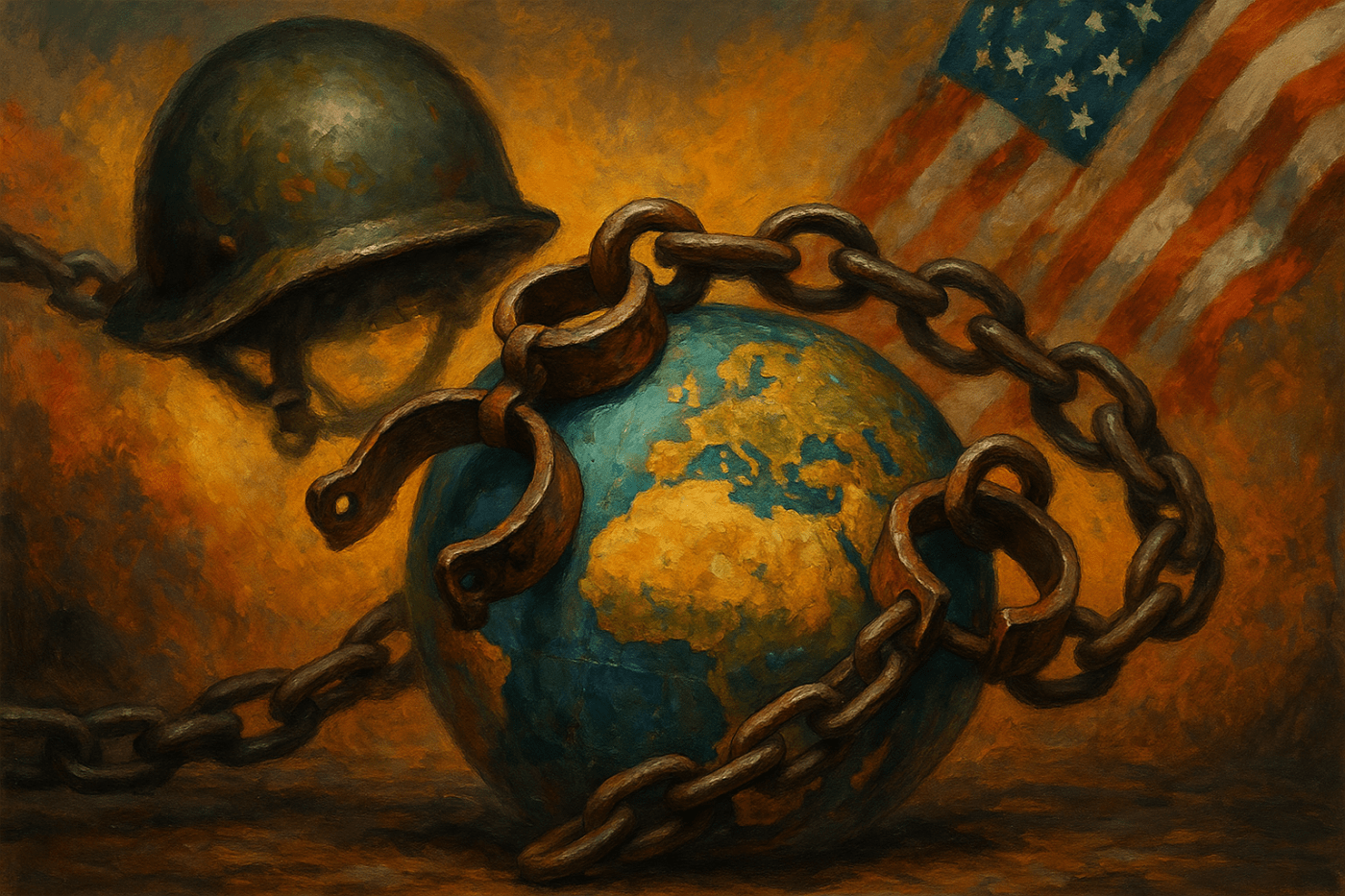
Reuters’ latest smear piece on Russia’s Glavprodukt isn’t journalism—it’s financial warfare disguised as reporting, written to delegitimize multipolar sovereignty and defend imperial property norms.
By Prince Kapone | Weaponized Information | July 11, 2025
Empire’s Canned Narrative
On July 10, 2025, Reuters published a short dispatch that, on its face, looks like business news: a U.S.-founded food company operating in Russia was seized by the Kremlin in late 2024, and is now exporting to China and North Korea. But this isn’t about canned goods or logistics. This is narrative warfare—an attempt to discipline readers into seeing Russian economic agency as instability, and multipolar trade as deviance. Through calculated omissions, ideological framing, and Cold War-era tropes, the article recycles an old imperial lesson: when the West can’t extract, it declares theft.
The authors, Anna Hirtenstein and Alexander Marrow, are not neutral observers. Hirtenstein, formerly with the Wall Street Journal, now reports on global markets for investors across Western finance. Marrow, stationed in Moscow, serves as Reuters’ conduit between Russian events and Anglo-American capital, interpreting developments through a lens shaped by corporate priorities and Western state-aligned information networks. They are not rogue reporters—they are functionaries within an imperial media apparatus that packages disruption as disorder and sovereignty as risk.
Reuters itself is no detached newswire. It is a division of Thomson Reuters, a Canadian multinational owned by the billionaire Thomson family, with deep ties to global finance, law, and government contracting. Its institutional clients include hedge funds, Western-aligned think tanks such as the Atlantic Council, whose funding sources include NATO and the U.S. State Department, and various state entities. According to a 2024 company report, its AI-driven data services are marketed directly to central banks, military contractors, and legal risk management firms. In practice, Reuters functions as an information syndicate for the Western ruling class—a mechanism for signaling threat, enforcing consensus, and managing perception on behalf of capital.
This particular narrative was rapidly amplified. The U.S. State Department was forced to address the case after a Reuters investigation revealed that Moscow intended to use Glavprodukt—an American-owned canned food firm seized in October 2024—to supply the Russian military. A letter reviewed by Reuters confirmed the company’s planned role in feeding the national guard and defense ministry, prompting Secretary of State Marco Rubio to declare the matter a priority in U.S.–Russia talks. The Atlantic Council’s Eurasia Center republished the article in its daily digest with commentary warning of “authoritarian commercial practices.” These amplifiers don’t simply inform—they discipline. They reinforce a core ideological claim: property is only legitimate when aligned with U.S. interests.
The propaganda structure hinges on framing inversion: the seizure of Glavprodukt is presented not as a state act of economic reorganization, but as a business disruption. The central figure, U.S.-based businessman Leonid Smirnov, is cast as a tragic capitalist—betrayed by a state that defies market logic. Readers are guided to grieve the “loss” of his enterprise, as if private property rights in a sanctioned nation remain sacred under global siege.
This is reinforced by selective omission. There is no mention of reciprocal measures, no context on foreign asset seizures, no legal grounding cited. In this vacuum, state intervention appears irrational by default—and that perceived irrationality then serves to legitimize further sanctions, isolation, and financial warfare.
The article relies on emotional manipulation: it details delayed shipments, declining sales, and unanswered emails to imply dysfunction. These are not forensic facts—they are mood cues, deployed to evoke disorder and opacity. In Western media, such terms are repeatedly applied to any state operating outside U.S.-controlled supply chains.
It also performs a cognitive reversal: by noting that Glavprodukt now exports food abroad, the article insinuates that its initial seizure for “food security” was invalid. This logic erases the broader function of sovereign provisioning—which can include strategic exports, military logistics, and food diplomacy—and narrows food security to a nationalist consumer framework that conveniently ignores war economies and siege conditions.
Finally, the article closes with a Cold War revivalist trope: Russia and North Korea are named in the same breath—not as trade partners, but as code for authoritarian contagion. This pairing is meant to signal deviation, danger, and disorder. The goal isn’t to inform readers about supply routes—it’s to trigger affective cues: isolation, illegitimacy, and disobedience.
What emerges is not journalism, but narrative engineering: U.S. capital is framed as rightful, Russian sovereignty as menacing, and non-Western trade as criminal. Reuters doesn’t need to prove this—only to imply it. That is the function of empire’s media architecture. And like all architecture, it rests on colonial foundations: the idea that only the West has the right to own, to define theft, or to decide who eats.
The Facts They Erased to Make Theft Seem Surprising
Reuters told you that a U.S.-founded company was seized by Russia, and now sells food to China and North Korea. What it didn’t tell you is why that happened—or what was done to Russia long before that seizure ever occurred. This isn’t an oversight. Imperial journalism always hides the first blow. It waits until the Global South responds, then calls it aggression. So let’s lay out what’s missing—starting with what even Reuters had to admit.
Here are the verifiable claims drawn directly from the article:
- Glavprodukt, Russia’s largest canned food producer, was seized by the Kremlin in October 2024 under the justification of national food security.
- The company was founded and owned by U.S.-based businessman Leonid Smirnov.
- Since the seizure, domestic sales have declined, leading to a shift toward exports to China, North Korea, the Middle East, Africa, and South Asia.
- The new management has begun expanding warehouse capacity and e-commerce distribution.
- Smirnov is contesting the seizure in the Moscow Court of Arbitration as of July 2025.
- Internal documents suggest the Ministry of Agriculture expressed concern about sales performance in early summer 2025.
Here’s what Reuters left out: In 2022, the U.S. and European Union froze around $300 billion in Russian central bank reserves—legally held sovereign funds. This was not a spontaneous reaction to war. It was the culmination of a decades-long economic offensive, beginning with NATO expansion and escalating after the 2014 Crimean referendum. Glavprodukt’s seizure was not arbitrary. It was a strategic act of economic reciprocity under blockade.
Russia’s legal justification for the move is grounded in Federal Law 127‑FZ on Insolvency and External Management. This law allows the state to assume temporary control over foreign‑owned companies deemed vital to national security. It has been used in other high‑profile cases, including the effective nationalization of Carlsberg’s Russian operations and Danone’s Russian operations in 2023. Yet Reuters omits this legal foundation entirely, leaving readers with the impression that the act was spontaneous or unlawful.
There is also no mention that Glavprodukt had been listed in multiple Russian food logistics plans as a critical node in the state’s emergency provisioning infrastructure—serving disaster relief, civil reserve stockpiles, and military rations. According to economic analysts cited in Reuters, the company was operating at stable output levels and was repositioned, not collapsed. The pivot to exports was part of a planned reorientation.
Glavprodukt’s new trade routes are also left unexamined. By mid‑2025, Russia–China agricultural exports had risen around 20–22 % year‑on‑year, with processed foods, meat and dairy increasingly entering the Chinese market. Russia now exports processed food, grain, and canned goods via the China–Kazakhstan–Iran rail corridor (the “Middle Corridor”), bypassing Western-controlled chokepoints – the New Land Grain Corridor initiative. North Korea—operating under barter arrangements through the Rason SEZ, Rajin port, and Far East land routes—has quietly expanded food logistics cooperation with Russia via Rason zone rail links and is building a new road bridge to Russia to facilitate greater trade. These are not shadow transactions. They are public infrastructure shifts in an emerging trade ecosystem.
None of this is unprecedented. When Venezuela nationalized Citgo, it was called theft. When Iran retook its oil platforms, it was called extremism. When Libya tried to sell oil in currencies other than dollars, it was invaded. But when Russia reclaims a domestic food company in the middle of a global economic war, Reuters calls it unpredictable. What links these cases is not chaos—it’s colonial continuity.
Meanwhile, Western expropriations are treated as normal. The U.S. froze Afghanistan’s central bank reserves and redirected them without public process. Britain still holds Venezuelan gold reserves in the Bank of England, denying their return. These seizures are portrayed as measured responses. But when non-aligned states do the same, it becomes a scandal.
Concurrently, Russia has expanded its food diplomacy across Africa. In February 2024, it delivered 25,000 tonnes of free grain each to Mali, Burkina Faso, and Zimbabwe—part of a wider 200,000-tonne initiative aimed at circumventing Western-dominated food logistics. Meanwhile, Reuters reports that Glavprodukt—now under Russian state control—is actively pivoting toward export markets in Africa, as well as China, North Korea, the Middle East, and South Asia, to manage domestic oversupply and sustain production. While specific deals for processed meats or dairy concentrates have not been confirmed, the export strategy aligns with Russia’s broader reorientation of food trade under sanctions.
As the Tricontinental Institute explains in its 2024 report on food sovereignty, “the global sanctions regime creates artificial scarcities by weaponizing ports, logistics, and finance against sovereign provisioning.” In this context, the seizure of Glavprodukt is not chaos—it is coherence. It is what happens when a country reroutes its survival architecture away from colonial choke points and toward mutual security. Reuters didn’t forget these facts. It buried them.
Against the Empire’s Ledger: Reclaiming the Right to Seize
If the facts show that Russia’s seizure of Glavprodukt was legal, reciprocal, and embedded within a broader strategy of national survival, then the question isn’t whether the action was lawful. The real question is: whose sovereignty counts, and whose property is sacred? Reuters has already answered this. The West seizes to “stabilize markets.” The rest of the world seizes out of desperation. But when we shift the lens—when we center the sanctioned, the plundered, the excluded—we see something else: not crisis, but clarity. Not collapse, but coordination.
This is a textbook case of Multipolar Recalibration—a structural adjustment, not of budgets, but of global power. As the U.S.-led unipolar system fragments, former subordinate states like Russia are no longer willing to sacrifice internal provisioning for investor confidence. The seizure of Glavprodukt is not the return of autarky. It is the refusal to remain a colony within capitalism. As the rules of imperial finance shift—from SWIFT lockouts to reserve theft to sanctions on food logistics—Russia is adapting by asserting strategic control over its domestic supply chains. This is not a glitch in the system. It is the system adjusting to its own contradictions.
At the center of these contradictions is the Sanctions Architecture—a global regime of economic warfare designed to discipline autonomy. As the Tricontinental Institute writes in its 2024 report on food sovereignty and sanctions, this architecture “uses legality to mask expropriation and starvation to enforce order.” The $300 billion stolen from Russia’s central bank was not a policy error. It was a signal: no disobedience will be tolerated. Glavprodukt’s seizure was a signal in return. When the empire privatizes food, resistance must nationalize it.
This is also an example of what Vijay Prashad calls Anti-Imperialist Sovereignty: not a pure rejection of global capitalism, but a tactical assertion of self-determination under siege. Russia is not socialist. But its pivot toward barter trade with North Korea, export provisioning to Africa, and corridor-building with China signals a break with imperial hierarchy. As Prashad argues in The Darker Nations, sovereignty is not the absence of contradiction—it is the struggle for autonomy inside contradiction. Glavprodukt is not a revolution, but it is rupture. It is what happens when logistics are rerouted from Wall Street to Addis Ababa.
Western analysts will still cry foul: “This isn’t fair,” “This isn’t transparent.” But these same voices said nothing when Venezuela’s gold was held hostage, when Libya was destroyed for its monetary policy, or when Afghanistan’s central bank was carved up like war booty. Their problem is not with seizure—it’s with the wrong people doing the seizing.
As Samir Amin wrote in Unequal Development, imperialism doesn’t just extract—it criminalizes the refusal to be extracted from. That’s the deeper story here. The empire is not panicking because it lost a canned food company. It’s panicking because a node in its food logistics web defected—and joined a rival infrastructure being built from Beijing to Bamako.
Glavprodukt is not the disease—it’s a symptom of empire’s unraveling center. And its seizure shows us what becomes possible when the periphery stops acting like the periphery. It doesn’t mean Russia is building socialism. But it does mean the monopoly on ownership is breaking. And when that monopoly breaks, everything else—food, trade, sovereignty—can begin to move.
We Don’t Need Permission to Stand with the Seizers
When the empire calls national sovereignty “theft,” our job is not to debate—it’s to organize. Russia’s seizure of Glavprodukt is not an outlier; it is a frontline in an international conflict that stretches from Caracas to Harare to Gaza. It is a reminder that imperialism does not only bomb—it starves, it blocks ports, it freezes funds, it cuts off trade, and then demands that the hungry remain polite. And when the sanctioned, the blockaded, the besieged respond with seizures and rerouted supply chains? That’s when the propaganda kicks in. But we know the truth. What they call theft is survival. What they call chaos is coordination. What they call instability is sovereignty clawing its way back.
We declare our solidarity with the working class in Russia—not out of nationalism, but because they labor in factories that no longer feed Wall Street. We stand with the drivers loading shipments to China and Africa, the plant workers packaging shelf-stable goods, and the warehouse clerks restocking wartime reserves. And we stand with those labeled “rogue states” by Western media—North Korea, Burkina Faso, Iran—not because they are perfect, but because they are targeted. Their resistance is ours.
In July 2025, Russia signed new long-term food contracts at the BRICS+ Food Sovereignty Forum in Addis Ababa. According to reports, Zimbabwe announced a trilateral food agreement with Russia and Belarus to bypass U.S.-dominated grain markets. Mali and Burkina Faso soon followed, securing overland supply routes for Russian food through Algeria. These are not diplomatic gestures. They are ruptures—material breaks in empire’s food logistics. Glavprodukt, with its cans of meat and condensed milk, now circulates within an infrastructure of refusal. That’s why they’re panicking.
In the imperial core, our task is not to merely applaud these ruptures from afar. It is to build Dual and Contending Power—structures of solidarity, sabotage, and survival that challenge empire’s legitimacy from within. Here’s how:
1. Demand the Return of Stolen Assets
Launch a public campaign for the return of Russia’s $300 billion in frozen reserves, looted by the U.S. and EU. Use the slogan #ReturnWhatYouStole. Draw on the tactics of the BDS movement—teach-ins, coordinated actions, digital pressure campaigns—and target institutions like the U.S. Treasury and Bank for International Settlements. This isn’t a defense of any state. It’s a rejection of imperial robbery dressed up as policy.
2. Fund South–South Food Sovereignty Projects
Build direct material support for agricultural and food logistics cooperatives aligned with multipolar partners. Use platforms like Mutual Aid Disaster Relief to connect funds or tools to peasant unions in Mali or transport cooperatives in Zimbabwe. As Via Campesina has shown, transnational food sovereignty can be both material and militant.
3. Launch a Sanctions Theft Map
Build a digital archive tracking every major seizure of Global South assets by imperial states—Venezuelan gold, Afghan reserves, Libyan wealth, Iranian tankers, Russian infrastructure. Make it searchable by country, commodity, and institution. This is counter-narrative infrastructure. It’s what the Zapatistas once called “memory as resistance.” Use open-source mapping tools and partner with anti-sanctions networks like #SanctionsKill to expand reach. This is Dual and Contending Power in digital form.
4. Develop a Political Education Curriculum on Economic Warfare
Create a teach-in series titled Sovereignty Under Siege: Sanctions, Seizures, and the Fight to Eat. Focus on food logistics, port sovereignty, multipolar trade, and imperial blockade strategies. Base it in radical bookstores, union halls, libraries, and online spaces. Let Glavprodukt be the case study. Connect it to lived realities—rising food costs, empty shelves, IMF austerity. Turn analysis into consciousness. Turn consciousness into strategy.
None of this requires loyalty to Moscow. But it does require defection from empire. It requires rejecting the idea that only Western capital has the right to own, seize, or define legality. It requires standing with the seizers—not because they are saints, but because they refuse to starve quietly. As long as we live in the belly of the beast, our duty is not neutrality. It is alignment. Not later. Now.
 Weaponized Information
Leave a comment