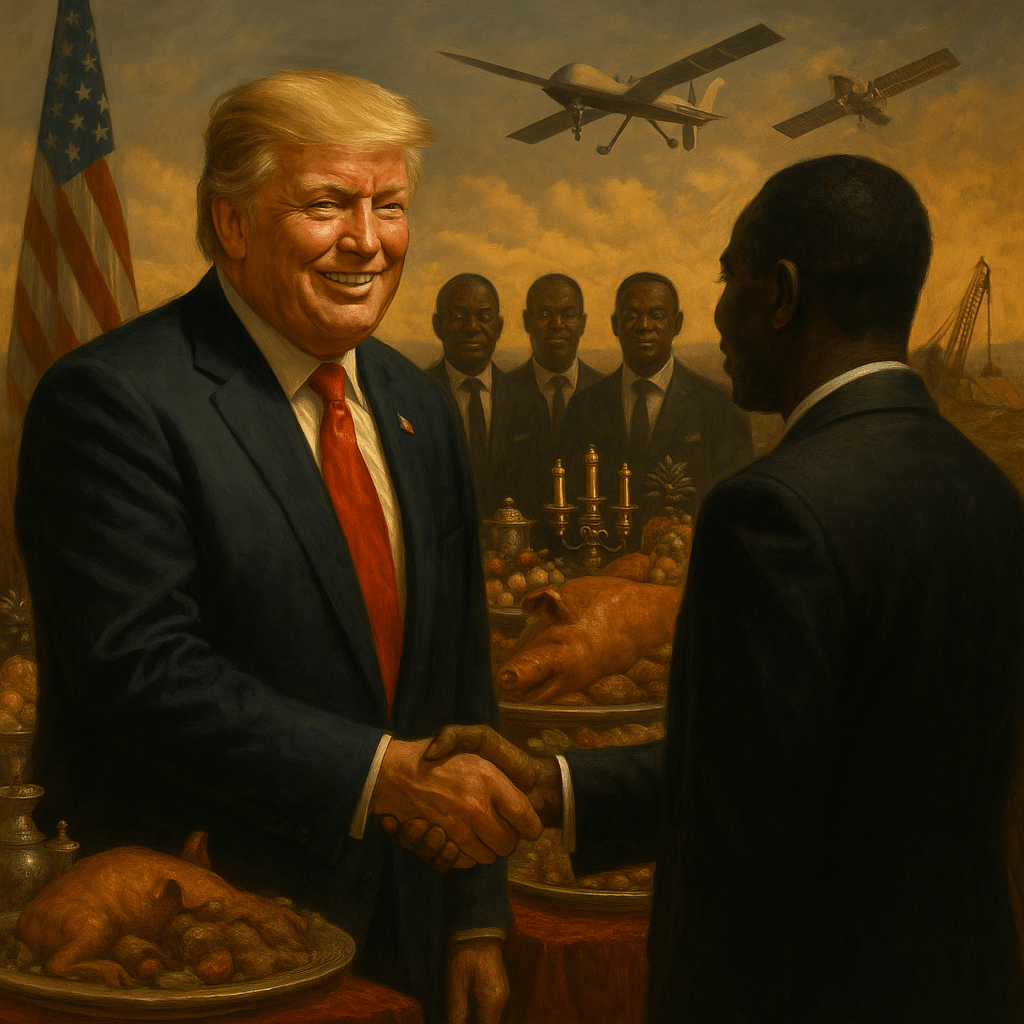
This wasn’t aid or trade. It was imperialist recalibration—Trump’s empire tightening the screws with spreadsheets, satellites, and handshakes.
By Prince Kapone | Weaponized Information | July 10, 2025
Tuxedos and Trade Deals: The New Language of Looting
The imperial press has always known how to dress a wolf in a tuxedo. And so, when NPR’s Jewel Bright reported on Donald Trump’s three-day “mini summit” with five West African heads of state, we got all charm and no chains. The article, published July 9, 2025, casts the summit as a diplomatic triumph: deepening “commercial opportunities,” pivoting “from aid to trade,” and winning African applause for Trump’s leadership—and, bizarrely, his golf game. But beneath the diplomatic linen lies a familiar script: a U.S. president praising Africa’s “great minerals” while quietly brokering new coercive frameworks for control.
Bright’s narrative serves up this summit as a rational reimagining of U.S.-Africa relations, but never once asks what’s being traded, who’s doing the trading, or what happens when “aid” is yanked away as punishment. Her framing suggests sustainable prosperity, but her omissions are glaring: no mention of AFRICOM’s recent expulsion from the Sahel, no discussion of how IMF-imposed austerity gutted public services across West Africa, no context for the historical looting of African resources. Instead, we get Trump’s claim that Africa is full of “anger” and that he’s helped “solve a lot of it.” Bright lets it pass unchallenged.
The emotional scaffolding of the article is built on spectacle. African leaders praise Trump’s “vision,” joke about his golf swing, and even suggest he deserves a Nobel Peace Prize. Bright presents these scenes as harmless pageantry, but this too is a form of emotional manipulation. It manufactures the illusion of mutual respect while hiding the reality of economic subordination and dependency. No mention is made of the power imbalance behind the smiles.
The article also engages in false equivalence—equating a U.S.-brokered “peace deal” between the DRC and Rwanda with regional stability, when in reality it functions as a precondition for rare earth mineral access. By presenting peace as apolitical calm, Bright normalizes U.S. involvement while obscuring its extractive motives.
Trump’s announcement that his administration is making progress on “safe third country agreements” with all five attending nations is reported with the neutrality of a press release. No explanation is offered that these deals are designed to turn African states into detention hubs for migrants fleeing crises rooted in imperial policy. This is cognitive warfare in action—laundering repression through bureaucratic jargon.
Bright’s past reporting—from her 2023 NPR piece on USAID’s biometric rollout in Ethiopia, which framed the program as “empowering” without mentioning surveillance or coercive data regimes— to her 2025 article on the Lagos evictions, which portrayed violent dispossession as a local governance failure while omitting the imperialist forces driving real estate gentrification,
shows consistent loyalty to the soft-power apparatus of U.S. empire.
The article’s narrative is reinforced by key amplifiers. Cameron Hudson of the Center for Strategic and International Studies (CSIS)—a Beltway think tank bankrolled by Raytheon and ExxonMobil—warns about Chinese naval ambitions in Gabon, implying U.S. intervention is necessary. Prof. David Okoye of Nigeria’s Niger Delta University echoes the transactional logic, saying “Trump wants to know what these nations can offer.” Their inclusion grants elite approval to Trump’s summit while framing it as a sober response to Chinese influence.
NPR’s institutional role should surprise no one. Funded in part by the Corporation for Public Broadcasting, the Ford Foundation, and weapons contractors like Lockheed Martin, NPR speaks in calm, calibrated tones—but always in service of U.S. global power. It sanitizes coups, frames austerity as reform, and presents extraction as modernization. It is empire in a reusable tote bag.
Crucially, Bright’s article engages in agenda-setting—highlighting Trump’s trade rhetoric while ignoring the broader geopolitical context: declining U.S. military presence, BRICS realignments, and Global South resistance. The framing isn’t just biased—it directs public consciousness away from empire’s crisis and toward a manufactured sense of benevolent leadership.
And finally, we see narrative laundering at work. Trump’s role in brokering the DRC-Rwanda mineral deal is described as peacemaking, completely detached from the known U.S. interest in cobalt and coltan. By scrubbing the material basis of these “diplomatic” wins, the article converts imperial maneuvering into high-minded internationalism.
The leaders who weren’t invited—Nigeria, Ethiopia, South Africa, Ghana—are barely mentioned, and their economic realignment through BRICS+ is omitted entirely. This exclusion wasn’t diplomatic oversight—it was strategic signaling. The U.S. wants obedient subcontractors, not sovereign equals. The nations who showed up were there to be screened, not courted.
In the end, Bright’s reporting doesn’t illuminate. It obscures. It smooths over contradictions, strips imperialism of its teeth, and presents power as partnership. This isn’t journalism—it’s public relations wrapped in press credentials. And Trump’s summit wasn’t a pivot to prosperity. It was a rollout of new subcontracting terms, repackaged in the language of respect. A colonial buffet with better lighting.
The Silence Between the Flashbulbs: What the Article Doesn’t Tell You
Once the photo-ops fade and the press pool packs up, all that’s left is silence—the silence between the flashbulbs, where the real story lives. Jewel Bright’s NPR write-up on Trump’s summit may appear thorough, but what it omits is precisely what matters: the history, the casualties, the power plays behind the curtain. Like all effective propaganda, its power lies not in blatant lies but in what’s left unsaid.
The article outlines the basic facts: Trump hosted a summit with the presidents of Senegal, Liberia, Guinea-Bissau, Mauritania, and Gabon. He praised the continent’s “very valuable lands” and “great minerals,” and announced a pivot from “aid to trade.” He floated vague claims about solving conflict in places like Sudan and Libya and referenced so-called “safe third country agreements” with the visiting leaders. The article also mentions Liberia’s USAID cutoff and the exclusion of Nigeria, South Africa, Ethiopia, and Ghana from the invite list.
Take Trump’s offhand reference to “safe third country agreements.” NPR repeats the phrase without explanation, as if it were an ordinary piece of diplomatic furniture. In reality, these agreements are a tool to outsource U.S. border violence, forcing African and other nations to detain and warehouse asylum seekers the U.S. doesn’t want. According to the International Organization for Migration, this “externalization” policy has created sprawling migrant containment zones, often under military supervision. While Section I noted the rhetorical framing, here we confront the machinery itself: a system of subcontracted repression designed in Washington and deployed in Dakar.
The omission of Liberia’s dependency is equally glaring. While the article mentions the USAID cuts, it fails to explain that U.S. aid accounted for nearly 2.6% of Liberia’s gross national income—the highest of any country globally. This dependency underscores the immense economic leverage wielded by the U.S. and the profound impact of aid withdrawal. When Trump shut off the spigot, the impact was immediate and devastating. more than 10,000 pregnant women lost access to prenatal care in just three months. According to that same report, some mothers walked ten miles to reach shuttered clinics; others delivered at home without midwives, antibiotics, or basic sanitation. NPR calls this a policy shift. In reality, it was a calculated act of economic asphyxiation—imperial punishment for stepping out of line.
Equally absent is the truth behind the so-called “peace deal” between Rwanda and the DRC. NPR mentions it only in passing, but this diplomatic stunt was timed perfectly with new U.S. and EU contracts to extract coltan, cobalt, and lithium from eastern Congo—minerals essential to smartphones, AI weapons systems, and electric vehicles. And while diplomats shook hands, workers like 17-year-old Jean were digging barefoot in open-pit mines for less than $2 a day. According to a 2021 report on private security firms in eastern DRC, these companies routinely beat, extort, and detain Congolese miners—while multinational corporations post record quarterly profits. This isn’t “post-conflict development.” It’s organized looting, blessed by foreign dignitaries and enforced with guns.
Then there’s the geopolitical bait-and-switch. NPR notes the absence of Nigeria, South Africa, Ethiopia, and Ghana but offers no explanation. The real reason is simple: these are the African countries most aligned with the emerging multipolar order. All four are actively engaged with BRICS+ and have advocated for dedollarization, regional currency blocs, and sovereign financing mechanisms. The African Union itself has declared a “strategic shift toward multilateral balance,” endorsing deeper integration with South–South partners. In other words: they were not invited because they are no longer compliant. The empire does not negotiate with defectors—it isolates them.
Meanwhile, in the Sahel, the silence gets even louder. Mali, Niger, and Burkina Faso have expelled U.S. and French troops and formed the Alliance of Sahel States—a revolutionary rupture with the neocolonial order. But you won’t hear that in Bright’s article. There’s no mention of the 10,000-strong protest in Niamey, led by grassroots organizer Aisha Issoufou, chanting “Down with imperialism, up with sovereignty.” No mention of the new Sahelian security pact that rejects AFRICOM and builds cross-border food and energy cooperation without IMF strings. For NPR, that story doesn’t exist. When Black people fight for power, the microphones turn off.
The contradiction at the heart of the summit is this: it posed as a gathering of equals but functioned as a loyalty test. The invited leaders came not to co-create a new order, but to preserve their seat at the old one. They were offered no reparations, no restructuring—just the conditional promise of being allowed to remain useful. Those who declined to attend were not forgotten. They were targeted.
This is the silence between the flashbulbs. No tanks. No missiles. Just closed clinics, looted mines, detained migrants, and canceled aid budgets. It is a quieter kind of war—but war all the same. And every paragraph left unwritten is part of the arsenal.
Welcome to the Open-Air Auction Block: Reframing the Summit as Technofascist Realignment
Let’s strip away the pleasantries and call this summit what it was: a marketplace for managed sovereignty. Five heads of state arrived at the White House not to negotiate, but to be appraised. The meeting was less diplomacy, more showroom—a transactional exchange where minerals were the currency, migration control was the bargaining chip, and U.S. recognition was the prize. Behind the handshakes and headlines lies a desperate empire attempting to recalibrate its grip on a continent slipping from its grasp. This isn’t a pivot from aid to trade. This is theft dressed as invitation.
The real story here is not about diplomacy, but about imperialist recalibration—a strategic shift by the U.S. empire away from soft-power façades and toward overt technofascist control. As Weaponized Information exposed, Trump’s second-term policy toward Africa isn’t isolationism. It’s consolidation. Diplomatic missions are closing, but military outposts and venture capital channels are expanding. Gone is the language of partnership; what remains is AFRICOM, mining contracts, and Starlink-enabled surveillance.
Trump’s announcement of “aid to trade” isn’t modernization—it’s a transition to discipline. Aid once pretended to be humanitarian. Trade now functions as coercion. Infrastructure deals, mineral rights, and migration control are bundled into a new system of resource capture. This is technofascism: the fusion of corporate finance, surveillance systems, and militarized state power to suppress dissent and enforce extraction. It doesn’t need diplomats. It needs drones, ports, and data pipelines.
This shift is not accidental—it’s structural. As laid out in WI’s analysis of Rubio’s Africa blueprint, even so-called bipartisan “reformers” are building on Trump’s model. Rubio’s version is slicker—recasting imperialism as regional integration and surveillance as security—but it’s the same machine. Whether shouted by Trump or whispered by Rubio, empire now speaks in the language of logistics, stabilization, and “resilience.” What it means is: lock African economies into subcontracted extraction zones and outsource U.S. repression to compliant client states.
“Safe third country” agreements exemplify this perfectly. These are not migration partnerships—they are imperial outsourcing contracts. African governments are being offered budget lines and trade perks in exchange for turning their countries into detention zones for refugees fleeing wars, sanctions, and climate collapse rooted in U.S. policy. This is mass incarceration by memorandum. And it fits neatly into the technofascist model: fewer soldiers, more software; fewer boots, more borders.
What’s often omitted from this picture is how resource concessions are spliced directly into this border regime. Take Nigeria, where the Trump administration is simultaneously threatening visa bans and encouraging lithium and samarium deals with Pentagon-linked firms. As WI’s investigation into samarium extraction revealed, these minerals don’t just power smartphones—they power missile guidance systems, naval propulsion, and AI weapons. Visas aren’t just policy—they’re currency in a technofascist barter economy. You give minerals; you get migration access. You give stability; you get surveillance tech. The price is sovereignty.
Liberia’s experience under Trump is a warning. When USAID funds were cut, it wasn’t austerity—it was punishment. Over 10,000 pregnant women lost access to care. Hospitals shuttered. Infants died. It was a textbook example of discipline through deprivation. For empire, food, medicine, and infrastructure are no longer tools of development—they’re weapons of control. Aid is conditional. Obedience is monetized. And sovereignty is auctioned off.
And for the African working class—for miners like Jean in the DRC, digging cobalt for $2/day under the watch of armed guards, or for organizers like Aisha Issoufou leading anti-AFRICOM protests in Niamey—this summit offered nothing but new layers of exploitation. They weren’t participants in diplomacy. They were collateral in a corporate-military auction.
Nowhere is this clearer than in Nigeria, where the ruling elite isn’t resisting imperial recalibration—they’re auditioning to be its subcontractors. While Mali, Niger, and Burkina Faso expel troops and chart a sovereign course, Nigeria courts Pentagon-linked mining ventures, signs sweetheart rare-earth deals, and rolls out digital ID systems to comply with U.S. deportation frameworks. As WI’s Sahel dispatch made plain, rupture—not reform—is the condition for autonomy.
This wasn’t a diplomatic milestone—it was a rollout. A rollout of new subcontracting terms, enforced by satellites and spreadsheets. A recalibration of empire from friendly façades to raw technocratic coercion. And while the invited leaders smiled for the cameras, the empire walked away with signatures, not solidarity. For Africa’s people, there was no seat at the table—only invoices.
Class Solidarity, Not Continental Subcontracting
What Trump’s summit offered was not partnership—it was a subcontract. A subcontract for border policing, for mineral extraction, for imperial stability in a world that’s shifting beneath Washington’s feet. But African workers, peasants, students, and militants have no obligation to accept the terms of empire’s new deal. And neither do we. The fight against technofascism requires transcontinental solidarity—not between heads of state and billionaires, but between the people who bear the brunt of U.S. militarism, austerity, and coercive trade.
We stand with the Sahelian revolts that expelled AFRICOM and burned the flag of French neocolonialism. We stand with the healthcare workers in Liberia left stranded by NGO abandonment. We stand with the miners in the DRC fighting to unionize under the boots of private security forces. And we stand with the students and workers in Nigeria and South Africa demanding a future beyond BRICS tokenism and U.S. retaliation. The struggle against neocolonial golf diplomacy must be waged on both sides of the ocean.
Resistance is already underway. In June 2025, Zambia and Zimbabwe signed a joint lithium refining deal with China, refusing to export raw ore on Western terms. This wasn’t just a trade agreement—it was a declaration of sovereignty, a break in the neocolonial supply chain, and a step toward building African industrial capacity independent of U.S. capital. Actions like these point toward the possibility of a new world economic order, one grounded in horizontal cooperation rather than vertical extraction.
In the Global North, our task is clear: interrupt the flow of empire from within. We can start by dismantling the migration containment infrastructure Trump is expanding with African governments. Demand the cancellation of “safe third country” agreements and target the private contractors who profit off outsourced repression—firms like Palantir, Booz Allen, and private ICE subcontractors operating globally. These are the digital architects of border fascism, and they must be exposed and defunded.
Fund the counter-narrative. Platforms like African Stream and Pan-African Television need material support to break the information blockade and amplify African revolutionary voices. Every dollar to these outlets is a blow against propaganda networks like NPR and CSIS, which sanitize imperial aggression with technocratic polish.
Disrupt the digital façade. Use platforms like X (formerly Twitter), Instagram, and encrypted messaging to flood the public sphere with truth. Expose the summit with archival footage of U.S. coups in Africa, the collapse of Liberian clinics, the conditions in DRC mining zones. Use tools like Canva or CapCut to generate images, reels, and infographics. Weaponize social media against the propaganda machine. Hashtags like #NoNeoColonialSummit, #AFRICOMOut, and #AfricaIsNotForSale are your ammunition.
Link the struggles. Host teach-ins that connect U.S. border militarization with outsourced repression in Africa. Draw parallels between ICE raids in Texas and detention agreements in Guinea-Bissau. Show how austerity in Jackson, Mississippi and in Monrovia follow the same blueprint. Make the invisible visible. Build unity not in theory, but in shared opposition to the imperial order that chains us all.
What empire fears most is not China, or BRICS, or even Russia—it is a global class alignment that cannot be bought, flattered, or coerced. It is a solidarity that runs deeper than diplomacy, one forged in struggle, suffering, and a shared vision for emancipation. Trump’s summit was meant to secure the future of neocolonialism. Let our answer be a transnational movement to bury it.
 Weaponized Information
Leave a comment