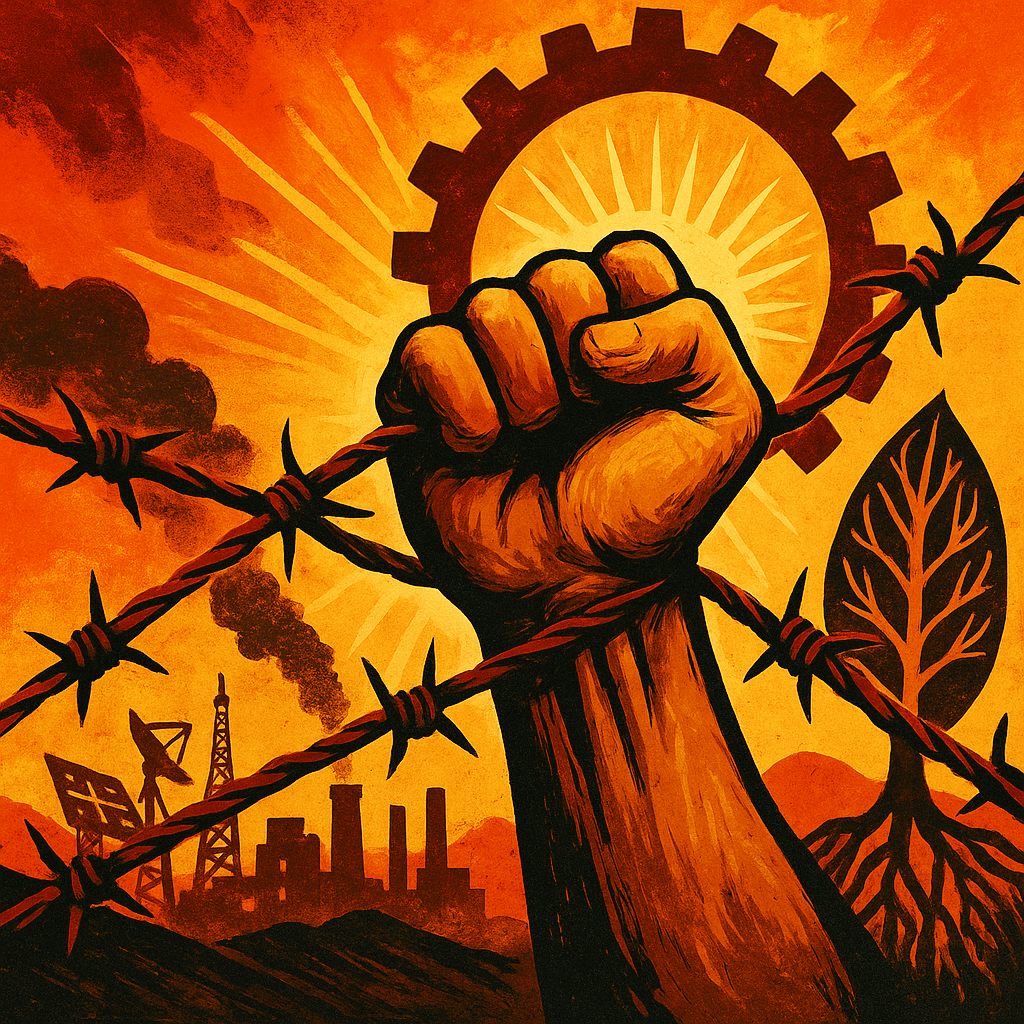
From pharmaceutical apartheid to digital colonialism, the TRIPS regime turns knowledge into property, and property into a weapon. To reclaim the future, we must delink from the empire of rent—and dismantle its legal machinery.
By Prince Kapone | Weaponized Information | June 29, 2025
I. From Conquest to Code: The Colonial Foundations of the IP Regime
The Agreement on Trade-Related Aspects of Intellectual Property Rights (TRIPS), adopted in 1994 and enforced through the World Trade Organization (WTO), is often presented as a neutral framework to regulate global innovation. In reality, it is a legal architecture of imperial control—designed to privatize knowledge, extract intellectual rent from the Global South, and preserve the monopoly power of the imperial core. TRIPS institutionalizes colonial power dynamics in legal form, criminalizing technological sovereignty and turning Indigenous and postcolonial knowledge systems into corporate property. This is not development. It is dependency. And it must be abolished—not reformed—to achieve epistemic justice.
To understand how we arrived at this moment, we must begin with the colonial theft of knowledge. Long before patents and licensing agreements, European empires built their technological and scientific infrastructure on the systematic expropriation of Indigenous, African, and Asian knowledge. This was not incidental. It was foundational. From agricultural techniques and botanical medicine to architectural design and astronomical navigation, the wealth of the West was not only extracted in gold and labor—it was extracted in ideas.
British institutions like the Royal Botanic Gardens at Kew were explicitly tasked with collecting, cataloguing, and weaponizing the biological and ecological knowledge of colonized peoples. The theft was industrial in scale. In 1876, British agents smuggled rubber tree seeds from Brazil to British Malaya, breaking the Amazonian monopoly and laying the foundation for the empire’s rubber plantations in Southeast Asia. In India, British firms attempted to patent neem-based fungicides, despite their widespread use for centuries in South Asian medicine and agriculture.
This is what historian Vandana Shiva has called “biopiracy”—the appropriation of traditional knowledge systems by imperial powers who then claim exclusive ownership over what they have stolen. The colonial regime did not recognize communal knowledge as legitimate. Only that which was codified by European institutions could be owned, patented, and enforced.
With the decline of formal colonialism in the mid-20th century, the imperial powers shifted strategy. Rather than direct rule, they constructed a global legal and financial order designed to maintain control over the productive capacities of the South. Institutions like the IMF, World Bank, and later the WTO formed a new apparatus of economic domination. TRIPS became the crown jewel of this regime. It was the mechanism by which corporations in the imperial core could claim permanent, transnational control over the very building blocks of life: genes, molecules, data, and ideas.
But TRIPS was never about “protecting innovation.” It was about protecting monopoly. The agreement mandates that all WTO members adopt a standardized intellectual property regime that privileges corporate patent holders—nearly all headquartered in the Global North—across nearly every sector: pharmaceuticals, agriculture, software, industrial equipment, communications infrastructure, and more. What was once called scientific collaboration became enforceable rent.
Critically, TRIPS marked a major legal shift—from protecting the process of innovation to protecting the product itself. Under earlier frameworks, countries could develop the same medicine or tool using a different method, as long as they did not copy the original patented process. TRIPS outlawed this approach. The patent now covered the end product—regardless of how it was made. Even if a country reverse-engineered a vaccine using entirely domestic resources and techniques, it could still be sued for patent violation.
This change had devastating consequences. Nations of the Global South were stripped of the right to independently innovate. Their scientists were criminalized for creating what their communities needed. Their economies were locked into permanent licensing agreements. Innovation was transformed into rent—and rent into dependency.
TRIPS did not emerge from a democratic process. It was written by monopoly capital. Corporations like Pfizer, DuPont, Monsanto, and IBM—operating through lobbying coalitions such as the Intellectual Property Committee—authored the text that would later be pushed through international negotiations as non-negotiable. Most countries in the Global South had no meaningful input. By the time they sat at the table, the terms were already set.
The goal was simple: prevent the Global South from achieving technological sovereignty. Lock in permanent royalty streams. Preserve the imperial division of labor. Maintain monopoly ownership of the present—and of the future. The plantation has been digitized. But its purpose has not changed.
II. TRIPS and the Institutionalization of Intellectual Empire
TRIPS is not a neutral framework. It is the legal consolidation of a global monopoly system—the codification of white empire through the language of “intellectual property.” It does not protect innovation. It protects control. It does not promote development. It guarantees dependency. Its function is not to equalize access to technology—it is to extract rent from the future by enclosing knowledge itself.
When the United States pushed for the inclusion of IP protections in the Uruguay Round of GATT negotiations in the 1980s, it was not acting on behalf of science, nor of democratic governance. It was acting on behalf of its monopolies. The actual architecture of TRIPS was written not by nations, but by corporate lobbies representing the largest firms of the imperial core. Pfizer, IBM, Monsanto, DuPont, General Electric—these were the real authors of the agreement. The so-called Intellectual Property Committee was not a multilateral body. It was a front for concentrated corporate power.
These firms had a single objective: to use international law to preserve their global dominance in the face of growing technological capacities in the Global South. They knew that China, India, Brazil, and others were developing the industrial and scientific base to challenge U.S. and European hegemony. TRIPS was their preemptive strike. It transformed what had once been a national legal matter into a binding global regime, enforced by the WTO and backed by the coercive weight of sanctions and trade blackmail.
Under TRIPS, every signatory nation must adopt a standardized IP regime that aligns with the interests of transnational capital. Countries are required to protect product patents across nearly every sector—pharmaceuticals, software, manufacturing, telecommunications, and agriculture—regardless of their level of development, historical injustice, or national priorities. These patents are enforced for a minimum of twenty years, and failure to comply can trigger WTO dispute mechanisms, investor-state arbitration, or retaliatory tariffs by more powerful states.
The shift from process patents to product patents was particularly devastating. In the past, countries like India could legally reverse-engineer essential medicines and industrial tools by using different production methods, thus meeting domestic needs without violating international law. TRIPS criminalized that possibility. It made the final product—the vaccine, the microchip, the seed, the signal frequency—a private asset, regardless of how it was made. This is not protection of invention. It is ownership of outcomes. It is rent on reality itself.
The implications are totalizing. A country can extract its own minerals, refine its own materials, train its own scientists, and build its own factories—but if the final product even resembles an item patented by a firm in the imperial core, that country must pay tribute. That tribute is not a one-time fee. It is a recurring, compound, often opaque stream of royalties, license payments, and contractual concessions. The system is designed to ensure that no matter how productive the South becomes, it remains subordinate—paying rent to its former colonizers for the right to exist in modernity.
This is how empire evolves. No longer does it need to extract raw materials through colonial charter companies or enslave labor through direct military rule. Today, it extracts intellectual rent. It enslaves futures instead of bodies. It captures development not through invasion, but through paperwork. And it disciplines nations through the courts of capital, where the judge, jury, and executioner all speak the language of investment law.
In this context, calls to “reform” TRIPS miss the point. The problem is not that the system is being misused. The system is functioning exactly as designed. It is not broken. It is working. The enforcement of intellectual property under TRIPS is not a technocratic flaw in global governance—it is the primary mechanism through which the racialized global division of labor is preserved. The modern patent regime is the Berlin Conference of the digital age. The technologies may have changed. The borders may have dissolved. But the principle remains the same: white power must own what the rest of the world creates.
III. Racial Capitalism’s Legal Armor: TRIPS and the Afterlife of Empire
TRIPS is not just about patents—it is about power. More precisely, it is about how racial capitalism enshrines colonial hierarchy in the legal code of the world system. When the World Trade Organization forced TRIPS down the throats of the Global South in 1995, it was not a new beginning. It was the codification of an old order: where whiteness rules, and the nonwhite world obeys. The only difference was the weapon of enforcement. Gunboats became trade agreements. Cannons became lawsuits. The Berlin Conference gave way to Geneva.
TRIPS operationalizes racial capitalism by converting centuries of stolen knowledge, biological life, and cultural practice into Northern-owned property. This is not metaphor. Ninety-two percent of global patent royalties flow to just three regions: North America, Europe, and Japan. This is not the outcome of innovation—it is the outcome of enclosure. What was once public, communal, ancestral, or simply necessary for survival has been fenced off behind paywalls and licensing fees.
This is not a bug in the system—it is the system. TRIPS functions as racial capitalism’s legal armor: protecting Northern monopolies with the full weight of global trade law while leaving the South dependent, indebted, and disposable. It is not simply that the Global South must pay to access technology it helped develop. It is that the very act of knowing—of healing, planting, inventing, remembering—is now criminalized unless sanctioned by white-owned IP regimes.
Universities and corporations in the Global North play the role of imperial archivists. They comb through the forests, farms, rituals, and recipes of the Global South, extract usable insights, patent them in Europe or the U.S., and then rent them back to the people they were taken from. This is not “sharing.” It is epistemic enclosure. It is the legal form of biopiracy. From neem and turmeric to quinoa and cassava, the knowledge of colonized peoples has become a revenue stream for the descendants of their conquerors.
Even the global digital economy reflects this colonial asymmetry. Software, AI models, and data systems are increasingly trained on users in the Global South, but the profits—and patents—flow Northward. The South is rendered a raw data frontier, not a sovereign digital producer. In this way, TRIPS extends the logic of racial capitalism into cyberspace: extractive, unequal, and enforced through sanctions and lawsuits, not bullets.
Software licensing costs in Africa rival entire national health budgets. The continent pays billions annually to access digital tools developed using its own raw data, while its people remain locked out of scientific infrastructure. Even renewable energy isn’t spared: the Lake Turkana Wind Power project in Kenya was delayed nearly three years due to IP disputes over turbine patents.
The human cost is not abstract. In India, Bt cotton seeds patented by Monsanto were linked to a wave of farmer suicides, as smallholders drowned in debt from rising seed and pesticide costs. Their crops failed, but the royalty payments did not.
Knowledge itself has been enclosed. Seventy percent of researchers in the Global South cannot access basic scientific journals due to paywalls. Meanwhile, their own research is extracted, reformatted, and monetized by elite universities in the imperial core.
Many in the North still believe the IP system benefits them. But even here, the illusion is cracking. Most white workers do not own patents. They do not profit from monopolies. They pay for insulin just like everyone else. But unlike their colonized counterparts, they have been politically trained to identify with the system that exploits them. TRIPS is designed to protect Apple, Pfizer, and Monsanto—not the average white worker. Yet that worker is conscripted into defending “property rights” that will never be theirs.
Racial capitalism depends on this lie: that whiteness equals wealth, and therefore its protection is everyone’s duty. But the empire’s rents are running out of excuses. The knowledge it stole is rising up. The people it enclosed are breaking through. The system it protects is rotting from within. The only question left is whether we will let the laws of the last empire define the future—or whether we will abolish them.
IV. Five Frontlines of Epistemic War: How TRIPS Encloses the World
TRIPS weaponizes scarcity—where healing is priced, knowledge is policed, and survival requires imperial permission.
1. Pharmaceutical Apartheid
TRIPS criminalizes the right to survive. During the AIDS crisis in South Africa, patent-holders like GlaxoSmithKline priced antiretrovirals beyond the reach of millions. When South Africa sought to import generics, it was sued by pharmaceutical giants backed by the U.S. and EU. Even during the COVID‑19 pandemic, Global South nations proposed a temporary TRIPS waiver for vaccine patents—only to be blocked by Europe and the U.S. on behalf of Pfizer and Moderna.
Bayer’s CEO infamously declared that their cancer drug was not developed for Indians but for “Western patients who can afford it”. This chilling admission reveals TRIPS’ logic: privatize life, monopolize healing, and punish poverty.
2. Digital Colonialism
Software licensing has become a tribute system. Africa loses €2.4 billion annually on software imports—enough to fund malaria elimination in a dozen nations. Meanwhile, proprietary software bans criminalize open-source alternatives like Ushahidi—digital liberation tools born in the Global South—locking the continent into perpetual dependency.
3. Green Tech Apartheid
TRIPS is the tollkeeper of the energy transition. Siemens used TRIPS enforcement to sue South African wind farms for patent infringement, delaying renewable infrastructure in townships while Europe profits from Africa’s sun and wind.
4. Food and Seed Sovereignty
TRIPS enforces botanical apartheid.Monsanto’s patented Bt cotton failed drought tests in key Indian states, leading to massive farmer debt and a wave of suicides. Indian government data confirms thousands of deaths concentrated in areas where Bt cotton dominates.
5. Knowledge, Education, and Academic Apartheid
TRIPS turns education into an intellectual prison. Global South scholars are locked out of access to academic knowledge their taxes helped fund, while elite Northern universities patent discoveries based on research derived from their communities. Elsevier and Springer extract $1.3B yearly from Global South universities—rent paid for knowledge their scholars produced. Even textbooks are locked behind licensing regimes that extract tolls from postcolonial education systems.
These five frontlines are not isolated—they are a unified terrain of war. A war on the right to live, know, grow, and survive.
TRIPS is not broken. It is working exactly as intended.
Each patent is a border; each license fee is colonial tax reinvented.
V. Delinking from the Empire of Rent: Toward Epistemic Sovereignty
The fight against TRIPS is not just a legal battle—it is a strategic campaign for epistemic sovereignty. To challenge TRIPS is to challenge the entire colonial infrastructure of knowledge ownership. Reform will not suffice. The regime must be dismantled. But abolition is not destruction alone. It is construction: the building of a new system grounded in autonomy, reciprocity, and solidarity.
Throughout history, some states have charted paths toward delinking. India’s 1970 Patent Act, which excluded pharmaceutical product patents, enabled its generic drug industry to flourish and saved millions of lives across the Global South. As documented in this WHO report, this legal delinking from rentier regimes reduced HIV treatment costs from $395/month to $20/month—defying pharma monopolies and TRIPS fundamentalism.
Cuba, under embargo, developed its own vaccine ecosystem—sharing knowledge with nations in need, not selling it to the highest bidder. As evidenced in the peer-reviewed MEDICC Review, Cuba’s Abdala and Soberana-02 vaccines achieved 90%+ efficacy and were distributed to countries such as Venezuela, Vietnam, and Saint Vincent. This was epistemic sovereignty in motion.
China, within the framework of the capitalist-imperialist world system, has disrupted TRIPS hegemony through massive state investment and tech self-sufficiency. As shown in this SCMP article and corroborated by ADB/World Bank data, solar panel prices dropped over 60% from 2020–2024, driven by China’s strategic flooding of global markets. This was scale weaponized against monopoly rents.
But delinking must go deeper. It must become collective. A Global South IP Alliance could:
- Pool patents for essential medicines, energy, and infrastructure under shared licenses.
- Establish open-source repositories for seeds, designs, and algorithms.
- Create a joint legal defense fund to counter imperial litigation.
- Coordinate state-led research platforms insulated from WTO rules.
Delinking is not isolationism. It is refusal. Refusal to let rentiers dictate the terms of survival. Refusal to treat learning as theft. Refusal to accept a future leased from yesterday’s thieves.
The path forward will not be easy. Sanctions, sabotage, and retaliation await those who step out of line. But Cuba has survived six decades of siege. India defied pharma giants and won. South-South alliances like ALBA and the African Medicines Agency are showing what resistance looks like in motion. As evidenced by the Treaty for the Establishment of the African Medicines Agency and long-standing Cuba–Venezuela health accords, collective sovereignty is not theory—it is strategy.
The future cannot be copyrighted. The right to learn, heal, and create belongs to the people—not to monopolies. Delinking is not utopia. It is necessity.
🔥 Epistemic Sovereignty: Delinking in Action
| Case | Mechanism | Outcome |
|---|---|---|
| India (1970 Patent Act) | Excluded product patents; spurred local production | Drastically reduced HIV/TB drug costs; millions of lives saved |
| Cuba (COVID vaccines) | National R&D + tech transfer to allies | High‑efficacy vaccines shared with South partners |
| China (clean‑tech scale) | Massive public investment, scale‑driven export | 60% price drop in solar tech despite international complaints |
| ALBA / AMA | Treaty frameworks & inter‑state pharmaceutical collaboration | Collective resistance; continental regulatory autonomy |
These aren’t exceptions—they’re blueprints for abolition. Delinking from the empire of rent means dismantling extractive regimes and constructing solidarity-driven systems rooted in autonomy, reciprocity, and shared knowledge.
VI. You Can’t Sue a Revolution: Abolishing TRIPS, Reclaiming the Future
The abolition of TRIPS is not a utopian dream—it is a strategic necessity. This treaty, enforced through trade blackmail and imperial litigation, is a machine for global dependency. You cannot reform a machine built to exploit. You dismantle it. You sabotage its circuits. You replace it with something else entirely.
Some say it’s impossible. That the Global South can’t survive without Western “innovation.” But these are the same voices that said Africans couldn’t govern themselves. That Cuba couldn’t survive without U.S. sugar refineries. That China would collapse without American markets. Every act of liberation begins with rejecting the limits imposed by empire.
Revolution is the act of refusing permission. You don’t need a license to breathe. You don’t need a patent to grow food, build machines, or make medicine. Let them come sue a billion people. Let them litigate against barefoot engineers, communal clinics, open-source scientists, and underground universities. What TRIPS fears most is not theft—it’s irrelevance.
The real threat to imperial intellectual property isn’t piracy. It’s autonomy. It’s communities that don’t ask permission. Networks that share without profit. Laboratories that build without licenses. Seed banks, local fab labs, street pharmacies, encrypted archives—these are not crimes. They are blueprints for liberation.
Epistemic sovereignty will not come from WTO back rooms or IMF reform panels. It will come from rupture. Rebellion. Revolt. From the global reclaiming of what was stolen. From a new common sense: that knowledge, like air and water, belongs to all of us.
TRIPS is the Berlin Conference of the digital age. It carved up the world’s future and sold it back in pieces. But the lines it drew are cracking. The people it tried to bind are breaking free. The fight against TRIPS is not just a policy dispute. It is a class war. A colonial war. A war for the right to think, build, and live without paying tribute to empire.
Abolishing TRIPS is not reform. It is repatriation. The Global South will reclaim its knowledge—or die renting it.
 Weaponized Information
Leave a comment