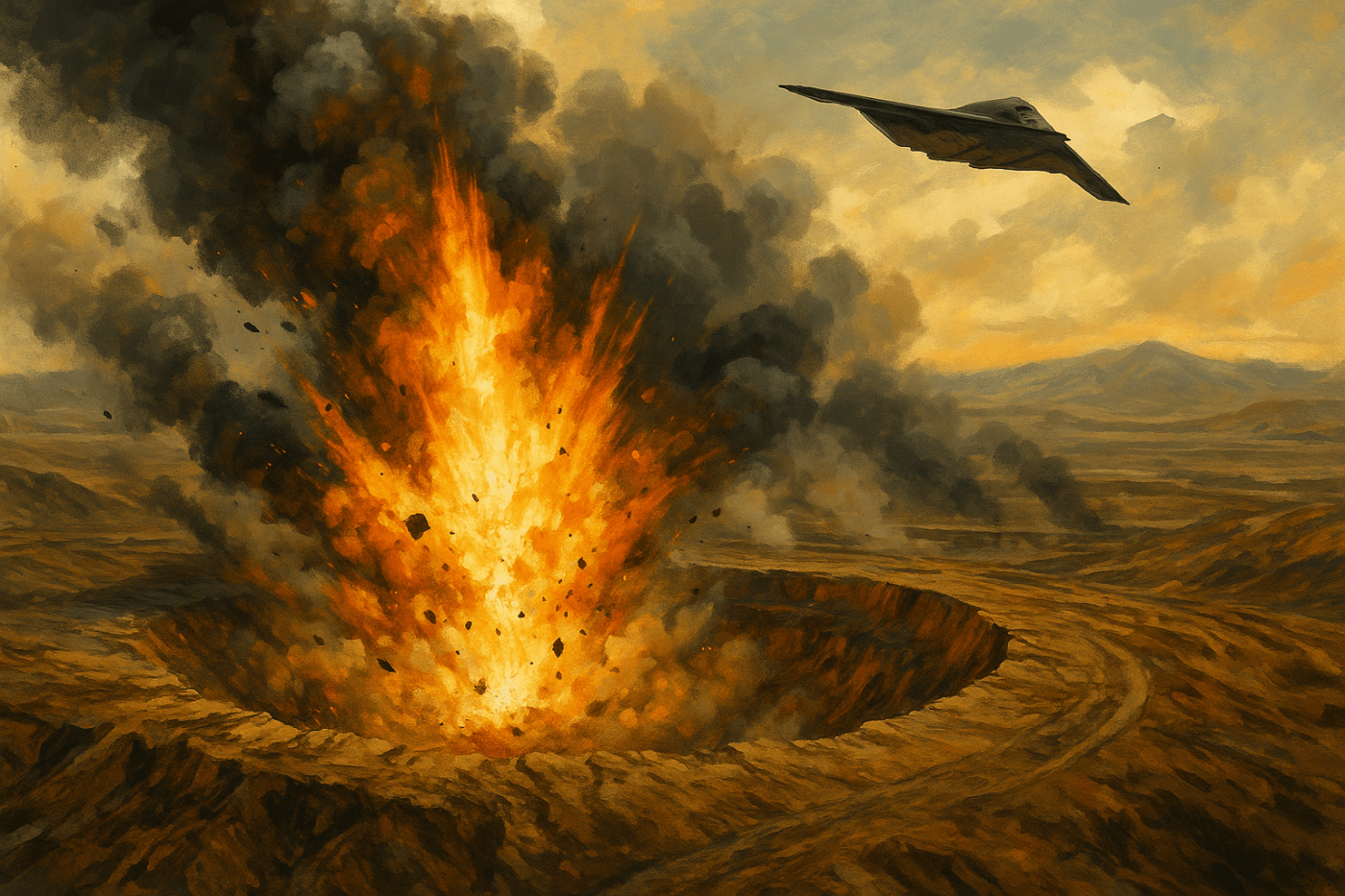
What the bomb couldn’t breach, the narrative tried to contain. Inside the technofascist media campaign to frame imperial siege as scientific success.
By Prince Kapone | Weaponized Information | June 25, 2025
Technofascist Newsrooms and the Science of Silence
David Hambling’s article on the U.S. deployment of 30,000-pound bunker-buster bombs is a prime example of technofascist propaganda. Not because it lies outright—but because it performs the function of cognitive warfare: disarming the political consciousness of the reader, framing imperial violence as engineering progress, and evacuating the event of all historical, legal, and moral content. This is not journalism. It is ideological camouflage in a lab coat.
Technofascism refers to the fusion of monopoly capital, military force, and technological management of populations—where war is framed as innovation and control is enforced through both infrastructure and narrative. Its media wing doesn’t shout. It calculates. It doesn’t lie directly—it recodes. Hambling is not an aberration; he is a mechanism. A longtime contributor to Wired and Forbes—outlets deeply entwined with venture capital, Silicon Valley, and defense tech—he embodies the narrative function of the Imperialist Media Apparatus. His current publisher, Yahoo News, is owned by Apollo Global Management, a $600+ billion private equity empire with major holdings in aerospace, cyber defense, and weapons logistics. This is not information. It is coordination.
The article itself is textbook propaganda laundering. There is no reference to Iran’s sovereignty, no legal context, no moral accounting. Instead, the reader is guided through bomb mechanics like a Popular Science article: penetration depths, steel alloy formulations, PSI thresholds. The bomb becomes the protagonist, the target becomes a composite structure, and the act of imperial aggression becomes a technical case study. This is how imperial power reproduces itself in public imagination—not through explicit threat, but through the normalization of force as physics.
Euphemisms abound. The article refers to a “quiet arms race between bombs and concrete,” as if Iran pouring ultra-dense concrete to defend itself against unprovoked attack is the same as the U.S. developing bunker-busting payloads for strategic siege. Hambling quotes only military engineers and materials scientists—not international legal scholars, Iranian officials, or historians of warfare. The political is stripped out. The reader is never asked whether the bombing was justified—only whether the concrete held up.
This framing is not accidental. It is a function of imperial amplifier networks—defense-funded think tanks like the RAND Corporation, contractors like Lockheed Martin and Northrop Grumman, and media institutions that translate state messaging into digestible “explainer” content. RAND has for decades advised U.S. planners on how to manage nuclear chokepoints, while those same planners cycle through advisory boards and bylines in corporate media. Hambling’s piece is not “coverage.” It is part of an embedded system of military-academic-media control.
To understand this article as journalism is to be disarmed by it. To see it as propaganda is to recognize its place in the larger architecture of technofascism—where bombs are data points, sovereignty is negotiable, and war crimes are pre-reviewed by science editors. Yahoo’s role in this isn’t coincidental. The empire doesn’t just drop bombs. It publishes case studies to admire their performance.
The Burial Plan: When Empire Fails to Destroy, It Contains
The June 21, 2025 bombing of Iran’s Fordow enrichment facility did not succeed in destroying Iran’s nuclear infrastructure. It couldn’t. Fordow sits buried under 260 to 300 feet of rock, reinforced by layers of Ultra High Performance Concrete (UHPC)—capable of absorbing over 40,000 PSI of compressive stress. Even the U.S. military’s most advanced ordnance, the Massive Ordnance Penetrator (MOP), has a demonstrated maximum penetration depth of approximately 20–30 feet in reinforced concrete. Pentagon officials knew this. The strike was not designed to breach. It was designed to bury.
Seymour Hersh’s exposé revealed that Israeli and American planners, aware of the MOP’s limitations, devised what they called a “Burial Plan”: to collapse all known entrances, ventilation shafts, and surface-level access tunnels into Fordow, sealing off the site under tons of rubble. It wasn’t about eliminating uranium—it was about rendering it inaccessible. Not destruction, but entombment. Not victory, but denial.
CNN confirmed days later that U.S. intelligence believed Iran’s nuclear program was only “set back” by the strike—not destroyed. No spikes in radiation were detected. Iranian spokespeople, including Atomic Energy Organization official Behrouz Kamalvandi, claimed that all nuclear material had been preemptively moved from the site. Whether this was fact, disinformation, or strategic preparation is unclear. What is clear is that Fordow had been fortified—and anticipated—as a site of siege.
The Burial Plan reveals what we call Imperial Recalibration: when an empire can no longer eliminate its target, it shifts to permanent containment. It freezes sovereign development beneath infrastructure sabotage, narrative fog, and technological blockade. The goal is no longer to win, but to delay—indefinitely. This is the logic of late-stage technofascism: war by suffocation when rupture is impossible.
The illegality of the strike is almost entirely omitted from mainstream coverage. Fordow is an IAEA-inspected site, operated under safeguards in accordance with Iran’s obligations as a signatory to the Non-Proliferation Treaty. The U.S. strike violated Article 2(4) of the UN Charter, which prohibits the use of force against any state’s territorial integrity absent Security Council authorization or direct self-defense. There was no declaration of war. No UN resolution. No legal fig leaf. And yet, the story was framed as engineering, not escalation.
But the Burial Plan wasn’t just about geology—it was about geopolitics. Even as the strike failed to neutralize Iran’s nuclear infrastructure, it succeeded in sending a message. It was an act of imperial theater: a 30,000-pound signal flare dropped not to destroy, but to declare. The U.S. sought to reassert deterrence, to remind both Tehran and the watching world that defiance of the unipolar order would be met not with diplomacy, but with devastation. In this sense, the bombing functioned as an optical operation—symbolic violence aimed at maintaining the credibility of American force projection, even as its material efficacy crumbles. It wasn’t just Fordow that was targeted. It was the idea that sovereignty could be secured through science.
Iran’s response to this siege was not just diplomatic, but infrastructural. UHPC was developed under sanction, embargo, and cyberattack. In resisting direct penetration, it functioned not merely as defense material, but as material sovereignty. The empire did not fail to bomb Iran’s nuclear capacity. It failed to break the scientific foundation on which it was built.
Every collapsed tunnel at Fordow is evidence—not of Iranian weakness, but of U.S. impotence. The bomb did not erase Iran’s technological future. It buried it, in the hope that rubble would do what military might could not: contain sovereignty.
Siege Doctrine and the Crisis of Imperialism
The Burial Plan was never about obliteration. It was about delay. A 30,000‑pound MOP—a single weapon costing around $30 million—can breach no more than 20–30 feet of reinforced concrete, yet Fordow lies 260–300 feet below and behind ultra‑dense UHPC walls. The gap is no design flaw—it’s a strategic confession. Unable to destroy, the empire contained. Unable to win, it walled. This is not tactical adaptation—it is structural decay.
What unfolds is the material logic of imperial decline: when decisive domination fails, permanent siege becomes doctrine. We call this Necro‑Extractivism—the burial of what you cannot conquer or commodify. Not extraction for profit, but extraction of certainty. No uranium, no laurels—just indefinite suspension under rubble.
A crisis emerges when reliance on force gives way to reliance on containment. The empire now regulates, delays, and buries. It sabotages ports and cables, disrupts economies, and, at Fordow, collapses access shafts. The aim is not control—it is stasis. But what empire fears, empire fails. Stasis is a symptom, not a strategy.
The consequences ripple outward. Russian Security Council Deputy Chairman Dmitry Medvedev—Putin’s former president—stated publicly that “a number of countries are ready to directly supply Iran with their own nuclear warheads” if U.S. strikes continue. He later walked it back, clarifying Russia would not—but the insinuation remains: if Empire digs, others may fill. This is not solidarity. It is opportunism. Yet it signals a reordering.
This escalation threat isn’t idle chatter—it reflects a fracture in the monopoly of coercion. Medvedev’s gambit suggests that when Washington’s siege falters, other states are willing to supply the tools of counter‑containment. Military decline doesn’t happen in a vacuum—it invites rivals to weaponize the vacuum.
U.S. siege doctrine meets BRICS+ infrastructure. Consider China’s Functionally Graded Cementitious Composite (FGCC)—a layered defense where each tier interrupts and dissipates kinetic energy, turning penetrator munitions into fragmentation. Tests show FGCC outperforming even UHPC against steel-tipped threats. The message is clear: infrastructure is now the frontline.
The United States acknowledges it cannot penetrate this level of technological fortification. The B‑2 Spirit—bombing platform of exclusivity—and its MOP come not as solutions, but as relics. The Fordow crater is not the climax of U.S. dominance—it is its monument of impotence.
Iran’s positioning at the nexus of these developments is no accident. Its scientific infrastructure—cement, centrifuges, communications—is defended not just by labs, but by international treaty and multipolar alliances. The January 2025 technology‑sharing pact with Russia, alongside deepening ties with China and other BRICS, reflects this integrated defiance.
The empire’s siege has a new beneficiary: a networked counter‑order that responds to bombardment not with capitulation, but with fortification. Upgrading bunkers to outlast bombs, forging alliances to outshape embargoes, and building infrastructure that defies siege. Iran’s next generation of centrifuge plants and satellites will be buried—or elevated.
When bombing becomes burial, and containment becomes doctrine, you are watching the empire contract—not conquer. The death of its myth of invincibility is now hidden within underground rubble. The MOP didn’t win. It buried one future—and revealed another.
Mobilizing Against the Burial Doctrine
We cannot simply analyze the Burial Plan—we must dismantle its logic, infrastructure, and ideological scaffolding. The bunker-buster is not just a weapon; it’s a symbol of technofascist siege logic masquerading as scientific inevitability. This doctrine, which seeks to entomb sovereignty under rubble while declaring “mission accomplished,” thrives only when our movements remain above ground—exposed and reactive. But what if we dug deeper?
First, we target the manufacturers. Lockheed Martin, Boeing, and Northrop Grumman have all profited from the production and upgrading of the Massive Ordnance Penetrator (MOP)—a bomb that costs over $30 million each and has failed to pierce Iranian infrastructure built with Ultra-High Performance Concrete (UHPC). The U.S. government, instead of cutting its losses, has quadrupled down: funding new variants, new delivery systems, and new test sites—all in the name of “deterrence.” We say: #BuryTheMOP.
Second, we expose and disrupt the academic-military pipeline that produces this technofascist consensus. MIT’s Lincoln Lab, Sandia National Laboratories, and the Pentagon’s Defense Threat Reduction Agency have been engineering the ideological and material justification for nuclear-adjacent attacks under the euphemism of “counterproliferation.” These aren’t ivory tower institutions; they are forward operating bases in the war of ideas, where “infrastructure hardening” becomes a pretext for preemptive strikes and where every Iranian centrifuge is treated as a target waiting to be buried.
Third, we build international solidarity networks to defend Iran’s right to scientific sovereignty. Iran is a member of the International Atomic Energy Agency. Its Fordow site is monitored by cameras and sensors placed there under multilateral agreements. It has not diverted enriched uranium for weapons use, yet it is treated as guilty without trial. Meanwhile, Israel—a nuclear state outside the IAEA framework—faces no inspections and no sanctions. This is not nonproliferation; it is imperial asymmetry.
Fourth, we honor the principle of informational counterforce. The truth must be excavated like concrete rubble: carefully, deliberately, and with collective tools. Hersh’s exposé is one such tool (The Burial Plan). But we need more. Platforms like Weaponized Information, Revolutionary Blackout Network, Geopolitical Economy Report, and others must be supported, funded, and defended. The battlefield has shifted; it now runs through the cables of fiber-optic disinformation and the bunkers of media monopolies.
Finally, we act. Not in abstraction, but in formation. Disrupt the arms fairs that sell MOPs as marvels of American might. Pressure Congress to defund future upgrades to weapons that serve no purpose but entombment. Forge worker-to-worker connections with Iranian engineers and scientists who refuse to have their dignity bombed out of existence. Solidarity is not sentimental—it is structural. And structures, like Fordow’s concrete, can withstand the empire’s most precise tools of erasure.
The doctrine of burial is not just about sealing off material—it’s about interring possibility, sovereignty, and resistance. But every empire that builds a tomb for its enemies also digs the outline of its own collapse. Let us ensure the ground never settles.
 Weaponized Information
Leave a comment