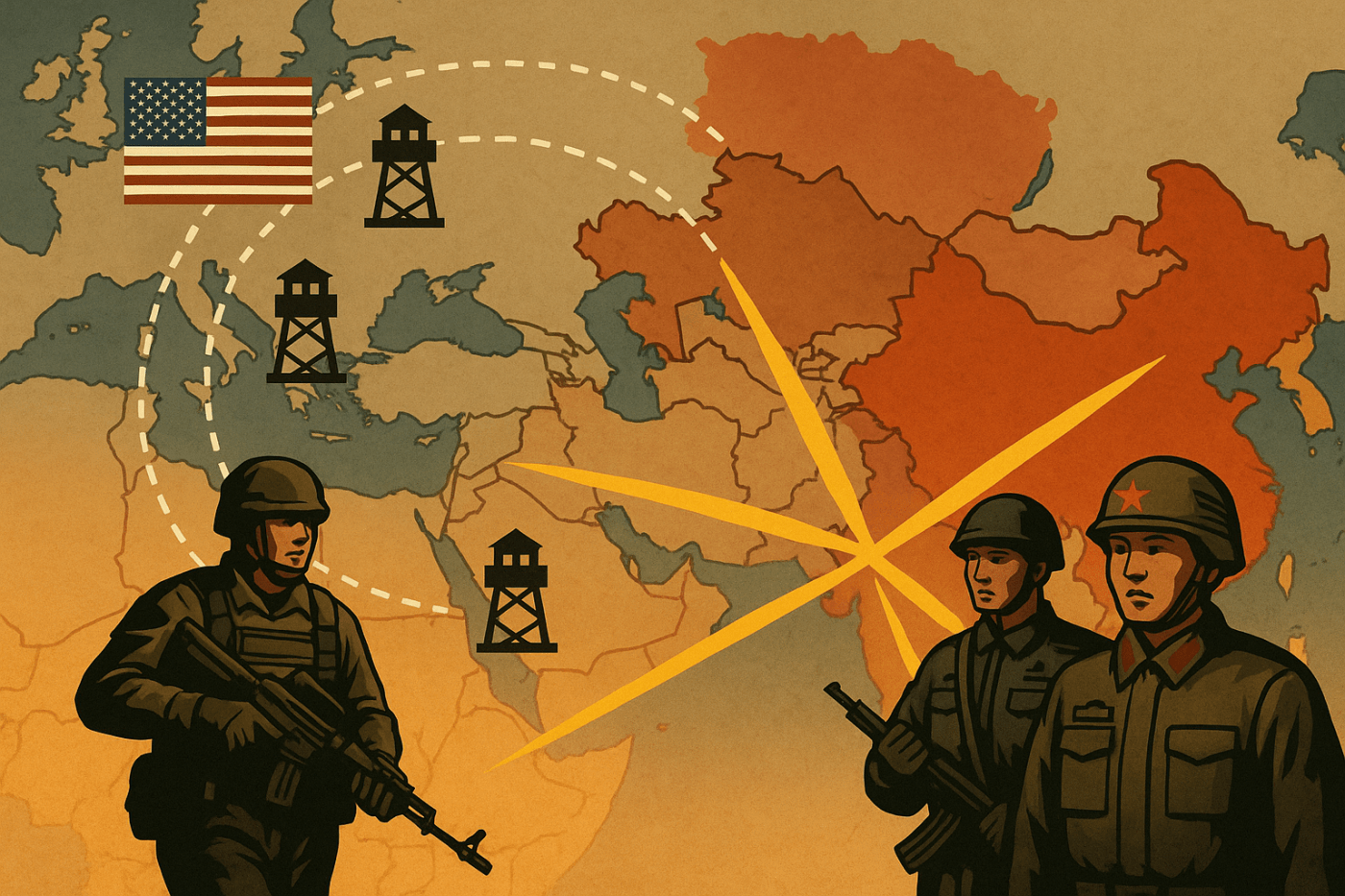
Washington plots a perimeter of bases; Beijing and Moscow lay corridors of sovereignty.
By Prince Kapone | Weaponized Information | June 22, 2025
1. Central Asia’s Strategic Pivot
For centuries, Central Asia languished in the imperial imagination as a wind-scoured backwater. Today it blazes as a dialectical furnace—where the collapsing unipolar order meets the molten forces of multipolar sovereignty. Infrastructure is the fuel; class struggle is the oxygen. The region is no longer a sleepy “bridge” between East and West but the live hinge on which the future of global power turns.
Imperial planners know this. The U.S. State Department sells its role as “security cooperation.” Neocon strategists at AFPC advocate a “Greater Central Asia” cordon. Yet beneath the diplomatic varnish lies what Lenin called the territorial division of the globe by monopoly capital—the endless scramble to preserve super-profits when domestic markets saturate (Lenin 1916).
As Samir Amin later theorized in his Law of Worldwide Value, imperialism extracts value by enforcing a worldwide hierarchy of wages, prices, and technologies. Multipolar initiatives—China’s Belt and Road, Russia’s Eurasian Economic Union—negate this hierarchy by hard-wiring co-development into rail spurs, pipelines, and data cables (Amin 2010).
In other words, the region’s explosive transformation is no accident; it is the inevitable result of imperialism’s internal contradictions—over-accumulation, resource wars, and the search for new frontiers of profit. As these contradictions sharpen, Central Asia becomes the pressure-valve where the kill-chain of empire meets its dialectical limits.
| Imperialist Accumulation Model | Multipolar Accumulation Model |
|---|---|
| Resource extraction & raw-material drains | Joint industrialization & technology transfer |
| Dollar hegemony / debt peonage | Local-currency settlements & CRA reserve pool |
| NATO force projection & regime-change | SCO/CICA non-interference & collective security |
The analysis that follows excavates this clash: the projects, the pipelines, the proxy elites, and—most importantly—the workers whose labor will decide which model prevails. As WI’s Long Road to Multipolarity argued, multipolarity is neither utopia nor inevitability—it is the negation of empire in motion.
1B. Grand Chessboards and Heartlands: The Imperial Doctrine Behind the Curtain
Before the first Chinese railcar entered Khorgos or the EEU signed a customs union, imperial strategy had already mapped Central Asia. Not as a sovereign zone—but as a vital lever for sustaining global domination. U.S. foreign policy architects from Mackinder to Brzezinski saw Eurasia as the geopolitical keystone—and Central Asia as its soft underbelly.
In The Grand Chessboard, Zbigniew Brzezinski argued that “America’s global primacy is directly dependent on how long and how effectively it can sustain its preponderance on the Eurasian continent.” He identified Central Asia as the “black hole” to be filled by U.S. power to preempt a Russia–China convergence (Brzezinski 1997).
This logic echoes Mackinder’s Heartland Theory—that whoever controls the Eurasian pivot controls the world—and Spykman’s Rimland thesis, which shaped Cold War containment strategies. These were not geographic musings but strategic roadmaps for imperial management.
That management took material form in the 2000s via the Project for a New American Century (PNAC). Its playbook called for full-spectrum dominance and permanent basing in Central Asia. Manas Air Base in Kyrgyzstan and the drone corridors over Tajikistan were early testbeds for this strategy.
Today, the imperial reboot is encoded in the “Greater Central Asia” strategy pushed by the American Foreign Policy Council—seeking to integrate Central Asia into U.S.-aligned security, energy, and academic regimes while breaking Eurasian connectivity.
But this doctrine is not new—it’s imperialism in its digital phase. It is imperialism’s kill-chain: mapping chokepoints, installing proxies, and disabling resistance before it coalesces. That kill-chain is being broken not by speeches, but by infrastructure—by the rails, ports, and cables of multipolar power.
2. Belt and Road Initiative: Infrastructure as Sovereignty
While the U.S. floods Central Asia with defense attachés and think-tank seminars, China lays steel. Through the Belt and Road Initiative (BRI), Beijing has transformed the material geography of the region—turning desert borders into digital corridors, rail hubs, and logistical sovereignty zones. This is not charity. It’s not aid. It’s a strategic wager: that development without domination is both possible and necessary.
At the heart of the BRI’s Central Asian expansion is the Khorgos Dry Port, a logistical megahub on the China–Kazakhstan border. Known as the “New Silk Road Gateway,” Khorgos connects the New Eurasian Land Bridge—a transcontinental railway linking China to Europe through Kazakhstan, Russia, and Belarus. It bypasses maritime chokepoints dominated by U.S. naval supremacy and reorients trade around land-based sovereignty.
Parallel corridors are emerging: the China–Central Asia–West Asia route now stretches through Turkmenistan and Iran to Turkey, linking the Persian Gulf with Western China via rail and road. These are not just trade routes—they are the material architecture of multipolar autonomy. Fiber optic cables, green-energy stations, customs harmonization software, and surveillance-resilient data nodes all ride alongside the freight.
What makes the BRI revolutionary is not its speed or scale, but its political content. China does not demand IMF-style “structural adjustments,” military base rights, or ideological loyalty. Instead, it offers energy infrastructure, digital connectivity, and development financing that respect national sovereignty. As part of its broader “Socialism with Chinese Characteristics,” Beijing is exporting not only hardware—but a model of state-led development without U.S. tutelage.
Yet contradictions persist. In Kazakhstan, Chinese state-owned enterprises frequently partner with oligarchs like Timur Kulibayev—a pipeline magnate and son-in-law of former President Nazarbayev—ensuring that rail revenues and energy deals flow through comprador hands. In Kyrgyzstan, Chinese loans for hydropower and roads have stoked debt fears, while elite capture distorts project execution. Multipolar infrastructure without class struggle risks becoming a corridor of co-optation.
To truly de-link from imperialism, BRI projects must embed worker audits, local control mechanisms, and wage transparency clauses—not just high-speed rail. Sovereignty must mean more than diplomatic neutrality; it must mean wresting infrastructure from oligarch control and putting it under the stewardship of those who operate, maintain, and defend it.
And so, rail by rail, fiber by fiber, port by port, China is not just building infrastructure—it is laying the groundwork for a different world system. A system in which sovereignty is coded into servers, where pipelines follow non-NATO alignments, and where development no longer requires permission from Washington—or approval from comprador intermediaries.
3. Eurasian Economic Union: Integration Against Dependency
While China builds corridors, Russia weaves integration. The Eurasian Economic Union (EEU)—formed in 2015 and comprising Russia, Kazakhstan, Kyrgyzstan, Armenia, and Belarus—is often dismissed in Western media as a neo-imperial vanity project. But beneath that narrative lies a deeper reality: a coordinated effort to construct a regional economic bloc anchored in sovereignty, self-determination, and post-imperial coherence.
The EEU harmonizes customs regimes, synchronizes technical standards, and develops joint infrastructure planning mechanisms. Its design is not merely bureaucratic—it is infrastructural. Railways, gas pipelines, electrical grids, and digital networks are being reoriented toward continental circuits, reducing dependency on Western routes and rules. Kazakhstan and Kyrgyzstan function as key Central Asian nodes in this pivot.
In geopolitical terms, the EEU is a form of regional economic delinking—a defense mechanism against sanctions, speculative capital, and IMF coercion. Russia’s strategic use of local currency trade, investment funds, and barter arrangements illustrates how financial sovereignty is pursued not through confrontation, but through construction.
But sovereignty is not guaranteed by treaties—it is won through class struggle. While EEU frameworks offer an escape from Western financial dependency, they often reproduce internal hierarchies. Migrant labor from Kyrgyzstan and Tajikistan powers Russian industries under exploitative conditions, with remittances accounting for up to 30% of Kyrgyz GDP. This is not solidarity—it is wage colonialism rebranded.
In Kazakhstan, oligarchic families like the Nazarbayev clan retain stakes in energy, mining, and logistics sectors central to EEU integration. EEU-backed rail projects often serve elite trade corridors while neglecting worker infrastructure—like housing, pensions, and transit wages.
The EEU does provide a platform for resisting conditionality. Unlike World Bank or USAID packages, EEU projects do not come with “good governance” strings attached. Belarus, Kazakhstan, and post-Maidan Armenia all turn to EEU institutions to avoid being leveraged into Western debt traps or regime-change pipelines.
But integration without proletarian power risks reproducing dependence under new management. If EEU corridors bypass Washington only to funnel wealth to Astana’s oligarchs or Moscow’s comprador bureaucrats, the cycle continues. To weaponize the EEU as a tool of sovereignty, it must be grounded in worker ownership, trade union governance, and bottom-up infrastructure planning.
When aligned with China’s BRI and the broader multipolar project, the EEU is more than a customs union. It becomes a material armature for Eurasian integration—from logistics to energy to digital policy. And it signals to smaller states that another path exists: one that does not begin in Washington or Brussels—but must not end in oligarch boardrooms either.
4. Shanghai Cooperation Organization: Security Without Subjugation
In the Western strategic lexicon, “security” often means occupation, basing rights, and soft coups dressed as civil society. The Shanghai Cooperation Organization (SCO) offers an alternative: security grounded in sovereignty, mutual respect, and non-interference. Formed in 2001 by China, Russia, Kazakhstan, Kyrgyzstan, Tajikistan, and Uzbekistan, the SCO is now one of the largest regional organizations in the world—and one of the least understood.
Its Regional Anti-Terrorist Structure (RATS) in Tashkent facilitates intelligence-sharing and counter-extremism operations without external occupation. The SCO conducts regular joint military exercises focused on counterinsurgency, border stability, and regional defense—not regime change or expeditionary war.
But SCO’s significance extends beyond hardware. Its doctrine of security explicitly rejects NATO-style “interventionism” in favor of a regional balance rooted in multipolar respect. Official statements uphold the principle that development and stability must be endogenous—not imposed via sanctions, military contractors, or hybrid war.
And yet, contradictions remain. SCO operations are coordinated through national militaries, many of which are deeply embedded with comprador elites and hostile to independent worker organization. What is framed as “extremism” often includes mass protest against inequality, land grabs, or environmental destruction. The risk: that multipolar security becomes a velvet truncheon—suppressing rebellion in the name of regional harmony.
Tajikistan’s use of SCO counterterrorism channels to monitor labor migrant flows, or Uzbekistan’s surveillance tech contracts embedded in RATS cooperation, show how sovereignty can quickly become securitized against the poor. A truly emancipatory security framework must move beyond non-interference toward positive sovereignty—the right of workers, farmers, and oppressed nationalities to organize, strike, and resist both Western and local elites.
Increasingly, the SCO is evolving into a multipolar development platform. Talks on a free trade area, an SCO development bank, and joint energy frameworks signal a shift from military deterrence to holistic autonomy. With new members like India, Pakistan, and Iran, the bloc stretches from the Persian Gulf to the Himalayas.
Central Asia sits at the heart of this bloc—not as a battlefield, but as a blueprint. Through the SCO, states like Uzbekistan and Tajikistan can chart development paths free from NATO preconditions or IMF packages. But for these paths to be liberatory, sovereignty must be defined not just by territory—but by class. A railroad defended by oligarch troops is not freedom. A network of organized rail workers is.
5. BRICS+, CICA, and the Dialectics of Multipolarity
Multipolarity did not begin with cargo trains or digital fiber—it began with Bandung. It began with revolutionaries from Africa, Asia, and Latin America envisioning a world beyond imperial mandates. Today, that vision continues—reforged through frameworks like BRICS+ and the Conference on Interaction and Confidence-Building Measures in Asia (CICA).
The BRICS bloc—Brazil, Russia, India, China, South Africa—has grown into a gravitational force against G7 monopoly. Its institutional arms, like the New Development Bank (NDB) and the Contingent Reserve Arrangement (CRA), offer developing states credit and reserves outside the Bretton Woods framework. Currency swaps, alternative settlement systems, and de-dollarization initiatives challenge the very financial scaffolding of empire. Uzbekistan’s recent full accession to the NDB, alongside growing BRICS+ financial interlinks with Kazakhstan, signals deepening Eurasian entanglement with this counter-system.
And yet, BRICS is not utopia. Internal contradictions abound. India hosts U.S. warships at Andaman bases while joining SCO energy pacts in Astana—a geopolitical schizophrenia that mirrors its bourgeois-nationalist duality. As a Quad member, India amplifies U.S. containment of China, even while promoting multipolar currency swaps with Russia. This is not non-alignment—it is split allegiance in real time.
Brazil’s economy remains tethered to agribusiness exports and dollarized capital circuits, even under progressive administrations. In South Africa, the ruling ANC courts Western investors while miners die for European battery markets—stripped of union power by neoliberal rollbacks and elite compromises. Russia’s state capitalism and China’s party-state hybrid each bring their own tensions between capital accumulation and socialist aspiration.
These contradictions are not failures—they are the terrain of transformation. Multipolarity is not a destination but a site of contest. Whether the bloc breaks empire or merely manages its decline will depend on whether workers, peasants, and decolonial movements seize the steering wheel—or are once again ridden by comprador elites.
Central Asia is increasingly embedded in this dialectic. Kazakhstan has joined BRICS+ platforms to deepen energy and digital infrastructure partnerships. Uzbekistan’s TuronPay initiative and sovereign fintech pilot aim to bypass SWIFT through local-currency CBDC transactions. These are not panaceas—but they signal a pivot toward self-determined financial sovereignty.
Meanwhile, CICA—based in Astana and comprising over 25 Asian states—offers a multipolar security architecture rooted in non-alignment and respect for internal development models. It rejects NATO-style “rules-based” coercion and affirms an Asian logic of stability: one not governed by bombs and sanctions, but by sovereignty and consensus.
Together, BRICS+ and CICA represent a dual movement: economic delinking from imperial finance, and diplomatic emancipation from Western command. Their success is not inevitable. But their existence—grounded in collective sovereignty—marks the crumbling of unipolar authority. And in that rupture, a new geopolitical grammar is being written—from the Sahel to Samarkand, from Johannesburg to Jalal-Abad.
6. C5+1 and the Counter-Architecture of Empire
While China and Russia build multipolar infrastructure, the U.S. builds counter-architecture—designed not to empower, but to intercept. At the core of this strategy is the C5+1 platform, a diplomatic-military web binding the five Central Asian republics to U.S. regional designs under the pretext of “cooperation.”
Launched in 2015 and expanded aggressively since Trump 1.0, C5+1 is both a talking shop and a control mechanism. It coordinates security agreements, officer training, and foreign aid pipelines—all aligned to disrupt multipolar integration. Between 2001 and 2024, the U.S. spent over $79 million in Foreign Military Sales (FMS) across the region, with an additional $3–5 million annually through Foreign Military Financing (FMF) and the International Military Education and Training (IMET) program.
Beneath the surface, this architecture embeds National Guard State Partnership Programs: Arizona with Kazakhstan, Virginia with Tajikistan, Montana with Kyrgyzstan, and Mississippi with Uzbekistan. These pairings quietly insert NATO military doctrine into local command structures, cultivating elite allegiance to U.S. strategic culture. Cadets graduate not just with uniforms—but with a worldview: that sovereignty means Atlantic integration.
U.S. exercises like Steppe Eagle and Regional Cooperation simulate interoperability with NATO forces, while Acquisition and Cross-Servicing Agreements (ACSAs) and General Security of Information Agreements (GSIAs) open logistical and surveillance channels between U.S. agencies and Central Asian militaries.
But hard security is only half the picture. The U.S. Development Finance Corporation (DFC) has funneled $150 million in loans to Kazakh SMEs with strings attached—demanding “alignment with U.S. standards,” a euphemism for digital and political decoupling from China and Russia. USAID’s “digital governance” programs have seeded U.S.-controlled cloud infrastructure, surveillance tools, and English-language platforms across Central Asian IT ministries.
| U.S. Aid Architecture | Multipolar Alternatives |
|---|---|
| Conditional aid tied to U.S. foreign policy | Non-interference principle (SCO, BRI, EEU) |
| IMET & National Guard proxy training | Defense cooperation based on sovereignty |
| Tech stack dependency via USAID grants | Digital infrastructure via Digital Silk Road |
Officially, C5+1 emphasizes “rule of law,” “civil society,” and “regional stability.” But beneath these euphemisms lies a familiar colonial logic: elite capture. Through think tanks, military schools, and foreign fellowships, the U.S. cultivates a comprador class fluent in Atlanticist ideology—engineered to short-circuit Eurasian integration from within.
This is not cooperation. It is containment. And in the age of multipolarity, containment increasingly takes the form of soft militarism, data warfare, and embedded elite discipline. Empire has learned that it need not occupy a country to own its cloud servers, its telecom protocols, or its civil service entrance exams. The new kill-chain is coded—less in boots and more in backend APIs.
7. Multipolar vs. Unipolar: Contradiction Matrix
In Central Asia, the clash between multipolarity and unipolarity is not philosophical—it is logistical, financial, territorial, and digital. It takes the form of ports versus pipelines, digital infrastructure versus drone bases, and ruble-yuan swap lines versus SWIFT blackmail. Each contradiction reveals a deeper antagonism between imperial preservation and sovereign construction.
| Multipolar Project | Unipolar Countermove | Contradiction |
|---|---|---|
| BRI & EEU logistics integration | C5+1 transit “alternatives” & NATO rail drills | Territorial sovereignty vs. chokepoint control |
| SCO security regime & non-intervention norms | IMET, National Guard partnerships, soft militarism | Regional peace vs. proxy elite militarization |
| BRICS de-dollarization & NDB/CRA finance | DFC leverage, IMF/WB conditional loans | Currency sovereignty vs. debt dependency |
| Digital Silk Road infrastructure | USAID cloud frameworks & English-language regimes | Data autonomy vs. extractive surveillance platforms |
| CICA diplomatic norms | OSCE “rule of law” seminars | Multilateral consensus vs. Western value imposition |
Multipolarity is not just a counter-project—it is a dialectical rupture. It emerges not from idealism but from the concrete failures of the imperial system to reproduce stability. Every multipolar initiative—whether logistical corridor, financial institution, or diplomatic bloc—embeds itself in a contradiction the U.S. empire cannot resolve without undermining its own architecture.
Unipolarity is not dying in its sleep—it is thrashing through the contradictions it created. Sanctions beget alternative systems. Coups generate sovereign backlash. Cloud domination invites decolonized servers. Every imperial move to retain control deepens the legitimacy crisis it seeks to escape.
Central Asia—once imagined as a wind-blown void between empires—is now where the two futures crash head-on. It is not merely a battleground. It is the battlefield of the world-system’s next phase. And the only question that remains is who controls the contradiction: comprador elites—or the workers who lay the cables, drive the rails, and write the code.
8. Class Lens: From Bandung to BRI Rail-Yards
Beneath the summits and treaties, beneath the pipelines and fiber optics, multipolarity is being built by workers. Railway technicians, pipeline welders, data engineers, and power plant operators are not just participants in this transformation—they are its engine. But like any engine, they are subject to friction, heat, and breakdown.
Across Central Asia, BRI and EEU projects have created a transnational class of logistical laborers. These workers are not just moving freight—they are moving sovereignty. Their collective experiences—overwork, unsafe conditions, cross-border wage disparities—reveal a deeper contradiction: that infrastructure without class consciousness risks reproducing new forms of hierarchy.
In Uzbekistan, cotton sector reforms under Chinese co-financing have improved productivity but left many rural workers with stagnant wages. In Kazakhstan, engineers at joint Sino-Kazakh ventures have begun informally sharing safety and pay data across borders—laying the foundations for corridor-based labor coordination. In Kyrgyzstan, public debt to Chinese firms has sparked protests demanding transparency and national benefit audits.
These dynamics underscore a critical truth: multipolarity is not inherently emancipatory—it must be organized from below. The comprador class—the English-speaking consultants, NGO elites, and foreign-trained policy analysts—are already being positioned to manage multipolar infrastructure on behalf of foreign and local capital. They are the administrators of a post-imperial order that may look different, but feel familiar.
To resist this, labor must become an international force along the Silk Road. Safety benchmarks, encrypted communications, union-backed audits of construction sites and transport tariffs—these are not technical tasks, but revolutionary ones. The logistics corridors of multipolarity must become corridors of class solidarity.
The ghost of Bandung was not a hand-shake between heads of state. It was the dream of the colonized worker building a sovereign future. That dream now rides the railways of Central Asia. Whether it derails or arrives depends on whether those workers organize—not just across sectors, but across borders.
9. Conclusion & Mobilization Tasks
Central Asia is no longer a passive prize—it is the dialectical furnace of global transformation. The region sits at the convergence point of infrastructure, ideology, and insurgent sovereignty. It is where empire’s kill-chain meets its contradiction, and where multipolarity either materializes or fragments. The outcome will not be decided in Beijing or Washington alone—but in rail yards, code labs, and workers’ assemblies from Khorgos to Kashgar.
This is not simply a struggle of states. It is a struggle of systems. Of accumulation logics, class formations, and epistemic frameworks. Multipolarity will not be handed down through summits. It must be constructed from below—defended by workers, coders, engineers, and organizers who refuse both IMF debt servitude and technocratic elite capture.
Mobilization Tasks
- Map the Material Terrain: Develop public data visualizations of U.S. military aid (FMS, FMF, IMET), logistics agreements (ACSA, GSIA), and USAID digital programs—overlaid with BRI/EEU/SCO infrastructure nodes.
- Build Worker Corridors: Launch a Silk Road Labor Solidarity Network connecting rail, energy, and data workers across Central Asia. Share wage standards, safety data, and encrypted communications tools beyond national borders.
- Expose Ideological Capture: Audit IMET curricula, State Department exchange programs, and Western-funded NGOs in Central Asia. Document how comprador elites are trained, credentialed, and installed to sabotage multipolar sovereignty from within.
- Establish Multipolar Media Circuits: Build Decolonized Servers—peer-to-peer mesh networks using Huawei routers and Iranian cryptography—to distribute translated anti-imperialist content like The Cradle, Podslushano, and Weaponized Information. Syndicate content across BRICS+ Telegram syndicates like SteppeSignal.
“From Khorgos to Caracas—forge the rails, shatter the chains.”
The Pentagon maps Central Asia as a “battlespace.” We must transform it into a liberated zone—where every data cable laid, every rail bolt driven, and every logistics hub organized becomes a blow to the imperial system. The rails are hot. The servers are live. The question is no longer when—but who: workers or compradors?
 Weaponized Information
Leave a comment