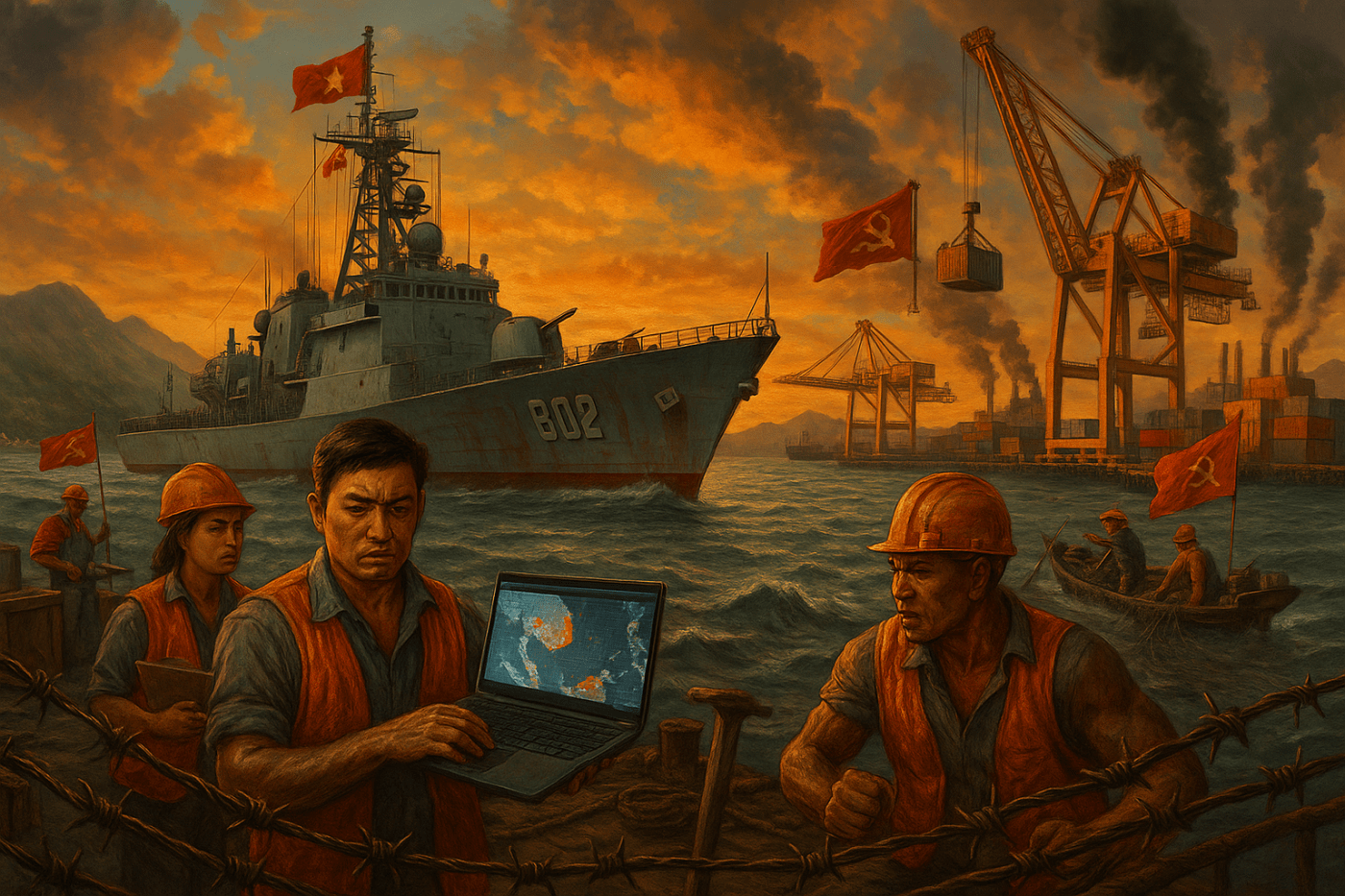
The Pentagon hands off warships, Newsweek hands off narratives, and a comprador class signs away sovereignty—all in time for the 30th anniversary of “normalized” relations
By Prince Kapone | Weaponized Information | June 21, 2025
Ink Over Napalm: Newsweek’s Cutter Diplomacy and the Manufacture of Consent
Newsweek’s breezy dispatch about Washington “growing a defense partnership next door to China” reads like a Hallmark card from the Pentagon. The byline—Hong Kong correspondent Ryan Chan—mirrors the vocabulary of a 2023 RAND playbook on countering Chinese “maritime coercion.” RAND, whose $400-million research portfolio is bankrolled by U.S. Department of Defense contracts, writes the scripts that copyists like Chan run with. That is, by our glossary, Cognitive Warfare with a press pass.
Newsweek itself is no neutral bystander. Still majority-owned by NW Media Holdings, successor to IBT Media, its parent company was enmeshed in a fraud and money laundering case linked to Olivet University—an evangelical sect with cult-like ties. These are not detached journalists; they are pipeline mouthpieces laundering Pentagon policy into PR.
Chan’s piece deploys six weapons in the imperial narrative arsenal:
- Threat Inflation: China is portrayed as an ominous dragon looming over a nervous Vietnam, turning a region of multipolar contestation into a morality play of menace and rescue.
- Humanitarian Euphemism: A 2,700-ton warship is whitewashed as a “search and rescue” vessel using language lifted verbatim from a U.S. Embassy press release.
- Historical Amnesia: The article references “former foes” but omits the eleven nights in December 1972 when U.S. B-52s dropped over 20,000 tons of bombs on Hanoi and Haiphong, killing more than 1,600 civilians.
- Benevolent Binary: U.S. diplomats are given warm quotes about “peace” and “mutual respect,” while China—contacted only by email—is left voiceless, cast as the faceless antagonist.
- Selective Silence: No Vietnamese workers, no anti-imperialist veterans, no independent analysts appear. Empire speaks; the colonized are scenery.
- False Neutrality: A data-visualization map embedded by “Flourish” lends scientific gloss to strategic positioning—pastel dots obscuring missile corridors and naval expansion.
Together, these narrative devices transform an imperial logistics handoff into an act of generosity. This is what Weaponized Information terms Militarized Imperialism via Maritime Outsourcing: a gunboat becomes a lifeboat, occupation becomes outreach.
We caution, however, against drawing crude conclusions about Vietnam itself. U.S. media framing flattens the contradictions within the Vietnamese political process, erasing the revolutionary current that continues to contest comprador policy. As Weaponized Information has previously documented, the Vietnamese Revolution is still unfolding—marked by a struggle between revisionist capitulation and revolutionary sovereignty. Vietnam remains a socialist state navigating a hostile, U.S.-dominated world order. To conflate tactical alignment with total submission is to accept the empire’s narrative as final. We do not.
In the pages to come, we will leave the pressroom and enter the port: exposing the debt traps and extractive contracts that follow the flag transfer, and mapping how revolutionary sovereignty—if it is to survive—must chart a course independent of U.S. empire’s maritime leash.
Material Costs of a “Free” Cutter: Debt, Extraction, and Encirclement
Dawn broke over Ninh Hòa on 18 June 2025 as the former USCGC Mellon arrived after stops in Seattle, Hawai‘i, and Guam. Re-christened CSB-8022, the Hamilton-class cutter joins its sister ships CSB 8020 and CSB 8021—the ex-Morgenthau and ex-John Midgett—delivered in 2017 and 2020. Each ship displaces 2 700 t, carries a 10 000-nmi range, and was built to hunt Soviet subs. Their arrival, choreographed to the 30-year fanfare of “normalized relations,” cloaks a deeper structure of control.
A. The Debt Trap
A 2023 GAO report shows foreign-military-sales “gifts” saddle recipients with tens of millions in life-cycle costs—training, fuel, spares, software. The hull may change flags, but U.S. contractors keep the keys. Raytheon and Lockheed cash the checks; Vietnamese taxpayers risk inheriting the bill. As How to Lose Your Sovereignty in Ten Easy Steps warned, cutter diplomacy converts “capacity-building” into a mortgage on national autonomy.
Yet the cutter hand-off is just the visible tip of a deeper debt regime. Beneath it lies a lattice of conditional lending and “technical-assistance” loans from the IMF, World Bank, and Japan’s JBIC—all packaged as development but tied to surveillance upgrades and customs algorithms that mesh seamlessly with U.S. security standards. Debt servicing is no longer about repayment; it is about real-time compliance with imperial supply-chain governance.
B. Necro-Extractivism
A 2023 study in Nature Sustainability found South-China-Sea fisheries have declined by 70 % since the 1950s, gutting anchovy and scad—pillars of Vietnam’s fish-sauce economy. This is maritime Necro-Extractivism: ecosystems sacrificed to uphold export quotas and insurance margins. Corn Diplomacy and the Class War showed the same logic on land, where grain import deals yoke farmers to imperial supply chains. At sea, cutters enforce that grain-trap mentality—protecting factory trawlers while small crews drown in debt.
Under joint U.S.–Vietnam “illegal-fishing” drills, these cutters routinely board artisanal boats, pushing subsistence crews farther out with no fuel subsidies or safety nets, while licensed industrial trawlers strip reefs under state protection. A maritime caste system emerges: corporate fishing rights backed by imperial hardware; independent labor fined, detained, or exiled.
Vice-Minister of Public Security Lương Tam Quang and PetroVietnam chair Lê Mạnh Hùng embody a revisionist bloc Weaponized Information tracks but does not confuse with Vietnam’s revolutionary totality.
C. Containment Logistics
The 2025 INDOPACOM posture statement brands Vietnam a “containment node.” Raytheon’s $537 million SPY-6 contract funnels encrypted updates through pier-side uploads—sovereignty by password. Cutter diplomacy is one arm of a perimeter meant for choke-point policing, not shared security.
As detailed in World War Sea, the U.S. Empire is weaponizing waterways into digital garrisons. Yet maritime encirclement is only half the trap. The other half is trade-war leverage. Trade Wars and Trapdoors exposed how Washington and Beijing both reroute supply chains to force Vietnam into binary alignment choices—dangling tariff exemptions, semiconductor deals, and rare-earth processing plants. Cutter transfers mesh with that strategy: military hardware on the pier, “friend-shoring” carrots in the export zones, one grand trapdoor slamming shut.
More insidious than hulls and hardpoints is the back-end architecture: AIS transponders upload to U.S. satellites; telemetry streams to Five Eyes cloud contracts. Vietnam does not “receive” cutters—it receives surveillance portals wrapped in sovereign paint. This is digital annexation.
From Chokepoint to Lifeline: Navigating Sovereignty in a Multipolar Sea
Part II tallied the costs in cash, coral, and code. Now we confront the strategic fork: accept a digital collar—or pivot toward multipolar lifelines. A third of global trade threads the South China Sea; whoever scripts the firmware decides whose cargo moves. The 2025 USINDOPACOM Statement demands a “distributed force posture” of proxy nodes—Vietnam foremost—as exposed in World War Sea.
The cutters may fly the Vietnamese flag, but their logic reports elsewhere: software compiled in Massachusetts; officer manuals in English; data uplinks to Five Eyes satellites. Sovereignty here is not the bridge watch—it is the back-end key.
Yet Vietnam’s revolutionary heritage did not vanish with the signing of a defense MoU. As Ho Chi Minh: The Bamboo Lenin reminds us, this country broke French and U.S. chains by merging mass line tactics with global proletarian solidarity. That strategic DNA persists in every fishermen’s cooperative, every dock-union caucus, and every Party debate over market-socialist planning.
Sovereign-aligned forces advance a counter-trajectory. PetroVietnam–Rosneft projects stitch Hanoi into Eurasian energy corridors outside dollar jurisdiction. Choking on the Chain showed how U.S. decoupling fantasies crumble when regional trade routes detour through such multipolar pipelines.
Financial sovereignty gains ground too. Vietcombank and BIDV have joined CIPS, routing liquidity around SWIFT sanctions. As Vietnam’s Crossroads outlined, whether this becomes socialist leverage or neoliberal capture is a live class struggle.
Labor remains a sovereign weapon. Dock-worker unions in Đà Nẵng—700-plus strong—are embedded in the ITF, able to halt retrofits and slow data-cable installations. Their strikes blockade empire at the bolt, not the ballot box.
Peasant cooperatives in the Mekong, state engineers in Cam Ranh, and left-aligned Party cadres push a development path rooted in self-reliance. Cutter hardware thus becomes a pressure gauge: who governs—the comprador block or the revolutionary current?
Weaponized Information calls this Anti-Imperialist Sovereignty: class capacity to command infrastructure without U.S. permission. Every software patch, every joint drill, every fisheries closure is a class decision. And class struggle in Vietnam is far from over.
Whether the tri-cutter squadron tightens a collar or rusts into irrelevance will be decided not in Washington, but in Vietnam’s ports, cooperatives, and Party congresses—where the bamboo strategy of Ho Chi Minh still whispers: bend, don’t break; root, then rise.
Sabotage the Chain, Build Dual Power: A Roadmap from Dockside to Datastream
The cutters are afloat; the narrative is launched. What remains is the struggle over sovereignty. Will Việt Nam’s coastline be subcontracted into U.S. imperial circuitry—or repurposed into a platform for non-aligned, multipolar development? Victory requires more than policy—it demands power. The following are not symbolic acts; they are real leverage points across code, labor, media, and energy infrastructure.
1. Cyber-Resistance
Every Hamilton-class retrofit runs on proprietary firmware compiled by Raytheon. On 2 June 2025, RTX secured a U.S. Navy sole-source contract worth $537 million for SPY‑6 systems integration—including support for “foreign military sales partners.” That code is uploaded pier-side through encrypted update packages. A single leaked hash, installer bug, or admin credential—circulated anonymously through dockworker or engineer Telegram channels—can brick the update cycle, trigger costly audits, and expose the absurdity of calling a cutter “Vietnamese” when it fails without a U.S. password. Anonymous whistle-posting is not sabotage—it is revolutionary debugging.
2. Port-Blockade Tactics
Hardware is worthless if it never leaves the pier. Dockworkers in Đà Nẵng—774 strong as of 2024—are organized and embedded within the International Transport Workers’ Federation, which coordinates strategic slowdowns across over 700 global ports. A 48-hour refusal to berth retrofitted cutters or load U.S. munitions would reverberate from Cam Ranh to Subic Bay. These are not moral appeals—they are economic weapons. If the cutters exist to patrol for empire, then dockers have every right to interrupt their launch.
3. Expose the Think-Tank Pipeline
Political cover for cutter diplomacy is manufactured upstream—through think tanks like Singapore’s ISEAS–Yusof Ishak Institute, a recipient of U.S. NED funds classified as “counter authoritarian influence.” These institutions circulate talking points—“shared norms,” “responsible maritime conduct”—that show up verbatim in embassy briefings and Newsweek headlines. Documenting the funding pipeline in Vietnamese-language media, student unions, and TikTok explainers cracks the illusion of “independent research.” This isn’t analysis—it’s narrative laundering.
4. Build a Dual-Power Economic Corridor
Cutter diplomacy is baited with spare-parts grants. A sovereign alternative is baited with revenue. In Q1 2025, Rosneft reported 20.2 billion cubic meters of gas production—volumes already linked to PetroVietnam’s Block 06.1 and Nam Con Son assets. Expanding that axis to include trans-shipment via Cam Ranh and tank farms under joint Vietnamese-Russian control would anchor industrial development in đồng and ruble, not dollars. Every cubic meter under those terms denies Washington leverage and rewires revenue toward Vietnam’s tool-and-die sector—not Lockheed’s quarterly report.
These tactics are not protest. They are pre-figurative power—acts of dual sovereignty that treat the empire’s hardware as contested terrain. Leak a checksum. Pause a loading shift. Trace a think tank. Sign a ruble fuel swap. None require a majority vote or a revolutionary decree. All require disciplined coordination between dockers, engineers, coders, and cooperatives. That is the material core of anti-imperialist sovereignty.
And if Washington insists on labeling Việt Nam a “containment node,” then the fastest way to shatter the cage is to disable the hinges—one update, one cable, one joint venture at a time.
 Weaponized Information
Leave a comment