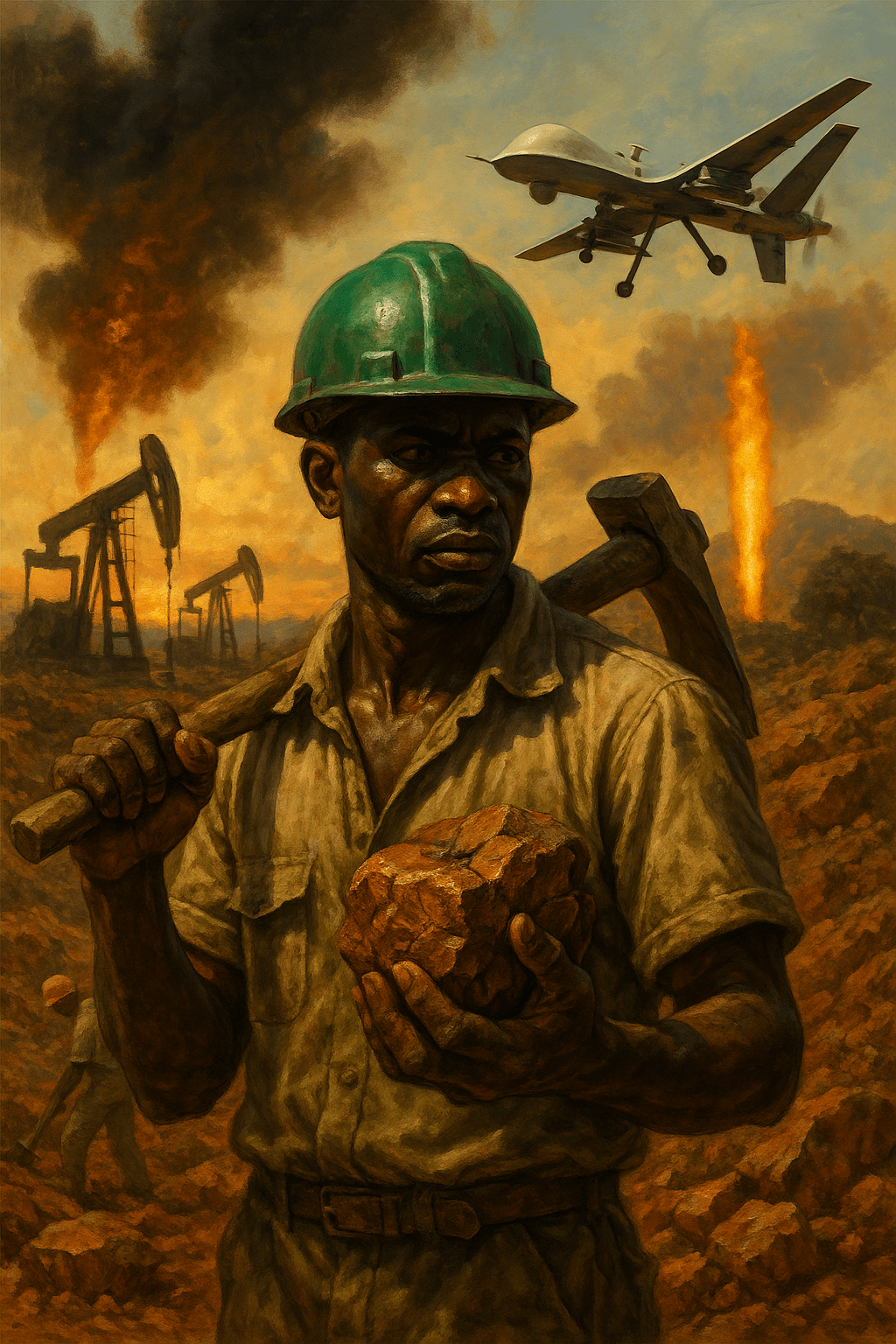
West Africa’s mineral-rich states aren’t “open for business”—they’re open to plunder. But a rising regional revolt is rewriting the terms.
By Prince Kapone | Weaponized Information | June 2025
Part I – Samarium for the Empire: Digging through the Visa Smoke-Screen
The story splashed across Reuters’ Africa wire reads like a polite business memo to Wall Street: West Africa, brimming with samarium and oil, is “ready to do deals,” but President Trump’s looming visa bans might “derail the effort.” The by-line belongs to Ope Adetayo, a hustling Abuja correspondent whose résumé runs through Al Jazeera, The Washington Post, and other prestige outlets before docking at the world’s largest wire service. Here, neutrality is the product: copy trimmed of context, scrubbed of colonial stench, packaged for instant syndication.
Behind the curtain sits Thomson Reuters Corp., a Canadian‑British data behemoth 67 percent owned by the Thomson dynasty’s Woodbridge Company. Its brand promise—“Trust Principles”—masks a century‑long entanglement with bankers, intelligence agencies, and the wider Imperialist Media Apparatus. Whether the copy lands on Bloomberg terminals or in suburban newspapers, the angle stays constant: global resources are assets for Western portfolios, and African sovereignty is an irritating footnote.
Today’s dispatch was piped verbatim onto TRT Global, Turkey’s state‑funded English network. Ankara may posture as a Global‑South champion, yet its newsroom still mainlines Reuters copy—proof that even “alternative” broadcasters outsource Africa to the City of London and Bay Street. Republished wires launder imperial framing through fresh mastheads, giving the illusion of pluralism while repeating the same dominant narrative.
Adetayo’s prose is genteel: travel bans are “non‑tariff barriers,” Nigerians are “strategic alternatives,” and samarium—vital for drone motors and smart bombs—slips in as a neutral commodity, not a mineral soaked in sweat and oil‑misted blood. Missing entirely is the power choreography: Washington weaponises visas as a bureaucratic whip, dangling market access with one hand while tightening a digital noose on African mobility with the other—a move our comrades rightly term technofascism (a fusion of algorithmic control and militarised border regimes).
Also absent is any whiff of class struggle inside Nigeria. The article quotes Foreign Minister Yussuf Tuggar as if he spoke for “West Africa,” eliding the gulf between Abuja’s comprador elite—local profiteers of foreign exploitation—and the nine in ten Nigerians scraping by on less than $2.15 a day, according to the latest World Bank data. No mention of the hunger crisis, the oil‑soaked insurgencies, or the fact that samarium wealth rarely trickles into public clinics. Silence, too, on Trump 2.0’s broader Africa hustle—visa walls, AFRICOM drills, tariff blackmail—outlined in the administration’s own documents and cheer‑sung by Capitol Hill hawks.
In short, Reuters hands us a neatly shrink‑wrapped commodity fairy‑tale: minerals for the taking, Africans grateful, Uncle Sam momentarily distracted by paperwork. Our job is to tear off the plastic. In the next section we excavate the hard facts Reuters buried—Nigeria’s extraction‑dependent state, the regional revolt against ECOWAS, and the hyper‑imperial blueprint stamped “Made on Capitol Hill.” Stay tuned.
Neocolony at the Crossroads: Facts the Wire Forgot
Peel back the diplomatic gloss and Nigeria looks less like an “emerging partner” and more like a textbook extraction-dependent state. Roughly 63 percent of its 220 million people live on less than $2.15 a day, according to World Bank data. Hunger isn’t an accident—it’s a policy, as Weaponized Information exposed in “Starvation as Strategy.” While the elite courts foreign contracts, 33 million Nigerians are projected food insecure by August, per a joint UN–government report.
We heard a similar alarm in the northeast—where UN appeals warned of catastrophic children’s hunger, overwhelmed by floods, war, inflation, and dwindling aid. “We are far from where we want to be,” admitted OCHA’s Mohamed Malick Fall, citing severely underfunded appeals. Meanwhile, civil society organizations including SERAP are calling out the government over hoarded palliatives and failure to help the most vulnerable.
This suffering is useful to Abuja’s ruling class, who declare samarium-rich zones “commercially promising” only after agreeing to overseas contracts in secret. A survey by the Royal Society of Chemistry tested coal fly-ash near Kogi and Oyo and found rare-earth elements—including samarium—ranging between 806–2,100 ppm, crossing the 1,000 ppm threshold often used to judge economic viability. Samarium is not trivia: it’s officially listed as a U.S. critical mineral by the US Geological Survey and vital for permanent magnets used in missiles, nuclear reactors, and satellite technologies.
On the ground, this is not just data—it’s danger. Informal miners in Kogi speak of lung disease and toxic water. “Workers are paid peanuts after long hours without break,” warned the Nigerian Mine Workers Union in 2018, recounting exploitation in Chinese-owned quarries. Meanwhile, Abuja’s mineral licenses bypass local oversight under the 2007 Act, sidelining communities who should own and benefit from sub‑soil wealth.
Now, Trump 2.0 wields the visa dossier. In June, Washington circulated a cable threatening to slap 36 African nations—including Nigeria—with entry bans unless they tightened passport issuance, traveler vetting, and deportee acceptance protocols. Effectively, visas are the new border toll on African mobility.
This isn’t accidental timing. In January, Mali, Burkina Faso, and Niger formally exited ECOWAS to form the Alliance of Sahel States, a military-led bloc resisting Western diktats. The alliance posted strong GDP growth in 2024 (Niger ~9.9 percent; Mali ~3.8 percent; Burkina Faso ~5.5 percent), even as human rights organizations report repression and Wagner-linked crackdowns.
Around them, revolutionary ruptures open space for multipolar sovereignty. In Nigeria, the extraction-dependent elite responds with red carpets for investors and pitch decks for Washington.
This romp falls within a larger structure. In “Technofascism Without the Mask,” we exposed Trump 2.0’s purging of traditional diplomacy in favor of corporate deal‑brokers and AFRICOM liaison officers. In “Empire Reloaded,” we traced the network: rare‑earths, visa walls, militarized data control—strategic assets in a U.S.-led mission to box China out of Africa.
All of this distills to one material test: who owns the earth beneath you, who controls your movement, who eats, and who starves? Nigeria’s elite talk opportunity—but deliver subjugation. In Part III, we name their game: auditioning for subcontractor status in U.S. strategic designs, even as revolutionary tides surge around them.
Begging for Chains: Nigeria’s Desperate Bid to Be Empire’s Subcontractor
Strip away the diplomatic sidestep and you see exactly what’s happening: Nigeria’s extraction-dependent elite—those descendants of cocoa brokers and oil barons—are begging for a seat at America’s strategic table. They’re auditioning as Africa’s version of mid-century South Korea or Taiwan: obedient satellites mired in subjugation, ready to trade minerals for military favour. This isn’t negotiation—it’s submission.
Mining Minister Dele Alake recently trumpeted a $1.3 billion lithium package—two processing plants slated to open by Q2 2025. Foreign media hail it as “confidence-building investment,” yet public hospitals still ration gauze and electricity flickers in Lagos tenements.
ECOWAS trumpets “strategic opportunity,” but regional currents have turned. In January, Mali, Burkina Faso, and Niger formally exited ECOWAS and forged a military-led Alliance to defy Western diktat, chronicled in “The Sahel Doesn’t Beg Anymore.” Nigeria sees that uprising and, instead of learning, doubles down—rolling out red carpets for Pentagon-linked rare-earth firms, signing sweetheart mining deals, and hoping empathy from Washington’s hawks will follow.
Consider the mineral at the heart of it: samarium. It’s not just another rare-earth—U.S. defence memoranda and the U.S. Geological Survey list it as a strategic critical mineral, essential for high-temperature magnets in missiles, submarines, and F-35 guidance systems. China holds 90 percent of refining power, creating a choke-point that hawks call “a chink in our armor.”
But talk of minerals merges with misery on the ground. In Kogi and Oyo quarries, informal miners endure lung disease and poisoned water. A 2012 study of Ebonyi quarry workers—sharing coal-dust exposure—found cough in 40.7 percent, chest pain in 47.6 percent, and shortness of breath in 6.5 percent—none had protective gear. Meanwhile, the Nigerian Mine Workers Union warned in 2018 that “workers are paid peanuts after long hours without break” in Chinese-backed mines.
So the elite pitches samarium to Washington, knowing full well the social cost. It’s technofascism in motion: visa bans tethered to resource concession, border walls linked to drill zones, extractive contracts spliced into national security bills—like Rubio’s “Africa Blueprint” outlining choke-point diplomacy, surveillance walls, and extraction corridors. “Rubio’s Africa Blueprint” makes clear that Nigeria’s job is to manage unrest, guard foreign investment, and deliver minerals—fast.
And let’s be clear: this isn’t debate—it’s betrayal. Civil-society watchdog SERAP has petitioned anti-corruption agencies over COVID-19 food palliatives hoarded in state warehouses; other reports trace the stored relief to multiple states stockpiling supplies meant for the poor. While elites stockpile aid, they auction the sub-soil to foreign bidders.
Yussuf Tuggar dangles samarium before the imperial altar, but he’s not speaking for the youth of Lagos, whose future is outsourced, or the farmers in Benue, whose land is now a buffer zone. He speaks for the fraction clinging to the illusion that U.S. empire is negotiable.
You don’t negotiate upward out of dependency. You beg. You export minerals and accept surveillance. You boast of “strategic partnerships” even as your children starve. This is the gambit of a class terrified of irrelevance.
History is not waiting. Across West Africa, ruptures are happening. The challenge now is whether the Nigerian masses will break from this betrayal—or double down on the chains being laid at their feet.
From Submission to Sovereignty: How Nigeria Breaks the Chain
No, West Africa is not “ready to do deals”—its ruling clique is. And that distinction matters. If Nigeria is to have a future worth living, it will not come from visa dramas or mineral handshakes—it will come from rupture, from refusing to act like a junior partner in another imperial project, from rejecting the lie that extraction equals dignity, and from burning the playbook that says Africa’s only value lies under its soil or in the cheap labor of its people.
Take the Sahel; Mali, Niger, and Burkina Faso didn’t just declare independence—they took back command of their destiny. Military-led regimes expelled French troops, refused IMF austerity, and exposed the hollowness of “partnership,” as shown in “The Sahel Doesn’t Beg Anymore.” Their path was neither clean nor democratic—they are juntas, after all—but it was clear: sovereignty was more urgent than PR reform.
Revolt is not a mistake—it’s a necessity. If Nigeria wants to chart a different course, here are concrete steps revolutionaries should insist on:
- Mandate Community Development Agreements (CDAs): Require legally binding CDAs—guaranteeing 3–5% of mining revenue for host communities, health clinics, schools, and land restoration—before any samarium license. Models in Ghana’s gold sector show CDAs reduce local conflict and promote shared benefits.
- Ban raw rare-earth exports by 2027: Nigeria must follow Ghana’s partially nationalized gold-refinery model, which mandates local smelting before export—capturing an estimated extra $130 million annually and strengthening environmental oversight.
- Join the Sahel tariff shield: Coordinate with Mali, Niger, and Burkina Faso to form a regional tariff bloc resisting ECOWAS and conforming to BRICS+ trade and currency frameworks. BRICS+ now includes nearly 55% of the world population and wields significant bargaining power.
- Enact environmental and labor protections for samarium sites: Women miners’ associations demand full Environmental Impact Assessments and health monitoring to address lung disease, water toxicity, and mercury pollution.
- Launch “Chain‑Free Africa” information campaign: Use social media, community radio, and protest banners to expose visa bans as resource‑control tools, map AFRICOM and rare-earth operations, and demand transparency in all mining contracts.
- Material solidarity for miners: Support mutual‑aid networks offering medical aid, legal support, and coalitions like SERAP to hold officials accountable.
Build genuine solidarity with West Africa’s peoples—not the ministers or corporations. Reject “development through dependency,” whether wrapped in U.S. green-tech slides or World Bank envelopes. Demand dual power structures: cooperatively run mines, local processing, transparent budgets—political sovereignty fused with economic self‑determination.
The window is open. The choice is clear. Embrace multipolar cooperation, forge alliances based on shared struggle, and refuse every chain offered by empire. Nigeria can break from the old scripts—but only if the people refuse to passively accept their fate. History has already begun knocking.
 Weaponized Information
Leave a comment