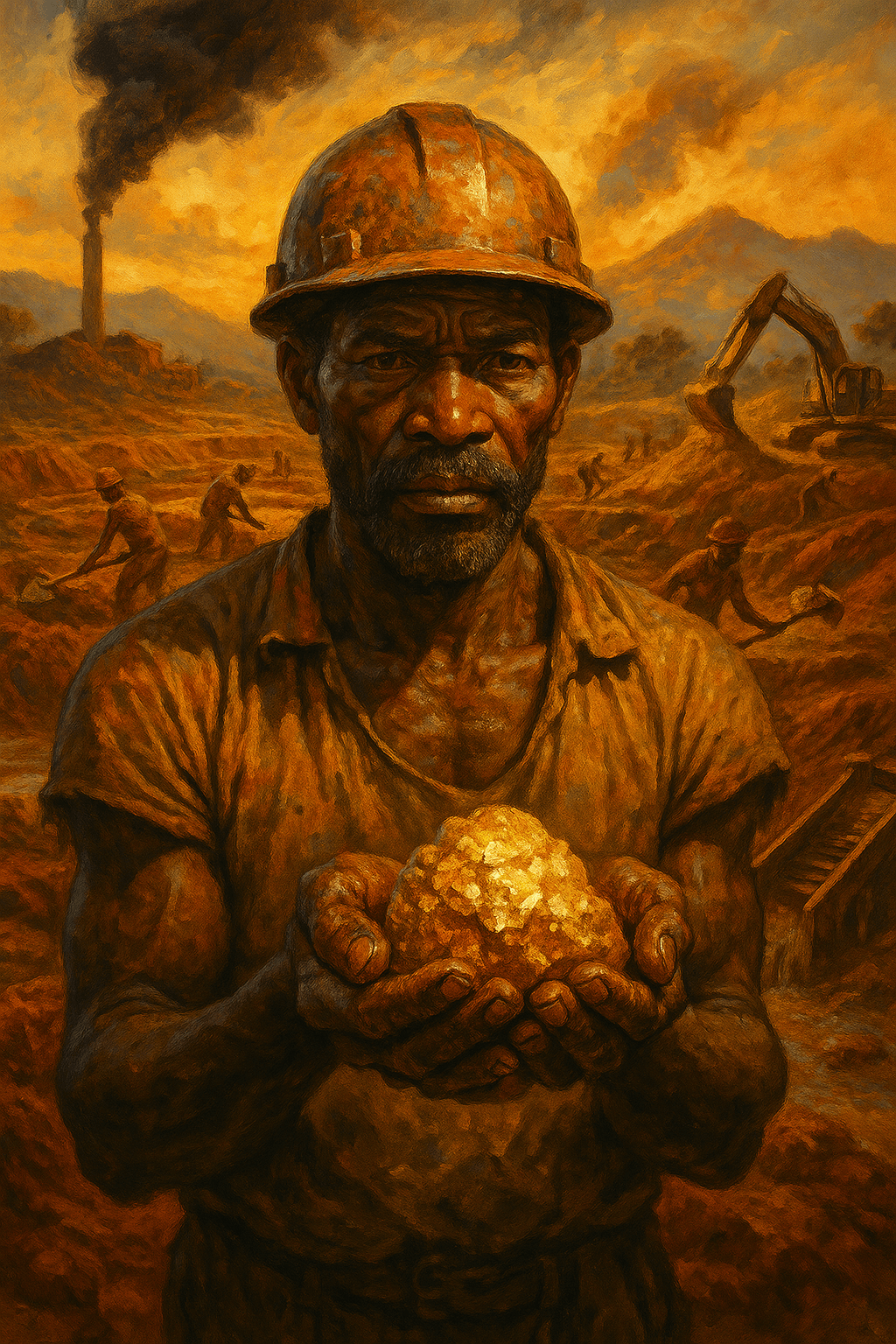
A Weaponized Propaganda Excavation exposing how a glittering bullion program masks necro-extractivism, LBMA chokeholds, and imperial continuity—while also revealing cracks in the colonial chain that hint at future rupture.
Gilded Scripts: How The EastAfrican Polishes a Colonial Chain
On June 17, 2025 The EastAfrican published a Xinhua-bylined dispatch—“Tanzania’s central bank to buy gold from four local miners.” The article celebrates a shiny new bullion programme in which the Bank of Tanzania (BoT) will purchase a tranche of domestically mined gold under the country’s 20 percent “local-sales” quota, presenting the move as a master-stroke of sovereign monetary policy. The copy glitters with talk of “stability,” “value addition,” and “diversified reserves,” inviting readers to admire the spectacle without peering into the shaft beneath the stage.
The byline itself is telling. Xinhua’s reporter files from Dar es Salaam but the story is piped through The EastAfrican, flagship weekly of Kenya’s Nation Media Group (NMG), a conglomerate whose commercial lifeblood is advertising from multinational banks, extractive giants, and donor-funded “development” projects. In other words, the editor’s desk is rent-paid by precisely the forces that profit from smooth commodity frontiers. The author’s class orientation—professional scribe for a corporate newswire embedded in a donor-driven outlet—skews unambiguously toward the managerial wing of the imperial information apparatus.
Cue the chorus: the London Bullion Market Association (LBMA) that certifies “good delivery,” Barrick Gold and Shanta Gold that mine the veins, the Geita Gold Refinery that smelts the ore, and the usual Bretton-Woods book-keepers hovering over the balance sheet. Each player performs a distinct note in the symphony of extraction—refining, pricing, insuring, or underwriting the metal’s voyage from African rock face to Western vault.
Strip away the brass section and the article’s orchestration is clear. It practises the soft art of Cognitive Warfare—selling policy as progress while air-brushing the scaffolding of Financial Piracy that keeps value anchored to London. Euphemisms—“local sourcing,” “market efficiency,” “quality assurance”—mask a chokepoint regime in which no East African refinery appears on the LBMA’s “good-delivery” list, forcing every Tanzanian bar to detour through foreign intermediaries before it can fetch full price on the world market. Omitted entirely are the mercury-laced rivers of Geita, the royalty ceilings penned by World-Bank consultants, and the contractual escape hatches that let Canadian and Guernsey miners expatriate profits faster than bullion cools.
What passes for “sovereignty” in the column inches is really Imperialist Recalibration: the BoT is permitted to hold a little more gold so long as London still writes the receipt. The story’s affective hook—patriotic pride in “home-grown” reserves—functions like a carnival mirror, reflecting an image of autonomy while concealing the hinges of Necro-Extractivism and dollar dominance. It is a textbook performance by the Imperialist Media Apparatus: adorn the policy, omit the poison, and keep the commodity chain humming beneath the applause.
Our task, therefore, is not merely to scrape away the editorial varnish but to reveal the subterranean gears: the bullion chokepoint, the World-Bank fingerprints on mining law, the gendered toxic burdens, and the emerging cracks where Tanzanian workers and planners do inch toward anti-imperialist sovereignty. That deeper excavation begins in Part II.
From Glitter to Grit: Unveiling the Hidden Truths
Let’s unpack the objective facts behind the cheerleading headlines. Since the programme launched, the Bank of Tanzania has stockpiled 5,022.85 kg of gold—equivalent to roughly USD 554 million in spot-market value as of June 13, 2025, according to The Chanzo report. It has already exceeded its six-tonne fiscal-year target.
The Mining Act amendment of 2024 caps state royalty revenue on domestically sourced gold at just 4 percent, while multinational firms—like Barrick Gold—extract outsized profits. As of December 31, 2024, Barrick reported a 16.59 percent net profit margin, according to its key financial statistics on Yahoo Finance.
Tanzania’s chokepoint problem is technical but brutal: no East African refinery is accredited on the London Bullion Market Association’s “Good Delivery” list. That forces all domestic bullion to be trucked through third-party smelters abroad—racking up a value haircut of up to 12–18 percent in swap and quality discount fees. This was clearly documented during Ghana’s gold-for-oil swap fiasco.
We face a deeper hemorrhage—not just of value but of life and ecology. Around 1.2 million artisanal miners handle mercury-based amalgamation, dumping an estimated 13–214 tonnes of mercury annually into Tanzanian air, soil, and rivers. Health Policy Watch covers this crisis, supported by the occupational health data in the NCBI PMC study. In Geita district alone, about 150,000 miners work under constant exposure, with each kilogram of mercury-laced gold generating roughly 1.3 kg of mercury waste, as per Telmer & Veiga’s global assessment.
The poison trails don’t stay local. Significant quantities of methyl-mercury make their way into Lake Victoria, with typical fish exceeding WHO safety limits by 2–5 times. The environmental assessment confirms this alarming reality.
And this toll is unevenly borne. Women comprise nearly 30 percent of artisanal workforces—forcing pregnant bodies to shoulder crippling reproductive and neurological risks, amplified by mercury’s toxicity. Meanwhile, child labor persists in toxic sludge-panning pits under the weight of poverty and coercion.
Beyond health, the UNEP pegs global mercury remediation costs in ASGM-heavy countries at hundreds of millions annually. The UNEP brief outlines the scale of the damage bill.
These facts paint a powerful contradiction: the Bank of Tanzania hoards bullion—and boasts of “sovereignty”—while the state’s royalty share is capped, foreign intermediaries extract upwards of 18 percent fees, and communities bear the costs of mercury’s violence. What shines in the vault is paid for in poison, poverty, and profit extraction.
Finally—and crucially—this “local-content” gold quota is written into the Mining Act under pressure from the World Bank back in 1998, as part of a structural adjustment package that locked in royalty ceilings, foreign concessions (including Barrick’s Bulyanhulu mine), and dependency on IMF indexes. A thoughtful analysis by DIIS confirms that the 1998 Mining Act was explicitly designed as a “World Bank–sponsored mining reform programme,” aimed at liberalizing the sector with tax exemptions and investor protections. And our own earlier Weaponized Information critique in Blood from the Soil supports this reading.
These empirical truths form the bedrock of our material critique—without them, any claim to sovereignty is gilded misdirection. Part III will reframe this fried narrative into a revolutionary roadmap.
The Furnace and the Fable: Reframing Gold as Class War
The headlines speak of gold. But the real story is one of value—and who controls it. Tanzania’s bullion-buying programme is framed as a breakthrough in monetary sovereignty. In truth, it is a reform within imperial constraint: a narrow corridor inside a larger colonial structure. The Bank of Tanzania may hold the bars, but the London Bullion Market Association still controls the certification. Without LBMA’s blessing, Tanzanian gold cannot enter the global over-the-counter market without an imperial escort. This is not freedom—it is a financial leash disguised as prestige.
Yet contradictions ripen in the furnace. The very act of stockpiling domestically sourced bullion signals a desire—however modest—to reclaim national value. As we’ve argued in Furnace of Sovereignty, it’s not the mine alone that matters—but the refinery. In Mali, a new state-owned gold refinery boosted domestic processing by 50%, slashed foreign leakage, and redirected profits toward state coinage and local production. Mali’s move was not cosmetic—it was structural. It seized the means of valuation.
Tanzania’s programme, by contrast, remains embedded in a framework of tax incentives and value export. In 2024 alone, over $120 million in royalties and duties were waived for mining giants like Barrick and AngloGold Ashanti—part of “strategic partnerships” that deepen dependency even as bullion fills the vault. NRGI reporting confirms the scale of these giveaways. The gold may be labeled “Dodoma,” but the receipts still read Toronto and London.
This is the hidden architecture of Imperialist Recalibration: allow minor shifts in surface ownership while preserving the core mechanics of extraction, certification, and value siphoning. It is a system in which former colonies can stock gold—but not price it; refine it—but not sell it directly; extract it—but never escape the toxic costs borne by their people and ecosystems.
And still, cracks form in the wall. In Zimbabwe, the government has recently moved to revive Community Share Ownership Trusts, requiring mining firms to allocate 10 percent of their shares to local host communities through CSOTs—designed to channel profits into schools, clinics, and rural infrastructure. This revival was confirmed by BusinessDaily Zimbabwe’s report on government reforms aimed at empowering communities through shared ownership. BusinessDaily Zimbabwe details the renewed political will behind this initiative. In Ghana, village-based gold cooperatives have started bypassing foreign middlemen, experimenting with credit-backed local sales. In Mali, unionized refinery workers have retooled production toward local jewelry and currency. These are not panaceas—but they are ruptures. They show that it is possible to tear away the monetary mask and seize control of the gold chain itself.
What we witness in Tanzania, then, is not sovereignty—but a contested terrain. A space where contradictions sharpen. The 20% domestic quota is no revolution—but it is a sign of pressure from below, a signal of unease among elites who feel the structure shifting beneath them. It is, as we noted in Gold and the Guillotine, the telltale shimmer of a system bracing for breakage.
The question is not whether Tanzania is sovereign. The question is: who will command the chain of value? Who will control the refinery, the price, the reinvestment? Who will define what gold is for—the IMF or the people of Geita?
That struggle is already underway. In Fortuna’s Flight, we showed how Canadian capital fled Burkina Faso not due to “instability”—but because the masses enforced sovereignty. They demanded control over land, law, and labor. The mine could no longer be looted without resistance. It is this principle—seize the refinery, retake the furnace—that must guide us now.
Gold Cannot Buy Freedom: Toward Revolutionary Control of Value
The Bank of Tanzania’s gold vaults may be full—but the people’s clinics remain empty. This is the contradiction that defines the current phase of extraction: a glittering façade of “national reserves” masking a colonial continuity in the chain of value. As we wrote in Gold and the Guillotine, “sovereignty is not a slogan—it is a seizure.” Until Tanzania’s gold is refined by its workers, priced in its currency, and redistributed for its people, the reserve programme remains a cage gilded in nationalist colors.
We stand not with the finance minister’s press conferences, but with the miners whose lungs darken with mercury, the women who pan poisoned riverbeds, and the youth buried alive in unregulated shafts. They subsidize imperial wealth with their bodies. Our duty—especially those of us living inside the imperial core—is to sever the circuits that turn their gold into Wall Street’s collateral.
There is no room for neutrality. The empire counts on our silence. It relies on the fact that few will trace Tanzanian bullion from rural death pits to vaulted ETFs. But that chain is visible now. And so is our obligation.
Here is what anti-imperialists in the core must do:
- Amplify frontline voices. Share and support organizing efforts by Tanzanian cooperatives like TAMIDA and women-led collectives like TAWOMA. Translate, republish, and prioritize their analysis over ours.
- Target the chokepoints. Expose and pressure the London Bullion Market Association, whose so-called “technical” barriers enforce value apartheid. Investigate its ties to mining multinationals, Western banks, and logistics monopolies like Brinks and Loomis.
- Disrupt imperial finance. Launch campaigns to divest from pension funds, central banks, and ETFs that depend on LBMA-certified bullion. Force disclosure of supply chain abuses tied to Tanzanian gold.
- Resource the struggle. Build strike funds, legal defense pools, and technical solidarity networks accessible to Tanzanian workers and organizers—on their terms, without conditions.
- Link the struggles. Connect Tanzanian necro-extractivism to other imperial chokeholds: the water struggle in Flint, the pipeline fight at Standing Rock, the blood-slick lithium pits in Chile, the prison-labor mines of the U.S. South. Imperialism is global. So must be our resistance.
Our goal is not charity—but co-struggle. Tanzania’s miners are not victims. They are frontline workers in the world-historic fight for control over value. Our role, as comrades in the belly of the beast, is to dismantle the architecture of theft—from LBMA’s pricing desk to Wall Street’s derivatives market.
As we concluded in Blood from the Soil, “the empire has upgraded its tools, but the theft remains the same.” So let us upgrade ours. Let us build dual and contending power not just in Tanzania, but inside the imperial core—from classrooms to coding collectives, from legal networks to sabotage campaigns.
We don’t want more gold in vaults. We want gold turned into clinics, irrigation systems, cooperative granaries, and dignified labor. And we want the people who mine it to govern its use.
Until then, every ounce stacked in Dodoma’s vault is a down payment on another child’s poisoned future. Every press release is a eulogy dressed in finance-speak. And every victory claimed by the Bank of Tanzania is a deferred revolution—waiting to be fulfilled by those who refuse to let gold define freedom.
Endnotes
- “Tanzania’s central bank to buy gold from four local miners” — The EastAfrican (June 17, 2025)
- Nation Media Group — 2024 Annual Report & Financial Statements
- London Bullion Market Association — Good Delivery List (Gold)
- “Ghana’s gold-for-oil programme leaves central bank nursing heavy losses” — Norvan Reports (Feb 27, 2025)
- “Bank of Tanzania boosts gold reserves with new agreements to strengthen gold purchase programme” — The Chanzo (June 17, 2025)
- Barrick Gold Corp. — Key Statistics (Net Profit Margin as of Dec 2024) — Yahoo Finance
- “Tanzania’s gold miners poison themselves with mercury” — Health Policy Watch (April 8, 2024)
- “Occupational exposure to mercury among small-scale gold miners in Geita, Tanzania” — NCBI (Public Health Study)
- “World emissions of mercury from small-scale artisanal gold mining and the knowledge gaps about them” — Telmer & Veiga (2009)
- “Distribution and speciation of mercury in fish from Lake Victoria, Tanzania” — Science of the Total Environment (2005)
- UNEP Global Mercury Partnership — ASGM Thematic Area Brief
- “From enclave to linkage economy: A review of reforms in Tanzania’s mineral sector” — DIIS Working Paper 2016:11
- Natural Resource Governance Institute — Publications Database (Royalty & Waiver Analysis)
- “Mali inaugurates its first gold refinery” — APA News (Nov 2023)
- “Furnace of Sovereignty: Mali’s Refinery and the War for Gold” — Weaponized Information (June 15, 2025)
- “Blood from the Soil: Gold for the Core — The New Face of Colonial Extraction in Africa” — Weaponized Information (June 5, 2025)
- “Gold and the Guillotine: Imperial Propaganda and the Sahelian Struggle for Sovereignty” — Weaponized Information (June 12, 2025)
- “Fortuna’s Flight: How a Canadian Mining Giant Fled People’s Sovereignty in Burkina Faso to Feast in Guinea” — Weaponized Information (May 7, 2025)
- “Zimbabwe Govt Announces Major Reforms to Revive Community Share Ownership Trusts” — BusinessDaily Zimbabwe (2024)
- TAMIDA — Tanzania Artisanal Miners Development Association (Official Site)
- TAWOMA — Tanzania Women Miners Association (Official Site)
- London Bullion Market Association — Official Website
 Weaponized Information
Leave a comment