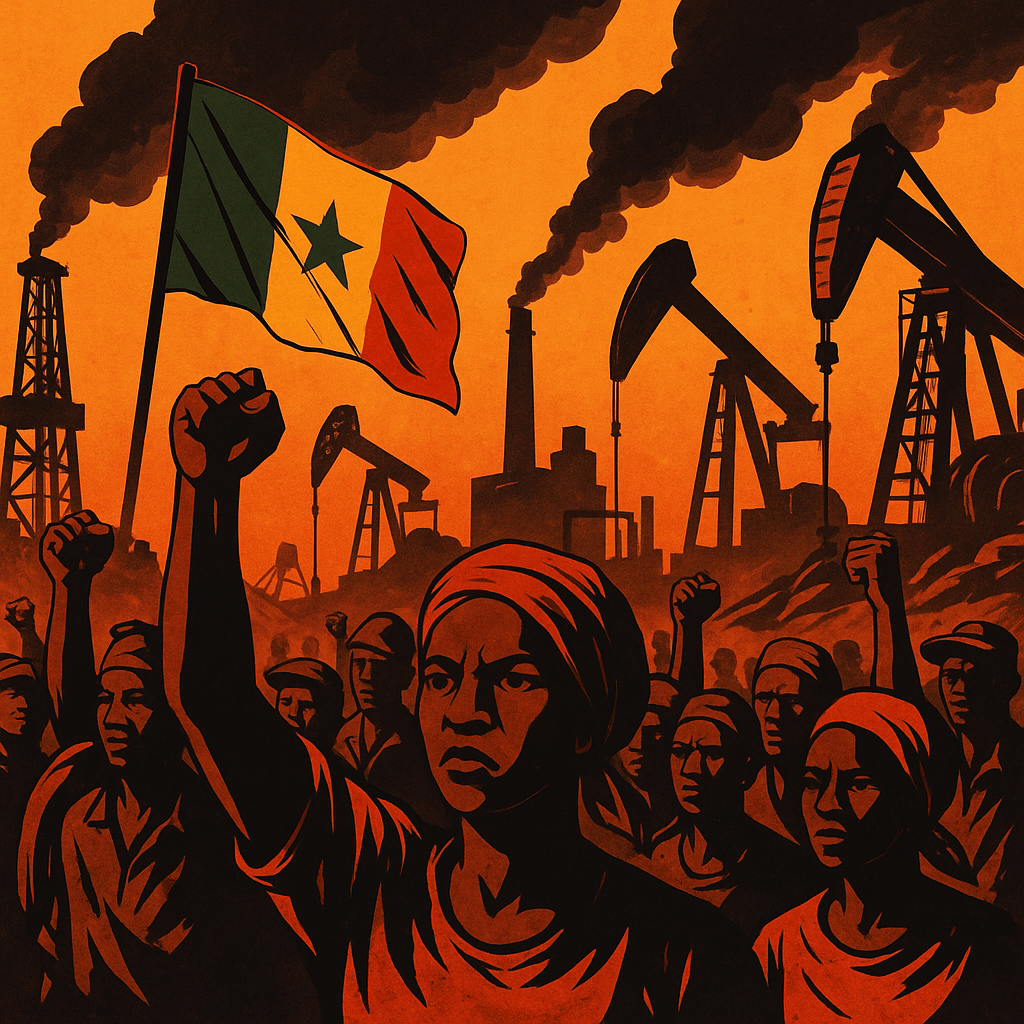
A revolutionary analysis of Dakar’s 2025–2029 plan, exposing the CFA trap, extractive PPPs, and the class war beneath “endogenous growth.”
By Prince Kapone | Weaponized Information | June 15, 2025
Part I – Chains in the Name of Growth: Senegal’s Neocolonial Architecture
The government says development. The people see debt. The experts say fragility. The worker sees hunger. This is not mismanagement—it’s imperial design.
The first part of Senegal’s new national plan opens with a kind of quiet confession. For all the headlines about GDP growth and “emerging market potential,” the country is stuck. Stuck exporting raw goods—gold, phosphates, peanuts, oil—while importing everything of value. Stuck borrowing money to build roads that lead to ports that send wealth abroad. Stuck watching the same old game where foreign companies dig, dredge, extract—and leave behind nothing but poverty and potholes.
They call this model “fragile.” But let’s not flatter it. It’s not weak. It’s predatory. It works perfectly—for French banks, Gulf investors, and the local elites who cash the checks. The mining sector is booming, but only for those who already have power. The economy’s informal sector—where most Senegalese actually work—is ignored, unbanked, and overworked. The state borrows because domestic capital is too busy speculating or fleeing. Less than 5% of exports are processed at home. That’s not underdevelopment by accident. That’s underdevelopment by design.
The plan admits that nearly 37% of the population lives in poverty. That most of the youth—who make up the overwhelming majority—have no jobs and no future. That land is being taken from peasants in the name of “modernization.” That women, especially in the countryside, bear the double burden of unpaid labor and unrecognized production. It’s all laid out, page after page, with cold clarity. What’s missing is the courage to say why it’s this way. This isn’t a failed development model—it’s a very successful system of imperial extraction. Austerity wasn’t a mistake. It was policy. And it worked. Not for the people, but for those who rule over them.
Take the ecological crisis. The plan says climate shocks could cost 8% of GDP by 2030. And what’s the proposed solution? Coastal tourism zones, “resilience corridors,” and Special Economic Zones. Translation: sell the land, evict the fishers, and turn the climate catastrophe into a business model. No mention of land reform. No vision for agroecology. No commitment to give control back to the people who work the land and live with the floods. Climate apartheid wears a green mask now.
And then there’s the state. The plan admits people don’t trust their government. That power is centralized. That corruption is endemic. But what it calls “fragile governance” is, again, not a bug—it’s the system working as intended. A state built to manage dependency, not break it. A democracy that votes every few years, but never decides who owns the mines, who controls the banks, or who eats. Decentralization without real power just means spreading the blame while hoarding the money.
Toward the end of this section, the plan brings up multipolarity. BRICS. African free trade. The promise of something different. And yes, there’s potential there. But let’s be honest: there’s no salvation coming from above, whether it’s Washington, Paris, or even Beijing. BRICS includes capitalist states with their own elite classes. The only sovereignty that matters is the kind built from below—by workers, peasants, women, and youth taking control of their labor, their land, their futures.
What Part I does well is lay bare the facts. The model is broken. The country is stuck. The people are struggling. But the truth is this: diagnosis is not revolution. And no amount of state planning will shift the ground unless the people move. Unless the CFA franc is thrown off. Unless the mines and ports and oil rigs are brought under public, democratic control. Unless cooperatives, not corporations, shape the economy. Unless mass political education and revolutionary organization replace technocratic buzzwords and donor reports.
Part II – From Slogans to Sovereignty: Will “Endogenous Development” Deliver?
Senegal’s planners have traded the gleam of “structural adjustment” for the poetry of “Jub, Jubal, Jubbanti.” Fine words. The question is: who commands the steel, the seed, and the surplus?
After the grim confession of Part I, the Stratégie Nationale de Développement 2025–2029 pivots to hope. It is an ambitious hope, draped in Wolof proverbs and anti-neoliberal bravado. The plan speaks of endogenous development, of consuming what the nation produces and producing what the nation consumes (SND, p. 68). It swears by the moral code of “do right, justify, rectify,” promising transparency in public office and accountability in every franc spent. In a country exhausted by IMF dictates, these words sound like sweet water in the Sahel. But history teaches that water can be bottled and sold before it reaches thirsty lips.
The heart of Part II is a pledge to reclaim the commanding heights: mining, hydrocarbons, agriculture, manufacturing, crafts. The state vows to renegotiate contracts, boost local content, and funnel investment through a sovereign fund (p. 73). It’s stirring stuff—until the fine print arrives. Public-private partnerships will “mobilize capital,” Special Economic Zones will “accelerate transformation,” and export platforms will “integrate Senegal into global value chains” (p. 75). We’ve seen that movie: profits privatized, losses socialized, labor casualized. SEZs become islands where labor law goes on holiday and the environment takes early retirement. If the land is fenced off for duty-free extraction, the slogan of sovereignty rings hollow.
Still, there is a shimmer of possibility. The plan nods to the économie sociale et solidaire, to cooperatives and local innovation funds (p. 77). If worker-run enterprises anchor production—if peasants, fishers, and artisans control credit and markets—then “endogenous” might mean something more than a rebranded trickle-down. But that would require wresting real power from merchants of debt and brokers of raw export. It would require breaking the CFA chain that still tethers Dakar to the Banque de France. The plan praises transparency; yet without monetary sovereignty, transparency merely broadcasts subordination in high definition.
The language of inclusion flows easily: no youth left behind, no woman excluded, no village ignored. But inclusion inside a capitalist shell is often the freedom to queue for the same meager rations. As Vijay Prashad might remind us, “solidarity is not a logo, it is a practice.” And as Karl Marx would grin, “the point, however, is to change it.” So let’s measure this vision by practice: Will land be redistributed or merely catalogued? Will factories be owned by those who labor or leased to multinationals behind patriotic signage? Will hydrocarbon revenue build free clinics and public transport, or service Eurobonds and pay consulting fees?
If the answer tilts toward the latter, Part II is a technocratic lullaby—better lyrics than the IMF’s old dirge, but a lullaby all the same. If the answer tilts toward workers’ power, peasant control of soil and seed, and a hard break from neocolonial finance, then these pages could mark a turning. The choice will not be made in ministerial retreats. It will be settled in union halls, village assemblies, and street corners. That is where “Jub, Jubal, Jubbanti” must find its muscle.
Part III – Implementation on the Battlefield of Class: Who Holds the Lever?
Plans are promises. Budgets are battle orders. Here the struggle leaves the drafting table and moves into warehouses, rail yards, ministry corridors, and village councils. Either the people drive the engine or the old conductors keep their seats.
The third section of Senegal’s Stratégie Nationale de Développement 2025-2029 lays out the gears meant to turn lofty slogans into street-level reality. It speaks the language of logistics: national stockpiles for rice and fuel (p. 95); rail repairs and dry ports to knit the hinterland into markets (p. 98); and a national price-watch system to tame speculation on everyday goods (p. 96). On paper, it looks like wartime provisioning: build reserves, police prices, move grain before it rots. That is no small break from the laissez-faire orthodoxy of yesterday. But as Noam Chomsky would coolly remind us, “policy resides in the details of power,” and that power is still up for grabs.
Take debt. The plan vows to cap deficits, refinance on softer terms, and lift SME credit from 9 % to 14 % of bank lending (p. 102). But the CFA franc remains under Parisian lock-and-key; interest-rate policy is set in a boardroom miles north of the Sahara. How do you march toward sovereignty with a colonial currency strapped to your ankle? Karl Marx would mutter, “The debtor is the true serf of our time.” Unless that chain is broken, every repayment schedule becomes a siphon of surplus from Dakar to the City of Light.
On infrastructure, the document promises to stitch the country together—roads to the peanut basin, rail to the mining corridor, river ports for the east. Fine. But whose bulldozers, whose cement, whose ownership? Public–private partnerships are again invited to “mobilize capital” (p. 104). History’s verdict on PPPs is brutal: public risk, private reward. Without worker representation on every project board, without transparent contracts published in Wolof and Pulaar, the bulldozers will pave profit corridors while the villagers pick dust from their teeth.
Then comes the bright star in the chapter: the économie sociale et solidaire. Co-ops, mutuals, neighborhood funds, grassroots incubators—the plan hands them a legal framework and a budgetary toe-hold (p. 107). Here lies a real possibility: peasants organizing seed banks, women’s collectives running dairy plants, transport unions managing bus fleets. Yet the same paragraph invites “impact investors” and CSR-branded philanthro-capitalists to shepherd the process. Walter Rodney would slam the table: “You cannot decolonize with the colonizer as consultant.” If NGOs and foreign funds steer the solidarity economy, the wolf is back in sheepskin.
Finally, the plan unveils its digital dashboard—KPIs, public scorecards, quarterly audits (p. 110). Transparency is good, but data never dethroned a landlord. A spreadsheet can expose a scandal; only organized people can end it. If monitoring bodies do not seat union delegates, peasant leaders, and street-vendor associations, the numbers will glow on screens while corruption skulks behind curtains.
So Part III leaves us on a razor’s edge. The tools assembled could fortify popular sovereignty: price controls to defend wages, stockpiles to defeat hunger, co-ops to root production in community, and debt rules to block speculative looting. Or the same tools could be handed to the usual suspects—consultants, creditors, and contractors—who will rewire them for profit and call it progress. Implementation, as Vijay Prashad likes to say, is not about algorithms but alliances. Which class holds the lever—that is the only metric history remembers.
Part IV – Anchoring or Rebranding? The Final Provisions and the Struggle for Power
This is where most plans end: with maps, diagrams, and managerial flourishes. But history doesn’t end in annexes—it begins wherever the people take control. Will this be a foundation or a façade?
The final section of Senegal’s Stratégie Nationale de Développement 2025–2029 turns its gaze toward territory, institutions, and what it calls “anchoring.” It promises to rebalance investment away from the colonial core of Dakar and toward historically neglected zones. It lays out a blueprint for regional development poles, sectoral value chains, and inter-ministerial coordination. It even pledges to integrate the informal economy—long treated as a problem—into national planning. On paper, it reads like a sincere attempt to democratize geography. But the question remains: who is anchoring what, and for whose benefit?
Territorial development, we’re told, will be driven by local economic potential and population dynamics. But we’ve heard this before. When imperial cartographers drew the first colonial borders, they too claimed to respect “local conditions.” The danger here is not decentralization—it’s delegated control without real autonomy. If regional “co-management” means handing rural development to unelected bureaucrats, NGOs, and private investors, then all we’ve done is repackaged colonial command in participatory language.
The section then turns to the private sector. A dedicated strategy (SNDSP) will develop SMEs, start-ups, cooperatives, and “structured enterprises.” In theory, this could stimulate domestic production. In practice, this often means lubricating the rise of a national bourgeoisie—local capitalists trained to replace foreign ones, not to abolish exploitation. If these “national champions” are not bound by public mandates, labor standards, and cooperative principles, they will become what Fanon warned of: a bourgeoisie that mimics its colonizer while trampling its own people.
But perhaps the most delicate move here is the plan’s approach to the informal sector. It recognizes, finally, that this is not a “problem” to be solved, but the lifeblood of Senegal’s economy. From street vendors to transport workers, from women in open-air markets to artisanal fishers, the informal sector is the real foundation of survival. Yet the proposed “integration” sounds suspiciously like formalization on the state’s terms—registration, taxation, and datafication. That’s not empowerment; that’s enclosure. Unless integration means investment, training, infrastructure, credit, and control by the workers themselves, this is just surveillance in a development mask.
The plan concludes with a call for institutional coordination and statistical monitoring. Decentralized committees, performance indicators, participatory reviews. These are useful instruments. But let’s not confuse instruments with power. An evaluation dashboard cannot expropriate a foreign concessionaire. A commune-level meeting cannot redistribute land if the land registry is controlled by technocrats in the capital. Participation without power is the opium of modern development policy.
So we return to the original question: is this anchoring or rebranding? Is this a rupture with the past or a smoother version of the same dependency? The answer, as always, won’t be found in the text. It will be found in whether the masses of Senegal—peasants, workers, youth, and women—are organized enough to demand, defend, and direct the transformation promised here.
Weaponized Information’s final word: the language is promising, the structure is improved, and the diagnosis is clear. But unless the working and peasant classes are the architects—not just the audience—this plan will be co-opted. Anchor it in the people, or watch the comprador class moor it to the same old empire in new regional paint.
 Weaponized Information
Leave a comment