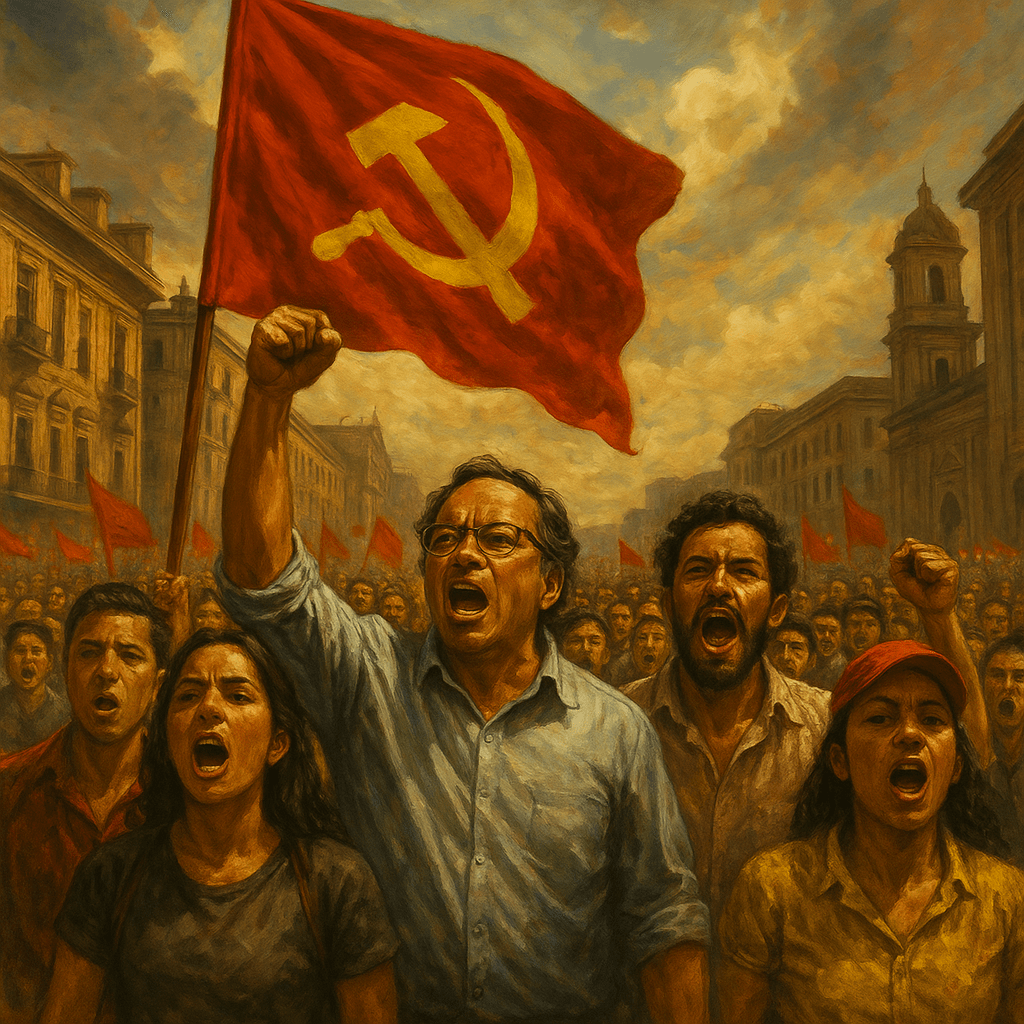
This isn’t a legal gamble—it’s a class insurgency. Petro’s referendum isn’t bypassing democracy. It’s invoking it, in the only language the oligarchy fears: mass participation backed by working-class power.
By Prince Kapone | Weaponized Information | June 12, 2025
I. When the Ruling Class Cries “Unconstitutional”
On June 11, 2025, AP News published a story that, at first glance, might seem like routine political reporting. The headline reads almost dispassionately: “Colombia’s President seeks referendum after Congress blocks labor reforms.” But the text is anything but neutral. Through veiled warnings, selective omissions, and polished legalese, the article paints a picture of an ambitious president “bypassing” legislative norms to push “leftist” labor reforms—implying recklessness, danger, and constitutional crisis. As always, the bourgeois press plays referee while wearing the jersey of the owning team.
The article was filed without a byline—a common imperial journalistic tactic when the narrative needs to be sanitized, institutionalized, and presented as unchallengeable fact rather than authored opinion. But anonymity doesn’t absolve complicity. Byline or not, AP’s house style has long reflected a class commitment to market order and elite continuity. It rarely speaks truth to power—it speaks in the voice of power, dressed in the language of “objectivity.” As one of the cornerstone institutions in the Western Imperialist Media Apparatus, the Associated Press is structurally beholden to the ideological needs of Wall Street, Washington, and transnational capital. Funded by corporate subscriptions and dependent on access to elite sources, its reporting reflects the assumptions, anxieties, and worldview of the ruling class—no matter how calmly it’s phrased.
The story gives voice—without critique—to institutional mouthpieces like Senate President Iván Name and representatives from Colombia’s high court, casting them as neutral defenders of law and order. Also mentioned are unnamed “business leaders” and “critics” who warn that the referendum could “destabilize institutions.” These are not casual observers; they are structural defenders of oligarchic rule, embedded within the architecture of Colombian capitalism and imperial stewardship. Their worry isn’t over legality—it’s over legitimacy slipping from their grip.
Let’s get to the bones of the thing. This isn’t journalism—it’s narrative policing. The article’s central move is its framing of President Gustavo Petro’s executive decree as a deviation from constitutional order. By using the phrase “bypass Congress,” AP implies an act of subversion or illegality, rather than what it is: a constitutional mechanism to take a repeatedly blocked reform to a democratic referendum. The rhetorical sleight-of-hand is elegant in its dishonesty: it turns executive initiative into executive tyranny by omission of legal context and political necessity.
Second, the article uses Cold War shorthand to tag Petro as a “leftist” president—no mention of his base among Colombia’s working poor, nor the vast informal sector that his labor reforms seek to address. This “leftist” label isn’t descriptive, it’s disciplinary: it flags him as an ideological aberration, a disruptor of market orthodoxy, and a potential threat to the natural order of neoliberal governance. The term functions as a subtle alarm bell to investors, NGOs, and U.S. policy planners: beware, populism is afoot.
Third, the piece consistently centers “stability” and “governance” as threatened values, without once naming the class structure that defines what counts as stable or whose governance is being protected. There is no mention of Colombia’s entrenched labor informality, nor of the country’s notorious history of anti-union violence—because to mention these would expose the real disorder of oligarchic capitalism. The only “instability” here is elite discomfort at the possibility of actual labor rights being codified by popular will.
Fourth, there’s the glorification of Congress itself—framed as a bulwark against executive excess. But AP fails to ask the fundamental question: whose interests does this Congress represent? The article offers no analysis of the class makeup of the legislature or its voting record on social reforms. In this absence, bourgeois institutions are assumed to be neutral, their obstruction recoded as prudence.
Fifth, the article gives surface-level coverage to the labor reform’s content but offers no space for the demands of workers themselves. There are no quotes from unions. No voices from street protests. No articulation of what an eight-hour day or holiday pay means for someone working 12-hour shifts with no contract. The people most impacted by this story are denied narrative agency entirely. This is more than omission—it’s narrative class erasure.
And finally, there’s the subtle moralizing of Petro’s decision. The article says he “announced he would call a referendum” after being blocked twice by Congress—suggesting impulsiveness, vindictiveness, or a hunger for power. There’s no exploration of how this maneuver might be a calculated, legally grounded response to institutional sabotage. The reader is left to infer that Petro is acting rashly, emotionally—qualities long ascribed to leaders from the Global South challenging capitalist orthodoxy.
In sum, this is not a neutral report on Colombian politics. It’s a textbook case of Cognitive Warfare, waged through syntax, structure, and selective silence. It polices the boundaries of acceptable political conduct—not for democracy’s sake, but for capital’s. And when workers push too hard, when presidents stop asking for permission, this is the kind of journalism that shows up to warn them back into line. But the line is moving—and it’s not Petro who’s stepping out of bounds. It’s empire, shaken by the possibility that in Colombia, history might once again be written from below.
II. Beneath the Surface: What the Headlines Leave Out
When the Associated Press told its readers that Colombia’s president was “bypassing” Congress, it left something critical out: Congress had already bypassed the people. Twice. In March and again in May 2025, Gustavo Petro’s proposed labor reform—a 12-point package focused on job security, fair scheduling, and improved compensation—was struck down in narrow votes by a legislature stacked with business-aligned conservatives. Petro’s move to invoke a national referendum was not an impulsive sidestep. It was a structural correction. Yet nowhere in the original reporting does this context appear. To name the facts plainly would rupture the illusion of institutional neutrality.
The truth is, Petro’s labor reforms strike at the core of Colombia’s oligarchic labor model. And that model is rotten.
As of 2024, nearly 47% of Colombian workers operate in the informal economy—no contracts, no benefits, no bargaining rights. ILO data confirms that Colombia remains among the Latin American countries with the highest informality rates, especially affecting women, youth, and gig workers. These workers clean homes, drive taxis, deliver food, and sell fruit in the streets. They keep the economy moving but live outside the protection of the law. Petro’s reforms would begin to pull them into visibility—starting with guarantees like an eight-hour workday, double pay on holidays, and social protections for app-based labor.
Even more invisibilized is Colombia’s violent history of labor repression. Since the 1980s, thousands of unionists have been assassinated by right-wing paramilitaries, often with the tacit approval—or direct collusion—of the state.
Amnesty International has documented how multinational firms like Chiquita Brands admitted to financing paramilitary death squads such as the AUC, particularly in regions with strong union activity. In Colombia, capital doesn’t just bargain with labor—it often eliminates it. That history isn’t procedural. It’s structural. And it shapes every legislative vote, judicial maneuver, and headline.
This institutional blockade is no accident. As documented in Weaponized Information’s coverage of the failed May vote, the congressional rejections of Petro’s labor plan were not technocratic objections—they were acts of class war, coordinated by entrenched economic elites and international financial interests. The oligarchy didn’t just vote “no” on labor justice; it voted “yes” to preserving its control over wages, time, and legality itself. And it did so knowing that mass resistance was already underway—from transport workers and gig laborers to trade unions and student blocs mobilizing in defense of the reforms.
Nor is this conflict confined to the urban economy. As Weaponized Information has exposed, rural Colombia is locked in a parallel battle over land, autonomy, and survival. The state’s so-called crop substitution program—backed by USAID and financial technocrats—functions as a counterinsurgency weapon to criminalize poor farmers and reassert elite control over coca zones. This isn’t just a war on drugs—it’s a war on livelihoods. What ties these struggles together is their shared enemy: an oligarchic state structure designed to discipline the working class—whether through congressional sabotage or paramilitary pacification.
The media also obscures the broader geopolitical moment in which this referendum is unfolding. Petro’s Colombia is not just battling its own internal oligarchy—it is repositioning itself within a changing global order. In May 2025, during the 4th CELAC–China Forum, Petro joined other Latin American leaders in advancing multipolar collaboration with Beijing—signaling a break from decades of U.S.-led hemispheric control. His domestic reforms are part of this broader political orientation: a challenge to the IMF-backed model of flexible labor markets, debt servitude, and foreign investment dependency. The AP’s refusal to place the referendum within this hemispheric shift is no accident. It maintains the illusion that Colombian politics occur in isolation, rather than as part of an emergent wave of anti-imperialist sovereignty building across the Global South.
The referenda strategy itself has historical resonance in Latin America. It recalls Venezuela’s Bolivarian process under Hugo Chávez, where direct democracy was used not as a populist stunt but as a revolutionary tool to bypass oligarchic bottlenecks and legitimize mass social transformation. That memory still haunts the Western media class. Which is why they frame Petro’s decree not as a democratic intervention, but as a constitutional gamble. But for the Colombian working class, this is no gamble—it’s the only path left.
We must also remember that labor reform is not a gift from above. It is being demanded from below. In the final days of May 2025, the Central Unitaria de Trabajadores (CUT) and other major unions launched a 48-hour general strike in support of the referendum. These were not symbolic marches—they were class offensives. From Medellín’s metro operators to Bogotá’s delivery workers, the streets erupted with the sound of collective refusal. This was not chaos. This was a counter-narrative in motion. And it was barely a footnote in the international press.
When we pull back the curtain on the mainstream narrative, what we see is not a power-hungry executive flouting the law. We see a president—elected by a multiracial working-class coalition—responding to the structural sabotage of elite institutions. We see a population long excluded from labor protections taking hold of the only mechanism left: direct democracy. And we see a regional context in which Colombia’s realignment with anti-imperialist blocs is reframing labor rights not as charity, but as sovereignty. The corporate press won’t tell that story. But history just might.
III. Not a Crisis—A Confrontation
What the oligarchy calls a “constitutional crisis” is in fact a confrontation it can no longer avoid. Not just with Gustavo Petro, but with the very class it has tried to erase—informal laborers, domestic workers, delivery drivers, teachers, miners, students, and the forgotten rural poor. This referendum is not the story of a rogue president—it is the story of a reawakening proletariat using the state as a battlefield, not a cathedral. And that is precisely what unnerves the empire’s mouthpieces. Because when the working class begins to shape law not through petitions but through power, the ruling class no longer gets to narrate the future as theirs.
The Western media narrative depends on one trick above all: recoding rupture as recklessness. Petro’s decision to take labor reform to a national vote is framed not as strategy but as desperation, not as organization but as overreach. But there is a long revolutionary tradition behind these tactics. From Venezuela’s Bolivarian referenda to Bolivia’s plurinational assemblies, popular mandates have been used across Latin America not merely to ratify elite policy but to assert the political will of the colonized, the dispossessed, the poor. These were never smooth or polite processes—they were struggles over the meaning of sovereignty itself. That struggle has now come to Colombia.
For the empire and its local enforcers, this is a dangerous moment. Not because Petro is violating the constitution—he isn’t—but because he is revealing what the constitution has always protected: property, profit, and the procedural façade of oligarchic rule. By calling a referendum, he invites millions of workers to reenter the political terrain as protagonists. Not clients. Not spectators. But class combatants. This is not instability. This is insurgent democracy, and the ruling class knows it. That’s why they’re panicking.
To understand why the backlash is so ferocious, one must look beyond legal categories and into geopolitical fault lines. Petro’s Colombia is emerging as part of a larger axis of resistance across the Global South—a realignment that includes China, Brazil, South Africa, and much of CELAC. At the 4th CELAC–China Forum, Petro signaled a strategic break from the Monroe Doctrine and its embedded neoliberal logic. That alignment is not just diplomatic—it’s economic. It threatens to reroute capital flows, challenge Western labor standards, and elevate anti-imperialist models of development. In that context, Colombia’s labor referendum is not just domestic legislation—it is a declaration of sovereign economic war. Not with bombs, but with ballots. Not through occupation, but through organization.
And what terrifies the empire is not just that Petro is acting, but that people are following. This is how revolutions incubate: not in decrees alone, but in mass political activation. In factories. In schools. In the cadence of street chants and the defiant silence of those who refuse to return to work without rights. The general strikes that rippled across Colombia in support of the referendum weren’t adjuncts to Petro’s agenda. They were a parallel force—spontaneous, organized, militant. This is dual and contending power in embryonic form. A state still largely managed by capital, now being pressed from below by a proletariat in motion.
This rising dual power is precisely what the ruling class and its media auxiliaries are desperate to contain—not through bullets, but through narrative. As Weaponized Information recently revealed, even an assassination attempt on opposition senator Miguel Uribe Turbay was rapidly reframed and instrumentalized by the press—not to investigate Colombia’s deep structures of political violence, but to smear Petro and recenter elite victimhood. The message was clear: Petro must not be allowed to symbolize anti-imperialist rupture. He must remain suspect, destabilizing, irrational. If the bullet doesn’t strike its target, the narrative will. This is how cognitive warfare operates in the age of hyper-imperialism: not merely by suppressing truth, but by suppressing meaning itself.
This is why the media cannot allow Petro to be seen as anything other than a threat. They need to strip his action of historical resonance, isolate him from regional currents, and reduce him to a power-hungry outlier. But that narrative is cracking. Because from Quito to La Paz, from Caracas to Bogotá, a new vocabulary is being spoken. It does not ask for development. It demands liberation. And in that grammar, Petro’s referendum is not a rupture from law—it is a rupture from imperial logic.
This moment is not just about one president or one reform. It is about who gets to define the limits of the possible. The ruling class wants labor to remain a market variable. Petro is saying labor is the foundation of democracy. The oligarchs want consent without participation. The referendum insists on participation with power. The empire wants a Colombia that behaves. Petro and the people are offering one that belongs—to itself, to its workers, to its history, and maybe, just maybe, to the world that is coming.
IV. The Line Has Been Drawn—Now Cross It
If the ballot box is where this battle will be decided, then the streets are where it will be won. Petro’s decree has opened a door, but it is the working class that must walk through it—marching not behind him, but beside him, and sometimes ahead. And that’s exactly what’s already happening. In cities across Colombia, the slogan is not just “Sí al referendo”—it’s “El pueblo manda.” On June 11, while elite commentators bemoaned constitutional decay, the masses surged forward: Bogotá, Medellín, Cali—thousands in the streets, waving union flags and banging pots, not asking for reform but demanding it. This isn’t public opinion—it’s public power.
And this isn’t spontaneous either. For months, organizations like the Central Unitaria de Trabajadores (CUT) and Confederación General del Trabajo (CGT) have been building the scaffolding of resistance. In late May, they called a 48-hour general strike that united transport workers, teachers, gig drivers, Indigenous organizations, and the urban unemployed. It was not a strike of slogans—it was a strike of logistics. Roads blocked. Deliveries stopped. Entire cities slowed to a halt by the very people who make them run. These are not support actions. These are premonitions of a new order.
What’s happening in Colombia isn’t just national—it’s continental. At the 4th CELAC–China Forum, Petro aligned with regional leaders seeking not reform but rupture: a break from IMF-era labor flexibility, foreign capital subservience, and Washington’s veto over domestic sovereignty. Petro isn’t asking for permission—he’s offering a new precedent. And if it succeeds, it will not stay within Colombia’s borders. Workers in Peru, Chile, Honduras, and Argentina are watching. Organizers are watching. Empires, too.
And so we raise the question: what must we do from outside Colombia’s borders, from within the belly of empire itself? First, we must break the informational blockade. The media disinformation campaign that paints Petro as unstable and the referendum as reckless must be countered by independent, worker-aligned propaganda. Socialists, anti-imperialists, and trade unionists must flood digital channels with counter-narratives: videos, memes, explainers, press releases, even translated campaign material from CUT and CGT. We don’t need permission—we need bandwidth.
Second, we organize material support. Solidarity isn’t a tweet—it’s logistics. Organize international fundraisers to supply Colombian strike committees with banners, sound equipment, printing tools, and transportation stipends. Connect with local diasporic groups. Set up WhatsApp chains. Sponsor a block in the next march. Make support visible and sustained. Build dual infrastructure for solidarity—political and material.
Third, we launch transnational worker actions. On the day of the referendum—whether in August or pushed further—call for coordinated symbolic strikes targeting U.S.-based companies operating in Colombia: Uber, Rappi, Coca-Cola, and Amazon supply contractors. These corporations feed off the same exploitative labor pool Petro’s reforms aim to uplift. Hit them where it hurts: at the point of profit.
Finally, and most critically, we must treat this referendum not as Colombia’s isolated moment—but as a spark in a much larger blaze. The referendum is not just about holiday pay. It’s about building dual and contending power: democratic muscle independent of elite mediation. It’s a prototype of mass popular control. And it reminds us that the working class, when mobilized with clarity and organization, doesn’t need permission to govern—it only needs the power to do so.
So cross the line. Amplify the movement. Break the silence. Build the networks. The oligarchy will vote no. The empire will whisper caution. But the masses have already said go. And if we are who we say we are—organizers, comrades, revolutionaries—then we must say it too. Not in words. In action.
Further Reading and Source Citations
- AP News – “Colombia’s President seeks referendum after Congress blocks labor reforms” (June 11, 2025)
- ILO – “Transitioning from the Informal to the Formal Economy in Latin America and the Caribbean” (2024)
- Amnesty International – “Colombia: Corporate Complicity and Paramilitary Violence” (2007)
- Weaponized Information – “The Oligarchy Votes No, The Masses Say Go” (May 16, 2025)
- Weaponized Information – “Cash, Coca and Counterinsurgency” (June 4, 2025)
- Weaponized Information – “When the Bullet Misses, the Narrative Doesn’t” (June 8, 2025)
- Weaponized Information – Redlines: May 30, 2025
- Green Left Weekly – Homepage
- Al Jazeera – “Colombia Protests Erupt in Support of Referendum” (June 11, 2025)
- SASK – International Solidarity Programs (2025)
- Council on Foreign Relations – “Colombia’s Political System: A Broken Party Order” (2022)
 Weaponized Information
Leave a comment