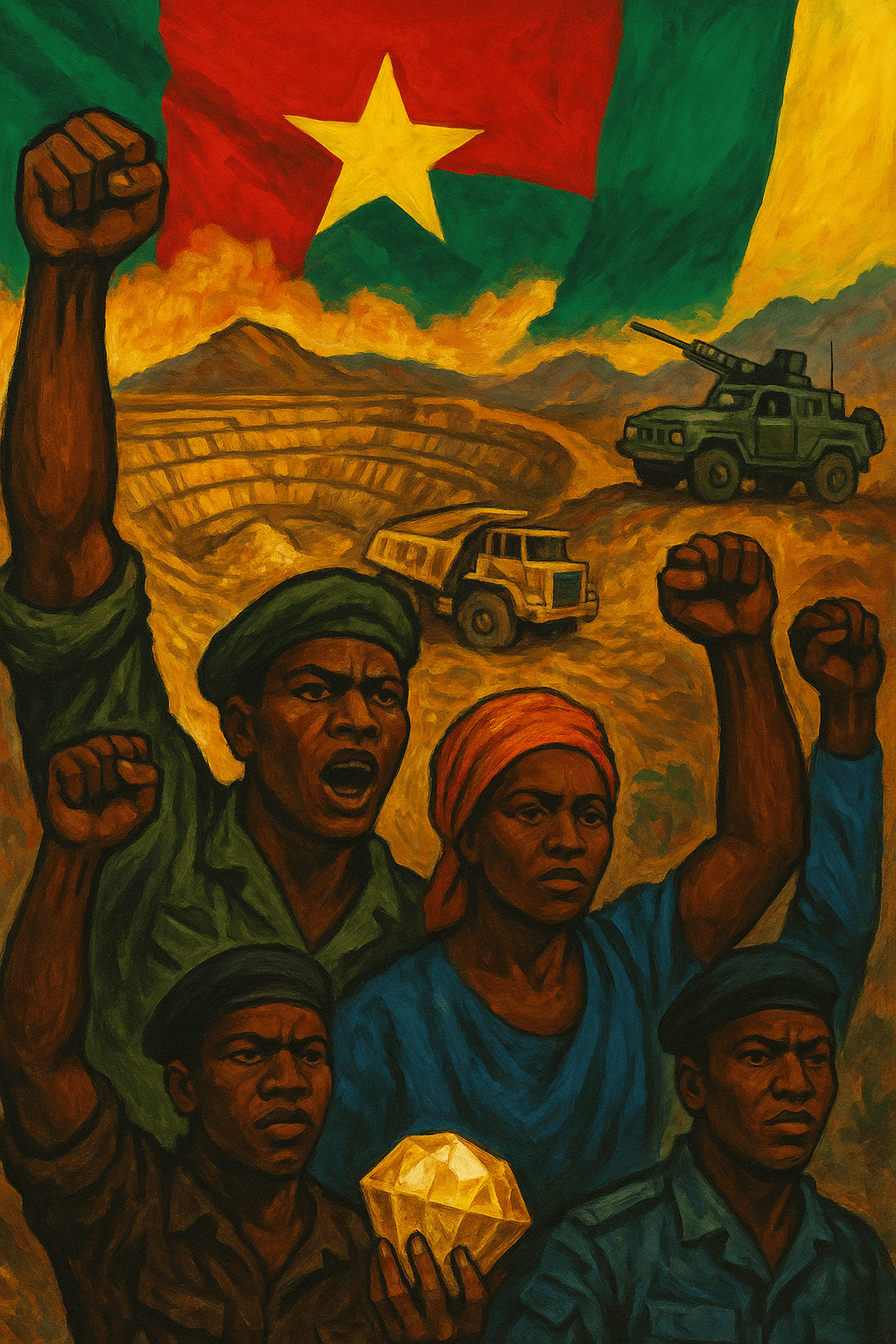
Burkina Faso and Mali are reclaiming their gold—but Western media calls it “instability.” What’s really being threatened isn’t investment. It’s empire.
By Prince Kapone | Weaponized Information | June 12, 2025
I. The Narratives of Empire, Gilded in Panic
In June 2025, a pair of dispatches from Business Insider Africa and Reuters landed like mortar shells in global investor circles. They warned that Burkina Faso had nationalized five major gold assets—and Mali had frozen exports, detained foreign staff, and seized three metric tons of gold from Barrick, pulling its Loulo–Gounkoto complex from production forecasts. To Western capital, this was “instability.” To empire, it was a threat. But the question we must ask is this: whose empire?
“Empire” here isn’t a metaphor—it is a structural apparatus functioning through three converging vectors: financial coercion wielded by institutions like the IMF and World Bank; militarized enforcement via French garrisons, U.S. bases, and UN missions; and legal weaponization through ICSID and arbitration courts that enforce investor rights above national sovereignty. It is a system designed to ensure that African gold flows outward and power remains external.
Yet Reuters and Insider treat this as a technical disturbance—“dispute over new mining legislation,” “uncertainty for investors.” They never ask: how much gold has already disappeared? How many human lives were sacrificed to foreign profit? Mali exported 72 tons of gold in 2024 but still ranked among the world’s poorest nations—rich in resources but not in investment for its people. That, not the intervention, is the real crisis.
Media coverage is not neutral. Business Insider Africa is an affiliate of Insider Inc.—a digital platform shaped to serve capital, funded by venture capital and ad dollars that depend on growth narratives. Reuters, owned by the London Stock Exchange–listed Thomson Reuters Corporation, is the ideological core of the Imperialist Media Apparatus: disciplined neutrality in service of capital flow, foreign policy coordination, and investor psychology.
This coverage amplifies and legitimizes empire by framing national resource reclamation as a risk to global markets. The real crisis—necro‑extractivism, where land, life, and labor are sacrificed on the altar of profit—is erased. Instead we get platitudes about “investor confidence” and “export stability.” And who benefits? The shareholders of Barrick, Endeavour, B2Gold, IAMGOLD—who export not only gold, but also corporate tax evasion, environmental destruction, and paramilitary complicity.
Meanwhile, Sahelian voices are silenced. No miner, no villager, no union organizer speaks in these reports. No mention of Burkina’s popular uprising under Captain Ibrahim Traoré, which Weaponized Information has called a revolutionary rupture. No recognition of the Alliance of Sahel States—a strategic confederation explicitly rejecting ECOWAS, CFA franc dependency, and imperial subsidy—dismantling Western control from within. These are not side notes. They are central to the story.
Western media call it “risk.” We call it repatriation. They call it “export halts.” We call it sovereignty. And therein lies the contradiction. Empire built its dominion on the assumption that African resources, laws, and futures belonged somewhere else. Now that assumption is being challenged, and empire trembles—not because of violence, but because of empowerment.
II. When Gold Becomes the Measure of Liberation
The story begins with law—but it ends with power. In August 2024, Burkina Faso’s transitional assembly rewrote the mining code, raising the state’s stake in new gold projects from 10% to between 15% and 45%, mandating in-kind delivery of ore, and imposing a 20% capital-gains tax. This wasn’t a technical adjustment—it was a blow against neocolonialism. The state-owned mining company, SOPAMIB, was granted the authority to seize and operate mines on behalf of the people.
That authority was exercised on June 12, 2025, when SOPAMIB completed the nationalization of five major mining sites—including Wahgnion and Boungou—previously run by foreign corporations like Endeavour Mining and Lilium. The Burkinabè state didn’t negotiate for equity. It took it outright.
Mali followed suit with equal force. After Barrick Gold reported disruptions at its flagship Loulo–Gounkoto complex—operations suspended since January after the government blocked gold exports, detained staff, and seized three metric tons of bullion—Malian authorities transported and deposited the stock worth approximately $245 million into the Banque Malienne de Solidarité (BMS). Barrick’s executives then removed the mine from their 2025 earnings forecast and scrambled to initiate international arbitration.
Their outrage was predictable. Between January and September 2024, Barrick had already extracted over $949 million in Malian gold. But fewer than 25% of rural Malians have access to electricity. That’s not “growth.” That’s looting.
This isn’t some reactionary lurch. It is a calculated return fire against a centuries-long assault. European geologists charted Mali’s gold during the colonial conquest. The IMF handed it to multinationals in the 1980s under Structural Adjustment Programs. Today, the same wealth that was once siphoned off to Europe and Canada is being seized by Sahelian governments trying to keep it in the ground—or at least within the continent.
The Alliance of Sahel States (AES)—formed by Mali, Burkina Faso, and Niger in 2023—has been preparing for this break. After exiting ECOWAS in early 2025, they accelerated plans for a shared currency, an investment bank, and a new gold standard that could finally replace the CFA franc’s French-imposed chokehold. And now they’re walking the walk: not just forming commissions, but detaining executives, seizing bullion, and refusing arbitration under World Bank lawfare tribunals.
Western media calls this “uncertainty.” But ask the people in the gold belts of Sadiola, Houndé, or Kayes—where malaria spreads and schools crumble—and you’ll find clarity. In these zones, gold has always flowed one direction: out. What’s uncertain now is whether empire can still enforce its one-way street.
In the villages, liberation doesn’t mean buzzwords. It means lights that stay on after dark. It means roads paved by gold profits, not UN jeeps. It means an end to what the Sahel Doesn’t Beg Anymore rightly called “necro-extractivism”—the process of extracting wealth by extinguishing life.
In Burkina Faso, the revolutionary mining code is an echo of the late Thomas Sankara’s 1986 national policy that prioritized domestic resource control and agricultural self-sufficiency. His assassination, widely believed to have been backed by France, interrupted that vision. Traoré’s government is attempting to complete it.
This new terrain is still fraught with contradictions. Junta power can turn reactionary if not rooted in popular control. But in Traoré’s Burkina Faso, we are seeing a real rupture. Miners are arming to defend cooperatives. Villagers are forming councils. What began as state seizure must now move toward democratic control. Sovereignty is not measured by flags or speeches—it’s measured by who controls the mine shaft.
This is not about gold. It’s about power. Empire didn’t fall. It’s being dismantled—shaft by shaft, ounce by ounce.
III. From Reclamation to Revolution: Reframing the Sahelian Strike
What Burkina Faso and Mali are doing now is not timid—this is anti-imperialist sovereignty in motion. When Burkina’s parliament upped the state’s share in mining to 45%, mandated in-kind ore deliveries, and nationalized five major sites, it wasn’t tweaking contracts—it was reclaiming its future. When Mali seized bullion and forced Barrick Gold into its own courts, it wasn’t reneging—it was resisting a lawfare apparatus designed to protect empire.
This is not the rise of “autocracy” but the fall of colonial order. The AES’s formation—exiting ECOWAS, ditching the CFA franc, planning a gold-backed currency, and building a regional investment bank—is not a stunt. It’s a geopolitical fracture in the architecture of Western domination. When Burkina Faso, Mali, and Niger withdrew from ECOWAS, it signaled not chaos—but clarity.
Let’s ground this in memory and materialism. Burkina’s revolutionary mining code echoes Thomas Sankara’s 1986 nationalization of land and minerals, implemented through people’s tribunals and revolutionary decrees—interrupted only by his assassination. Sankara’s rejection of IMF and World Bank control lives on in Traoré’s mining code, which trades rhetoric for refinery infrastructure and gold reserves.
Mali is asserting jurisdiction over its own wealth, not appealing to Western arbitration panels. The barrage of complaints filed by firms like Barrick at the ICSID tribunal isn’t legal redress—it’s hyper-imperialism in a judge’s robe. Refusing to comply isn’t lawlessness—it’s liberation.
The imperial pipeline runs through more than just the mine—it passes through ECOWAS, which has sanctioned Sahelian states at the behest of France and the IMF. That’s why the AES bloc left it behind. As Reuters reported, this was not a policy disagreement—it was a structural rupture.
Panic is the sound empire makes when its rules are no longer obeyed. Financial analysts fret about the AES disrupting regional GDP, but ignore that ECOWAS’s wealth circulates among comprador elites and financial proxies, not workers or peasants. What’s at risk isn’t trade—it’s tribute.
Remember—“instability” is a euphemism. When the media warns of “risk,” what they mean is risk to the system of extraction. When they decry “uncertainty,” they’re mourning the loss of colonial certainty. When Barrick pulls its Mali mine from its 2025 forecast, they call it bad for business. But for the Malian people, it’s a down payment on dignity.
The gold itself becomes the battleground. It is not an export—it is a deposit of collective dignity. The AES’s gold-backed currency proposal isn’t symbolic—it’s a direct assault on the monetary chokehold of the CFA franc and SWIFT. The emergence of mining courts is not lawlessness—it’s an assertion: Africa’s wealth will no longer be adjudicated by colonial courts.
What Traoré’s government is doing is more than seizure. It is building a dual-power infrastructure: seizing strategic industries while laying the groundwork for worker and peasant control. The long-term test is clear—will the people who dug the gold rule its redistribution, or will new elites erect bureaucratic enclosures?
This is not the conclusion of empire. It is the opening act of its dismantling. And in the Sahel, sovereignty is no longer a slogan—it is being forged in iron, oil, and gold.
IV. No More Gold Without Liberation
Let’s be clear: this is not just a shift in who holds the deed to the mine—it’s a battle over whether the people who bled for that gold will ever see it shine in their lives. Empire doesn’t fear nationalization. It fears politicization. It fears when the people organize not only to seize resources, but to direct production toward human need, not capitalist profit.
That’s why Burkina Faso’s refinery launch sent shudders through boardrooms in Toronto and Paris. It wasn’t just about adding value—it was about removing dependence. For generations, Africa has exported raw gold only to import refined bullion at tenfold the price. Now, Traoré’s government is cutting off the imperial markup by processing it at home. That’s not just economics—it’s class war.
But gold refineries alone won’t deliver liberation. The mines are still dangerous, the soil still poisoned, the workers still underpaid. For the seizure of mineral wealth to mean anything, it must be paired with deep, democratic control—by the workers in the shafts, the communities displaced by the pits, the youth denied futures while their nations were robbed blind. Without that, we trade foreign corporations for domestic oligarchs.
So how do we escalate this rupture into revolution? First, we must name the enemy. Companies like Barrick Gold and IAMGOLD do not simply operate—they extract under military and legal protection. Their financiers—RBC, BlackRock, Scotiabank—are not neutral. They are complicit. And their propaganda arms—from Reuters to Bloomberg—manufacture “instability” to justify sanctions, interventions, and coups.
Second, we must build counter-narratives. The Western press calls this chaos. We call it clarity. We must flood social media with images of mines reclaimed, refineries opened, and borders redrawn. Use the hashtag #SahelGoldSovereignty to circulate our truths in every language of the exploited. Turn the imperial echo chamber into a chamber of contradictions.
Third, we must expand alliances. The Sahel is not alone. Latin America has long waged these battles—from Evo Morales’ lithium reforms to Mexico’s nationalization of its power grid. We must forge bonds between revolutionary states reasserting control over natural resources, building a coalition that bypasses the IMF, the World Bank, and the World Economic Forum altogether.
Fourth, we must target the financial arteries. Barrick’s shareholders meet every spring. Let us meet them there. Protest outside AGMs, expose their human rights records, crash investor calls with the stories of poisoned rivers and murdered unionists. Demand universities and pension funds divest from mining cartels that feed off colonial leftovers.
Finally, we must prepare for backlash. The empire does not retreat without a scorched path. The AES states will be targeted—through sabotage, lawfare, and proxy destabilization. Our role is not to applaud from a distance. It is to defend, support, and amplify. When Traoré is slandered as a strongman, we answer: better a strong people than a weak state. When Mali is sanctioned, we send aid—not charity, but revolutionary solidarity.
Because this is bigger than the Sahel. This is about proving that the South can rise not through reform, but rupture. Not through charity, but seizure. Not through permission, but power. Gold is only the beginning. The oil fields are next. Then the ports. Then the land. Then the airwaves.
And when the empire calls that dangerous, we answer: you’re damn right it is.
 Weaponized Information
Leave a comment