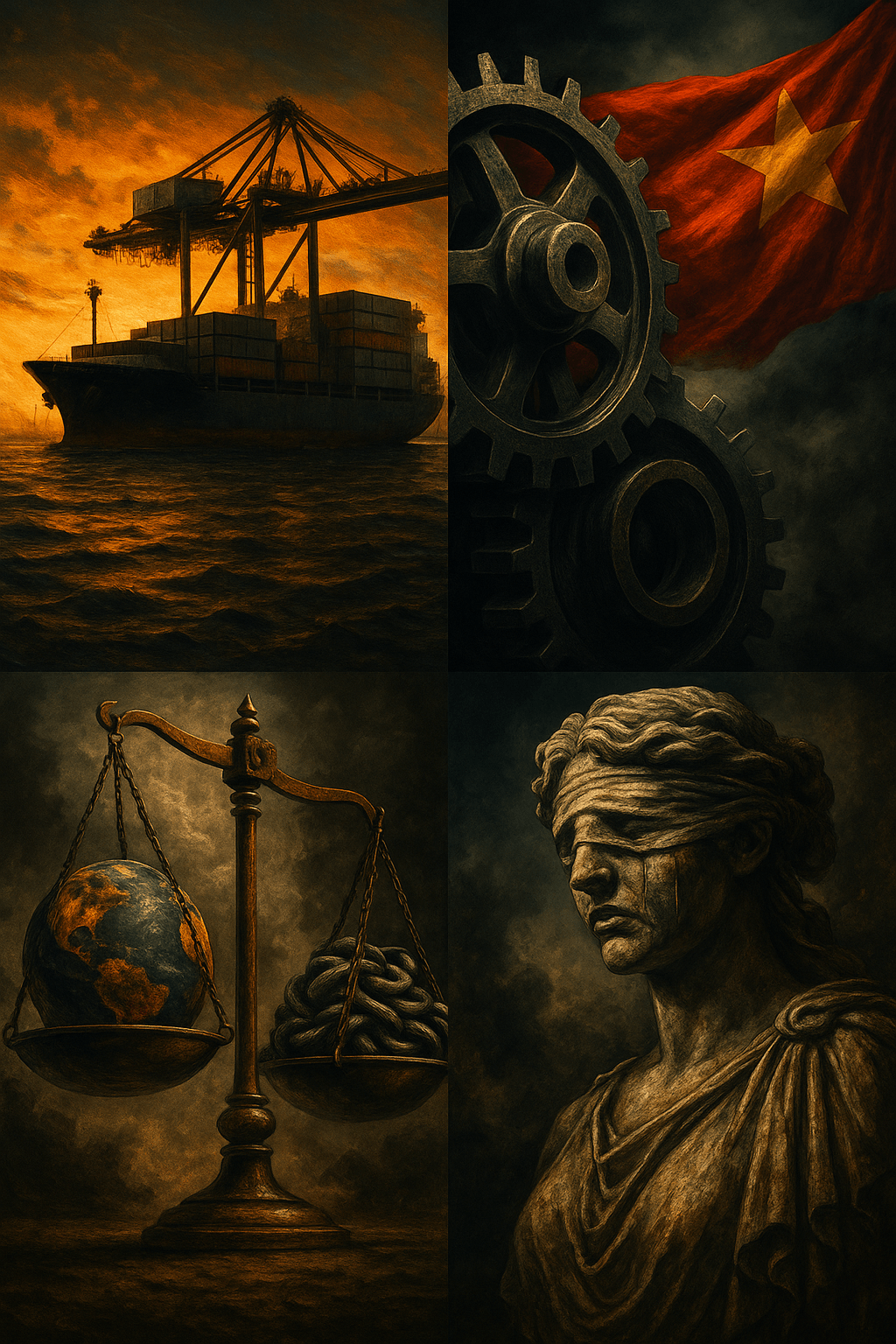
China’s resource sovereignty is shattering Europe’s industrial illusions—and marking a new phase in the global class war
By Weaponized Information
June 5, 2025
Rare Earths, Real Power, and the Empire’s Media Shell Game
The Reuters article, “Some European auto supplier plants shut down after China’s rare earth curbs,” is co-written by Victoria Waldersee and Christoph Steitz—career stenographers for Western capital, currently stationed in Germany to serve as PR liaisons between transnational corporations and a confused, manipulated European public. Waldersee, a former staffer at YouGov and a contributor to neoliberal “accessible economics” initiatives, exemplifies the class function of the Western reporter under technofascist capitalism: packaging imperial panic as objective journalism. Steitz, embedded in Frankfurt’s finance-industrial matrix, reinforces the ideological architecture of Atlanticism through every dispatch. Their employer, Reuters, is a cornerstone of the transatlantic propaganda machine—owned by the London Stock Exchange Group and historically linked to both British intelligence and corporate finance. It operates not as a news agency, but as an ideological relay station for the mandates of empire.
Among those quoted or referenced are Maroš Šefčovič (EU Trade Commissioner and Atlanticist loyalist), Stephane Séjourné (EU Industrial Strategy Commissioner and Macron protégé), Sherry House (Ford CFO), and Wolfgang Weber (ZVEI head and industry lobbyist). Each plays a role in the logistical, ideological, or material enforcement of Western monopoly capitalism—either managing public perception or orchestrating state-capital interventions to preserve corporate supremacy.
Now let’s strip the propaganda coating and get to the guts of the thing.
The headline pretends this is about “supply chain disruption,” but what it conceals is a tectonic shift in global power relations. Reuters adopts the affect of neutrality while implicitly portraying China as a destabilizing force—an irrational actor upending an otherwise well-functioning global economy. The language is saturated with passive voice and market-friendly euphemism: “curbs,” “shortages,” “disruption,” “stress on the system.” There’s no mention of why China might tighten exports, nor any reference to the decades-long Western efforts to sabotage Chinese industrial sovereignty.
The framing of European automakers as helpless victims strips the narrative of historical causality. The fact that Europe offshored its mineral dependency to China, gutted its own extraction infrastructure, and tethered its industrial policy to the U.S.-led imperial bloc is left unexamined. Reuters offers no investigation into whether these curbs are retaliatory, defensive, or strategic. That’s because the article isn’t designed to inform—it’s designed to inoculate the public against understanding. It presumes China’s dominance over rare earths is a problem to be solved, rather than a geopolitical reality rooted in historical agency and long-term socialist planning.
Even the quotes from corporate figures like Ford’s CFO are selected not to clarify, but to sustain ambiguity—acknowledging the export controls as “an issue,” but never questioning their legitimacy or genesis. Meanwhile, bureaucrats like Šefčovič and Séjourné call for “diversification” and “reducing dependency,” echoing Cold War containment language dressed up in trade lingo. This is classic technofascist double-speak: assert global domination, then cry victim when that domination is contested.
Finally, the piece is riddled with strategic omissions. There’s no reference to the BRICS agenda for resource sovereignty. No mention of Trump’s tariff war and economic bullying, or the EU’s complicity in Washington’s sanctions regime. No historical framing of how the West used rare earths to dominate the tech economy and how China’s rise is structurally tied to breaking that monopoly. Instead, we’re fed a morality tale in which Western capital is noble, China is opaque, and the “free market” is some neutral, apolitical arbiter of prosperity.
But as we’ve said before: empire doesn’t report reality—it manufactures it. This article is not an analysis. It’s damage control.
Empire’s Supply Chain Meltdown and the Weaponization of Dependency
Stripped of its ideological casing, the Reuters article confirms several material facts: China currently produces around 90% of the world’s rare earths. Its April 2025 decision to tighten export controls—particularly on rare earth metals and related magnetics—has reverberated across Europe’s industrial sector, triggering shutdowns in auto part supply chains. Corporations like Mercedes-Benz, BMW, ZF Friedrichshafen, and Ford admit operational stress or potential future risk. Meanwhile, EU officials scramble to “diversify” sources, and Atlanticist technocrats float dreams of stockpiling, reshoring, or state-backed substitution.
But what this all points to—beneath the sanitized language—is the unraveling of an imperial arrangement. For decades, the Global North externalized its extractive needs onto the periphery, weaponizing neoliberalism to dismantle domestic resource sovereignty in the South. China, however, broke that mold. Through socialist state planning and long-term investment in strategic sectors, it built an industrial core capable of not only meeting internal demands but dominating global markets—particularly in rare earths, solar tech, and battery supply chains.
The West’s relationship to rare earths is not incidental—it’s foundational. These minerals are the invisible skeleton of the “green transition,” AI computing, EVs, defense systems, and semiconductor production. From the Pentagon’s missile systems to iPhones and electric sedans, rare earths are the connective tissue of imperial modernity. The empire’s ability to dictate the pace of technological development—through patents, supply chain monopolies, and geopolitical coercion—has relied on uninterrupted access to these materials. China’s curbs don’t just delay parts; they fracture the very premise of unipolar logistics.
The article deliberately ignores the historical and political logic of China’s decision. It doesn’t mention that this move came in response to Trump’s technofascist tariff regime, which includes over 145% duties on Chinese goods and strategic restrictions on Chinese tech firms. Nor does it acknowledge the Biden and Trump administrations’ bipartisan consensus on economic warfare against China—via semiconductor blacklists, TikTok bans, and anti-BRI propaganda. Most notably, it omits the broader trend: the weaponization of trade and the collapse of the post-Cold War “free market” order.
Reuters frames China’s actions as irrational obstacles to “normal” functioning. But what we’re really seeing is the Global South—led by China—asserting sovereignty over its resources and economic future. It’s not China that disrupted the world economy. It was the U.S. and Europe that militarized trade, sanctioned entire nations, occupied oil fields, and dictated which states could develop and how. The rare earth curbs are not an escalation—they’re a counter-move in a long-standing war of imperial containment.
This isn’t just about China and Europe. The contradiction here is systemic: the imperial core is losing its grip on the productive and extractive nodes that fuel its dominance. Countries across Latin America, Africa, and Asia are watching China’s maneuvers closely. If the largest socialist economy can weaponize minerals in defense of sovereignty, so can they. This is what makes the situation so explosive. China isn’t just managing its supply chains—it’s demonstrating that the Global South no longer has to play by the empire’s rules.
The End of Free Markets and the Rise of Strategic Sovereignty
The collapse of “just-in-time” production in Europe’s auto sector isn’t a hiccup—it’s the death rattle of an imperial model built on the illusion of free markets and frictionless global supply chains. The Reuters piece frames the crisis as a “shortage,” but what we’re witnessing is something far more profound: the return of geopolitical economy. China’s rare earth curbs are not about disruption—they are about discipline. For decades, the imperial core plundered the resources of the periphery, enforced dependency through IMF restructuring and World Bank policy conditionalities, and punished any nation that dared to build an independent industrial base. Now, the periphery is striking back, and the technocrats are panicking.
Western capitalism outsourced its industrial base to China because it was profitable. But it never relinquished its imperial arrogance. The assumption was always that China would make the parts, while the West retained the patents, profits, and geopolitical command. China’s rare earth move shatters this fantasy. Beijing has made it clear: it will no longer supply the raw materials of empire while being demonized, contained, and sanctioned. It will not fuel the machine that encircles it.
What this signals is a fundamental shift in the global order. The empire’s unipolar command over commodities, logistics, and technology is breaking. The South is no longer a passive exporter of raw goods—it is emerging as a sovereign actor with the ability to leverage strategic resources to defend national development. China is leading this shift, not by overthrowing capitalism from the outside, but by exploiting its contradictions from within—weaponizing state capacity, infrastructure, and trade integration through platforms like the Belt and Road Initiative (BRI) and BRICS+.
Europe’s cries for “diversification” are too little, too late. What they really mean is: “We want someone else to exploit.” But the Global South is watching. Latin American lithium producers, African coltan exporters, West Asian energy giants—they are beginning to realize they hold the keys to the empire’s future. As China redefines what economic sovereignty looks like, a multipolar framework is emerging—one in which no single bloc can dominate access to the critical inputs of development.
In this new era, resource control becomes a weapon of resistance. Strategic sovereignty becomes the foundation of internationalism. And the colonized, plundered, and sanctioned nations of the world are beginning to coordinate—not through NGOs and summit photo-ops, but through infrastructure, production, and supply chain power. The West is being forced to learn what the rest of the world has always known: you can’t eat ideology, and you can’t manufacture consent without the materials to build the machines of empire.
From Extraction to Solidarity – Reclaiming the Supply Chain for the People
This is not the time to lament the so-called “disruption” of Western supply chains. It’s time to sharpen our understanding of what must be disrupted, who must do the disrupting, and how it must be done. The people of the Global South have long lived under the iron heel of resource colonialism. Their labor, their lands, their rare earths built the machines that rule them. Now, as China flexes strategic control over the veins of modern industry, we must ask: what kind of world can we build when those veins flow toward sovereignty instead of servitude?
Revolutionaries in the imperial core must reject the myth of neutral supply chains and expose their true function: to extract the value of oppressed nations and deliver it to Wall Street and Frankfurt. Every battery, every semiconductor, every “green” vehicle assembled in Europe or North America is steeped in the blood of neocolonial labor. When China blocks those shipments, it doesn’t just halt production—it halts imperial momentum. That is a political act.
It is the duty of militants, organizers, and anti-imperialist defectors in the North to explain this to their class and mobilize solidarity with those challenging empire through economic means. We must support rare earth nationalization efforts. We must demand reparative economic partnerships that break with debt traps and trade imbalances. And we must lift up the revolutionary potential of state-led planning and resource sovereignty as tools of class power, not mere “protectionist” deviations.
Our task is to transform this rare earth confrontation into revolutionary consciousness. This means aligning with national liberation forces in the Global South who seek to wield their resources in service of their people, not ExxonMobil or Tesla. It means pressuring our own governments to end sanctions, break with the empire’s trade war, and invest in just transition industries rooted in international cooperation—not technofascist control. It means refusing to blame China for defending itself, and instead blaming the colonial system that built its power on our collective dispossession.
Let the temporary shutdown of a Mercedes-Benz factory become the spark for a deeper conversation: Who controls production? Who benefits from the global supply chain? And how do we seize that chain and repurpose it—not for profit, but for the liberation of the world’s majority?
Further Reading from Weaponized Information
For a deeper understanding of the geopolitical and class contradictions exposed by this rare earths crisis—and its broader implications for U.S. and Western imperial decline—see our related investigations:
- When the Dragon Confronted the Octopus: Obama’s 2009 Visit to China and China’s Declaration of Sovereignty
- The Tariff Hammer: Trump’s Protectionism and the Recalibration of Imperialism
- The House Always Wins: The China Gamble and the Protracted Decline of Imperialism
- Atlanticism on a Leash: Why Europe Won’t Break with Empire
- The Long Road to Multipolarity: BRICS and the Contradictions of the Imperial Order
- China’s 3D Chess: Building the New World While the Empire Throws Tantrums
- TikTok and Tariffs: Trump’s Technofascist Theater of Empire
- The West is Dead: Ursula von der Leyen Says the Quiet Part Out Loud
- China’s Rare Earths Move: Empire Gets a Taste of Its Own Medicine
- Innovation or Imperial Panic? How the West Reframes China’s Rise as a Threat to Its Monopoly on Power
- The Chip and the Chokepoint: BRICS Tech Rebellion and the End of Silicon Supremacy
- Apple Walks Away from China: The New Cold War Marches Through the Supply Chain
Together, these pieces form a collective dissection of the crumbling imperial order—and a roadmap for understanding how sovereignty, technology, and global class struggle are reshaping the world system in real time.
 Weaponized Information
Leave a comment