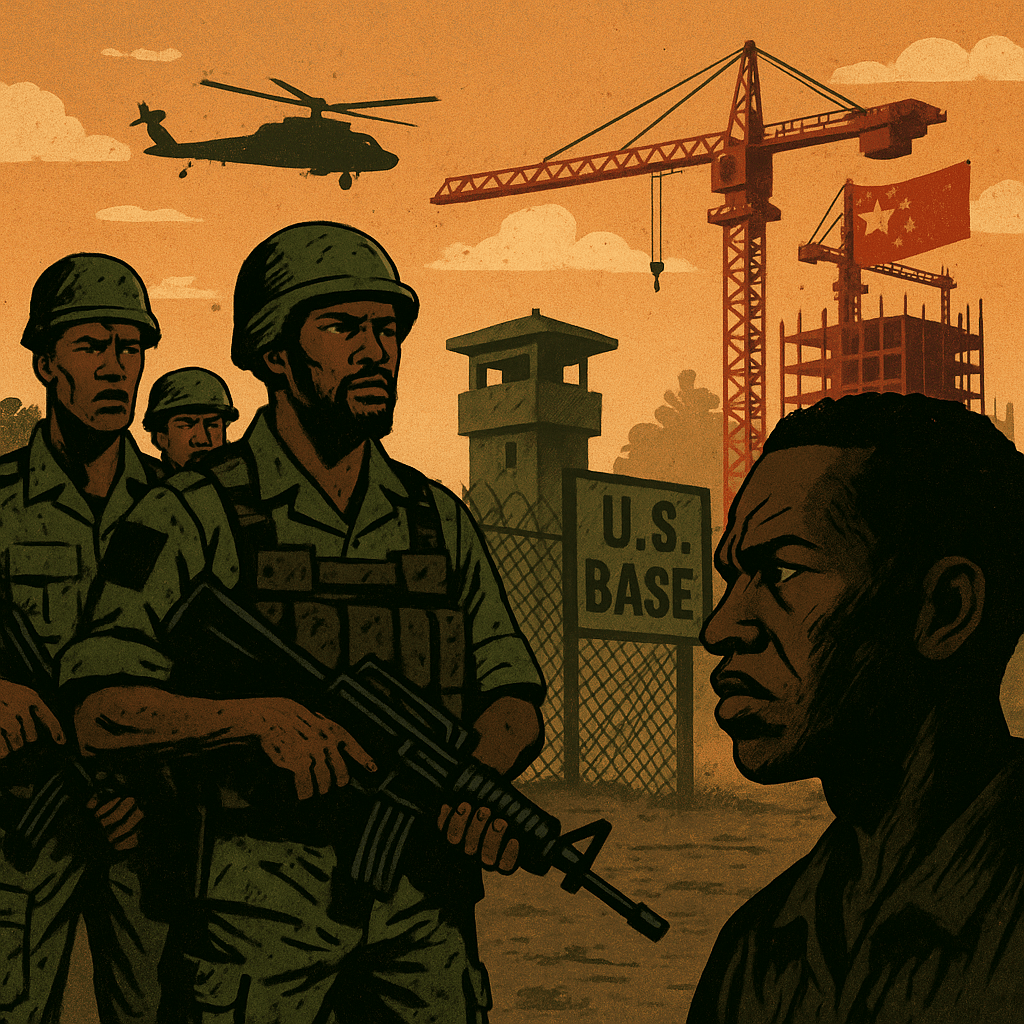
As U.S. bases are kicked out and IMF shackles are broken, African nations are forging new futures—without empire. AFRICOM isn’t defending Africa. It’s defending the illusion of Western control.
By Prince Kapone | Weaponized Information | May 30, 2025
When the General Cries “China,” You Know Africa Is Winning
Lee Ferran doesn’t write journalism—he writes permission slips for empire. A longtime mouthpiece for U.S. intelligence and military elites, Ferran has made a career out of laundering Pentagon press releases into palatable prose for corporate media outlets. From ABC News to Breaking Defense, his loyalty has never been to the truth—it’s to the empire’s credibility. His latest dispatch on AFRICOM is no different. He hands the microphone to Gen. Michael Langley without challenge or context, allowing the commander of U.S. Africa Command to recite Cold War talking points about China “replicating” American military assistance. But what Langley really fears is not imitation. It’s displacement. He’s not worried China might copy AFRICOM’s model—he’s panicked that African nations are rejecting it altogether.
The mouthpiece matters. Breaking Defense is not a media outlet in any real sense—it’s a digital fiefdom of the military-industrial complex. Paid for by weapons manufacturers and defense contractors, it exists to normalize war as policy and frame imperial occupation as security assistance. It does not question power; it services it. And in this case, it acts as the voice of panic for a colonial project losing its grip.
The amplifiers are exactly who you’d expect: Gen. Langley, whose job is to keep the U.S. military footprint anchored in Africa; USAID, now folded deeper into the State Department’s imperial toolkit; and figures like Marco Rubio, whose Africa “strategy” reads like a Cold War playbook with a Wi-Fi signal. These actors don’t offer analysis—they offer continuity. Their role is to manage imperial decline, not to understand the continent rising beneath their boots.
The framing of the article is textbook imperial propaganda. China is portrayed as the suspicious newcomer, “stepping it up” across Africa, offering training, infrastructure, and military partnerships. But nowhere in the piece does Ferran ask: what has AFRICOM actually brought to Africa? Two decades of military bases, drone strikes, counterinsurgency operations, and special forces missions—and still, the Sahel burns. Still, insurgency spreads. Still, inequality deepens. And still, the U.S. preaches stability with one hand while fueling instability with the other.
Gen. Langley invokes “self-reliance,” claiming the U.S. wants Africa to stand on its own feet. But let’s not be naïve. This is not about partnership—it’s about burden-shifting. Washington wants Africa to carry the costs of empire without sharing any of its rewards. AFRICOM isn’t some benevolent force trying to help Africa—it’s a military structure designed to secure U.S. interests, enforce neoliberal extraction, and prop up comprador regimes that keep African wealth flowing out and Western capital flowing in.
And yet, not once does Ferran mention why so many African nations are pivoting toward China. He doesn’t name the wave of military and popular expulsions of U.S. and French troops. He doesn’t cite the BRICS realignments or the new sovereign development models emerging across the continent. He doesn’t mention Senegal, Burkina Faso, Mali, or Niger—where the people are in open rebellion against the neocolonial order. Because to acknowledge that would require recognizing African agency. And nothing terrifies the empire more than Africans choosing their own path.
What we’re witnessing is not a regional policy shift—it’s a global recalibration. AFRICOM is not being “replicated.” It’s being rendered obsolete. And the real story isn’t that China is expanding. It’s that empire is retreating. What’s unraveling isn’t security—it’s supremacy. And what’s rising in its place is the outline of a new world: multipolar, cooperative, and beyond the reach of U.S. gunboats.
What AFRICOM Built—and Why It’s Crumbling
AFRICOM was never about “assistance.” It was about architecture—constructing a lattice of military dominance across the continent to enforce the economic and political priorities of U.S. imperialism. Since its founding in 2007, AFRICOM has staged itself as a partner, but operated as a predator: mapping drone bases in Niger, embedding commandos in Somalia, training loyalist officers in Kenya, and staging joint operations to suppress popular resistance from the Sahel to the Horn. This wasn’t “advising”—it was anchoring empire in African soil.
But the soil is shifting. From Senegal’s rupture with France to Burkina Faso’s revolutionary government, African states are reclaiming sovereignty through expulsion, defiance, and realignment. The fall of France’s neocolonial architecture has created a domino effect, exposing the fragility of AFRICOM’s scaffolding. As one base after another becomes politically untenable, the U.S. can no longer mask its presence behind the fig leaf of “counterterrorism.” The people know better now. The insurgency isn’t just against al-Qaeda or ISIS—it’s against imperialism itself.
AFRICOM’s defenders cite the so-called “terrorist threat” in the Sahel to justify their ongoing footprint. But as we’ve shown in our analysis of Sudan’s Red Sea ports and IMF-induced destabilization, the U.S. doesn’t fight terror—it creates the conditions for it. Structural adjustment, land grabs, resource extraction, and drone warfare leave power vacuums and provoke blowback. The chaos that follows becomes the rationale for deeper occupation. It’s a cycle of engineered instability masquerading as humanitarian intervention.
China’s growing presence is a challenge to this cycle—but not in the cartoonish way Langley frames it. Beijing is not copying U.S. empire. It’s offering an alternative model rooted in state-to-state cooperation, infrastructure investment, and military training not aimed at regime preservation but at capacity building. That doesn’t make China perfect. It still operates under contradictions—capitalist integration, resource dependence, and its own geopolitical interests. But it doesn’t drop bombs. It builds railways.
As we wrote in “Africa Doesn’t Need Aid, It Needs the Keys to the Vault”, the question isn’t whether Africa gets help—it’s what kind of help, and on whose terms. AFRICOM offered “assistance” with the tip of a rifle. China’s Belt and Road offers fiber optic cables and trade corridors. One enforces dependency. The other—however limited—allows for maneuver.
AFRICOM is not panicking because China is evil. It’s panicking because the mask has slipped. The people of Africa are seeing the U.S. for what it is: a decaying empire clinging to the continent not out of solidarity, but out of necessity. As multipolarity expands and U.S. hegemony erodes, AFRICOM becomes not a guardian of security, but a monument to imperial decline.
The Mirage of Self-Reliance: Imperial Lies Rebranded
When General Langley tells African leaders that the U.S. wants them to “do more for themselves,” what he really means is: “We’re cutting the check, but you better keep the machine running.” This isn’t a pivot to African sovereignty. It’s empire offloading costs. AFRICOM doesn’t want less control—it wants cheaper control. And Washington doesn’t fear instability. It fears independence.
There’s no shortage of irony here. AFRICOM, a command built on drone strikes, special forces, and covert occupation, now paints itself as a midwife of African self-reliance. Langley talks about “helping Africa” like a plantation overseer handing out shovels while pocketing the harvest. But it’s not just hypocritical—it’s strategic. As Weaponized Information exposed in our analysis of Rubio’s blueprint, this is the technofascist phase of empire: less welfare, more warfare, dressed up in the language of partnership.
The real shift is this: the U.S. wants to train African militaries not to defend Africa, but to defend U.S. interests without U.S. troops. That’s what “burden-sharing” means. It’s a codeword for outsourced repression. Instead of boots on the ground, they want local regimes, trained in Langley’s programs, to keep the mines open, the ports running, and the people quiet.
But Africa’s not standing still. Ethiopia is asserting mining sovereignty. Burkina Faso is redistributing land and power. Senegal is breaking with the Francafrique order. As we’ve shown in pieces like “From Dakar to Niamey” and “The Sahel Rises”, the rebellion is real—and the empire knows it.
So Langley’s sermon on self-reliance isn’t a gift. It’s a warning. He’s telling African leaders: “You’re on your own now—but stay in line.” And that’s the contradiction at the heart of AFRICOM’s crisis. The U.S. can no longer afford to dominate Africa directly. But it also can’t afford to let go. So it spins a narrative: American retreat is benevolence, and Chinese engagement is interference.
But Africans aren’t confused. They know who built the bases, who dropped the bombs, and who looted the land. They know who backed the coups and blocked the roads to sovereignty. They remember Libya. They remember Niger. They remember the price of Western peace. And they are choosing something else.
China Isn’t the Threat—Liberation Is
AFRICOM’s panic over China has nothing to do with human rights, debt traps, or military transparency. That’s imperial theater. What Washington really fears is what China’s presence makes possible: an Africa no longer dependent on Western tutelage, terror, and theft. China’s growing partnerships on the continent don’t represent a new master—they signal the old master losing his grip.
Unlike the Pentagon’s militarized outreach programs, China’s approach—however complex and contradictory—rests on different principles: infrastructure over airstrikes, trade over troop deployments, non-interference over regime change. That doesn’t mean China is altruistic. As we analyzed in “Between the Dragon and the Dollar”, Beijing’s own economic dependency on raw materials makes its presence in Africa strategic. But it offers something the U.S. never did: room to maneuver.
China doesn’t build AFRICOM-style command hubs. It builds railways. It doesn’t arm local strongmen to kill villagers in the name of “stability.” It trains technicians and builds hospitals—because it understands what the West refuses to admit: you can’t drone your way to legitimacy. And legitimacy, not lethality, is what African nations are hungry for.
As U.S. troops pack up in Niger, Mali, and Burkina Faso, African nations are deciding for themselves how they want to relate to global powers. China steps in not as liberator, but as an alternative—one that isn’t trying to micromanage their elections, dismantle their parliaments, or siphon off their sovereign wealth. For empire, that’s the danger. Not China itself, but the space it opens for the Global South to walk a different path.
AFRICOM’s fear is that China is normalizing post-Western futures. It’s offering African leaders diplomatic choices without the usual fine print: adopt neoliberal reforms, welcome privatization, accept IMF shackles, and tolerate drone strikes. The U.S. model is crumbling because its leverage—military, financial, ideological—is losing legitimacy. What’s replacing it is not a new empire, but a new field of struggle.
The danger to AFRICOM isn’t Beijing—it’s Bamako. It’s Niamey. It’s Ouagadougou. It’s every African capital learning that imperial decline means imperial opportunity. The U.S. can demonize China all it wants. But the real revolution is already happening. On African soil. With African hands. Against the empire that overstayed its welcome.
Break the Command: What Revolutionaries in the North Must Do
If AFRICOM is panicking, it’s because Africa is rising—and revolutionaries in the Global North must choose their side. This isn’t just about solidarity. It’s about sabotage. About disrupting the machinery of empire that runs through our own backyards, banks, and ballot boxes. If we live in the belly of the beast, then our task is clear: rupture its digestive system from within.
AFRICOM doesn’t exist in isolation. It is a node in a global architecture of domination, propped up by arms manufacturers, military contractors, university think tanks, and bipartisan policy consensus. The generals speak, but Raytheon cashes the checks. The troops deploy, but Lockheed gets the contracts. And while the State Department cuts food aid, the Pentagon expands drone surveillance. This is not a mistake—it’s imperial design.
Our organizing must reflect that reality. No more charity drives. No more empty slogans. We must target the infrastructure of domination: protest AFRICOM command centers, disrupt the supply chains of weapons contractors, expose universities complicit in military research, and build militant solidarity with African liberation movements who are leading this charge.
But we must also fight the narrative war. The media amplifies Langley’s lies while suppressing African voices. We must weaponize our platforms to expose the farce of “security cooperation” and the brutality hidden behind diplomatic platitudes. As we’ve shown in our prior investigations—on IMF sabotage, on World Bank extraction, on neocolonial propaganda—imperial power thrives on invisibility. Our job is to tear off the veil.
And most importantly, we must learn. Africa is not a victim in need of rescue. It is a front line in the global battle against imperialism. The revolutions in Burkina Faso, Niger, Mali, and beyond are not side stories. They are sparks—and if we’re serious, we’ll fan them. Support African sovereignty not by speaking over it, but by echoing its demands in the imperial core.
To hell with Langley’s tears. Let AFRICOM fall. Let the military bases crumble. Let a thousand multipolar futures bloom. And let us, from the belly of empire, make damn sure the beast can never rebuild itself.
 Weaponized Information
Leave a comment