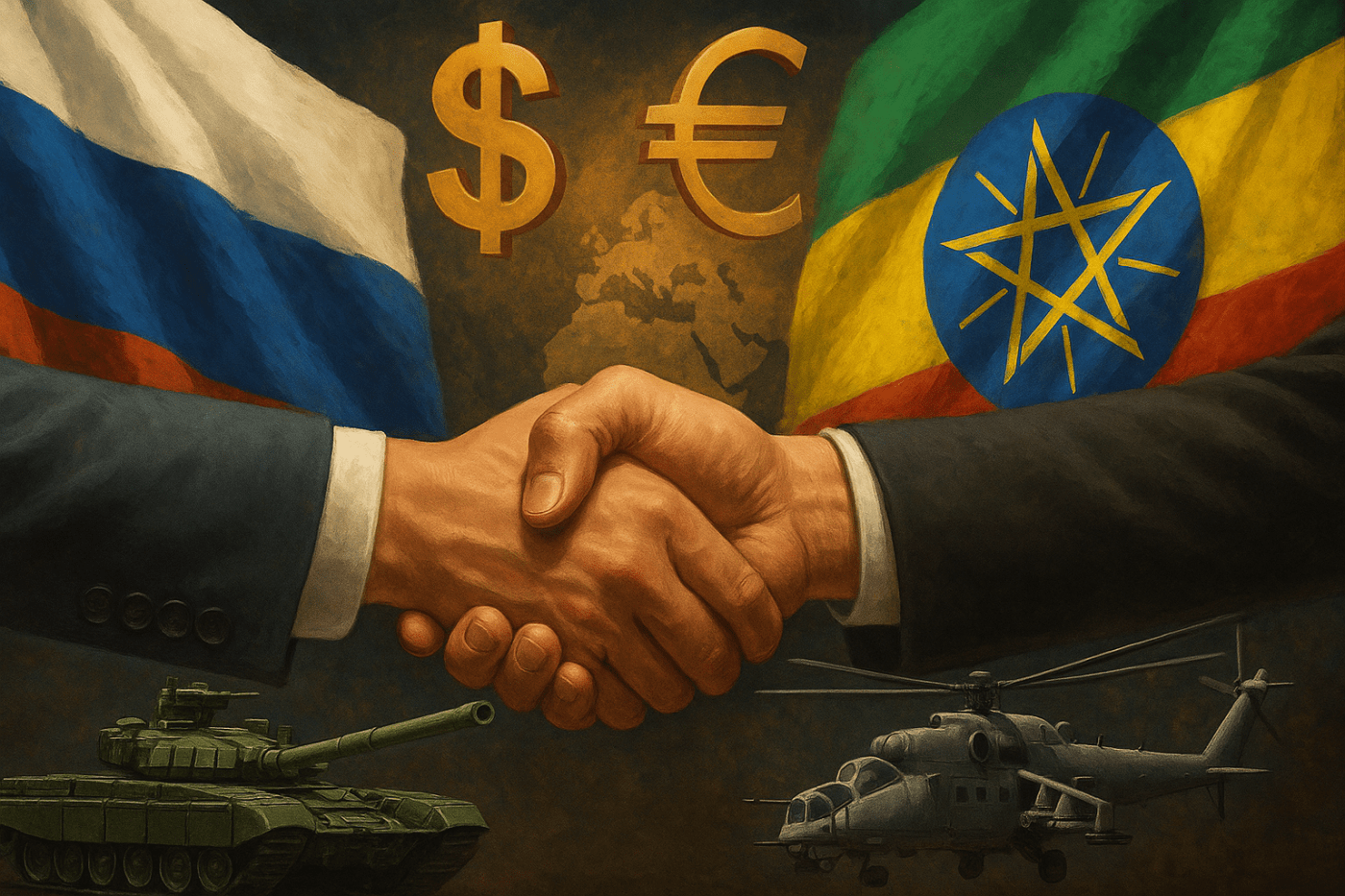
As the imperialist triad scrambles to maintain its grip on the Global South, Ethiopia and Russia are building new circuits of cooperation—military, financial, and ideological—that challenge the logic of hyper-imperialism from the inside.
By Prince Kapone | Weaponized Information
May 27, 2025
The Geopolitical Dance Beneath the Press Release
Chinedu Okafor, the credited author of this Business Insider Africa piece, presents himself as a regional correspondent. But his career arc, like the article itself, is thoroughly domesticated by the expectations of Western editorial gatekeeping. Business Insider Africa is not an independent African publication—it is the African franchise of Insider Inc., owned by the German-American media conglomerate Axel Springer SE. Springer enforces pro-NATO editorial alignment, open market dogma, and soft-washed Atlanticist propaganda across its platforms. What this means in practice is that Okafor writes under a corporate regime hostile to multipolarity and allergic to anti-imperialist sovereignty. His class orientation is not shaped by grassroots struggle or pan-African resistance, but by the careerist logic of Western-facing media production—churning out apolitical content that flatters empire while neutralizing liberation.
The intended beneficiaries of this framing are easy to name: the IMF, which still lords over Ethiopia through debt instruments; AFRICOM, which surveils and intervenes across the Horn; and the U.S. State Department, which views any Russian-African alignment as a threat to its global primacy. These institutions don’t just inform policy—they script the ideological contours of articles like this one.
Yet even within the rigid architecture of imperialist media, the facts leak through. The article notes, almost in passing, that Russia and Ethiopia are engaging in military cooperation, joint currency trade, and BRICS+ integration. But it offers no analysis, no context, no political meaning. This is not journalism—it’s stenography with a passport. The framing treats these developments as bland technocratic updates, divorced from the planetary crisis of U.S. unipolarity or the rising tide of South–South resistance. The refusal to name multipolarity, to contextualize BRICS+ as a rebellion against the dollar, or to identify local currency trade as a threat to financial piracy is not accidental. It’s cognitive warfare—by omission.
And so, we step in—not merely to deconstruct the narrative, but to clarify and sharpen it. Because this is a story of realignment. It is a challenge to Western domination. And it marks a significant stride in what we call anti-imperialist sovereignty—the right of Global South nations to sever their chains from IMF structural adjustment, bypass the dollar matrix, and engage in autonomous development without asking permission from Washington or Brussels. Where Okafor offers euphemism, we offer clarity. Where Business Insider dulls the blade, we sharpen it.
Behind the Bullet Points: Extracting the Truth From Between the Lines
Strip away the corporate formatting and press-release mimicry, and the core facts of the article are unmistakably significant:
- Russia and Ethiopia held high-level military talks in Moscow to deepen defense cooperation.
- Both countries are pursuing bilateral trade in local currencies and de-dollarization mechanisms.
- Ethiopia is actively seeking membership in the BRICS New Development Bank, with state officials publicly affirming this as a national strategic priority.
- Russia has launched a major media initiative in Addis Ababa, signaling long-term soft power investment in African public discourse.
Now contextualize this. These developments are not neutral—they are taking place amid the ongoing disintegration of the U.S.-led unipolar order and a growing wave of Global South states refusing to play second fiddle in the orchestra of hyper-imperialism. The dollar is no longer sacred. The IMF’s aura of inevitability is cracking. U.S. military dominance, once taken for granted on the African continent, is now met with protests, evictions, and multipolar defiance.
Ethiopia, historically one of the few African states never colonized, is once again stepping into its role as a bellwether of continental resistance. What’s happening here is not merely tactical—it’s strategic. Local currency trade is a direct assault on the scaffolding of financial piracy. The push toward BRICS+ is a break from Bretton Woods and a pivot toward an alternative model of development—one grounded in shared infrastructure, alternative finance, and anti-imperialist sovereignty.
What the article refuses to mention—what must be foregrounded—is that this is also happening in the shadow of AFRICOM, U.S. sanctions regimes, and the neocolonial grip of Euro-American influence on Africa’s central banks. Ethiopia’s defiance of that grip is not a side note; it is the story. Every line of economic coordination with Russia, every diplomatic signal of South-South realignment, is a blow against the dollar’s hegemony and the mechanisms of imperialist recalibration.
And yet the propaganda silence is deafening. There is no mention of the U.S. panic over BRICS+ de-dollarization. No reference to Ethiopia’s deepening ties with China. No recognition of the fact that currency swaps are not a financial experiment—they are a sovereign act of rebellion. These are not just policy shifts. They are the slow, deliberate formation of a new world struggling to be born inside the husk of a dying one.
When the South Speaks in Its Own Currency
This is not just diplomacy. It is a quiet revolution in the ledger books of global power. When Ethiopia sits across the table from Russia—not as a junior partner but as a sovereign actor plotting an exit route from dollar dependency—that’s not cooperation. That’s counter-offensive. It’s the deliberate construction of an alternative to the global system of financial piracy that has bled the Global South for decades.
For over a century, the world’s poorest countries have been chained to the currency of their colonizers. The U.S. dollar, enforced through debt, war, and “development,” has functioned as the empire’s whip. But now, as Western banks weaponize access, and the IMF conditions every loan on austerity, states like Ethiopia are turning elsewhere. Not out of desperation—but out of calculation. This is the long game of anti-imperialist sovereignty, unfolding one bilateral agreement at a time.
And Russia? It is not an imperial savior—but a semi-peripheral power navigating the same hostile system. Its interest in Africa is strategic, not philanthropic. But in its alignment with Ethiopia, we see a convergence: not of ideology, but of rejection. A shared refusal to be dictated to by the Atlanticist bloc. A joint bet on multipolarity over subjugation.
The media won’t say it, but this is the material terrain of what we call revolutionary rupture. Not a flashpoint. A process. Ethiopia’s BRICS+ alignment, its embrace of local currency trade, and its military diplomacy with Russia are all cracks in the architecture of empire. Cracks that may one day widen into exits.
For the working class of the world, especially in the colonized nations, these developments are not abstract. They are blueprints. Every currency swap that bypasses the dollar is a strike against hyper-imperialism. Every rejection of IMF strings is a nod toward liberation. Every African state that reorients its sovereignty away from the West expands the breathing room for others to follow.
This is not romanticism. It’s realism—of the revolutionary kind. Ethiopia is not free. Russia is not the answer. But the moves being made here are, for the first time in decades, not being made for empire. They are being made for a different future. And that is the terrain on which we must now struggle—not just to observe the cracks, but to organize their deepening.
Solidarity Is a Weapon—Deploy It
Ethiopia’s pivot away from Western tutelage and into strategic alignment with Russia and BRICS+ is not just a diplomatic story—it’s a battleground in the global class war. The ruling class in the imperial core will not sit idle. They will smear, sanction, sabotage, and spin. They will call it authoritarianism. They will call it corruption. They will do anything but admit the truth: that the Global South is trying to breathe, and the West is still kneeling on its neck.
We must declare, without hesitation or liberal hedging, our full ideological unity with the forces of anti-imperialist sovereignty asserting themselves across Africa, Asia, and Latin America. The U.S. empire may frame this as a return to “great power competition,” but we know better. This is not a cold war—it is a revolutionary rupture in the making.
And solidarity cannot remain symbolic. It must be material, organized, and internationalist. Revolutionary organizations in the imperial core must:
- Launch educational campaigns clarifying the role of BRICS+ in breaking from the IMF-dollar system.
- Expose AFRICOM’s military encirclement of the continent and its destabilizing operations in the Horn of Africa.
- Build direct relationships with anti-imperialist organizations in Ethiopia and across Africa—amplify their narratives, support their demands, and reject Western media demonization.
- Mobilize against U.S. and EU sanctions architecture, especially efforts to isolate BRICS-aligned states or weaponize “human rights” as regime-change rhetoric.
We also urge independent media workers, guerrilla intellectuals, and defectors from empire to document this shift relentlessly. The Ethiopian people are making a calculated move on the chessboard of history. If it succeeds, the rules of the game change. If it fails, we will have missed the moment to rally behind it.
This is not just about Ethiopia. This is about all of us who dream of a world where sovereignty is not punished, where poverty is not enforced by interest rates, and where dignity is not conditional on submission to the West.
Weaponized Information pledges to stand with the forces of multipolarity, liberation, and revolutionary transformation across the Global South. The future is already negotiating its terms. Let us not arrive late. Let us arrive organized.
 Weaponized Information
Leave a comment