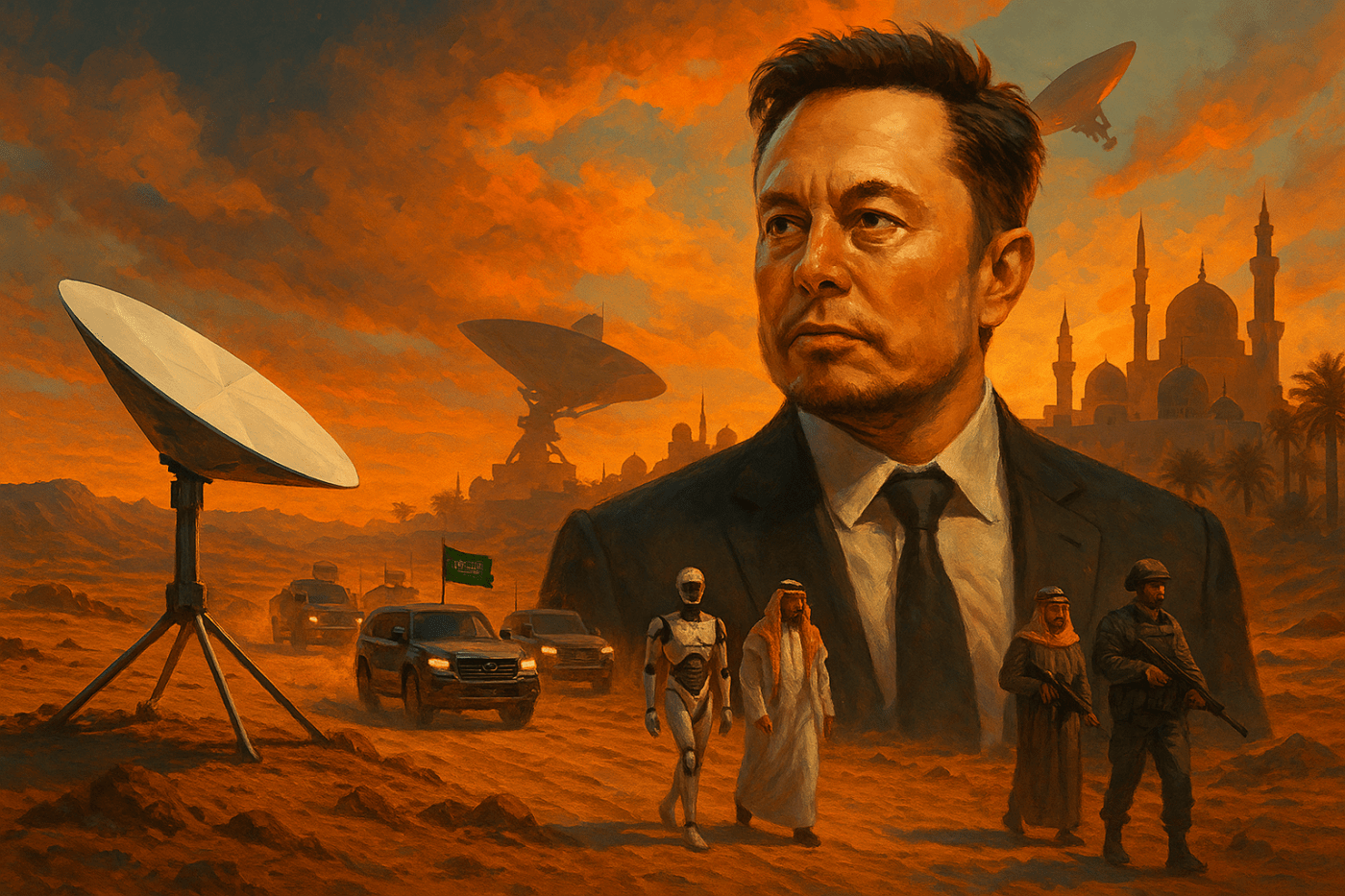
Trump’s return to the Middle East isn’t diplomacy—it’s a hyper-imperialist tech caravan. From Starlink satellites to humanoid robots, Elon Musk delivers the digital weapons of repression to monarchs and strongmen, wiring up empire in the name of modernization.
By Prince Kapone | Weaponized Information | May 13, 2025
Desert Deals and Digital Chains: Excavating the Mirage
The CBS article covering Trump’s Saudi summit reads like a press release from the Ministry of Empire. Co-authored by Olivia Rinaldi, Kaia Hubbard, and Kathryn Watson, the story peddles royal flattery and corporate spectacle as if geopolitics were a tech convention. Rinaldi, a White House reporter who shadowed Trump’s 2024 campaign, built her resume under Norah O’Donnell, producing feel-good segments for 60 Minutes and CBS Evening News—two prestige arms of the imperialist media apparatus. A graduate of UVA’s foreign affairs program, Rinaldi represents the soft managerial class tasked with laundering elite interests through the polish of network journalism. Her co-authors are D.C.-based political reporters trained to toe the beltway line, never stepping beyond the boundaries of acceptable discourse. Their employer, CBS News, is owned by Paramount Global, a multibillion-dollar node in the corporate latticework that links Wall Street, Hollywood, and Washington in a single, suffocating circuit of imperial reproduction.
It’s no surprise, then, that their coverage paints a rosy picture of Trump’s Riyadh circus. Donald Trump plays the role of imperial impresario. Elon Musk grins behind him, peddling satellites and androids like a snake-oil salesman in a sandstorm. Mohammed bin Salman hosts the pageant in a palace built on crushed dissent. And around the banquet table sit Jensen Huang, Larry Fink, and Steve Schwarzman—men who don’t govern countries but own them.
Here’s how the hustle works: Starlink gets “approved” for maritime and aviation use in the kingdom—no context offered, no questions asked. Musk flashes his Optimus robots for Trump and MBS like party tricks, omitting that these AI toys are just the PR tip of a deeper, darker spear. CBS treats it like innovation. But what’s really being installed is digital colonialism: a satellite-based control grid, wired into one of the most repressive regimes on Earth, sold under the banner of modernization.
Then there’s the showstopper: a $600 billion Saudi investment in the U.S. and a $142 billion arms package. That’s not economic cooperation. That’s a bribe. That’s MBS purchasing another decade of American protection and legitimacy, while Trump sells the store to stay liquid, stay relevant, and keep his family empire afloat. What CBS won’t say is that Trump’s entire Middle East tour looks like a corporate roadshow—except instead of startup pitches, it’s state-to-state shakedowns.
Notice, too, the carefully choreographed snub of Israel. In the week leading up to the Saudi summit, Trump made headlines by criticizing Netanyahu and keeping distance from Tel Aviv—breaking, even if symbolically, from the regime he once called America’s greatest ally. Is it genuine? Or just a public relations maneuver to convince the Saudis that Washington is shifting its center of gravity from Zionist settler colonialism to the oil-drenched monarchies of the Gulf? It’s too early to tell. But the triangulation is clear: Israel gets the cold shoulder, the Gulf gets the red carpet, and Musk gets to wire the whole region with surveillance satellites disguised as internet service.
What CBS presents as partnership is actually the privatization of imperial logistics. What it calls diplomacy is better understood as hyper-imperialist recalibration. Starlink, robotaxis, humanoid demos—these aren’t gifts from the future. They are the cables, cameras, and cloud servers of a control system built to outlive the dollar and outmaneuver multipolarity. And these journalists, whether knowingly or not, are doing the work of the empire: narrating subjugation as spectacle.
What They Say, What They Bury: Extracting the Empire’s Blueprint
Let’s sift through the rubble and pull out the facts buried beneath the spectacle. According to CBS and CNBC, Saudi Arabia has approved Starlink for maritime and aviation use—meaning Musk’s satellite network will now hover above the kingdom’s airspace and shipping lanes. At face value, that sounds like progress. But in the hands of a regime known for beheading dissidents and hacking journalists to pieces, it’s not internet—it’s infrastructure for repression.
Musk didn’t come alone. He brought his entire portfolio of imperial services: Starlink for surveillance, robotaxis for privatized mobility control, and humanoid robots to dazzle monarchs and hedge fund executives with visions of automated labor discipline. All of it was showcased before Trump and MBS, in a scene that looked less like diplomacy and more like a product demo for techno-oligarchs in a neo-feudal bazaar.
Alongside Musk were the usual suspects: Jensen Huang from Nvidia, selling chips that will power AI-based repression; Palantir’s Alex Karp, a pioneer in predictive policing software; and Larry Fink, who doesn’t build anything—but whose firm, BlackRock, owns everything. They weren’t there for “regional stability.” They were there to cash in on what Trump called “the next phase of Middle East prosperity,” which, translated from the imperial tongue, means: the next phase of pacification, extraction, and digitally enforced silence.
Beyond the tech glitz, the summit was anchored by hard imperial numbers: a $600 billion Saudi investment package, a $142 billion arms deal, and a series of bilateral agreements between the U.S. Department of Justice, Pentagon, and their Saudi counterparts. This is where the curtain drops. The deal isn’t just about business. It’s about integrating a loyal Gulf monarchy into the operational matrix of U.S. empire—through data, hardware, and digital enforcement mechanisms. It’s hyper-imperialism by other means.
But that’s not all that happened. Trump also announced a ceasefire with Ansar Allah in Yemen. He promised to normalize ties with Syria, lifting sanctions imposed on the Assad government’s U.S.-backed replacement. He hinted at potential reconciliation with Iran. All of this happened in the days before the Saudi deal. Coincidence? Or calculated choreography to show MBS that Washington is ready to reshuffle the regional deck and prioritize Riyadh as the new cornerstone of its Gulf strategy? If so, it represents a strategic pivot—one designed to neutralize multipolar influence from China and BRICS+, and to re-anchor the Gulf in the orbit of American finance capital.
And let’s not forget the backdrop: the recent apparent fracture between Trump and Netanyahu. Trump’s rhetorical jabs at Israel and his pointed omission of the Israeli state from this regional theater may be pure optics, a smokescreen to lure Saudi Arabia deeper into alliance. But if real, they signal something deeper: the slow recalibration of U.S. imperialism away from its traditional settler-colonial proxy and toward its oil-rich royalist clients. Either way, Palestinians remain besieged, and the weapons of repression—whether digital or kinetic—keep flowing.
This is what empire looks like in 2025: satellite grids above, investment forums below, and journalists narrating the theft as transformation. Beneath all the handshakes and business cards lies the real machinery of control: algorithmic governance, financial piracy, and a multi-layered system of imperialist logistics now wired into the deserts of the Arabian Peninsula. Trump and Musk didn’t just bring deals to Riyadh. They brought the future of repression—downloadable, privatized, and backed by a U.S. military guarantee.
The Empire Doesn’t Innovate—It Reorganizes
Strip away the banners, the pageantry, and the hashtags, and what’s left is simple: empire, recalibrated. The facts don’t lie. The U.S. isn’t withdrawing from the Middle East—it’s embedding itself deeper, just with fewer uniforms and more satellites. This isn’t diplomacy. It’s a logistical update. Starlink isn’t “bringing internet to the disconnected”—it’s installing surveillance infrastructure under the flag of connectivity. Musk’s robotaxi pitch isn’t about mobility—it’s a trial balloon for privatized algorithmic policing. And Trump’s role? He’s the dealmaker, the broker of repression, greasing the gears of hyper-imperialism with sovereign wealth and Pentagon contracts.
What CBS calls “a historic investment summit,” we call a crime scene in progress. A $600 billion payout to Trump’s cronies is framed as mutual development. A $142 billion arms transfer is described as regional stability. U.S.-Saudi coordination between the Pentagon and DOJ gets spun as cooperation—not what it is: counterinsurgency architecture. Starlink and xAI aren’t just corporate ventures. They’re digital battalions. Infrastructure for a wireless occupation.
And yet, for all its spectacle, the summit also reveals the fragility of empire. These deals aren’t a show of strength—they’re a concession to reality. The U.S. is no longer the unipolar master of the region. It’s desperate to hold onto the Gulf, especially as China courts the same monarchs with oil-for-yuan contracts, Belt and Road infrastructure, and BRICS+ diplomatic overtures. The Trump regime, unable to compete materially, is selling what it has left: satellites, sanctions relief, and robots with smiley faces.
What we’re witnessing is not the birth of a new Middle East—but the franchising of U.S. technofascism abroad. While technofascism, properly speaking, remains a domestic U.S. regime—the fusion of Big Tech, finance capital, and militarized governance—the tools of that system are now being exported to allied client states. The goal? To discipline restive populations with biometric borders, predictive policing, and always-on surveillance—without sending a single troop.
Even the timing of the so-called Trump-Netanyahu rift fits this pattern. Whether real or performative, the move was strategic: show Riyadh that Washington can prioritize Arab capitals over Zionist ones when the price is right. If MBS sees that the U.S. is willing to distance itself from Israel in exchange for deeper Saudi alignment, it gives the Kingdom new leverage in its jockeying for regional primacy. But make no mistake—the weapons will still flow to Tel Aviv, and the bombs will still fall on Gaza. This isn’t a rupture. It’s a repositioning.
The empire doesn’t innovate—it reorganizes. It doesn’t retreat—it digitizes. It doesn’t collapse in silence—it monetizes the collapse. The Starlink deal isn’t a footnote in a tech blog—it’s a node in the emerging architecture of global repression. And every journalist who framed it as a breakthrough, every CEO who inked a deal, every general who shook a Saudi hand—they didn’t just witness history. They helped bury it.
Against Satellites and Sultans: Organize for a World Without Empire
We stand in ideological unity with the workers, peasants, students, and revolutionaries of the Arab world and beyond. We reject the lie that the U.S.-Saudi alliance is a symbol of modernization. We see it clearly for what it is: an imperial pact to preserve domination in a moment of global fracture. Trump, Musk, and MBS aren’t delivering prosperity—they’re delivering a digital gulag, enforced by private satellites, policed by predictive code, and funded by stolen oil wealth.
But we also see the cracks in the system. Every imperial recalibration reveals a crisis. The ceasefire with Ansar Allah, the quiet reversal on Syria sanctions, the awkward cold shoulder to Israel—these are signs of a ruling class unsure of its footing. The U.S. empire isn’t falling gracefully. It’s repositioning under pressure, lashing out where it can, bribing allies where it must, and exporting its repression toolkit to whoever will sign a check.
In the face of this, our task is not just to analyze—it’s to mobilize.
- Resist the infrastructure of digital repression. Organize proletarian cyber resistance against Starlink’s expansion into repressive regimes. Track, expose, and interrupt the flow of data between U.S. tech monopolies and Gulf autocrats.
- Build revolutionary tech literacy. Create study circles, teach-ins, and encrypted workshops in working-class communities to demystify satellite surveillance, AI policing, and digital colonialism. Spread tools of self-defense. Break their monopoly on knowledge.
- Support Arab and Global South media insurgencies. Uplift revolutionary outlets exposing the U.S.-Saudi tech pact. Fund independent Arab journalists who risk their lives to challenge royalist propaganda.
- Recruit defectors from the inside. Target radical engineers, ethical coders, disillusioned Tesla and Nvidia workers. Help them blow the whistle, organize unions, or simply walk away from the machine.
- Support formations of dual and contending power. Materially back grassroots organizations in Yemen, Syria, Palestine, and the broader Arab world that refuse both imperialism and monarchy. Don’t romanticize—organize.
The future is not written in the clouds. It is fought for in the streets, in the server farms, and in the desert sands. Every satellite they launch is another line we must draw. Every robot they unveil is another reason we must resist. Empire doesn’t end on its own—it ends when we make it impossible to function.
Let them fly their satellites. We build our movements. Let them host their summits. We write our manifestos. And when the time comes, it will not be Starlink that lights up the night—it will be the fire of a people no longer willing to kneel.
 Weaponized Information
Leave a comment