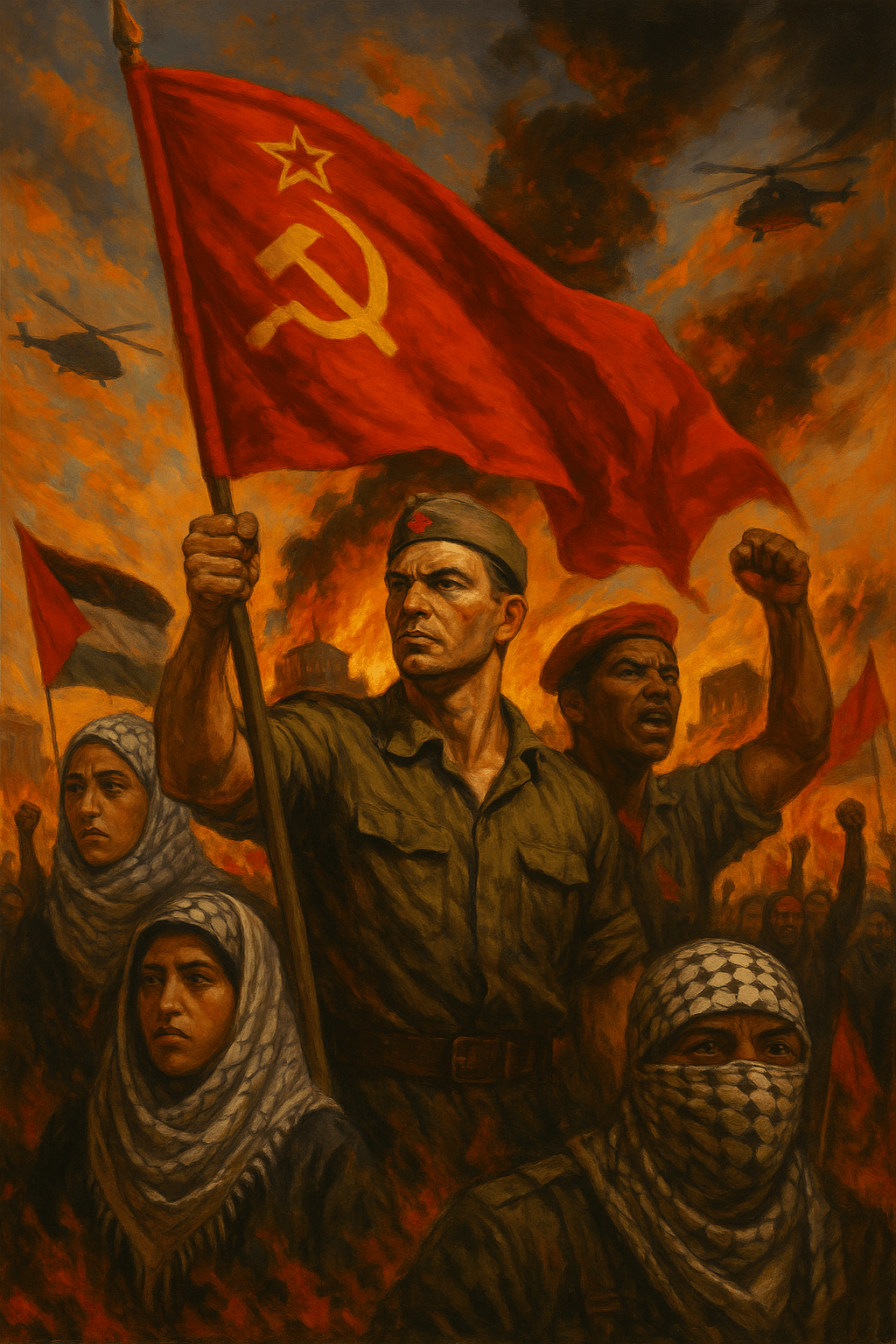
While Europe buries its own memory, the Global South honors the Red Army and reclaims antifascism as a living, breathing struggle against imperialism in our time.
By Prince Kapone | Weaponized Information
May 9, 2025
Part I: Commemorating Liberation While the Empire Erases It
This report from Peoples Dispatch, written by Ana Vračar, doesn’t need excavation in the traditional sense. It doesn’t twist facts or conceal truths like the corporate media of the imperial core. Instead, it lifts up a story that Western outlets refuse to tell: that as Europe turns its back on its own history, the Global South is keeping the flame of antifascist memory alive. Our task is to build on this report, amplify its resonance, and place it squarely within the ongoing struggle against imperialism and historical erasure.
Peoples Dispatch is a fraternal media organization rooted in the revolutionary traditions of the South. It serves working-class movements, not stockholders. It reports from the ground up, not the penthouse down. In this piece, it highlights how leaders from Brazil, Cuba, Venezuela, China, Burkina Faso, and Vietnam—many of whom lead nations under siege by Western sanctions or military encirclement—are traveling to Moscow to honor the Red Army’s role in defeating Nazi Germany.
That contrast speaks volumes. While Global South nations send heads of state to commemorate the defeat of fascism, the European Union sends veiled threats. Slovakia is the only EU state daring to attend, defying pressure from the bloc’s unelected bureaucrat-in-chief, Kaja Kallas, who warned of “consequences” for participation. Her statement wasn’t just political—it was ideological. It was an attempt to finalize a decades-long NATO campaign to rewrite World War II history, reduce the USSR to a footnote, and recast fascism as a historical anomaly rather than the logical child of European capitalism.
Peoples Dispatch rightfully centers the voices of those who remember: Maduro declaring that “it was the Red Army that liberated Europe,” Xi Jinping warning against a new wave of “unilateralism and coercive practices,” and Gennady Zyuganov drawing a straight line between fascism’s roots in imperialism and today’s erasure of the USSR’s sacrifice. These aren’t sentimental gestures. They are ideological weapons—wielded by nations that know too well what fascism looks like when dressed up in sanctions, coups, and drones.
What this article helps make clear—without needing to scream it—is that the battle over memory is part of the battle over the future. If the Red Army’s sacrifice can be erased, then so too can the legacy of proletarian internationalism. If Europe’s victory is detached from Soviet blood, then NATO can pretend it liberated the continent with Marshall Plans, not Molotov cocktails. The presence of Global South leaders in Moscow is not just a tribute. It’s a political alignment. It’s the memory of past liberation standing shoulder to shoulder with the present struggle for sovereignty.
Part II: Memory as Resistance, History as Strategy
The Global South didn’t just show up in Moscow for a parade. They came to plant a flag—a flag that says: we remember who bled for Europe’s liberation, and we refuse to let the empire erase it.
Let’s start with the facts. On May 9, 2025, Russia commemorates the 80th anniversary of Nazi Germany’s surrender in World War II. At least 29 world leaders confirmed attendance at the Victory Day events, including from Brazil, Burkina Faso, China, Cuba, Venezuela, and Vietnam. Meanwhile, the European Union—supposedly the cradle of this history—refused to attend. Only Slovakia broke ranks. The EU’s top foreign affairs official, Kaja Kallas, went as far as threatening sanctions against any European official who dared show up. Not against warmongers or fascists—against remembering.
Victory Day marks the defeat of fascism, but also exposes a geopolitical fracture: one side honors history; the other rewrites it. The Soviet Union lost over 27 million lives in World War II—more than all other Allied countries combined. It was the Red Army that liberated Auschwitz. It was Soviet tanks that broke the back of the Nazi war machine from Stalingrad to Berlin. The idea that this sacrifice can be reduced to an “inconvenient legacy” reveals the deeper truth: historical memory is a battlefield.
The erasure of the USSR’s central role in the war is not accidental. It is the cultural wing of NATO’s ongoing counterinsurgency against socialism. It serves three purposes: (1) to delegitimize past socialist victories, (2) to sever today’s movements from their ideological roots, and (3) to paint modern Russia as a historical enemy of Europe, rather than the inheritor of the antifascist tradition. It is imperialist recalibration through historical revisionism.
At the same time, the leaders gathering in Moscow come from countries that have either survived or are still surviving sanctions, coups, debt traps, economic blackmail, and military intervention by the very powers now boycotting this commemoration. They are not merely attending a ceremony—they are affirming a political alignment. What links Venezuela, Cuba, Vietnam, Burkina Faso, and Russia is not nostalgia, but material experience with imperialist violence.
Even the language used by Global South leaders reflects this clarity. Maduro’s statement that “it was the Red Army that liberated Europe” is not just historically accurate—it is a pointed rejection of NATO mythology. Xi Jinping’s remarks in the Russian Gazette go further, warning that today’s world is once again threatened by “unilateralism, hegemonism, bullying, and coercive practices.” In other words: fascism may have changed uniforms, but it hasn’t disappeared.
Meanwhile, leftist movements across Europe, from Belgium to the Balkans, are pushing back. They’re organizing commemorations, linking the Red Army’s sacrifice to today’s resistance against genocide in Palestine, austerity in Europe, and fascist resurgence in the streets. Their message is clear: Victory Day is not a relic. It is a rallying cry.
Part III: Antifascism Is Not Nostalgia—It’s a Frontline
This isn’t just a gathering of dignitaries. This is a gathering of the damned—nations damned by empire, sanctioned, slandered, and surrounded, yet unbroken. They came not to mourn, but to affirm: that antifascism is not a museum exhibit. It’s a weapon. And in this war, memory is ammunition.
When Global South leaders gather in Moscow while the imperial core stays away, they’re not participating in a cultural ceremony. They’re choosing sides. They’re standing on the shoulders of the Red Army and declaring that the struggle it fought has not ended—it has merely changed shape. The tanks may now be algorithms, the blockades financial, and the camps outsourced to “detention centers,” but the logic is the same. Fascism is not a past threat—it is the technocratic, capitalist present.
The European Union’s boycott of Victory Day is not about Ukraine. It’s about ideology. Empire can’t afford a collective memory where socialism defeated fascism. It can’t afford a world where Moscow, not Washington, broke Hitler. It can’t allow the truth that the greatest antifascist force in modern history was not liberalism or parliament—but the international working class, led by the Soviet people.
And that’s exactly what the Global South remembers. Not as romanticism, but as strategic clarity. Venezuela remembers because the same empire that funded Pinochet backed Guaidó. Vietnam remembers because the same West that funded Hitler napalmed Hanoi. Cuba remembers because the same banks that armed Mussolini now blockade medicine. Burkina Faso remembers because France never stopped colonizing. Russia remembers because it was their mothers and fathers who bled in Leningrad and Kursk.
What they all understand—what the EU dare not admit—is that the fascism of the past was born of imperial crisis. And so is the fascism of today. From the digital surveillance state to the militarization of borders, from the normalization of genocide in Gaza to the fascist street mobilizations in Europe and the U.S., the global ruling class is doing what it has always done when the system cracks: it revives the corpse of fascism, dresses it in the language of “security,” and points it at the working class.
So no, this is not a nostalgic trip down memory lane. This is a living rehearsal of revolutionary memory. The Global South isn’t clinging to the past. It’s declaring its future. A future where historical truth is not written by colonial victors. A future where antifascism isn’t diluted into liberal civics. A future where unity between the oppressed becomes the strategic core of global transformation.
And that’s why they remember. Because they must. Because if they forget, fascism wins twice—once in blood, and again in silence.
Part IV: Remembering Is Not Enough—We Must Fight
History is not a mirror—it’s a map. The Red Army’s sacrifice does not belong to the museums of Europe. It belongs to the trenches of today. And if the Global South is reclaiming Victory Day, it’s because it still has fascism to fight. But so do we.
From the militarized borders of Fortress Europe to the scorched ghettos of Gaza, from anti-migrant hysteria to settler-colonial censorship, fascism is not just on the march—it is in power. And it wears the mask of democracy. It speaks the language of “values” while dropping bombs. It funds Nazis in Ukraine while criminalizing resistance in the imperial core. It erases the Red Army to make room for NATO. And it rewrites history to sanitize genocide.
But it can be resisted. It is being resisted.
Let us honor the fallen not with flowers, but with action:
- Reclaim Victory Day: Organize events in your city to commemorate the Red Army and connect it to today’s antifascist struggles—against genocide in Palestine, sanctions on Venezuela and Cuba, and the fascist resurgence across Europe and the U.S.
- Expose Historical Revisionism: Challenge museums, schools, and media outlets that erase or whitewash the Soviet Union’s role in defeating fascism. Launch counter-education campaigns using radical history collectives and antifascist archives.
- Build Bridges of Struggle: Forge ties with comrades in the diaspora—from Cuba, Russia, Burkina Faso, Vietnam. Hold teach-ins, co-organize direct actions, and internationalize your analysis. The frontline is everywhere.
- Support Revolutionary States and Movements: Raise funds for Cuban and Venezuelan solidarity projects. Defend embassies when threatened. Join campaigns against U.S. sanctions and expose your own government’s complicity in economic warfare.
- Confront Fascism at Home: Disrupt far-right mobilizations. Defend migrant communities. Expose cops as agents of settler-colonial pacification. Smash the link between imperial war abroad and racist repression at home.
We are not mere spectators of history. We are its continuation. The same empires that birthed fascism in 1933 are trying to resurrect it in 2025. And the same forces that crushed it then—working-class internationalism, revolutionary unity, armed struggle for liberation—are rising again to meet the moment.
Our task is to link arms with that rising. To stand with the Global South not in pity, but in shared purpose. To say: We remember. We resist. And we will not let fascism win—not this time.
 Weaponized Information
Leave a comment