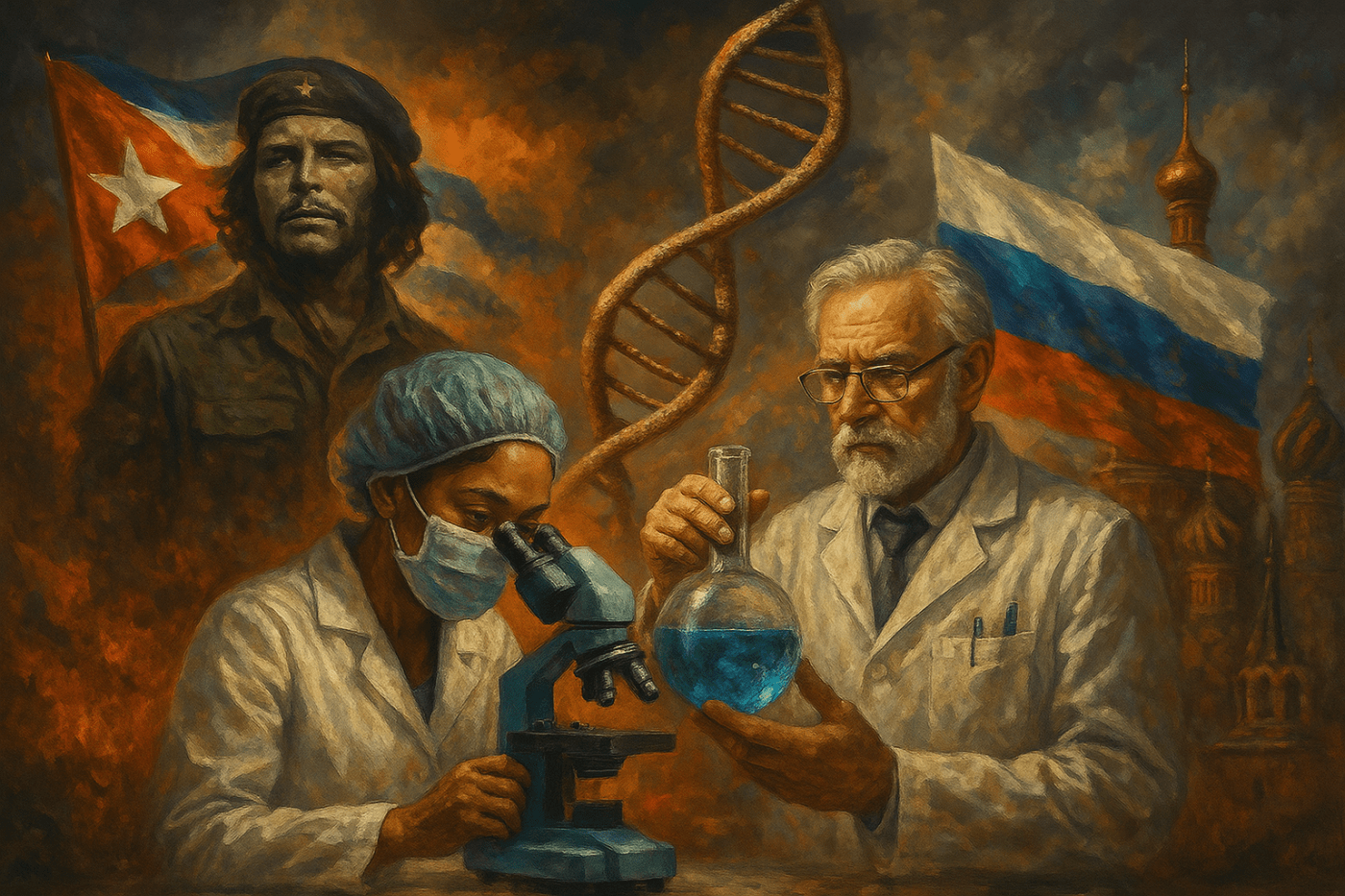
Exposing the Western media blackout on Cuban-Russian biotech cooperation as imperial narrative warfare
By Prince Kapone | Weaponized Information | May 6, 2025
I. The Erasure of Cuba’s Revolution: Why Western Media Won’t Tell You the Truth
On May 6, 2025, teleSUR reported that Cuban President Miguel Díaz-Canel visited St. Petersburg, meeting with Governor Alexandr Beglov to advance biotechnology cooperation between Cuba and Russia. The report described Díaz-Canel’s tour of the Russian pharmaceutical company Vertex and highlighted Cuba’s Mariel Special Development Zone as a hub for joint biotech production. Yet if you relied on Western media—CNN, The New York Times, BBC—you’d never know this visit happened. You’d never know Cuba’s socialist science was strengthening alliances beyond the reach of U.S. hegemony. You’d never know another world was already being built.
The silence isn’t ignorance. It’s propaganda by omission: an ideological operation designed to erase multipolar sovereignty from the global imaginary. Western outlets didn’t “miss” the story—they suppressed it. Because Cuban-Russian biotech collaboration exposes an inconvenient truth: that lifesaving medicine doesn’t need to flow through Pfizer’s pipelines or Moderna’s patent portfolios. That a tiny blockaded island, smeared as “authoritarian” and “failed,” has outperformed billion-dollar corporations in producing treatments for hepatitis B, diabetic foot ulcers, and lung cancer. Every headline they refuse to print is a defense mechanism for empire, shielding their audiences from the example of socialist science that works.
Why does Reuters breathlessly cover Pfizer’s stock gains but omit an international summit advancing non-Western biotech sovereignty? Why does The New York Times praise AstraZeneca’s licensing deals but ignore Cuba’s vaccine partnerships with 70 Global South nations? Because narrative silence is a weapon. The erasure protects Big Pharma’s legitimacy. It ensures that no ordinary reader asks: Why are Cuban vaccines banned from U.S. markets? Why does the U.S. blockade prevent access to Cuban cancer treatments that cost a fraction of Western equivalents? Why is Russia collaborating with Cuba instead of Pfizer?
This silence sustains the colonial contradiction embedded in global health: the imperial core monopolizes the story of scientific progress while the periphery provides the raw materials, bodies, and experimental spaces. To cover Cuban-Russian biotech cooperation would be to admit the possibility of sovereign socialist science—a model that threatens intellectual property cartels, patent monopolies, and the pharmaceutical profiteering that forms the economic armature of technofascism’s necro-extractivism.
And so, empire’s stenographers look away. The headlines vanish. But the struggle continues beneath the silence. Because every unreported summit, every suppressed breakthrough, every unspoken alliance is another crack in the imperial narrative machine. And every crack is a site of revolutionary possibility. This is why teleSUR told the story. This is why we must tell it again. Because silence is not neutral. Silence is complicity. And to excavate the omission is to arm the oppressed with the truth the empire fears most: that science belongs to the people, not capital.
II. Big Pharma’s Necro-Extractivism: The Silent Empire Behind the Omission
Why does Western media erase Cuba and Russia’s biotech collaboration? Because it punctures the imperial fiction that lifesaving medicine must flow through Wall Street’s supply chains. The silence is not a mistake—it’s the firewall of technofascism, defending a global system where Big Pharma’s patent monopolies rule under the banner of “innovation.”
Behind the omission stands an imperial cartel: Pfizer, Moderna, AstraZeneca, Roche, and their financiers at BlackRock, Vanguard, and State Street. These pharmaceutical giants don’t just monopolize medicine; they monopolize meaning itself—declaring whose science counts, whose cures circulate, and whose lives deserve saving. Cuba’s biotech breakthroughs—Heberprot-P for diabetic foot ulcers, CIMAvax for lung cancer, Abdala and Soberana COVID-19 vaccines—shatter that monopoly by proving that medical innovation can flourish outside the intellectual property cages of capitalism.
The West’s patent regimes, enforced by the WTO’s TRIPS agreement, aren’t neutral trade rules. They’re technofascist infrastructures: militarized intellectual property regimes designed to enforce imperial control over biology itself. Every Cuban medicine banned from U.S. and EU markets isn’t a bug in the system—it’s the system working exactly as designed. By criminalizing Cuban treatments while sanctifying Western patents, imperial law encodes a global health apartheid, where access to medicine is conditional on submission to capital.
And in the silence of the Western press, the ideological machinery of empire grinds on. Because if they reported the truth, audiences might ask dangerous questions: Why does the richest empire on Earth need to blockade a small socialist island’s medicines? Why do U.S. hospitals overpay for inferior treatments while better, cheaper Cuban alternatives are outlawed? Why does the FDA reject life-saving drugs from Havana while fast-tracking experimental pills from Silicon Valley?
Each question exposes a forbidden truth: that sovereign socialist science—publicly owned, cooperatively produced, freed from shareholder mandates—constitutes a dual and contending power to technofascist hegemony. This is why Díaz-Canel’s meeting at Vertex could not be acknowledged. It wasn’t just a handshake. It was a blow against Big Pharma’s ideological monopoly, a quiet declaration that the future of medicine does not belong to patents, profits, or pharmaceutical empires—it belongs to the peoples and nations reclaiming the knowledge stolen by colonial capitalism.
Western media won’t print that. Because to admit it would rupture the narrative scaffolding of empire. It would show that another science is not only possible—it’s already under construction, building a multipolar barricade against the necro-extractivism of the imperial health regime. And if that barricade spreads, if it links Havana to St. Petersburg to Caracas to Johannesburg to Beijing, the empire’s grip over the life sciences of the 21st century begins to fracture. That’s the story they fear. That’s the silence we must break.
III. Socialist Science: Cuba’s Biotech as Contending Power
At the heart of Díaz-Canel’s visit to Russia lies a revolutionary truth the imperial press dares not print: Cuba’s biotech sector is not an anomaly, nor a relic of Cold War patronage—it is the living embodiment of socialist science, forged by a revolutionary state that chose health as a collective right instead of a corporate privilege.
When Díaz-Canel highlighted the Mariel Special Development Zone, he wasn’t selling an export-processing zone. He was signaling a material base for an alternative scientific economy: one in which knowledge is produced, shared, and deployed for public good rather than enclosed behind patents. In Mariel’s biotech hub, Cuban scientists have developed vaccines against hepatitis B, groundbreaking cancer immunotherapies like CIMAvax, and life-saving drugs like Heberprot-P for diabetic foot ulcers—treatments unavailable to millions in the imperial core because their existence threatens the logic of monopoly medicine.
Every Cuban vaccine shipped abroad, every brigade of Cuban doctors deployed to disaster zones, every shared medical breakthrough constitutes an act of dual and contending power. Each one builds a parallel circuit of care that defies the necro-extractivism of Big Pharma’s patent regime. While Western pharmaceutical capital profits from sickness, hoards knowledge, and weaponizes intellectual property to deny care, Cuba’s biotech sector operates on the principle that life is not a commodity—it is a human right.
This is why Western media erases Cuba’s medical internationalism. Because to tell the story truthfully would expose that the blockade isn’t merely an economic siege—it’s a knowledge embargo. Imperialism fears not just Cuban medicines, but the political model they represent: a world in which science is liberated from shareholder imperatives, healthcare is de-commodified, and the periphery generates knowledge not for extraction but for liberation.
Díaz-Canel’s collaboration with Russian pharmaceutical industries must be understood not as dependency, but as multipolar solidarity. By partnering with Russia—and by extension BRICS+ nations—Cuba is embedding its biotech sovereignty into a counter-hegemonic bloc aimed at dismantling Big Pharma’s global monopoly. Every joint venture, every technology-sharing agreement, every shared patent between Havana and St. Petersburg constitutes a brick in the barricade against imperial health apartheid.
This barricade, invisible to Western audiences yet material in its effects, threatens the ideological core of pharmaceutical imperialism. That’s why CNN, The New York Times, and Reuters can only respond with silence. To cover Díaz-Canel’s visit would be to acknowledge that another scientific order is not only possible—it is already rising, carried on the backs of Cuban workers, scientists, and revolutionaries who continue to build a socialist future beneath the shadow of empire.
IV. Multipolarity and the Biotech Frontline
Díaz-Canel’s meeting with the Governor of St. Petersburg wasn’t merely a diplomatic formality—it was a strategic maneuver in the unfolding multipolar world order. The Cuban-Russian biotech partnership is not just a bilateral cooperation; it is a material front in the global struggle over who will control the life sciences of the 21st century: imperial finance capital or a coalition of sovereign states forging pathways outside the chokehold of the imperial core.
The Western media’s silence about this alliance is not ignorance—it is propaganda by omission. To report it honestly would mean admitting that Cuba’s socialist science model, despite decades of blockade and sabotage, has outperformed capitalist pharmaceutical giants in key medical innovations. It would mean acknowledging that Russia, under siege by Western sanctions, is building alternative supply chains for life-saving medicines beyond the reach of U.S. and EU intellectual property regimes. And it would mean conceding that these alliances are coalescing into a contending power bloc capable of undermining Big Pharma’s global monopoly.
When Díaz-Canel toured the Russian pharmaceutical company Vertex, it wasn’t just a site visit—it was a signal of alignment with Russia’s sovereign pharmaceutical industrialization. While the West sneers at Russia’s “import substitution” policies, revolutionaries understand them as a necessary act of economic self-defense against sanctions warfare. By offering the Mariel Special Development Zone as a platform for Cuban-Russian joint ventures, Díaz-Canel was laying groundwork for a biotech commons insulated from imperial financial capture, patent theft, and extractivist supply chains.
This is why the empire cannot afford to cover the story. Every successful Cuban vaccine exported to the Global South, every Cuban-trained doctor deployed to Africa and Latin America, every joint venture producing generics in defiance of patent monopolies, chips away at the ideological fiction that scientific progress requires capitalist incentives and private ownership. The imperial core’s biopolitical dominance depends on that fiction. And Cuba’s very existence, multiplied through alliances with Russia, China, Venezuela, and other BRICS+ nations, exposes it as a lie.
Imperialism’s biopolitical control—its monopolization of patents, its ability to weaponize disease, its capacity to extract life from death—depends not only on economic force but on narrative force. The silence of CNN, Reuters, and The New York Times is an extension of that imperial violence, an ideological firewall to keep audiences in the core from seeing that a world beyond Big Pharma is not just imaginable—it is already being built.
Díaz-Canel’s visit, then, wasn’t merely a diplomatic footnote—it was a flare from the rising multipolar order. Every headline the empire refuses to print about Cuba’s biotech sovereignty is proof that this struggle is not abstract. It is material. It is geopolitical. And it is revolutionary. The battle for biotech sovereignty is the frontline of a broader war to dismantle pharmaceutical imperialism, technofascist patent regimes, and the intellectual property stranglehold that holds billions hostage to capitalist medicine.
V. Dismantling Technofascism: Big Pharma’s Monopoly and the Cuban Alternative
The silence surrounding Cuba’s biotech breakthroughs isn’t just about withholding information; it’s part of a broader strategy to maintain Big Pharma’s monopoly over global health. The Western media’s erasure of Cuban and Russian biotech cooperation is a direct response to the growing threat that Cuba’s model of socialist science represents—a model based on collective labor, public ownership, and the primacy of human needs over profit.
Big Pharma’s patent regimes, upheld by the WTO’s Trade-Related Aspects of Intellectual Property Rights (TRIPS) agreement, are not just trade protocols. They are technofascist mechanisms, designed to keep pharmaceutical production under the control of a few powerful corporations. These monopolies enforce a global health apartheid, where life-saving medicines are reserved for the few who can afford them, and the vast majority are left to die from diseases preventable by cheaper, generically available alternatives.
Cuba’s response to this monopolistic system is clear: it is building an alternative model, one that operates outside the reach of capitalist patent regimes. Through its biotechnology sector, Cuba produces vaccines, treatments for diabetic foot ulcers, cancer therapies, and more—often at a fraction of the cost of their Western counterparts. The Cuban vaccines, developed under the constraints of a brutal U.S. blockade, have proven to be more effective and affordable than many Western alternatives. And yet, these vaccines are routinely excluded from U.S. and European markets. The reason is simple: they challenge the technofascist logic of profit-driven medical science.
The Cuban healthcare model is rooted in the idea that healthcare is a fundamental human right, not a commodity to be bought and sold. Cuban scientists, supported by a publicly funded research infrastructure, are not incentivized by the need to patent their discoveries or sell them at a markup. Their work is driven by the goal of improving human health—not increasing shareholder profits. This is why Cuban biotech continues to thrive, despite the systemic barriers imposed by the U.S. and its allies. The West’s pharmaceutical giants fear that Cuba’s example will inspire other nations in the Global South to break free from the grip of imperialist pharmaceutical control and develop their own sovereign health systems.
Yet, this success has a price. Cuba’s achievements are not only suppressed in the media—they are also attacked through economic warfare. The U.S. blockade, which has lasted for over 60 years, has cost the Cuban healthcare system billions of dollars, forcing the country to spend more on medical imports and limiting its ability to access advanced technologies. The blockade is not just a political tool—it is a biological weapon, designed to cripple Cuba’s capacity to provide healthcare to its people and to deny the Global South access to affordable medicines. By erasing Cuban biotech from the global health narrative, Western media upholds the logic of imperialism and the technofascist control of the pharmaceutical industry.
The attack on Cuba’s biotech sovereignty is not an isolated incident. It is part of a broader campaign to discredit and suppress any alternatives to the capitalist model of healthcare. Big Pharma’s monopolies are not just economic—they are ideological. They rely on a narrative that insists that innovation and progress can only come from private corporations, driven by profit motives. The Cuban model directly contradicts this narrative, demonstrating that public health systems, based on collective effort and solidarity, can achieve far more than capitalist systems ever could. This is why Cuba’s biotech breakthroughs are erased from Western media—it is an existential threat to the imperialist order.
The empire knows what’s at stake. This is why the Western media ignores the Cuban biotech success stories—because to acknowledge them would open the floodgates for the Global South to reclaim its healthcare sovereignty. It would undermine the very foundations of technofascism. The Cuban example shows that another world is possible—one where healthcare is not a commodity, but a basic human right, accessible to all. And that is a world the empire cannot allow to exist.
In this context, Díaz-Canel’s meeting with the Governor of St. Petersburg is not just about biotech cooperation—it is about building a counter-narrative to the technofascist control of health systems. It is about creating a new model, based on solidarity, that challenges the monopolies and provides a real alternative to the capitalist paradigm. This partnership with Russia is a step toward building a multipolar health system, one that is not dependent on the U.S. or its allies, but on cooperation between sovereign nations. And it is a model that will continue to grow, despite the silence and erasure that attempts to suppress it.
VI. Mobilizing Against Imperial Medicine: Toward a Global Biotech Solidarity
To tell the story of Cuba’s biotech revolution is not simply to reclaim a silenced history—it is to chart a revolutionary path forward. Every Cuban vaccine, every Cuban-trained doctor, every cooperative research initiative with Russia and other BRICS+ nations is more than a scientific achievement. It is an act of resistance. It is a living practice of dual and contending power against the global pharmaceutical monopoly that holds human life hostage to patents, profits, and imperial control.
We, in the imperial core, must not merely admire this struggle from afar. We must embed it within our own. For the empire’s biomedical control is not only a foreign policy—it is a domestic reality. In the U.S., the working class faces medical bankruptcy, privatized hospitals, and life-or-death rationing of care. The same technofascist system that blocks Cuban medicine from entering the market also inflates insulin prices, denies experimental treatments, and exploits the sick as revenue streams.
Thus, solidarity with Cuba’s biotech sovereignty must become material. It means building networks to import banned Cuban medicines into our communities, establishing “guerrilla clinics” that defy pharmaceutical monopolies, and organizing “redline exposés” targeting the universities, think tanks, and NGOs that collaborate in the theft and suppression of socialist science. It means demanding that hospitals divest from Big Pharma-backed intellectual property regimes and reinvest in open-source, cooperative biomedical research. It means mobilizing healthcare workers, patients, and activists to blockade pharmaceutical profiteering—whether at Pfizer’s shareholder meetings or at the FDA’s regulatory gatekeeping offices.
But above all, it means joining Cuba in its revolutionary wager: that life cannot be a commodity. That health cannot be a privilege. That science, at its highest purpose, is a tool of liberation, not accumulation. The Western media’s erasure of Díaz-Canel’s visit to Russia was not a failure of journalism—it was the empire’s firewall against this emancipatory possibility. Our task is to breach that firewall, to name what has been silenced, and to carry forward the torch of biotech sovereignty as a banner of global class struggle.
As the empire’s technofascist grip tightens, every Cuban vaccine, every Cuban lab, every Cuban doctor abroad is a revolutionary node in a growing global counter-network. And every suppressed headline is an invitation to organize, agitate, and reclaim the future. The barricade has been built. Now, it is ours to defend.
 Weaponized Information
Leave a comment