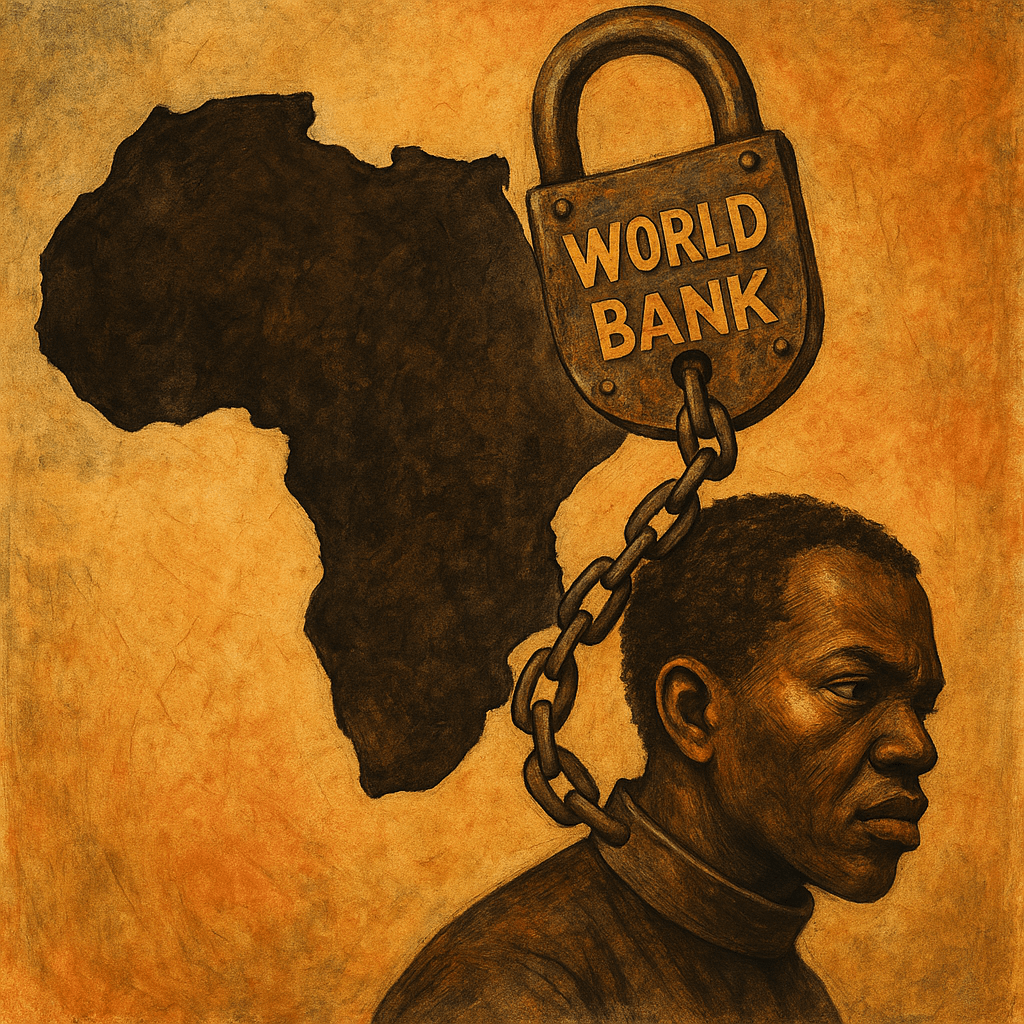
By Prince Kapone | Weaponized Information | April 30, 2025
I. World Bank Blame Games and the Colonial Gaslight Economy
On April 29, 2025, Business Insider Africa published a headline that read like something straight out of the 1890s colonial archives: “South Africa, Nigeria, Angola hold back Sub-Saharan Africa’s growth – World Bank.” The article cites a World Bank economic update blaming these three nations — the largest economies on the continent — for dragging down the region’s overall performance.
The producer of this narrative is the World Bank, the crown jewel of Washington’s financial imperial architecture. Business Insider Africa functions here as the amplifier, laundering the Bank’s imperialist talking points through a “local” outlet that wears an African face but serves Western capital’s voice. The real beneficiaries of this framing are not African nations — they are the global institutions of neocolonial finance, multinational corporations, and donor governments who need a scapegoat for the deepening contradictions of their own parasitic policies.
The World Bank’s framing is a masterclass in neoliberal inversion. Decades of economic sabotage — engineered by the Bank’s own conditional lending, structural adjustment programs, debt peonage schemes, and enforced market liberalization — are never mentioned. The theft is concealed, and the victims are blamed. Africa’s underdevelopment is not seen as a condition imposed, but a sin committed. The predators are invisible, the prey accused of failing to outrun the wolves.
Notice the language: “hold back.” It evokes obstruction, regression, failure — all placed on the shoulders of post-colonial nations attempting to rebuild with their legs broken and their hands tied. By targeting Nigeria, South Africa, and Angola specifically, the World Bank isolates the most potentially autonomous economies on the continent and paints them as threats to “regional progress.” Progress, of course, meaning integration into Western-dominated markets — not liberation.
This is not neutral economic commentary. It is imperial narrative warfare. It serves to discredit national development strategies, sabotage regional unity, and justify greater intervention — both fiscal and military — under the guise of helping Africa “grow.” And Business Insider Africa plays its assigned role faithfully, reproducing this ideological line without critique, without history, and without even the courtesy of naming the Bank’s role in shaping the very crises it laments.
So we excavate. We name the producer: the World Bank. We identify the amplifier: Business Insider Africa. We reveal the beneficiaries: Western capital, financial oligarchs, comprador technocrats, and neoliberal clients who thrive off Africa’s enforced dependency. The article is not analysis. It is a weapon. And like all weapons in the empire’s arsenal, it must be disarmed and dismantled — piece by ideological piece.
II. Debt, Dependency, and the Chains We Didn’t Choose
The article cites a few select facts: Sub-Saharan Africa’s growth is expected to rise slightly to 3.4% in 2024, inflation is falling in most parts of the continent, and smaller economies like Ivory Coast, Ethiopia, Kenya, and Senegal are projected to grow faster than their regional neighbors. These figures are deployed to reinforce the World Bank’s narrative: that it is not the global system that is broken, but these three “underperforming” African states that are dragging the region down.
But what the article doesn’t say — what it cannot say — is that the World Bank and its twin, the IMF, helped build the very conditions they now condemn. Throughout the 1980s and 1990s, Nigeria, Angola, and South Africa were targeted by structural adjustment programs (SAPs) that enforced brutal cuts to social spending, dismantled public enterprises, privatized state assets, and subordinated local economies to global capital. This was not “aid.” It was economic warfare, designed to crush developmental sovereignty and integrate Africa into the Western-dominated world system as a source of cheap labor, raw materials, and debt repayments.
In Nigeria, SAPs gutted the agricultural sector, led to mass unemployment, and generated social unrest that persists to this day. In Angola, IMF-linked oil-backed loans locked the country into commodity dependence, leaving it exposed to global price shocks and reliant on Western finance. In South Africa, post-apartheid governments were shackled by pre-negotiated debt obligations and neoliberal fiscal constraints that hollowed out the promise of economic justice after political liberation.
The “underperformance” of these nations is not the result of bad leadership or local mismanagement alone — though corruption, compradorism, and elite betrayal have played their role. It is the outcome of centuries of extraction, followed by decades of debt-based recolonization. The World Bank’s preferred economies — the so-called rising stars of the region — are precisely those that have most deeply integrated into neoliberal circuits: logistics hubs, tech enclaves, offshore finance sectors, and labor-exporting economies designed for imperial needs, not local emancipation.
The historical context matters: Nigeria and Angola are oil-rich but value-poor — because they export raw materials while importing finished goods. South Africa is mineral-rich and finance-dominated — where Black workers still die in platinum mines owned by transnational firms whose profits are extracted through London and New York. The structural position of these countries in the global system is not accidental. It is the intended outcome of imperial design.
And let’s not forget: the post-COVID debt crisis in Africa was not caused by fiscal irresponsibility. It was caused by dollar-denominated loans, speculative capital flight, and a global system where interest rates are dictated by the U.S. Federal Reserve — a body entirely outside African control. When interest rates rise in the Global North, currencies collapse in the Global South. This is not market fluctuation. It is class war by spreadsheet.
So yes, inflation is falling. But at what cost? To meet the World Bank’s criteria for “growth,” these nations are slashing subsidies, devaluing their currencies, and laying off workers. That is not development. It is triage under occupation. The facts don’t indict Nigeria, Angola, and South Africa. They expose the vampire logic of the imperial system that feeds off their crises and then blames them for bleeding.
III. Africa Isn’t Holding Back Growth — It’s Holding the Line
Let’s say it plain: Nigeria, Angola, and South Africa aren’t “dragging down” Sub-Saharan growth — they are resisting full recolonization. They are not the weakest links in Africa’s economic future — they are the battlefronts, where the contradictions of hyper-imperial capitalism are most concentrated. When the World Bank says they are underperforming, what they mean is: these countries haven’t surrendered enough. They haven’t privatized everything. They haven’t collapsed fully into IMF-approved export economies built to serve the Global North.
This isn’t a question of “growth” at all. It’s a question of who controls the direction of development, who benefits from it, and who pays the cost. The World Bank wants nations like Senegal and Ivory Coast to be held up as model students — obedient to austerity, open to capital, pliant in geopolitics. But real development isn’t measured by GDP. It’s measured by land sovereignty, industrial capacity, labor rights, and ecological balance. It’s measured by how many people are fed, housed, educated, and free — not by how many tech firms register in Kigali or how many ports get handed over to Dubai conglomerates.
When the World Bank praises “growth,” it means capital growth — for Western investors, corporate shareholders, and domestic comprador classes. When Nigeria, South Africa, or Angola assert resource sovereignty — when they nationalize oil fields, restrict capital outflows, or resist dollarized trade regimes — they are branded “problems.” But in truth, they are frontlines of struggle. Struggle against recolonization, debt enslavement, and technocratic domination by unelected institutions headquartered in Washington, D.C.
And let’s keep it a buck: even the metrics of success are fraudulent. Growth for whom? For what? Angola’s oil revenue “grows,” but most Angolans remain poor and exploited. South Africa has the most developed economy on the continent — and also one of the highest inequality rates on Earth. Nigeria has a booming tech sector and a crumbling energy grid. These are not contradictions. They are features of a system that bleeds the people dry to fatten the metrics for Western investors.
So when the World Bank says these countries are holding back Sub-Saharan Africa, it’s actually a quiet confession: they haven’t yet broken. They haven’t fully bent to the boot of financial capital. They haven’t dismantled every mechanism of sovereignty. And that refusal — however partial, uneven, and compromised — is exactly what must be defended, expanded, and deepened by revolutionary movements across the continent.
Africa’s economic future will not be secured by obeying Washington’s growth gospel. It will be secured by refusing the script entirely — and writing a new one grounded in Pan-African solidarity, socialist planning, ecological sustainability, and popular control. These are not pipe dreams. They are the only sane alternative to permanent crisis.
IV. Growth for the Colonizer, Survival for the Masses — Or Revolution
Let’s cut the bullshit: there is no such thing as neutral development under imperialism. Every pipeline, every tech hub, every loan, every economic projection is a political weapon — forged to discipline, extract, and pacify. The World Bank doesn’t want Africa to grow. It wants Africa to grow dependent, grow open, and grow silent. When Nigeria is scolded, it’s not for failing to feed its people — it’s for failing to feed the empire.
And yet, beneath this architecture of lies, the struggle continues. Farmers resisting land grabs in Angola. Youth resisting austerity in South Africa. Popular movements in Nigeria fighting to reclaim stolen oil wealth. Africa isn’t some helpless “developing” continent. It’s a global insurgency zone, and that’s precisely why the World Bank is panicking.
As we learned from the working class across the Global South: you do not internalize the lies of your oppressors. If your nation is being demonized, it’s because it poses a threat to imperial order. If your economy is “underperforming,” it’s because you haven’t been fully looted yet. And if your government is being told to reform, it means reform into something Western capital can eat.
And as we learned from African revolutionaries, organizers, and intellectuals: the World Bank must be named as it is — a colonial institution under new management. Its data is propaganda. Its prescriptions are poison. And its agenda is the recolonization of Africa through contracts instead of chains, and consultants instead of conquistadors.
But the masses see through it now. The people are no longer confused. The same hands that enslaved Africa now offer “technical assistance.” The same empires that looted the continent now offer “resilience frameworks.” The vocabulary has changed, but the violence hasn’t. And the only antidote to imperial growth is revolutionary rupture.
Burkina Faso is showing us the way. Mali, Niger, and even parts of Congo are beginning to speak the language of sovereignty again. This is not the “crisis” the West fears. This is the beginning of a new African century — if we make it so. But to do that, we must break the myths, burn the reports, and bury the bankers.
This is not just about Africa. It’s about the future of global liberation. The World Bank has declared economic war — not just on Nigeria, Angola, and South Africa — but on every people who refuse to sell their soil, their sweat, and their sovereignty to global finance. The global working class must meet that war with organization, with clarity, and with revolutionary courage.
The time for begging is over. The time for bargaining is over. The only path forward is revolutionary transformation — and the struggle has already begun.
 Weaponized Information
Leave a comment