By Prince Kapone | Weaponized Information | April 30, 2025
I. Multipolarity in Motion, Empire in Panic
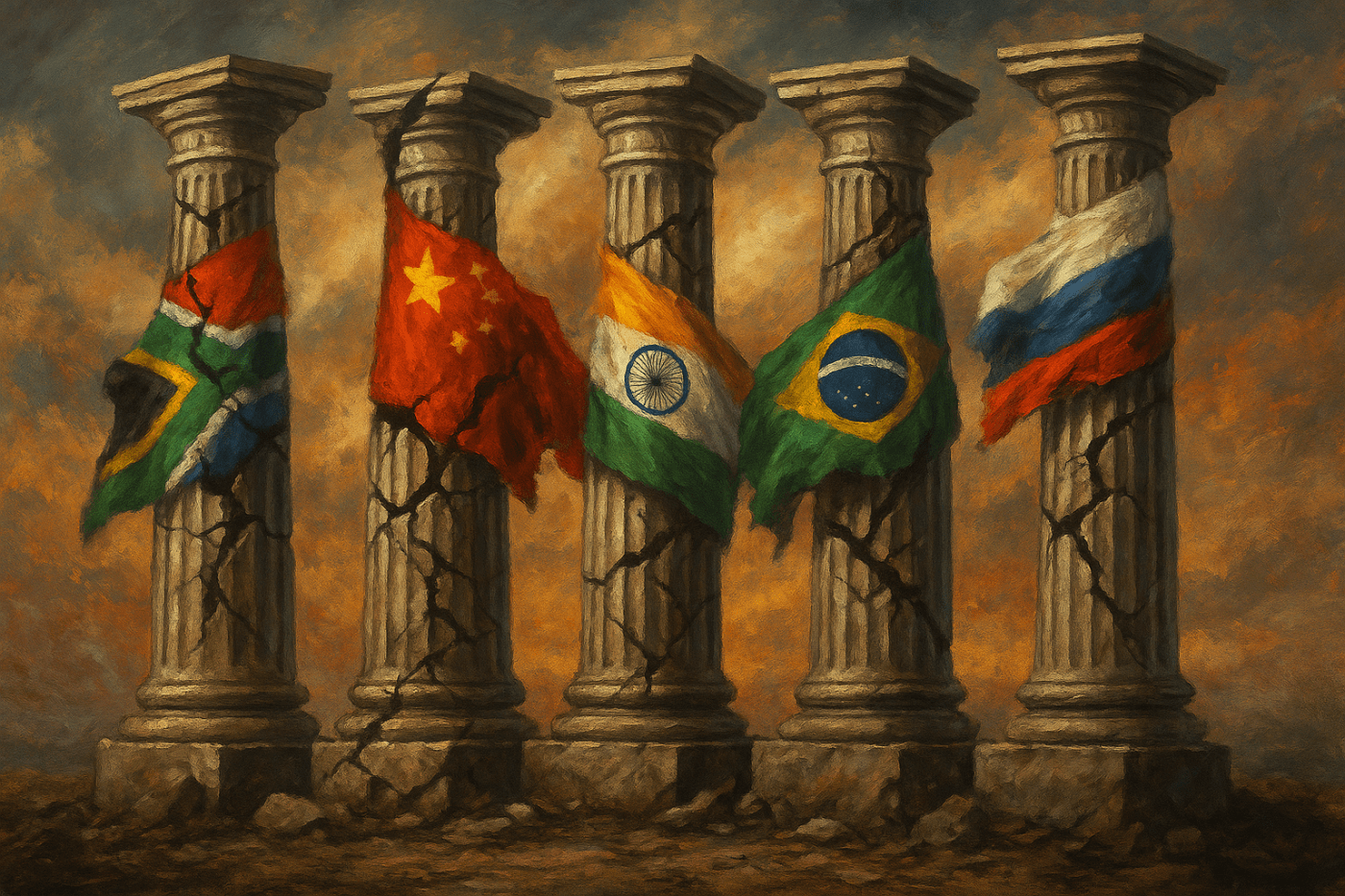
On April 29, 2025, Bloomberg published a short but telling piece by reporter Matthew Malinowski, titled: “BRICS Rift Emerges in Rio as New Members Balk at Past Agreements.” At first glance, it reads like routine summit coverage — a few logistical disagreements, some generic geopolitical analysis. But scratch the surface and you’ll find something deeper: a soft-power hit job aimed at sowing doubt, division, and Western triumphalism over the cracks forming inside the BRICS+ alliance.
The producer of this narrative is Bloomberg — a flagship outlet of transatlantic finance capital and one of Wall Street’s most loyal ideological bulldogs. Its job is not merely to report events, but to construct stories that preserve the worldview and interests of the global investor class. And Malinowski, a former IMF researcher turned Bloomberg correspondent, plays his role to perfection: downplaying Western imperialism while projecting instability onto any Global South formation that threatens dollar hegemony.
The amplifier is the entire Western financial media ecosystem, where Bloomberg articles are syndicated, cited, and absorbed into policymaking conversations. Think tankers, hedge fund analysts, State Department planners, and Beltway pundits will all read this piece not as journalism, but as confirmation: BRICS is falling apart, the Global South is too divided to govern itself, and Washington’s supremacy is safe after all.
The beneficiaries are clear. Western finance capital, NATO-aligned governments, and U.S. geopolitical planners who desperately need to downplay the systemic threat that BRICS+ poses to the unipolar world order. If BRICS+ fractures publicly, it relieves pressure on the dollar, re-legitimizes IMF-World Bank hegemony, and reasserts the illusion that Washington consensus is the only viable system.
The framing is slick: new BRICS members are “balking” at past agreements; old members are losing control; contradictions are mounting. But what’s left out is more telling than what’s included. No mention of the uneven development legacies that BRICS was built to confront. No discussion of Western economic sabotage that pushed countries like Egypt and Ethiopia into BRICS in the first place. No recognition of the fact that tensions in multipolar blocs are not signs of weakness — they’re signs of autonomous political activity outside of Western management.
So let’s name the operation: this isn’t journalism, it’s pre-emptive narrative warfare. An attempt to kill the legitimacy of multipolarity in the minds of the Western middle classes and financial elites before it can fully consolidate in material terms. It is Bloomberg playing ideological border guard for a world order that’s crumbling by the hour.
II. What They Call Dysfunction, We Call Dialectics
The Bloomberg article is built around a kernel of fact: at the recent BRICS+ summit in Rio, new member states expressed hesitations about some of the group’s older frameworks and prior economic agreements. The reporter notes friction around trade coordination, energy deals, and internal leadership dynamics. This is true — but the framing is distorted. It’s not the facts that lie. It’s how they’re wielded.
To the Western reader, this is meant to signal weakness: BRICS+ is too diverse, too disorganized, too fractured to function as a true counterweight to the G7. But from a dialectical and anti-colonial perspective, these tensions are not failures — they are the growing pains of sovereignty. What we’re witnessing isn’t the collapse of multipolarity. We are watching its birth, in real time.
Consider the composition of BRICS+. It includes revolutionary governments (like China and Iran), neoliberal client states (like Egypt), and large semi-peripheral economies (like India, Brazil, South Africa, and Russia) all attempting to chart a common course under the long shadow of Western domination. That’s not dysfunction. That’s the political reality of the postcolonial world — a world carved up, indebted, bombed, and blockaded for over a century. Unity will not come prepackaged. It must be forged through contradiction.
Western alliances don’t appear fractured because they aren’t built on autonomy. NATO members don’t disagree publicly — because Washington sets the terms. The IMF doesn’t have internal arguments — because its function is to extract, not deliberate. BRICS, by contrast, is attempting something dangerous: organizing a non-Western bloc not on the basis of imperial domination, but on mutual development. That process will be messy — because it’s real.
The article also ignores the material history behind this struggle. Countries like Egypt and Ethiopia joined BRICS not because they were seeking ideological unity — but because they were trapped: by IMF debt, dollar dependency, food insecurity, and commodity subordination. The BRICS+ project is not perfect. But it is an attempt — however contradictory — to break out of the neocolonial circuit.
This is why Bloomberg is so invested in calling these frictions a “rift.” If BRICS is just a mess of incoherent regimes, the West can dismiss it as irrelevant. But if it’s something more — a laboratory for post-imperial integration — then every disagreement becomes a potential foundation for independent blocs, de-dollarized trade, and coordinated resistance to Western hegemony.
The article says new members are “balking.” But what if they’re asserting? What if they’re resisting China’s dominance and U.S. sabotage — not to serve empire, but to chart independent terms within a new world system? That’s not failure. That’s politics. And in a world where Western alliances operate through coercion, blackmail, and war, the fact that BRICS+ has space for contradiction is not a sign of weakness — it’s a breath of sovereign air.
III. BRICS+ Is Not the End of Empire — But It Might Be the Beginning of Something Else
The West wants you to believe that BRICS is a failure because it doesn’t behave like NATO. But that’s exactly the point. BRICS+ is not a mirror of empire — it is a fracture in its foundation. It may not be revolutionary yet. But it represents the realignment of power away from unipolar command, toward a contested, contradictory, and more open geopolitical terrain — and that terrifies the ruling class.
The internal disagreements, the rivalries, the hesitations — these are the birth pangs of post-colonial agency. BRICS is not a utopian coalition. It is a battlefield — one where former colonies, semi-peripheral economies, and Global South elites are negotiating their role in a collapsing imperial system. Sometimes those negotiations reproduce inequality. Sometimes they defy it. But either way, they are being conducted on new terms, outside the discipline of Washington and Brussels.
Western liberal pundits bemoan that BRICS lacks ideological coherence. But what they really mean is: BRICS lacks imperial discipline. It doesn’t follow orders. It doesn’t speak with a single voice because it hasn’t been homogenized by force. And that is exactly what makes it dangerous — and potentially transformative. It opens up space for new alignments: South-South trade, currency realignment, development financing, and energy cooperation unmediated by Western banks.
We are not naive. We know that some BRICS+ members are run by oligarchies. We know there are class enemies within the bloc. We know that Russia and China’s dominant role can reproduce certain hierarchies. But that’s precisely why this moment matters. For the first time since Bandung, a real process of non-aligned coordination is taking shape — not as ideology, but as necessity.
And unlike NATO, BRICS has no standing army. It doesn’t invade. It doesn’t bomb. Its contradictions play out in boardrooms, at summits, and on trade routes — not on the bodies of the colonized. And that alone marks a fundamental shift in the nature of global power. It is not socialism. But it is not imperialism either. It is the contested terrain in between — and that’s exactly where history is made.
To the empire, BRICS is dangerous not because it’s united, but because it’s not under control. The U.S. can tolerate vassals, not voices. And the fact that BRICS is attempting to construct a platform for multipolarity, however flawed, represents a revolutionary threat — not because it is armed, but because it is sovereign.
This is the point Bloomberg won’t say out loud: the cracks in BRICS aren’t signs of weakness. They are signs that the Global South is no longer willing to accept Washington’s vision of order — an order built on war, debt, and dollar tyranny. The old world is dying. And while BRICS+ isn’t the answer, it might just be the opening.
IV. The Bloc May Be Fractured, But the Empire Is Falling
Let the Bloomberg class laugh at the BRICS “rift.” Let them gloat about the contradictions, the delays, the diplomatic misfires. Because beneath their smug headlines is a quiet panic: they no longer control the tempo of global politics. That is why every internal disagreement within BRICS+ is reported with glee — and every contradiction inside the G7 is buried under bureaucratic silence. The empire is trying to convince itself that a broken mirror proves there’s no reflection.
But the reality is far more threatening — for them. Even a fragmented BRICS+ means the beginning of something they cannot tame: a decentralized, imperfect, and multipolar world where Washington doesn’t get to write the rules. It means oil traded in yuan. Infrastructure financed in rupees. Tech built outside Silicon Valley. And sovereignty asserted without NATO gunships guarding the borders of profit.
Yes, some BRICS+ governments are corrupt. Some are capitalist. Some still play both sides. But they are not aligned with the imperial core. And that — in this historical moment — is a rupture worth defending and deepening. Revolutionary movements do not emerge from perfect alliances. They emerge from contradictions that crack the imperial shell and give breath to something new.
For revolutionaries in the Global South: BRICS+ is not the solution — but it is a front of struggle. They must pressure their respective governments from below, not just with slogans but with mass movements demanding sovereign development, ecological sanity, reparations, and labor power. The bloc may be compromised, but the space it opens is real — and the empire knows it.
For us in the North: we must not fall for imperial moralism. We can’t dismiss BRICS+ because it isn’t pure. Purity is for propaganda. Reality is messy. And this messy bloc is one of the only institutional formations today capable of undermining dollar tyranny, World Bank extortion, and U.S. global dominance. If we ignore it, we ignore the real movement of history.
So yes, the bloc may be fractured. But the empire is falling. And between the rubble of old systems and the blueprints of new ones, there is a terrain of possibility — wide enough for revolution, if we have the clarity and courage to seize it.
 Weaponized Information
Leave a comment