By Prince Kapone, Weaponized Information | April 21, 2025
The Market Doesn’t Fear Trump. It Follows His Orders.
According to the Associated Press, the U.S. stock market dipped sharply this week after Donald Trump—now comfortably ruling in his second presidential term—made offhanded threats about intervening in the Federal Reserve’s interest rate policies. Investors didn’t panic. They paused. Because by now, they know what’s coming: command capitalism in a tailored suit.
Trump’s threats against the Fed aren’t new. What’s changed is the structure of power beneath them. This isn’t about tweets anymore. It’s about total executive dominance over the last independent economic institutions standing between finance capital and total state capture.
The Fed: From Semi-Autonomy to Political Tool
For decades, the U.S. ruling class pretended the Federal Reserve was above politics—technocratic, objective, immune from pressure. In reality, the Fed always served capital. But now, Trump isn’t content with backroom influence. He wants direct control. In the name of growth, in the name of jobs, in the name of “America First,” he’s positioning the Fed as a wholly owned subsidiary of the executive branch.
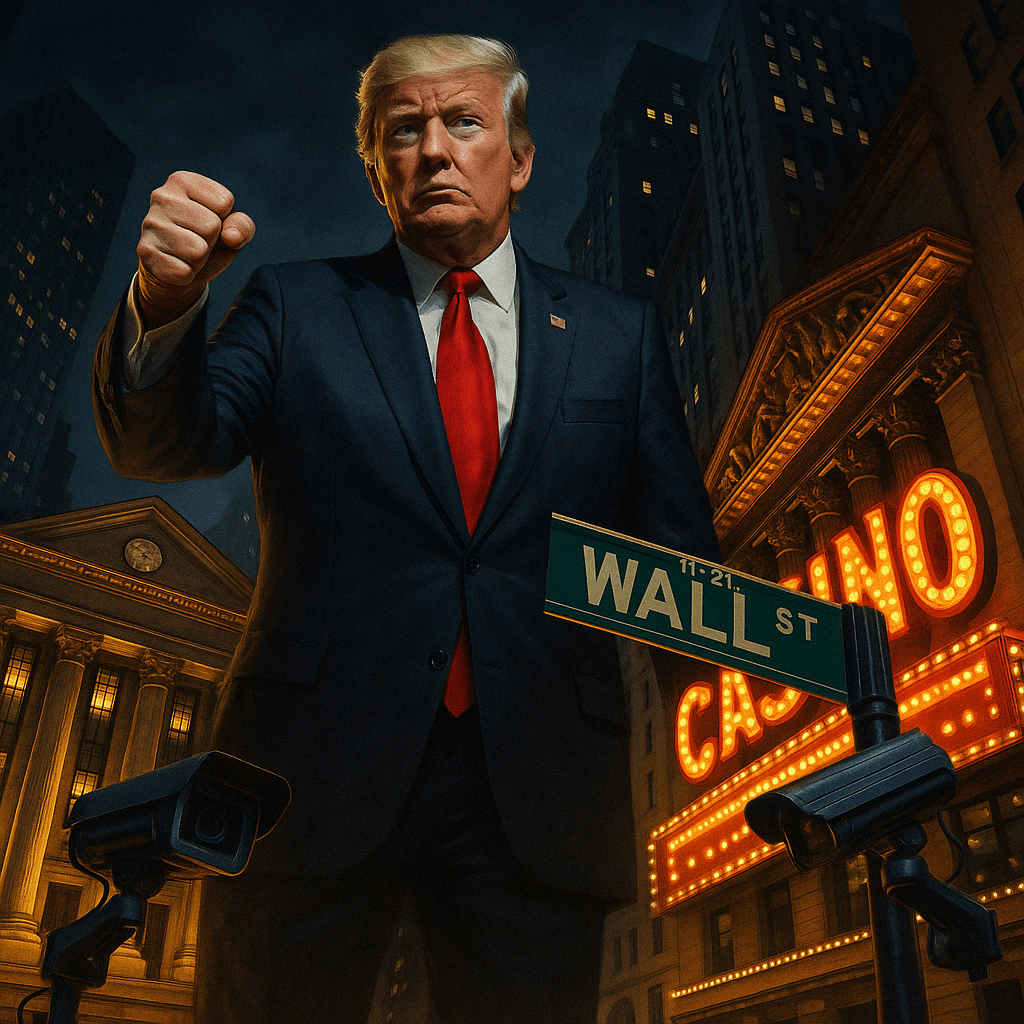
And Wall Street? They’ll gripe in public. But in private, they’re licking their lips. Because while independent rate hikes may calm inflation, they don’t pump asset bubbles. They don’t juice the stock market on demand. Trump is promising the gamblers full access to the house—and the power to print chips whenever they get low.
Market Fascism 101
What we are seeing is the emergence of market fascism: the fusion of financial speculation and authoritarian state power. Trump’s threats to override the Fed are not policy proposals—they’re a public demonstration of power. The stock market is no longer an economic indicator. It’s a theater. A mood ring for monopoly capital.
In this system, profit is no longer tied to production. It’s tied to proximity to power. If you’re in the good graces of the regime—through campaign donations, lobbying, or sheer ideological loyalty—you get bailouts, contracts, and deregulation. If you’re not, you get audited, broken up, or blacklisted. This is not free market capitalism. It’s executive-driven capital extraction with an audience.
The Theater of Instability
Trump knows exactly what he’s doing. He doesn’t need to tank the markets—he needs to jerk them. Each threat against the Fed shakes the indexes just enough to remind investors who’s in charge. He’s not interested in macroeconomic stability. He’s interested in loyalty. Market volatility isn’t a side effect—it’s a weapon.
This is how technofascism governs the economy: not through planning, but through chaos engineering. By creating crises, the regime justifies interventions. By stoking uncertainty, it controls both panic and reward. Trump’s attacks on the Fed are part of a broader authoritarian playbook: dominate the financial system, silence its critics, and punish the disobedient—while claiming to protect the “common man.”
Who’s Really Driving This Bus?
Behind the curtain are the same old players: BlackRock, JPMorgan, Citadel, Goldman Sachs. They don’t fear Trump. They fund him. Because as long as they remain in the driver’s seat, they don’t care who’s holding the steering wheel—or which cliff he’s headed toward.
But the contradiction is tightening. The U.S. economy, bloated with speculation and war spending, cannot float forever on vibes and executive decrees. Inflation still stalks the bottom half of the population. Wages are stagnant. Debt is exploding. And while Trump commands the casino, the working class is locked outside the velvet rope, watching their pensions bleed in real time.
The House Always Wins—Until It Burns
Trump’s flex against the Fed is not about economics. It’s about spectacle. It’s about domination. And it’s about signaling to capital: “Don’t worry, daddy’s got you.” But in doing so, he reveals the hollow core of the U.S. financial system—an empire of leverage built on lies, kept afloat by imperialism, and ruled by fear.
In the end, Trump doesn’t want to crash the market. He wants to own it. But the deeper crisis—the one no rate cut can fix—is that the people no longer believe in the house. And sooner or later, they may stop playing altogether.
 Weaponized Information
Leave a comment