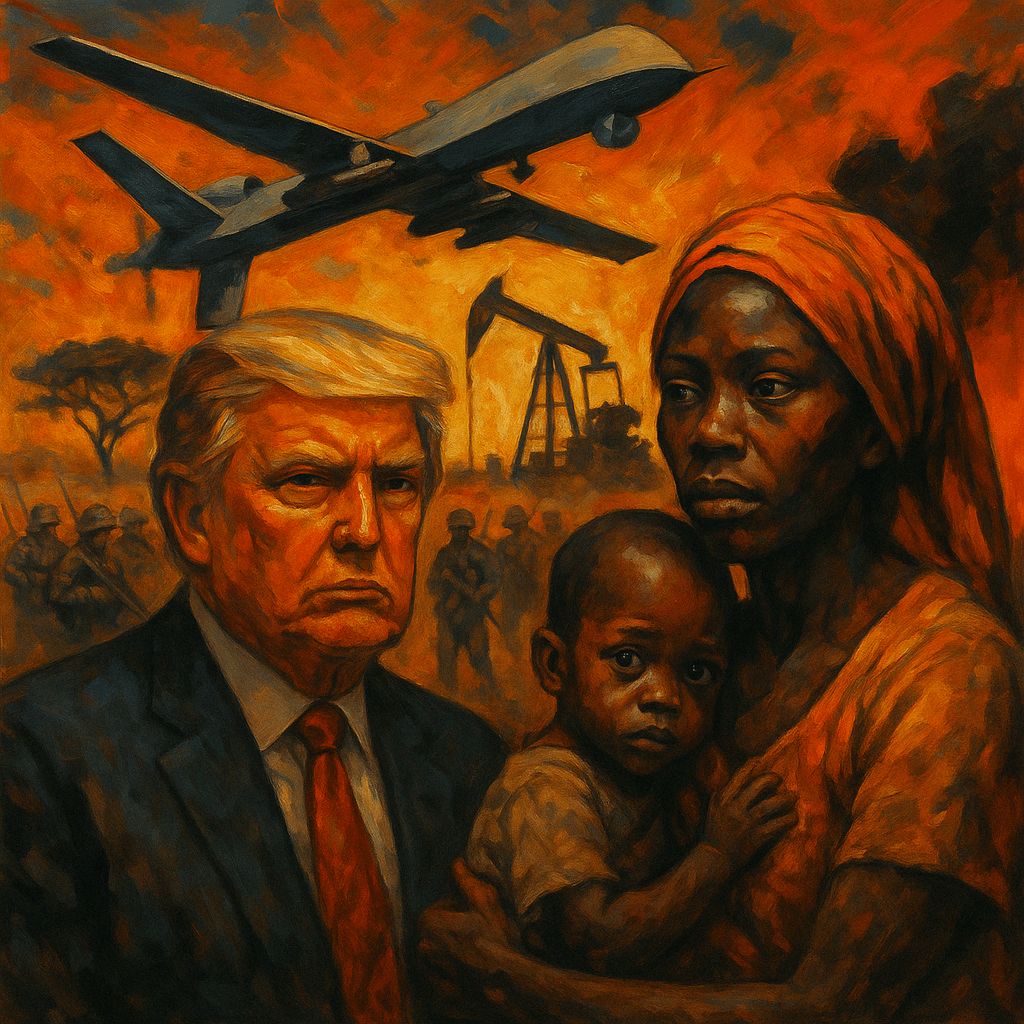
Behind the suits, speeches, and staged photo-ops, Trump’s return to Africa is a crude remix of old empire tactics—guns, loans, and lies. The only thing new is the software.
I. Africa, Empire, and the Fork in the Road
Let’s call it what it is. Africa is being pulled in two directions. On one side, you’ve got the ghosts of empire—dressed in Pentagon uniforms, armed with trade deals, and promising “security.” On the other, a fractured but growing push for multipolar sovereignty. Into this storm walks Trump 2.0, not with a new vision, but with a bigger stick.
For us, the analysis is sharp: what we call technofascism is the domestic operating system of U.S. capitalism in its stage of decay—rooted in mass surveillance, counterinsurgency, and authoritarian market rule. But when that same system stretches its claws into the Global South, it takes the shape of hyper-imperialism. Africa isn’t under technofascism—but it’s getting the fallout.
II. Guns, Deals, and Propaganda
Trump’s Africa playbook is simple:
- Show up with troops,
- Sign off on contracts,
- Smile for the cameras.
Guns: AFRICOM’s got the continent on lockdown. They call it “partnership,” but it looks a lot like occupation. Just look at African Lion 2025—touted as a multinational exercise, but scripted entirely by the Pentagon. U.S. troops lead, African troops follow. Drone strikes simulated, AI tech deployed, and real-time data fed straight back to Virginia. This isn’t training—it’s rehearsing for domination.
Deals: The State Department calls them investments. We call them bribes. Corporations like Raytheon and ExxonMobil roll into Africa behind trade envoys and military contractors, securing contracts that enrich a handful of local elites and leave everyone else buried under debt and displacement.
Propaganda: The empire’s gotten slick. Christian-right operatives talk about faith and family while signing basing agreements. Diplomatic speeches use the language of “self-determination” while militarizing borders and surveilling cities. And the Western press eats it up.
III. The Gatekeepers of Empire
Every empire needs managers. That’s where the comprador class comes in. Dressed in Ankara suits and Harvard diplomas, they smile for photos with U.S. generals while selling off land, ports, and infrastructure to imperial financiers. They’re not technofascists—they don’t need to be. They’re local admins for a global system of plunder.
They talk Pan-Africanism at the AU and turn around to sign defense agreements with AFRICOM. They quote Sankara while welcoming Oracle to monitor dissidents. Their job is to pacify the population while keeping the U.S. satisfied. And when they fail? The State Department finds a new puppet.
IV. Surveillance, Software, and Military Capitalism
This isn’t just about bullets. It’s about bandwidth. The new empire runs on data. Palantir is scanning migration routes. Microsoft is wiring biometric databases. AFRICOM isn’t just dropping bombs—it’s building the digital skeleton of a colonial operating system.
In African Lion 2025, we saw AI-assisted strikes, predictive battlefield analytics, and U.S. generals testing drone command protocols under real-world conditions—with African soldiers acting as their beta testers. This is military capitalism in its next iteration.
Meanwhile, Wall Street swallows African pensions, infrastructure loans, and telecom stocks. It’s not just neocolonialism—it’s hyper-imperialism backed by Silicon Valley, enforced by the Pentagon, and sanitized by CNN.
V. Something’s Gotta Give
But here’s the thing: the contradiction is too big to hide. The youth know what’s going on. From Dakar to Nairobi, they see the elite sellouts, the foreign troops, the disappearing futures. Resistance is building—sometimes as hunger strikes, sometimes as mass uprisings. The empire’s grip is firm, but the ground is shifting under its feet.
Multipolarity isn’t salvation, but it cracks the door. And through that crack, revolutionary possibilities are crawling in. Not reform. Not elections. Revolution—from the mine shaft to the marketplace.
VI. A Call for Revolutionary Internationalism
Let’s be crystal clear: what we’re facing is a U.S. regime governed by technofascism at home, and driven by hyper-imperialism abroad. Africa isn’t just collateral damage—it’s one of the main fronts in this global class war.
The answer isn’t a better deal with Washington. It’s not a pivot to Beijing. It’s a break from the entire system—rooted in anti-imperialist struggle, grounded in the working class, and led by the colonized masses who’ve had enough.
The old world is trembling. The empire is clinging to its last tricks. And a new world is possible—if we’re willing to fight for it, together.
 Weaponized Information
Leave a comment