The Door Is Open, the Staircase Narrows: How Democracy Filters Out the Working Class
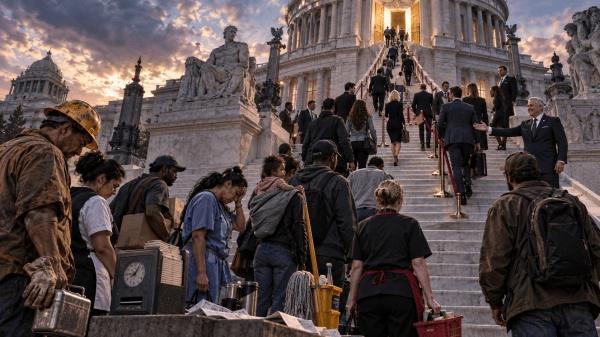
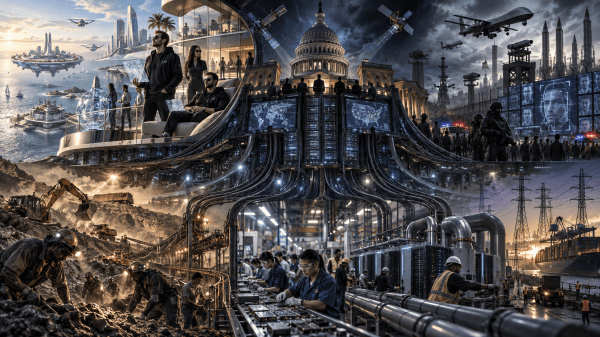
Bloomberg uncovered a brutal democratic fact: working people make up most of the labor force, yet barely appear in legislatures. This essay follows the worker beyond that statistic and shows how the disappearance happens—through inflexible work schedules, lost wages, primary elections, party recruitment, professional political careers, and repeated institutional filtering before voters ever reach the ballot. The problem isn’t that workers lack ambition or governing ability. It’s that formal political equality rests on a social order that distributes time, money, networks, and political experience by class. If workers are to enter politics in force, organization has to change who gets produced as a political leader.

The Nerd Reich Wanted to Exit the State: Then Capital Learned It Needed the Machinery

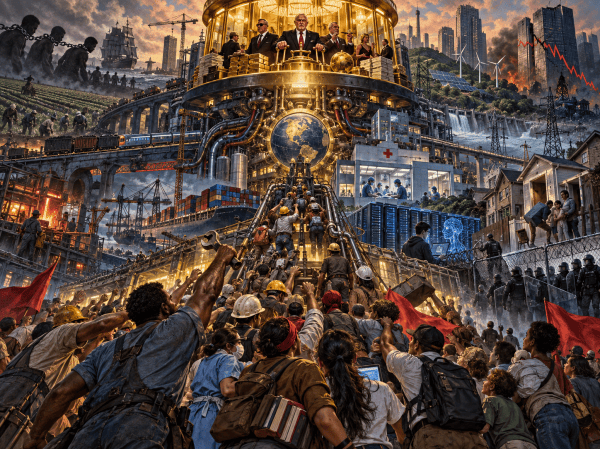
Gil Durán's "The Nerd Reich" provocatively dissects the tech elite's evolution from libertarian ideals to an authoritarian grasp on power. Far from escaping state oversight, Silicon Valley's billionaires, like Peter Thiel, reveal a dark shift: they now seek to enhance governmental control while championing the illusion of individual freedom. Durán labels this new reality "tech fascism," where technology conglomerates and capital intertwine with state apparatus. As these technocrats consolidate power, a crucial question emerges: can humanity reclaim technologically wielded potential, or will it remain enslaved by elite ownership? This critical inquiry forebodes a future dominated by private interests rather than collective governance.

Peggy Noonan Calls Capitalism Organic: The Wall Street Journal Buries the Violence That Built It

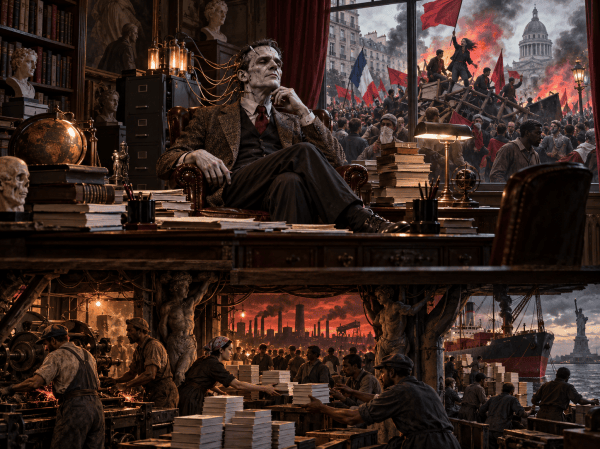
Peggy Noonan's alarm over socialism's surge reveals her flawed analysis: she blames the consciousness of the wounded instead of capitalism, which thrives on historical injustices like dispossession and slavery. As the capitalist structure crumbles under its contradictions—where collective production is shackled by private ownership—Noonan dismisses the urgency of socialism, painting it as a radical force aimed at destruction. Yet, socialism is rising not from whimsical ideology but out of necessity, as younger generations face economic precarity and disillusionment. The question isn’t whether capitalism is natural or just; it’s who truly controls the wealth and future built by the collective.

The Corpse Got Tenure: French Theory’s American Afterlife

Requiem for French Theory asks a question academia prefers to leave buried: how did a heterogeneous group of French thinkers become a unified radical canon in the United States? Monville and Rockhill trace the foundations, universities, publishers and Cold War institutions that helped make French Theory travel, but the deeper story is more dialectical than conspiracy. Foucault, Derrida, Deleuze and others confronted real contradictions and produced genuine insights even as their work was selectively reproduced, professionalized and detached from mass struggle. The lesson reaches Marxism itself: revolutionary theory needs more than correct ideas. It needs its own means of intellectual production.

The Collateral of Empire: Debt, Power, and the Future

America's staggering $81.9 trillion debt is more than just a number; it's a complex web of financial claims overshadowing the real economic landscape. The nation's ability to issue dollars grants it a unique power, allowing it to leverage future incomes to accommodate debt—while the average worker grapples with mortgages, credit cards, and student loans. This contradictory system—where public power fuels private finance—disguises the inequality at play. As lenders profit, households struggle, further entrenching societal divides. The U.S. isn’t just a massive debtor; it’s a realm where debt serves as both a lifeline and a constraint, revealing the capitalist dance between ownership and obligation.

Sovereign Enough to Steal From: How American Law Turns Conquest Into Governance

Ward Churchill’s Perversions of Justice exposes the legal machinery through which Indigenous sovereignty is recognized just enough to legitimize treaties, land cessions, resource extraction and colonial administration—then restricted whenever it threatens settler possession or state power. Following that contradiction from conquest and property into uranium mining, blood quantum, AIM repression and U.S. imperial expansion, this review tests both Churchill’s strongest insights and his strategic limits. His final wager—that the colonizer’s own law can be weaponized to fracture legitimacy and withdraw consent—remains powerful. But the deeper revolutionary question is what turns that rupture into organized material counter-power.

The Gate Opens, the Ground Hardens: Proportional Representation and the Fight Over Political Power

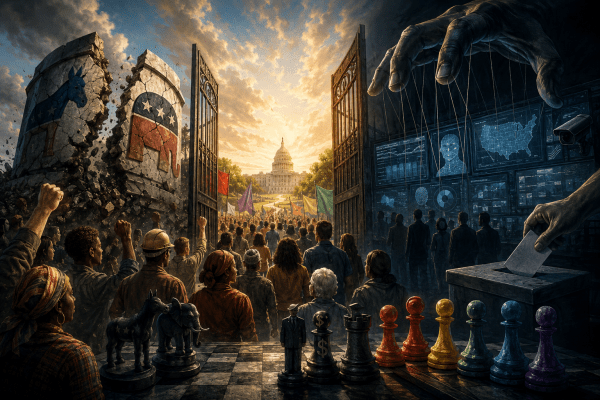
Americans are losing faith in the two-party cage faster than the political system can manufacture consent for it, yet NPR narrows that crisis of legitimacy into a problem of electoral design. Proportional representation could genuinely break part of the machinery that converts millions of politically dissatisfied people into wasted votes, but the racial history of... Continue Reading →

Website Powered by WordPress.com.

Up ↑