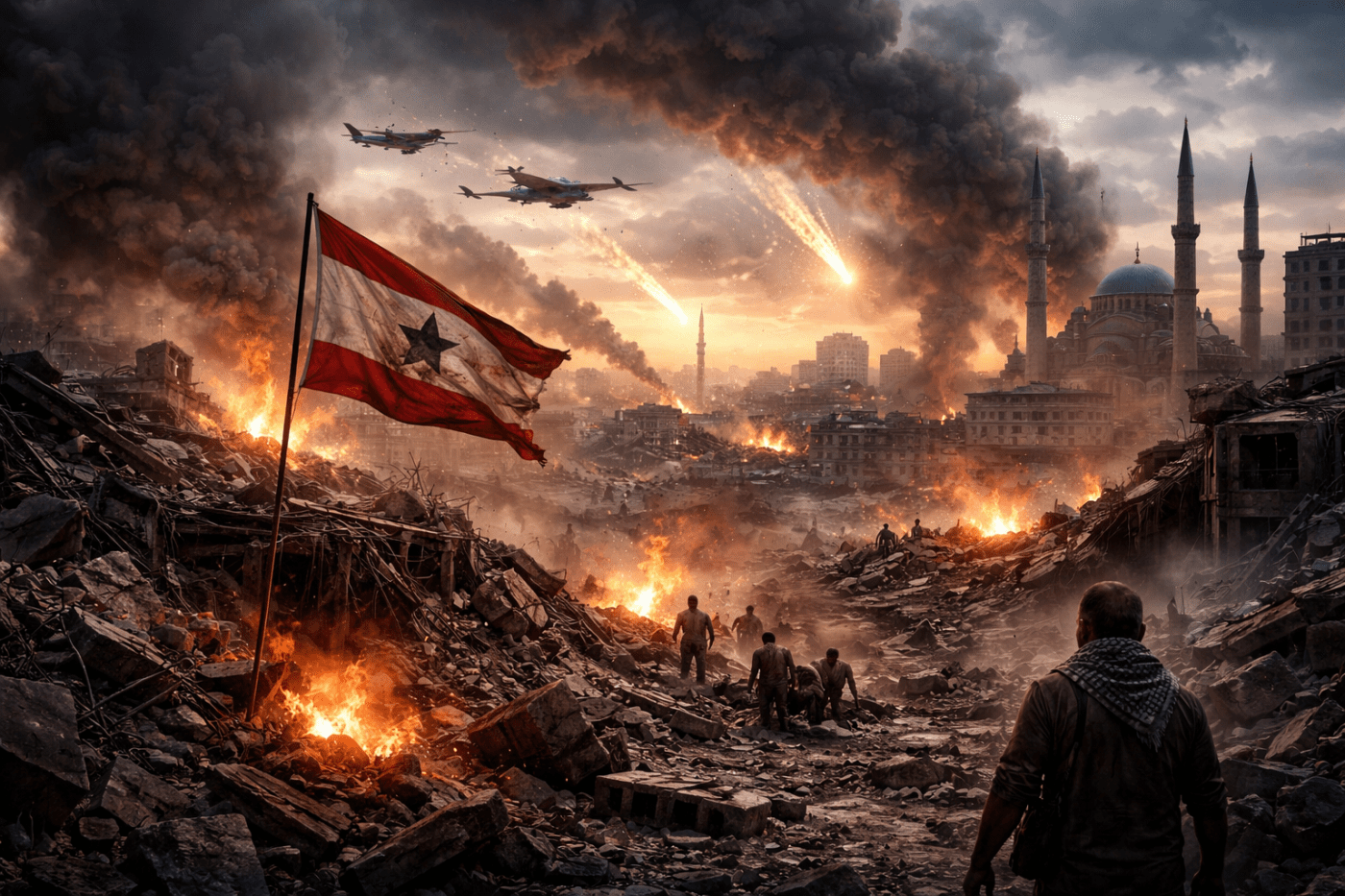
USA TODAY reports the bombs, the bodies, and the diplomatic noise, but leaves the machinery of power in the shadows. Beneath the language of “escalation” lies a longer structure of occupation, ceasefire manipulation, infrastructural warfare, and pressure on Lebanese sovereignty. The strikes on Lebanon are not an interruption of order, but one of the ways imperial order reproduces itself through managed destruction. To tell the truth about this violence is to move beyond liberal fog and see the regional architecture of domination that the corporate press is built to conceal.
By Prince Kapone | Weaponized Information
April 11, 2026
When the Bombs Fall Like Weather and Power Disappears from the Story
In its April 9 coverage, USA TODAY lays out what it presents as a clear account of Israel’s deadly strikes on Lebanon, situating the April 8 bombardment within the broader Iran war and an uncertain U.S.–Iran ceasefire. The article moves through a familiar sequence: large-scale Israeli airstrikes hitting more than 100 sites across Beirut, the Beqaa Valley, and southern Lebanon, hundreds killed and injured, Hezbollah attacks framed as the trigger, and Israeli leadership signaling both continued military operations and potential peace talks tied to disarming Hezbollah. It introduces regional tensions, cites official statements from Israel, Iran, and the United States, and gestures toward decades of conflict between Israel and Hezbollah. On the surface, the reader is given a complete picture—events, casualties, actors, and explanations. But even within this apparent completeness, the structure of the story is already being shaped by what is included, what is deferred, and what is left entirely outside the frame.
The article arrives dressed in the calm tone of routine reporting, as if what we are witnessing is another turn in the endless carousel of “escalation” that the modern reader has been trained to accept like bad weather. Israel strikes. Hezbollah responds. Civilians suffer. Diplomacy falters. The script is familiar, almost rehearsed. But what is most striking is not what the article says—it is what it quietly removes from view while speaking. The violence is described, but its structure is not. The destruction is counted, but its logic is not named. Power moves through the text like a ghost: everywhere present, nowhere acknowledged.
USA TODAY, a flagship of mass-market American journalism, does not shout propaganda. It performs something more effective. It smooths. It softens. It arranges events into a sequence that feels natural, inevitable, almost apolitical. Owned by Gannett and oriented toward a broad readership, its function is not to interrogate empire but to narrate it in digestible fragments. In this telling, the April 8 bombardment of Lebanon is rendered as an episode—an eruption of violence tied to Hezbollah activity and uncertainty over a ceasefire whose boundaries are left conveniently blurred. The reader is invited to observe, not to understand.
The article’s central maneuver is fragmentation. The strike wave is presented as a moment—an escalation—rather than as part of an ongoing structure of pressure that stretches backward through years of unresolved conflict. History is trimmed down to a passing reference, a faint echo of past wars that hovers without weight. The effect is to detach the present from its roots. Without a past, the violence becomes spontaneous. Without a structure, it becomes accidental. And what is accidental cannot be interrogated, only endured.
Even the dead are handled with a peculiar restraint. Numbers appear—killed, wounded, displaced—but they float in the text without a clear agent of causality. Civilians die, but the mechanism of their death is linguistically diffused. Airstrikes “hit.” Areas are “targeted.” Casualties “mount.” The language is careful not to draw a straight line between force and consequence. It is the grammar of plausible deniability, where destruction happens, but no one quite does it.
Meanwhile, the balance of power disappears under the weight of neutrality. The Israeli military—one of the most technologically advanced and heavily backed forces in the world—is placed on the same narrative plane as a non-state actor operating within a besieged country. This is not analysis; it is flattening. The asymmetry that defines the situation is quietly erased, replaced with the comforting fiction of two sides locked in a mutual exchange. The result is a moral symmetry that does not exist in material reality.
Perhaps the most telling omission is the absence of the Lebanese state as an active force. In the article’s world, Lebanon is not a political actor but a terrain—something events happen to, rather than something that responds, governs, or struggles to maintain coherence under pressure. The reality of state institutions managing displacement, coordinating emergency response, and attempting to navigate the crisis is nowhere to be found. This absence is not incidental. It is necessary for the narrative to hold. A state that acts complicates the story. A state that disappears simplifies it.
Then there is the question of the ceasefire, presented as a matter of confusion, as if the disagreement over its scope were a technical misunderstanding rather than a political contest. The article gestures toward ambiguity—was Lebanon included or not?—but refuses to probe the significance of that ambiguity. In doing so, it transforms a struggle over the boundaries of war into a fog of uncertainty. What is at stake is not clarity, but control. Yet the reader is left with the impression that no one quite knows what is happening, when in fact all sides know exactly what they are doing.
And beneath it all lies a deeper silence: the absence of law. The post-2006 framework that continues to govern the Israel–Lebanon front, the unresolved conditions that structure the conflict, the very architecture within which this violence unfolds—none of it appears. Without that framework, the bombardment floats free of any governing logic. It becomes an event without a system, a crisis without a structure. In this vacuum, power operates most effectively, because it no longer needs to justify itself.
This is how ideology works in its most refined form. Not by telling you what to think, but by shaping what you are allowed to see. The article does not lie. It simply arranges reality in such a way that its underlying logic disappears. The reader is given facts, but not the relationships between them. Events, but not the forces that produce them. Violence, but not the system that makes it routine.
In the end, what is normalized is not just the bombing of a country, but the very idea that such bombing can be understood without asking why it happens in the first place. And once that question disappears, everything else follows.
What the Article Reports, What It Leaves Out, and the Larger Terrain It Tries to Hide
Begin with the facts the USA TODAY piece does report. April 8 brought a major Israeli escalation in Lebanon. Israeli air raids hit southern towns including Qlaylah, Khirbet Selm, Zawtar, Doueir, and Jebchit, alongside major destruction in Beirut’s Chiyah district. The human toll rose rapidly over the course of the day. The death toll climbed from 77 killed and 527 wounded to 217 killed and 798 wounded by day’s end on April 8. Civilian casualties were not incidental to the day’s violence. An Israeli strike on Zrariyeh killed more than ten people, including women and children. Israeli military action was tied directly to political demands on Lebanon. Netanyahu stated that the Lebanese government was responsible for enforcing the ceasefire and disarming Hezbollah. The article also identified a real dispute over the scope of the ceasefire. The Pakistan-mediated U.S.–Iran ceasefire was described as applying “everywhere including Lebanon,”while later statements from that same political camp insisted that future talks depended on compliance “on all fronts, particularly in Lebanon.”
The omitted facts begin with the immediate operational effects of the strike campaign. The article does not tell the reader that the April 8–9 assault produced an acute territorial and humanitarian access crisis in southern Lebanon after the destruction of the Qasmiyeh bridge. Families south of the Litani were pleading for evacuation because the area had become “completely besieged”. It also omits the direct disruption of basic infrastructure and emergency response inside Lebanon. Civil defense crews were clearing damaged power lines and struggling to restore basic functionality amid ongoing raids. These are not secondary details. They are part of the material content of the attack.
The article also omits the coercive political logic publicly attached to the bombing campaign. It does not tell the reader that Israel’s stated position placed responsibility on the Lebanese state itself, not only on Hezbollah. Israel’s official line placed responsibility on Beirut to enforce the ceasefire and disarm Hezbollah. That made the bombardment part of a pressure strategy directed at the internal political and security order of Lebanon. The omission matters because it changes the nature of the event from a narrow battlefield exchange into a coercive project aimed at Lebanese state behavior.
The article also leaves out how the conflict was understood from the Iranian and Hezbollah-aligned side of the regional divide. In that political and media space, the bombing campaign was treated not as a separate Israel–Lebanon episode but as a direct breach of the U.S.–Iran ceasefire framework itself. Lebanon was treated as part of the ceasefire scope, and future talks were tied to compliance there. Those same sources also treated the strikes as part of a disarmament pressure campaign rather than a simple battlefield response. The campaign was framed as part of a broader effort to impose surrender through force. The same political camp also indicated that the situation remained unstable even after public ceasefire language circulated. Hezbollah told civilians to delay returning to southern Lebanon, the Bekaa, and Beirut’s southern suburbs pending confirmation of a ceasefire. Aligned reporting also framed the immediate sequence of events as mass attacks on civilians followed by retaliatory responses. Subsequent operations were cast as retaliatory responses after mass civilian attacks.
The omitted facts extend to the governing legal and historical framework. The article says little about the operative security baseline on the Israel–Lebanon front. Resolution 1701 remains the governing framework for the post-2006 order, tying cessation of hostilities to Israeli withdrawal and the extension of Lebanese state authority in the south. The article also does not state clearly that the current security order grows out of repeated Israeli military intervention, long-term occupation, and incomplete ceasefire implementation. Those are not background ornaments. They define the setting in which the present violence is taking place.
The article also erases the role of Lebanese state institutions in managing the crisis. Lebanon does not appear as an active political subject in the piece, yet Interior Minister Ahmad Hajjar was overseeing displacement response, shelter distribution, and emergency coordination from the ministry’s operations room. Lebanese authorities were acting inside the crisis rather than disappearing from it. The omission matters because it helps the article flatten Lebanon into a passive landscape instead of a state under pressure attempting to preserve administrative and social continuity.
The article also omits the wider regional and systemic significance of the Lebanon front. The Pakistan-brokered proposal linked the ceasefire process to broader efforts involving maritime routes such as the Strait of Hormuz. Later aligned reporting also indicated that the Lebanon front was explicitly linked to broader regional war architecture involving Iran, the U.S., and maritime pressure. That placed Lebanon within a wider regional confrontation rather than inside an isolated border conflict.
These admitted and omitted facts sit inside a broader context the article does not reconstruct. The current escalation takes place within the still-unfinished post-2006 order rather than outside it. Resolution 1701 remains the formal framework governing hostilities, Israeli withdrawal, and Lebanese state authority in the south. The violence is unfolding in a country already carrying an immense humanitarian burden. More than 1.2 million people were displaced across Lebanon, and shelters and host communities were under severe strain. The health system was under direct pressure as part of that crisis. Ambulances, emergency responders, hospitals, and medical facilities were repeatedly hit. The destruction of the Qasmiyeh bridge therefore belongs to a larger material question involving civilian mobility, humanitarian access, and medical reach. Areas south of the Litani were effectively cut off.
This context is also political-economic. The 2024 war left widespread infrastructure damage, direct attacks on hospitals and ambulances, roughly 1.2 million displaced within days, and about 1.6 million people facing high levels of acute food insecurity. The April 8 bombings landed on a society already weakened by previous assault. The regional diplomatic context matters as well. The ceasefire language included Lebanon, while later Iranian-aligned reporting insisted that talks on ending the war depended on compliance there. The historical baseline also remains decisive. Lebanon’s present security logic is shaped by repeated Israeli intervention, prolonged occupation in the south, and an armistice-like post-2006 order rather than normalized peace. Domestic governance belongs inside that same picture. Lebanese authorities were coordinating displacement response, shelter systems, and emergency management, which means the conflict unfolds not only as military exchange but also as a struggle over whether a battered state can continue to function under external pressure.
The article also omits a critical historical-security pattern regarding Israeli policy toward southern Lebanon. Israeli threats to reoccupy or even annex parts of southern Lebanon reflect a “decades-old playbook” rather than a new development. That pattern includes the 1978 invasion, the 1982 war, and the prolonged Israeli occupation of southern Lebanon that lasted until 2000, during which Israel maintained a security zone enforced through allied militias and direct military presence. The recurrence of occupation and territorial control language in current Israeli discourse situates the April 8 bombardment within a longer trajectory of military strategy centered on shaping conditions in southern Lebanon through force.
This historical continuity is directly tied to the emergence and role of Hezbollah within Lebanon. The article does not inform the reader that Hezbollah developed during the period of Israeli invasion and occupation in the early 1980s and consolidated itself as a force oriented toward resisting Israeli military presence in Lebanese territory. Over time, Hezbollah became a central actor in shaping the security balance on the Israel–Lebanon front, particularly in the context of Israel’s withdrawal in 2000 and the 2006 war. This context is directly relevant to present developments, linking current military pressure to longstanding efforts to alter the balance of force within Lebanon itself.
Our textual analysis therefore establishes three things clearly. First, the article reports a real mass-casualty Israeli escalation, real civilian deaths, real political demands, and a real dispute over ceasefire scope. Second, it omits the bridge destruction and territorial isolation in the south, the explicit coercive pressure on the Lebanese state, the disruption of emergency and transport systems, Lebanon’s inclusion in the regional ceasefire framework, the active role of Lebanese state institutions, the Iranian and Hezbollah-aligned understanding of the bombings as a ceasefire breach and disarmament campaign, and the unresolved 1701 framework rooted in occupation and incomplete ceasefire implementation. Third, these facts take on their full meaning only when placed inside Lebanon’s humanitarian crisis, weakened health and infrastructure systems, broader regional diplomacy, maritime-security pressures, and long history of sovereignty injury. That is the factual terrain on which our reconstructed narrative has to stand.
Order in the Rubble: How Empire Governs Through Managed Destruction
Strip away the language of “escalation,” and the picture comes into focus with a clarity the article could never permit. What unfolded on April 8 is not a breakdown of order. It is order functioning exactly as designed. The airstrikes on southern Lebanon, the leveling of neighborhoods in Beirut’s Chiyah district, the mounting civilian death toll, the destruction of infrastructure, the pressure placed directly on the Lebanese state, and the manipulation of ceasefire language all belong to a single system of rule. That system does not operate despite violence. It operates through it. The bombs are not a deviation from diplomacy. They are one of its instruments.
The framework governing this front has never been one of peace. The post-2006 arrangement, anchored in Resolution 1701, did not resolve the underlying contradiction. It suspended it. It froze a conflict inside a structure that preserved asymmetry, allowed for selective enforcement, and left open the possibility of renewed coercion whenever conditions required it. That is why the present moment does not appear as an exception. It appears as recurrence. And recurrence, in this context, is continuity. The ceasefire did not abolish war. It reorganized how war could be administered, when it could be reactivated, and under what legal and diplomatic cover it could be justified.
The scale and pattern of the April 8 assault make that clear. This was not a narrow exchange along a militarized border. Israeli airstrikes hit multiple towns across southern Lebanon—Qlaylah, Khirbet Selm, Zawtar, Doueir, Jebchit—while also striking dense urban areas in Beirut’s southern suburbs. The death toll surged from dozens to over two hundred within hours, with hundreds more wounded. Entire families were buried under rubble. Women and children were among the dead. This is not incidental damage orbiting a military objective. This is the material reality of how force is applied in a system that treats civilian life as a variable to be managed rather than a boundary to be respected.
The destruction of the Qasmiyeh bridge reveals the deeper logic behind that application of force. A bridge is not simply a structure. It is a node in a living system: it carries evacuation routes, medical transport, supply lines, civilian movement, and the basic circulation of social life. Once it is destroyed, the consequences cascade outward. Communities south of the Litani are cut off. Families plead for evacuation. Ambulances take longer routes or cannot reach the wounded at all. Aid is delayed. The injured remain untreated. The dead remain unrecovered. What is targeted is not only a physical object but the conditions that allow a society to function. This is logistics warfare—violence directed at the infrastructure of life itself.
At the same time, the political language surrounding the bombardment makes clear that the target is not limited to Hezbollah as an armed formation. Israeli leadership explicitly placed responsibility on the Lebanese state, demanding that Beirut enforce the ceasefire and disarm Hezbollah. That transforms the meaning of the violence. It is no longer simply an exchange between military actors. It is coercive pressure applied to the internal political and security order of Lebanon. Military force is being used to shape the decisions of a sovereign state, to narrow its political options, and to discipline its governing institutions from the outside. Sovereignty remains in form, but its substance is constrained through bombardment and threat. This is domination without formal annexation—a familiar structure in the long history of imperial power.
This pressure is not an improvisation. It sits inside a longer strategic struggle over southern Lebanon itself. Israeli military doctrine has repeatedly treated that region not as a stable border but as a zone to be controlled, occupied, or reshaped to secure its northern flank. From the 1978 invasion to the 1982 war and the long occupation that followed, southern Lebanon has functioned as a space where military force substitutes for political settlement. Contemporary threats to reoccupy or even annex parts of that territory do not mark a departure from this history. They signal its persistence. The language may shift, the justifications may change, but the underlying objective remains recognizable: to ensure that no force on that frontier can impose limits on Israeli power.
It is within that history that Hezbollah must be understood. Hezbollah did not appear as an external disruption to an otherwise stable order. It was produced by that order—formed in the context of invasion and occupation, and consolidated through a prolonged struggle against them. Over time, it became the only actor capable of imposing sustained military costs on Israeli operations in Lebanon, contributing to Israel’s withdrawal in 2000 and shaping the deterrence balance that followed the 2006 war. That history matters because it transforms the meaning of the present. Hezbollah is not simply a target of current operations. It is the residue of past resistance that continues to limit what Israeli and allied power can do.
Seen in that light, the demand that the Lebanese state disarm Hezbollah is not a narrow security measure. It is the political expression of a longer strategic objective: to dismantle the only structure within Lebanon that has historically constrained Israeli military freedom of action. The bombardment, the infrastructure strikes, the pressure on state institutions, and the manipulation of ceasefire boundaries all converge toward that end. What appears as a response to immediate hostilities is, in fact, part of a sustained effort to break the deterrent capacity that emerged out of previous cycles of invasion and resistance. The past is not background to the present. It is the condition that gives the present its logic.
The dispute over the ceasefire further exposes how this system operates. On one side, the U.S.–Iran framework was described as applying across all fronts, including Lebanon. On the other, later statements attempted to isolate Lebanon as an exception, a space where coercion could continue even as diplomacy claimed to be advancing. This is not confusion. It is selective application. Rules are articulated universally, then enforced unevenly. Ceasefire language becomes elastic, expanding or contracting depending on strategic need. What appears to the reader as ambiguity is, in practice, a mechanism of control. It allows force to continue under the cover of negotiation, and it ensures that “peace” remains compatible with ongoing violence.
Seen from the Lebanese side of the conflict, the meaning of these actions shifts further. The bombardment is not treated as an isolated Israel–Lebanon episode but as a breach of a broader regional arrangement tied to negotiations involving Iran and the United States. Within that perspective, the strikes are part of a coordinated pressure campaign aimed at forcing political concessions through sustained violence. Hezbollah’s warnings to civilians to delay returning home, the framing of subsequent operations as retaliatory responses to mass civilian attacks, and the insistence that future negotiations depend on compliance “on all fronts” all point to a recognition that this is not a localized clash. It is one front in a wider architecture of coercion that spans the region.
This is where the regional dimension becomes decisive. Lebanon does not sit outside the larger strategic field. It is embedded within it. The same political moment that produces airstrikes in southern Lebanon also produces negotiations over ceasefire terms, pressure on Iran, and concern over maritime routes such as the Strait of Hormuz. These are not separate issues. They are interconnected elements of a system that governs through control of movement—movement of goods, of energy, of military force, and of people. The destruction of a bridge in southern Lebanon and the anxiety over shipping lanes in the Gulf belong to different scales of the same logic: control the routes, and you control the field.
The humanitarian crisis unfolding inside Lebanon is not a tragic side effect of this process. It is one of its conditions. A country already carrying over a million displaced people, already facing severe strain on its shelters, hospitals, and food systems, becomes more vulnerable to coercion when those systems are further degraded. When infrastructure is damaged, when emergency services are stretched, when mobility is restricted, and when daily life becomes a struggle for survival, the capacity of the state and society to resist external pressure is weakened. Suffering is not only endured. It is instrumentalized. It becomes part of the mechanism through which political outcomes are pursued.
The role of the Lebanese state within this environment is therefore central, not peripheral. Contrary to its disappearance in the article, Lebanon is not a passive landscape. Its institutions are actively attempting to manage displacement, coordinate emergency response, maintain basic services, and preserve administrative continuity under bombardment. This is a state under pressure, not a vacuum. And that pressure is precisely the point. The objective is not simply to destroy. It is to force a state to operate within narrowing constraints, to discipline its choices, and to shape its internal balance of power through external force.
All of this unfolds against a historical baseline that the article leaves largely unspoken. Repeated Israeli intervention, prolonged occupation in southern Lebanon, and the incomplete implementation of post-2006 ceasefire arrangements have produced a condition that resembles neither war nor peace but a managed instability. Violence is not continuous, but it is never absent. It is suspended, reactivated, regulated, and justified through shifting legal and diplomatic frameworks. The present moment is one iteration of that longer pattern. It is not new. It is the latest expression of an enduring structure.
To call this “escalation” is therefore to misname the phenomenon. Escalation suggests deviation. What we are witnessing is reproduction. An imperial order that maintains itself by periodically reasserting dominance through force, by manipulating the boundaries of ceasefire and law, by targeting infrastructure that sustains civilian life, and by applying pressure to the sovereignty of weaker states without formally dissolving them. It is a system that governs through calibrated destruction—enough to discipline, not enough to resolve; enough to weaken, not enough to stabilize.
This is the colonial contradiction in its contemporary form. A formally independent state subjected to continuous external pressure. A population that bears the material cost of geopolitical strategy. A legal framework that promises order while enabling its violation. A diplomatic language that speaks of restraint while accommodating coercion. And a media apparatus that fragments the field so that each act of violence appears isolated rather than systemic.
Once these elements are brought together, the narrative collapses into its real shape. The April 8 bombardment is not an unfortunate episode in an otherwise functioning system. It is evidence of how that system functions. Not a failure of order, but its method. Not a temporary crisis, but a recurring technique. Not confusion, but design.
And that is why the story cannot be told from the vantage point of the strike itself. It has to be told from the vantage point of the structure that produces the strike, legitimizes it, absorbs its consequences, and prepares the ground for its repetition. What lies in the rubble is not only destruction. It is the operating logic of modern imperial power—an order that sustains itself by breaking the conditions of life and calling the result stability.
From Ruin to Resistance: Turning Clarity into Collective Power
Having alread stripped away the mask, we now have to answer the only question worth more than a press release: what is to be done with that clarity? Not in the abstract, not in the language of empty outrage, not in the little moral spasms that leave the machine untouched. The question lives in the concrete terrain where people are already moving, already organizing, already resisting the machinery that produced April 8 and will produce its next version if left alone. Because the lesson here is not simply that empire lies. It is that empire depends on fragmentation. Each struggle isolated. Each outrage treated like a separate event. Each population left to absorb pressure on its own. Breaking that isolation is the first act of resistance.
There are already forces moving in that direction. Organizations like CODEPINK have mobilized campaigns demanding an end to U.S. military support for Israeli operations, linking domestic political pressure directly to the machinery enabling bombardment abroad. The Palestinian Youth Movement has organized mass demonstrations and coordinated actions that frame Palestine, Lebanon, Yemen, and the wider region as interconnected fronts against a single imperial architecture. Meanwhile, formations such as Samidoun have worked on the terrain of political education and international solidarity, insisting that resistance movements cannot be understood in isolation from the larger system of domination targeting them. These are not perfect organizations, and they are not the whole field. But they are real nodes of activity, and reality is where strategy has to begin.
Beyond formal organizations, a wider ecosystem of resistance is taking shape across unions, student groups, community networks, and diasporic formations. Port workers refusing military cargo. Campus coalitions demanding divestment from weapons manufacturers. Independent journalists punching holes in the information blockade. Mutual aid networks raising money for displaced communities and reconstruction. These are not decorative gestures. They are early formations of counter-power. Uneven, scattered, still developing—but real. The task is not to romanticize them like posters on a dorm wall. The task is to connect them, deepen them, and give them strategy. Scattered resistance can be absorbed. Coordinated resistance begins to impose costs.
From this terrain, several concrete tasks emerge. First, material pressure has to be applied to the logistical chains that make this violence possible. That means campaigns targeting arms manufacturers, shipping routes, insurers, financiers, and every polished office where war is translated into invoices and delivery schedules. It means identifying where weapons are produced, how they move, who profits, and where disruption can bite. Second, political pressure inside the imperial core has to move beyond symbolic protest into sustained campaigns aimed at rupture: cutting military aid, ending diplomatic cover, exposing the legal frauds that allow endless war under the language of “defense,” and forcing institutions to choose a side in daylight. Third, international solidarity has to move from rhetoric to infrastructure: coordinated fundraising, medical support networks, reconstruction aid, legal defense, and direct ties between communities that do not wait for state permission to act human. Fourth, the ideological terrain has to be contested without rest. The narratives that normalize these operations—“security,” “deterrence,” “retaliation”—must be torn down and replaced with language that names what is actually happening: coercion, domination, and the managed reproduction of instability.
There is also a deeper strategic horizon that cannot be ignored. The events in Lebanon are not an anomaly. They belong to a broader pattern in which declining imperial power tries to maintain control through intensified coercion while losing the capacity to produce stable outcomes. That means resistance cannot remain purely reactive, forever sprinting after the latest fire. It has to anticipate. It has to understand that the same logic will appear elsewhere in different clothes: different geography, same method; different victims, same machinery. Networks capable of responding across regions, not just within them, are no longer a luxury. They are a necessity. The goal is not merely to stop one bombing campaign. The goal is to weaken the system that makes such campaigns routine.
This is where the relation between analysis and action becomes decisive. Without analysis, action is blind—easily redirected, easily neutralized, easily turned into spectacle for someone else’s fundraising email. Without action, analysis is sterile—another diagnosis on the shelf, another fine document, another truth that changes nothing. The task is to fuse them. To take the clarity produced in Section III and turn it into organized force. To move from understanding the structure to confronting it.
That requires discipline. It requires rejecting the comfort of outrage without strategy, the illusion that visibility by itself is power, and the temptation to confuse performance with organization. It requires building relationships, studying terrain, identifying leverage points, and committing to sustained struggle rather than episodic reaction. Empire does not operate in episodes. It operates continuously. Resistance must learn to do the same.
So the final lesson is simple, even if carrying it out is not. The rubble in southern Lebanon is not only a site of destruction. It is a site of revelation. It shows how power moves, how narratives are manufactured, how coercion is normalized, and how imperial order feeds itself on fragmentation. Once that is seen clearly, the responsibility changes. No longer merely to observe, but to intervene. No longer merely to interpret the world, but to help change it.
 Weaponized Information
Leave a comment