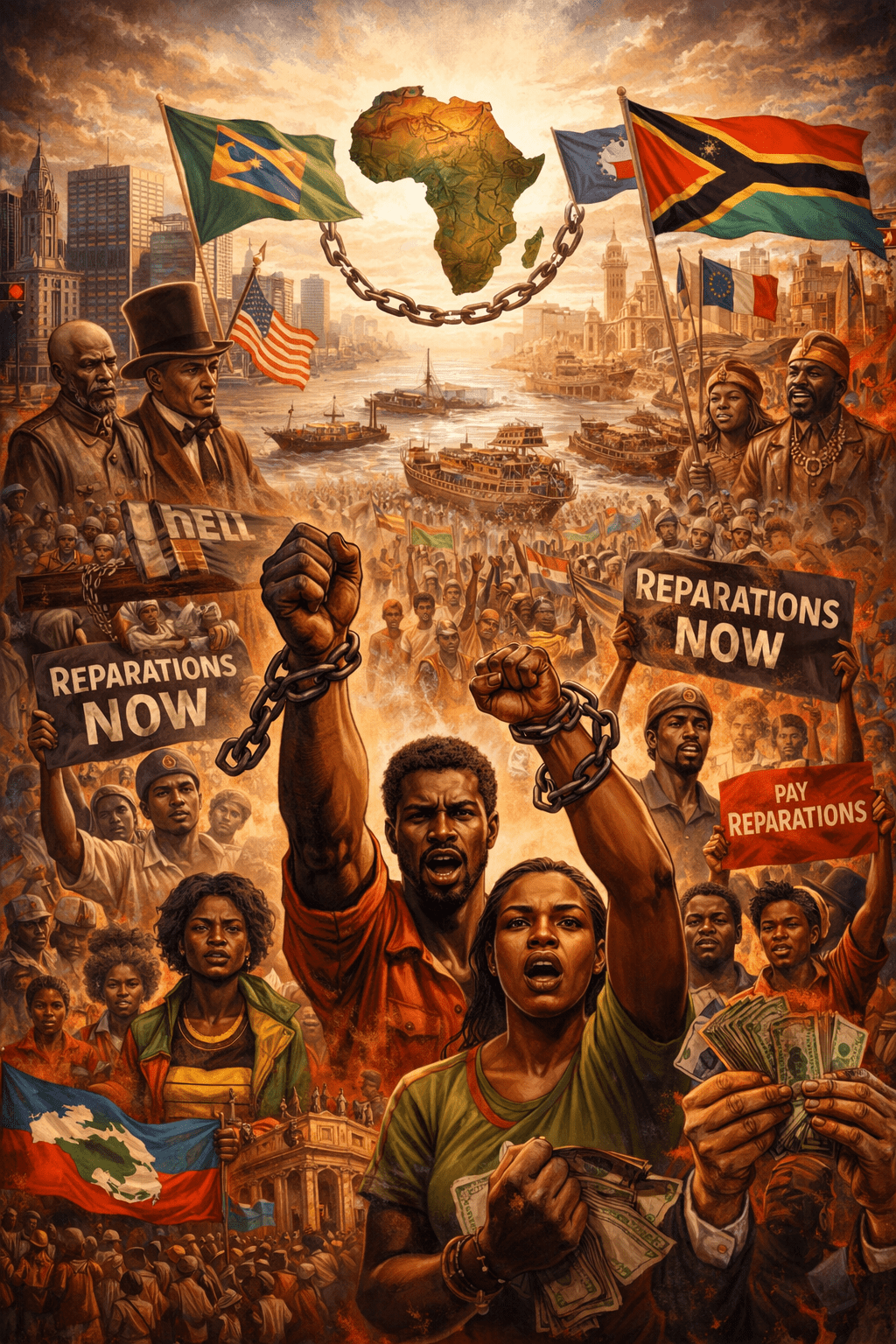
The Associated Press presents the UN resolution as a moment of moral recognition, but its reliance on official voices and diplomatic language reveals how power narrates history without disturbing itself. The material record shows that slavery’s wealth still structures the present, and that organized reparations movements—from Africa to the Caribbean to grassroots struggles—are confronting that reality. When placed in full historical context, the debate over reparations becomes a struggle over labor, capital, and the global order itself, exposing the limits of recognition without redistribution. The task now is to move from acknowledgment to organized action, linking existing movements and institutions into a broader fight to reclaim what was stolen.
By Prince Kapone | Weaponized Information | March 25, 2026
Recognition Without Obligation: When Power Learns to Speak Softly About Hard Crimes
The Associated Press article, “UN calls for reparations to remedy the ‘historical wrongs’ of trafficking enslaved Africans” (March 25, 2026), reads like the minutes of a meeting where the world finally agrees that a crime took place. The United Nations General Assembly votes. The numbers are counted—123 in favor, 3 against, 52 abstentions—and the ritual is performed. A president speaks of memory and justice. Western diplomats speak of reflection and responsibility. The institution speaks in its polished, familiar tone. On the surface, everything appears settled: the crime is named, the past is acknowledged, and the world, we are told, has taken a step forward.
But let’s be clear—this is not the voice of the people. This is the voice of power speaking to itself, and then handing us the transcript. The journalist here is not standing outside the system with a flashlight; she is inside the building, taking dictation. That’s not a personal failing—it’s the job. Access comes with conditions. You don’t bite the hand that lets you into the room. So what we get is not interrogation, but repetition. Not analysis, but arrangement. Statements are laid out like bricks, but no one asks who built the house or who lives buried underneath it.
And the Associated Press—that great conveyor belt of global news—does what it does best: it smooths everything down so it can travel far and fast. No sharp edges. No uncomfortable weight. Just a clean, neutral package that can slip into a thousand newspapers without disturbing anyone’s breakfast. The result is a story where the state speaks, and the world is expected to nod along politely.
Look closely at who is allowed to speak. Presidents. Ambassadors. Representatives of blocs. The United Nations itself. It is a conversation among officials, dressed up as a conversation about humanity. The voices of those who actually live with the consequences of this history are nowhere to be found. No organizers. No workers. No descendants speaking in their own name. Just the careful choreography of diplomacy, where even outrage must wear a suit.
And what kind of language do these officials use? The language of closure. Slavery is called “the gravest crime against humanity”—a phrase so heavy it almost collapses under its own weight. We are told of “solemn solidarity,” of “healing,” of the need to remember. It sounds profound, and in a sense it is. But it also performs a trick. By speaking with such moral certainty, it suggests that the main question has already been answered. The crime has been acknowledged. The conscience has been cleared. Now we can move forward—quietly, respectfully, without making a mess of things.
Notice how everything revolves around what will be discussed, encouraged, or promoted. The resolution “calls for,” it “urges,” it “encourages.” Words are busy. Verbs are active. But nothing actually moves. Dialogue becomes the destination. Engagement becomes the achievement. Education becomes the substitute for transformation. It’s like watching a machine spin beautifully without producing anything you can hold in your hands.
Then comes the broadening of the frame. When Western representatives step in, the conversation shifts. Now we are talking about racism, xenophobia, modern slavery. These are real problems—serious ones—but watch what happens. The specific history under discussion begins to dissolve into a wider pool of issues. Everything becomes important, and in that way, nothing remains central. The sharp question is softened, not by denial, but by dilution.
Even the vote itself is presented in a way that flattens reality. Numbers on a page. 123 for, 3 against, 52 abstentions. It looks democratic, almost comforting. As if all states stand on equal ground, casting their votes like neighbors in a town hall. But we are not told anything about the weight those states carry in the world, or their relationship to the very history being discussed. The powerful and the powerless appear side by side, indistinguishable in the arithmetic.
Time, too, is handled with care. Slavery is placed firmly in the past—a “historical wrong.” Something to remember, to honor, to never forget. And yes, memory matters. But memory can also be managed. By fixing the crime in the past, the article avoids asking what of it remains alive in the present. It invites us to look backward with solemnity, but not forward with urgency.
And then there is the silence. The United States, Israel, and Argentina vote against the resolution. This is stated plainly, almost casually, and then the story moves on. No explanation. No probing. No tension. Just a fact, placed gently on the table and left there. In a story about one of the greatest crimes in human history, that silence is not empty—it is doing work.
So what are we left with? Not a lie. That would be too crude. What we have instead is something far more refined: a narrative that recognizes without disturbing, that speaks without risking anything, that opens a conversation but carefully defines its limits. The system has learned how to talk about its crimes. It has even learned how to condemn them. What it has not yet learned—or perhaps refuses to learn—is how to answer for them.
The Bill Comes Due: What the Resolution Mentions—and What It Cannot Contain
The article tells us that the United Nations General Assembly passed a resolution recognizing the transatlantic slave trade as a crime against humanity, calling for reparations, restitution, and formal apologies, and encouraging the return of cultural artifacts. It gives us the vote—123 in favor, 3 against, 52 abstentions—and reminds us that the resolution is not legally binding. It tells us that Western states prefer to emphasize modern slavery and general discrimination, and that the matter should move forward through dialogue, education, and cooperation. All of this is accurate. But accuracy, as always, is not the same as completeness.
Because what sits just beneath this carefully arranged surface is something far larger than a resolution: a long, unfinished struggle over wealth, land, labor, and power that did not begin in that assembly hall and will not end there.
To begin with, the wealth generated by slavery was not incidental—it was foundational. The industrial and financial rise of Europe was built, in no small part, on the organized extraction of labor from enslaved Africans across the Atlantic system. This is not speculation but record. The Legacies of British Slavery database documents how compensation paid to slave owners at abolition was reinvested into British industry, banking, and infrastructure, seeding institutions that still dominate economic life today. The story is not simply that slavery happened, but that its profits were carried forward, multiplied, and institutionalized.
And the flow of wealth did not stop with abolition—it reversed direction. When Haiti won its freedom through revolution, it was forced to compensate France for the loss of enslaved “property,” a demand that shackled the new nation with debt for generations. The historical record of Haiti’s indemnity payments shows how the former enslaved were made to pay their former enslavers, transforming emancipation into a new mechanism of extraction.
These patterns extend into the corporate structures of the present. Major financial institutions did not arise in a vacuum. They grew out of—and in some cases directly profited from—slave economies. JPMorgan Chase’s own disclosures acknowledge that predecessor banks accepted enslaved people as collateral and profited from plantation economies. The past is not buried; it is sitting in balance sheets.
This is why reparations have never been merely an abstract idea discussed at conferences. They have been organized, demanded, and developed into concrete political programs. In the Caribbean, governments have come together through the CARICOM Ten Point Plan for Reparatory Justice, which goes far beyond symbolic apology to include demands for debt cancellation, public health investment, education, technology transfer, and repatriation. This is not a plea for recognition—it is a program for restructuring the conditions produced by centuries of extraction and exploitation.
On the African continent, the demand has been consolidated at the level of continental politics. The African Union’s reparations framework traces its lineage from the 1993 Abuja Proclamation through the 2001 Durban Conference to the 2023 Accra Reparations Conference, and identifies reparations as a central political question of the present moment. The AU has called for a coordinated global position and mechanisms to pursue reparatory justice, situating the issue within the broader struggle over development, sovereignty, and global inequality.
These are not isolated efforts. The African Union and Caribbean states are increasingly coordinating their positions, building a transatlantic political alignment rooted in a shared history of enslavement and colonial domination. What appears in the article as a resolution is, in reality, one expression of a growing geopolitical bloc asserting its claims on the world stage.
And this struggle is not confined to the Global South. Within the United States, the question of reparations continues to surface in legislative, local, and grassroots forms. The reintroduction of H.R. 40 signals ongoing federal debate, while cities like Evanston have begun implementing localized reparations programs, however limited and contested. These developments show that even within the core of the imperial system, the issue cannot be fully contained.
At the same time, pressure has been applied to cultural and academic institutions that hold material evidence of this history. Western museums and universities continue to house artifacts and wealth derived from colonial plunder. The British Museum’s own documentation of contested objects acknowledges that many items were acquired under conditions now recognized as coercive or illegitimate. Efforts to repatriate these artifacts are not symbolic gestures—they are direct challenges to the ownership structures produced by empire.
Even within elite institutions, limited forms of restitution have begun to appear under pressure. Georgetown University’s Reconciliation Fund explicitly recognizes the institution’s historical ties to slavery and attempts, in a controlled and partial way, to address that legacy. These initiatives are small compared to the scale of the historical crime, but they demonstrate that sustained pressure can force openings, however narrow.
Perhaps most important—and entirely absent from the article—is the long tradition of reparations struggle led by Black radical organizations themselves. The African People’s Socialist Party’s (APSP) reparations tribunals, beginning in 1982, framed reparations as a matter of international law and political struggle, not moral appeal. These tribunals brought forward evidence, testimony, and legal argument, asserting that the crime of slavery imposed obligations that remain unresolved. The work did not end there. The APSP continues to organize campaigns, build institutions, and develop material programs aimed at reclaiming resources and power at the community level.
All of this points to something the article cannot say directly: the question of reparations is not a new idea emerging from enlightened diplomacy. It is a long-standing demand rooted in struggle, carried forward across generations, and increasingly organized across regions and institutions. The resolution reported in the article is not the beginning of that struggle—it is a moment within it.
And that is why the emphasis on dialogue, education, and voluntary action feels so carefully placed. Because once the full scope of the issue comes into view—the accumulated wealth, the institutional continuity, the organized demands, the geopolitical coordination—it becomes clear that what is at stake is not simply how history is remembered, but how the present is structured. The resolution gestures toward that reality, but the broader struggle has already moved far beyond gesture.
From Stolen Labor to Stolen Futures: Reparations as a Struggle Over the World System
The article wants to present this moment as one of moral clarity, as if the world has finally gathered, spoken plainly, and agreed on the meaning of one of the greatest crimes in human history. But when we step outside the narrow frame of diplomatic language and place the facts in their full historical and material context, what emerges is not a story about moral agreement, but a struggle over power—over who owns the wealth of the modern world, how that wealth was produced, and whether those who produced it will ever reclaim it.
Slavery was not simply an atrocity—it was a system of production. It was organized labor extraction on a global scale, embedded within the early development of capitalism, and central to the rise of Europe and the formation of the modern imperial order. The plantation was not a backward institution; it was a disciplined site of commodity production feeding directly into industrial expansion, financial markets, and state power. The wealth generated through enslaved labor did not vanish with abolition. It was accumulated, reinvested, and institutionalized—flowing into banks, industries, universities, and state infrastructures that continue to shape the global economy today. What the resolution calls a “historical wrong” is, in material terms, an ongoing structure whose consequences remain embedded in patterns of wealth, development, and global inequality.
This is why the alignment of forces around the resolution cannot be read as a simple matter of opinion or moral difference. The states that have pushed most consistently for reparations—across Africa, the Caribbean, and the Americas—are those whose populations were subjected to enslavement, colonial extraction, and underdevelopment. The states that resist, abstain, or attempt to dilute the question are those whose wealth and power were historically built through those same processes. This is not coincidence. It is a reflection of a deeper structural contradiction. The issue is not whether slavery was wrong—on that question, the system can afford to speak with moral certainty. The issue is whether the material consequences of that system will be confronted, and whether the wealth accumulated through it will be redistributed.
At this point, the contradiction becomes unavoidable. Recognition is cheap. Redistribution is not. The language of the resolution—dialogue, healing, education—fits comfortably within a system that can acknowledge injustice while preserving the relations of power that injustice produced. This is the familiar pattern of liberal management: admit the crime, express regret, call for conversation, and in doing so stabilize the existing order. But the facts assembled in the broader record refuse to remain confined within that framework. The documented transfer of wealth from slavery into modern institutions, the forced extraction imposed on Haiti after its revolution, the persistence of global inequalities rooted in colonial domination, the coordinated demands emerging from African and Caribbean political formations, and the ongoing organizing efforts of movements and communities all point toward a different conclusion. They reveal that the question at hand is not symbolic recognition, but material redress.
Once the issue is posed in these terms, the terrain shifts. We are no longer dealing with memory, but with political economy. We are no longer asking whether the past should be acknowledged, but whether the present order—built through that past—will be transformed. The demand for reparations is, at its core, a demand to confront the relationship between labor and capital as it was forged under slavery and extended through colonialism into the modern world system. The labor of enslaved Africans generated immense value, yet that value was never returned to those who produced it. Instead, it became the foundation of accumulated capital, concentrated in the hands of ruling classes, institutions, and states that continue to benefit from it. The populations subjected to that system were left dispossessed, underdeveloped, and incorporated into the global economy under conditions of structural disadvantage.
This is why the struggle for reparations cannot be understood as external to class struggle. It is one of its most historically specific and concrete expressions. The enslaved were not outside the system of production; they were violently integrated into it as a coerced labor force. The descendants of that system are disproportionately located within the global working class and the most exploited sectors of labor. The wealth extracted from their labor has been accumulated, protected, and reproduced across generations. When reparations are demanded, what is being asserted is not a request for charity, but a claim on wealth that was produced through exploitation and never compensated. It is a demand to address a historical relationship between labor and capital that remains unresolved.
It is precisely this reality that explains the resistance of the most powerful states. To take reparations seriously would mean tracing the lines from past accumulation to present ownership, from plantation to corporation, from colonial extraction to contemporary inequality. It would mean confronting the fact that what is often presented as legitimate wealth is, in significant part, the product of organized expropriation. Such a process would not be limited to symbolic gestures or isolated payments; it would require structural transformation—redistribution of resources, reconfiguration of development, and shifts in control over land, capital, and institutions. In short, it would challenge the very foundations of the existing global order.
Faced with this possibility, the system responds by broadening and diffusing the issue. The conversation is expanded to include racism, discrimination, and modern forms of exploitation—important realities, but ones that can be addressed through reformist measures without fundamentally altering the structure of global power. The specific history of transatlantic slavery, with its clear lines of extraction and accumulation, is absorbed into a wider moral discourse where responsibility becomes generalized and consequences become negotiable. In this way, the demand for reparations is contained within a framework that emphasizes recognition while deferring material change.
Yet the movements driving this struggle have consistently pushed beyond these limits. The coordinated programs advanced by Caribbean states, the continental initiatives emerging from African institutions, and the long-standing organizing efforts of grassroots and revolutionary formations all point toward a different horizon. These are not appeals for remembrance; they are political projects aimed at restructuring the conditions produced by centuries of exploitation. They recognize that the question of reparations is inseparable from questions of development, sovereignty, and control over resources.
This is where the struggle reveals its broader implications. To fully realize the demands being raised would require transformations that exceed the capacity of the current system to absorb. Redistribution on the scale implied by reparations would challenge entrenched property relations, disrupt established patterns of accumulation, and reconfigure global hierarchies. The demand therefore begins to converge, not by rhetorical declaration but by material necessity, with broader struggles aimed at transforming the organization of wealth, labor, and power in society.
What the article presents as a moment of consensus is, in reality, a moment of contradiction. The system has acknowledged a crime whose consequences remain active, but it has not resolved how those consequences will be addressed. The resolution opens a space, but it does not settle the question. Beneath the language of unity lies a fundamental conflict over whether the world as it exists—shaped by centuries of forced labor and unequal exchange—will be preserved or transformed. That conflict is not confined to diplomatic halls. It is unfolding across continents, within institutions, and through the ongoing struggles of peoples who refuse to allow history to remain a closed chapter when its effects are still being lived in the present.
From Acknowledgment to Action: Turning Reparations Into a Material Struggle
By the time we reach this point, the illusion should be gone. The issue is no longer whether slavery will be remembered, but whether the world built on slavery will be transformed. The resolution reported in the article did not create this contradiction—it exposed it. And once exposed, it cannot be resolved through speeches, commemorations, or carefully worded declarations. It can only be resolved through struggle.
Because what is being contested is not memory, but material reality. The wealth extracted from enslaved labor did not disappear. It was accumulated, institutionalized, and passed down. The underdevelopment imposed on Africa and the African diaspora did not resolve itself. It was reproduced through colonialism, neocolonialism, and the global organization of labor and resources. To address this history in any meaningful sense requires more than acknowledgment. It requires intervention—organized, sustained, and grounded in the real balance of forces.
The good news, if we can call it that, is that this struggle is already underway. Across the Caribbean, governments have moved beyond symbolic recognition to develop coordinated political programs demanding reparatory justice. These efforts are not isolated; they are part of a broader regional strategy that links historical injustice to present conditions of debt, underdevelopment, and economic dependency. On the African continent, continental institutions have elevated reparations into a central political question, tying it directly to issues of sovereignty, development, and global inequality. These are not abstract positions—they are attempts to reorganize the terms on which Africa and its diaspora relate to the rest of the world.
At the same time, within the imperial core itself, cracks are appearing. Legislative proposals, municipal programs, and grassroots campaigns continue to push the issue into public debate, refusing to allow it to be buried under the language of “complexity” or “division.” Institutions that once treated their historical ties to slavery as distant and irrelevant are now being forced to account for them, whether through restitution efforts, public acknowledgment, or financial commitments. These developments are uneven, limited, and often tightly controlled, but they reveal something important: pressure works.
Perhaps most crucially, there exists a long tradition of organized struggle that has never waited for permission from states or international bodies. Black radical movements have framed reparations not as a moral appeal but as a political demand rooted in self-determination and material recovery. From tribunals that documented the crime and asserted its legal implications, to contemporary programs building economic and social infrastructure at the community level, this tradition has insisted that reparations must be fought for, not granted. It is within this lineage that the question of reparations remains most grounded, most concrete, and most dangerous to the existing order.
So the task before us is not to invent a movement, but to recognize the ones already in motion and to deepen them. That begins with clarity. We must reject the framing that reduces reparations to apology, diversity programs, or symbolic gestures. We must insist that the issue concerns wealth, land, labor, and power. Without that clarity, the demand will be absorbed, diluted, and neutralized.
From there, the lines of action begin to emerge directly from the terrain itself. First, the struggle must be anchored in the existing organizations that have carried this demand forward. Supporting and strengthening regional efforts in the Caribbean and Africa, as well as grassroots and national campaigns within the Global North, is essential. These are the formations that have already developed political programs, strategies, and demands grounded in concrete conditions.
Second, attention must be directed toward the institutions where the legacy of slavery is materially concentrated. Universities, museums, financial institutions, and corporate entities are not abstract symbols—they are repositories of accumulated wealth and power. Campaigns that target these institutions, demanding restitution, transparency, and redistribution, strike directly at the infrastructure through which historical exploitation has been preserved.
Third, political education must be expanded and deepened, not as an academic exercise, but as a tool of struggle. The connection between slavery, colonialism, and present-day inequality must be made explicit, accessible, and grounded in lived experience. Without this, the narrative will continue to be shaped by those who benefit from obscuring that connection.
Fourth, and perhaps most importantly, the struggle must be internationalized. The forces pushing for reparations are already moving in this direction, linking Africa, the Caribbean, and diasporic communities in a shared political project. Those within the Global North who seek transformation must align themselves with these efforts, not as saviors, but as participants in a broader struggle against a system that exploits labor and concentrates wealth on a global scale.
None of this will be easy. The forces aligned against meaningful reparations are not weak, and they will not yield without resistance. They have already shown their strategy: acknowledge the past, expand the conversation, and avoid material consequence. Breaking through that strategy requires organization, persistence, and a willingness to confront the system at its roots.
The resolution has done one thing, whether intended or not—it has placed the question on the table in a way that cannot be easily withdrawn. The next step will not come from another vote, another statement, or another carefully worded declaration. It will come from struggle, from the building of power, and from the insistence that what was taken must be returned—not in words, but in material form.
 Weaponized Information
Leave a comment