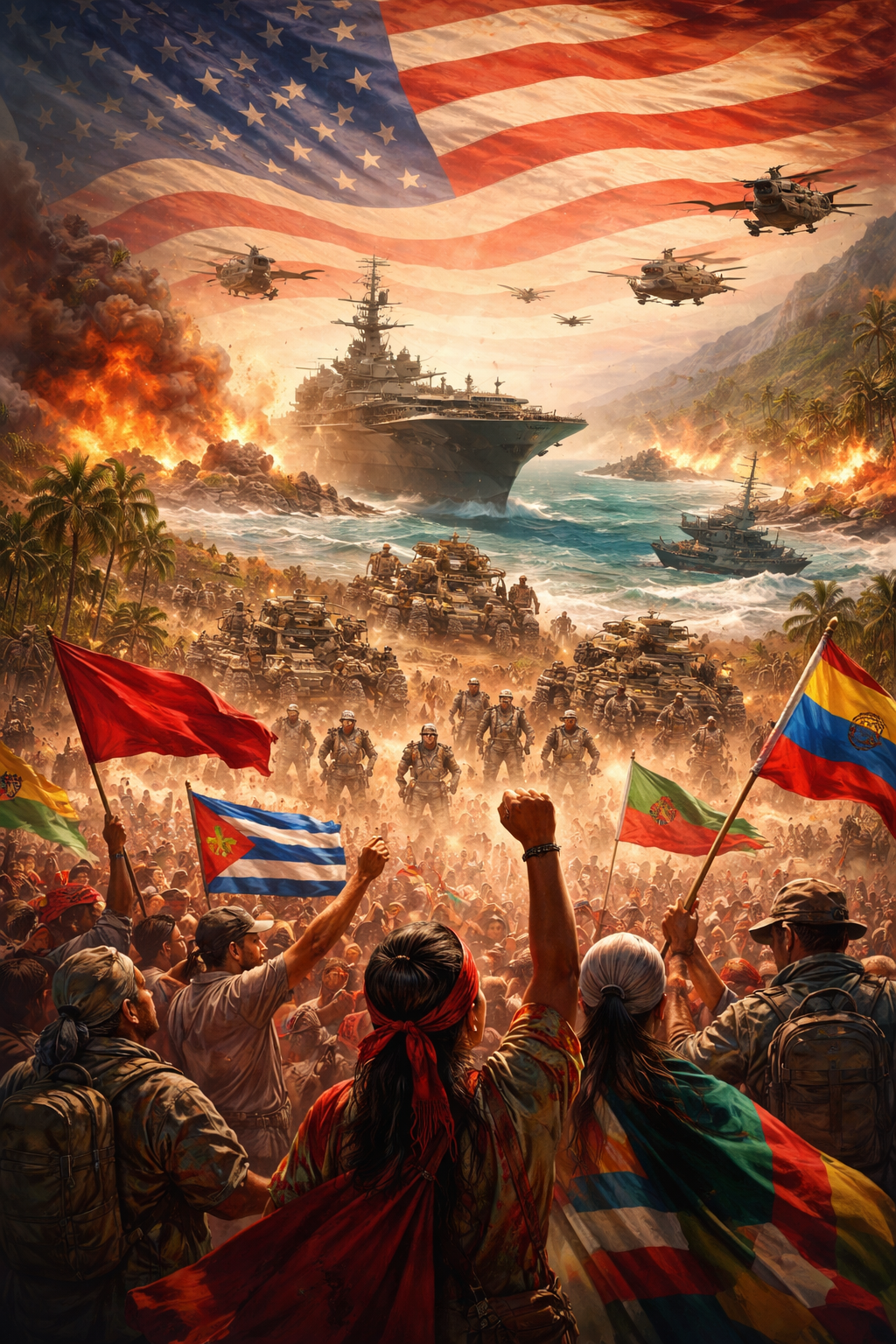
The Intercept’s reporting reveals a widening U.S.-aligned war across Latin America, exposing a moment where imperial language begins to outpace its own ideological cover. The documented facts—cross-border strikes, coalition warfare, regime change operations, and indefinite escalation—align directly with official doctrine and emerging hemispheric war architecture. When situated within the crisis of imperialism and the rise of multipolarity, these developments form a coherent strategy: the consolidation of a militarized “Fortress America” as the foundation of a new American Pole. Across the hemisphere and beyond, popular movements, internationalist networks, and anti-imperialist forces are already organizing in material resistance, transforming analysis into alignment and struggle.
By Prince Kapone | Weaponized Information | March 24, 2026
When a Crack Opens in the Imperial Mirror
In a recent report for The Intercept, “Trump’s ‘Operation Total Extermination’ Expands U.S. War in Latin America,” Nick Turse documents a sharp escalation in U.S.-aligned military activity across the Western Hemisphere, beginning with Ecuador’s cross-border strike into Colombia and extending toward a broader regional campaign that openly contemplates future operations in Cuba, Venezuela, and beyond. The article traces the emergence of a coordinated hemispheric security architecture—linking U.S. military command, regional governments, and counter-cartel doctrine—while highlighting the increasingly explicit language of extermination, deterrence, and permanent war now entering official discourse. What emerges from Turse’s reporting is not simply expansion, but exposure: a war that is no longer hiding behind the polite fictions of partnership and stability, but beginning to speak in its own operational language.
The Intercept is not a revolutionary organ, and Nick Turse is not writing from the organized standpoint of the global proletariat or the colonized masses. Let us be precise without being sectarian. The Intercept operates within the institutional terrain of the Western imperial core, where dissent is tolerated so long as it remains within recognizable ideological boundaries. It can reveal, it can document, it can disturb the surface of official narratives—but it rarely proceeds to a full structural indictment of imperial power. Turse himself has established a serious record as a chronicler of the American war machine, particularly where secrecy, mission-creep, and undeclared operations are concerned. That matters. It means we are not dealing with a court stenographer of empire. But it also means that the facts he gathers are still interpreted within the moral vocabulary of liberal alarm—illegality, overreach, constitutional violation—rather than within a theory of imperial crisis and systemic reorganization.
The names that appear in the article should not be read as isolated actors, but as positions within a structure. Donald Trump emerges as the unfiltered voice of a ruling class that no longer feels compelled to disguise its intentions; Joseph Humire functions as an intermediary between doctrine and justification, translating military strategy into the language of hemispheric security; SOUTHCOM and the wider War Department appear not as neutral institutions, but as the operational machinery through which imperial power is applied, calibrated, and expanded.
This is why the article is significant. It captures a moment when imperial language begins to outpace its own ideological cover. “Operation Total Extermination” is not the kind of phrase that can be easily folded into the old lexicon of humanitarian intervention or cooperative security. It reveals something about the stage we are entering. U.S.-backed attacks are expanding. Land strikes are normalized. Coalition warfare is forming. Entire nations—Cuba, Venezuela, Colombia, Panama, the Caribbean basin—are being repositioned within a security grid rather than treated as sovereign political entities. The article is strongest where it simply reports these developments, because the facts themselves already contain more truth than the frameworks used to interpret them.
But the article stops at the threshold of its own implications. It recognizes escalation, but not transformation. It identifies danger, but not structure. It asks whether the United States is overreaching, rather than asking what kind of historical moment produces this kind of behavior as necessity. This is the limit of liberal analysis. It can describe the symptoms with increasing urgency, but it cannot diagnose the underlying condition.
From the standpoint of Weaponized Information, what appears here is not a deviation from normal policy, but the emergence of a new phase of imperial strategy under conditions of decline. The problem is not that the American state has suddenly become reckless or lawless. The problem is that it is reorganizing itself in response to a world it no longer fully controls. The language of extermination, the fusion of cartel and terrorism discourse, the treatment of the hemisphere as a continuous battlespace—these are not rhetorical accidents. They are the early murmurs of a deeper tectonic shift.
What the article presents as escalation is, in fact, consolidation. What it treats as a series of aggressive moves is better understood as the initial formation of a hemispheric war architecture. The Western Hemisphere is no longer being managed as a periphery of influence, but is being reorganized as a secured zone of full spectrum dominance—a rear base for future conflict, a space to be disciplined, aligned, and integrated into a broader imperial strategy.
This is where the liberal frame begins to fracture. It can tell us that sovereignty is being violated, that war powers are being stretched, that a new “forever war” may be emerging in Latin America. All of that is correct—but insufficient. It cannot explain why these processes are accelerating now, why they are taking this specific form, or why they are being articulated with increasing explicitness. It sees improvisation where there is strategy, excess where there is structure, and recklessness where there is recalibration.
The real value of this article, then, lies precisely in its incompleteness. It brings us the surface of a deeper movement before the dominant frameworks have caught up with it. It records the operational language of a system in transition. What appears here as a series of alarming developments is, in reality, the early-stage consolidation of a new imperial formation—one shaped by declining global dominance, rising multipolar competition, and the urgent need of the U.S. ruling class to secure a stable territorial base from which to project power in the struggles ahead.
In that sense, this is not enemy propaganda to be dismantled, but fraternal reporting to be completed. The task is not to reject it, but to deepen it—to take the facts it presents and situate them within the historical process they belong to. What appears here as escalation is, in truth, reorganization. What appears as policy is structure. And what appears as excess is rapidly becoming doctrine.
From Counter-Cartel War to Hemispheric War Doctrine
Before we rush to dress this up in theory, let us first look at the thing as it is. The Intercept is not reporting a debate among policymakers or a drift in strategy—it is documenting a war already in motion, expanding across multiple fronts at the same time. While bombs fall across Iran and wider West Asia, the same machinery is being activated in the Western Hemisphere. This is not a pivot in imperial focus, as the commentators like to say. It is something more revealing: the empire learning to fight on all fronts at once, because it no longer has the luxury of choosing just one.
At the center of this escalation sits a name so blunt it feels almost honest—“Operation Total Extermination.” No soft language, no humanitarian gloss, no talk of stabilization. Just extermination. A military offensive carried out by Ecuador, yes, but only in the way a subcontractor “carries out” a project financed, equipped, and directed elsewhere. The targets are now called “terrorist organizations,” which is to say, they have been linguistically upgraded into enemies that can be bombed without limit. On March 3, Ecuador launched its strike along the northern border, and like all such “precise” operations, it spilled across the line into Colombia, leaving behind a 500-pound bomb as physical proof that sovereignty, in this new order, is more suggestion than reality. What was once called enforcement has matured into something far more recognizable: war, crossing borders with the same ease as capital.
The United States, for its part, is not lurking in the background playing the role of helpful advisor. It is in the cockpit. It provided the capabilities, carried out strikes, and formally acknowledged that its forces had entered “hostilities.” Even the usual theater of denial was abandoned. “We are bombing narco-terrorists on land as well,” one official declared, as if announcing a new product line. There is a certain grim clarity here. The mask is not slipping—it is being removed because it is no longer needed.
This escalation does not begin here. It is built on an already functioning campaign—“Operation Southern Spear”—which has turned the Caribbean and Eastern Pacific into testing grounds for maritime strikes, destroying vessels and killing civilians under the familiar pretext of targeting illicit networks. What we are witnessing now is the natural evolution of that logic: from sea to land, from intermittent blows to continuous pressure, from containment to projection. Even the generals admit as much. Boat strikes, they say, are only “one small part.” The real objective is to generate “total systemic friction”—a phrase that sounds technical until you realize it means making entire regions unlivable for whoever refuses alignment.
And the geography? There is no meaningful boundary left. Officials speak casually of expansion across Colombia, Ecuador, Venezuela, Cuba, and the wider Caribbean, as if discussing a logistics plan rather than sovereign nations. Ask them for limits, and they have none. Ask them for timelines, and they offer none. Ask them for an endpoint, and you receive only abstractions. Because this is not a war designed to end. It is a structure designed to continue.
Alongside the bombs comes the bureaucracy—the quiet architecture that makes war durable. The United States has stitched together agreements with at least seventeen countries under the banner of the Americas Counter Cartel Coalition, a name that suggests cooperation but functions as coordination under command. At the same time, agencies like the FBI, DEA, and Department of Homeland Security embed themselves deeper into regional states, while military planners refine targeting systems, air support protocols, and interoperability frameworks. What emerges is not partnership but integration—a hemispheric security apparatus with Washington at its center.
The ideological shift that lubricates this machinery is as important as the machinery itself. Cartels are no longer criminals; they are terrorists. And once something is named “terror,” it enters a different universe of permissible violence. “Deterrence” now means bombing. War becomes policing, and policing becomes war. The categories collapse, not by accident, but by design.
Within this same continuum, the article reports actions that would once have been called acts of aggression without hesitation. The United States has attacked Venezuela, kidnapped its president Nicolás Maduro, and forced painful concessions on the Bolivarian Government, using the language of criminality as both justification and leverage. In Cuba, the method is more familiar but no less violent—suffocating economic strangulation through complete blockade, collapsing electrical grids, and a population pushed toward crisis. These are not exceptions to the rule. They are the rule, applied with different instruments.
Above all this floats the rhetoric—blunt, almost theatrical, but entirely consistent with the material reality. The U.S. president speaks openly of taking Cuba, absorbing Venezuela, and redefining the nation’s “security perimeter” to include the entire hemisphere, from the Arctic down to the Panama Canal. Analysts may call this exaggeration. But when words align this neatly with action, they stop being exaggeration and start being disclosure.
Even at this stage—before we bring in doctrine, before we widen the lens—the pattern is already visible. Expansion. Escalation. Integration. Normalization. Indefiniteness. The pieces are all there. What remains is to understand how deliberately they have been assembled.
The 2026 National Defense Strategy removes any remaining doubt. It explicitly authorizes operations against “narco-terrorists” in the hemisphere, whether through partners or directly. Place that next to the Ecuador–Colombia strikes, and the picture clarifies immediately: this is not drift. It is design. The same document speaks of securing “key terrain,” a phrase that sounds geographic but operates as a map of control—canals, corridors, and chokepoints that must be held if power is to be projected elsewhere.
Now return to Venezuela. Once the “narco-terror” category expands to include states, the leap from targeting networks to abducting presidents becomes not a contradiction but a continuation. The legal language stretches, and with it, the boundaries of what can be done without formal declaration. What once required justification now requires only classification.
The coalition structure fits neatly into this design. The Americas Counter Cartel Coalition, reinforced through regional coordination mechanisms and expanding SOUTHCOM-led operations, functions as the delivery system for doctrine. It allows enforcement to be dispersed while strategy remains centralized—a familiar imperial trick, now updated for the present moment.
Outside observers confirm what the official language tries to soften. The Center for Economic and Policy Research tracks a steady expansion of operations across the region, with no indication of contraction or conclusion. This is not a temporary surge. It is a permanent condition in formation.
And then, finally, the wider terrain comes into view. The U.S. Southern Command posture statement points to Chinese involvement across ports, infrastructure, and strategic systems throughout Latin America and the Caribbean. This is the unspoken backdrop of everything we have just seen. The hemisphere is not simply unstable—it is contested.
That contest is visible in material terms. The ECLAC analysis of Latin America–China relations shows China embedded in trade, infrastructure, and development across the region, while regional trade data reveals the structural vulnerabilities that make that engagement both necessary and contested. This is not ideological competition. It is material entanglement.
Even the more polite voices of empire acknowledge the stakes. The Brookings analysis of the “Trump Corollary” frames U.S. policy as an effort to deny China access to strategic assets across the hemisphere. When read alongside the bombs, the coalitions, and the legal redefinitions, the argument sheds its academic tone and reveals itself for what it is: a description of strategy already underway.
At that point, the larger movement becomes impossible to ignore. As the Tricontinental Institute’s analysis of hyper-imperialism makes clear, a declining imperial order does not retreat quietly. It hardens. It coerces. It reorganizes space through force where it once relied on consent. What we are witnessing in the Western Hemisphere is that process, stripped of illusion and unfolding in real time.
So when we gather these facts—not as isolated incidents but as connected elements—they tell a story far more coherent than the language used to justify them. This is not a war on cartels. It is the construction of a hemispheric war formation, built to secure territory, discipline populations, and prepare the ground for struggles that extend far beyond the region itself. The language may still speak of crime and security. The reality speaks of empire in transition.
Fortress America and the War for the Hemisphere
What we are witnessing is not a “war on cartels,” and it is not even a regional security campaign that has spun out of control. It is something far more coherent—and far more dangerous. It is the conscious reorganization of the Western Hemisphere into a militarized rear base of U.S. imperial power, what we in Weaponized Information identify as the consolidation of Fortress America—the territorial core of an emerging American Pole in a world where U.S. supremacy can no longer be taken for granted.
The facts assembled in the previous section already point us in this direction. Cross-border strikes. Coalition warfare. Regime change. Economic strangulation. The reclassification of entire populations and networks into “terrorist” categories. None of this is accidental. These are not scattered reactions to criminality. They are coordinated moves in a larger historical process: the transition from the era of trilateral imperial management to the era of hyper-imperial consolidation under conditions of decline.
The United States no longer presides over an uncontested global order. The rise of China, the resilience of states like Iran, the persistence of anti-colonial governments in Latin America, and the slow but undeniable shift toward multipolarity have fractured the old architecture of dominance. Faced with this reality, the imperial response is not retreat, but contraction and fortification. When empire cannot rule everywhere, it tightens its grip somewhere. And for the United States, that “somewhere” is the hemisphere it has always claimed as its own.
This is the material meaning of Fortress America. It is not a slogan. It is a geopolitical strategy rooted in control over territory, infrastructure, and populations. The Panama Canal, Caribbean sea lanes, Andean corridors, energy flows, migration routes—these are not abstract concerns. They are the arteries of global capitalism. To secure them is to secure leverage. To lose them is to lose position in the world system. What we are seeing now is the attempt to ensure that these arteries remain firmly in the hands of U.S. power, even as that power weakens globally.
The so-called war on “narco-terrorism” is the ideological vehicle for this project. Just as anti-communism once served as the universal justification for intervention, and terrorism replaced it in the post-9/11 order, “narco-terror” now functions as the latest flexible category—elastic enough to absorb criminal networks, insurgent groups, and entire states when necessary. It is not the object of the war that matters, but the category itself. Once a target is placed within it, sovereignty dissolves, law becomes optional, and violence becomes normalized.
This is why the attack on Venezuela and the abduction of its president are not aberrations. They are revelations. They show us what the doctrine actually permits when stripped of its language. A state that refuses alignment can be criminalized. A leadership that resists can be removed. A population that endures can be starved into submission. Cuba’s electrical grid collapses are not unfortunate side effects. They are the continuation of a long-standing strategy: break the material conditions of life until political compliance becomes the only available option.
But Fortress America is not only about repression. It is also about preparation. The hemisphere is being reorganized not just to control it, but to use it. This is where the connection to the coming confrontation with China becomes unavoidable. The United States understands that any sustained conflict with China—economic, technological, or military—requires a secure rear base. It requires reliable access to resources, uncontested control of shipping routes, and political obedience across its immediate sphere. In other words, it requires a hemisphere that can function as a logistical, economic, and military platform for global struggle.
This is the strategic unity behind what might otherwise appear as disconnected actions. The pressure on Panama is about the canal. The militarization of the Caribbean is about sea lanes. The interventions in the Andes are about territory and resource corridors. The targeting of Venezuela is about energy. The destabilization of Cuba is about geopolitical alignment. Each move, taken individually, can be explained away. Taken together, they form a map—a map of consolidation, preparation, and projection.
From the standpoint of the global working class and the peasantry of the Global South, this process has a familiar character. It is the renewal of colonial relations under new conditions. The language has changed, the technologies have advanced, but the structure remains recognizable: external control over land, labor, and resources; internal elites integrated into imperial systems of power; populations disciplined through a combination of force and deprivation. What is new is not the existence of this system, but the intensity with which it is now being enforced.
At the same time, the contradictions within this project are already visible. Empire can impose, but it cannot resolve the conditions that produce resistance. Militarization does not eliminate poverty. Sanctions do not eliminate sovereignty. Regime change does not eliminate national consciousness. Each act of enforcement generates new forms of opposition, new alliances, new political clarity among those who are targeted. The very process of consolidation accelerates the formation of the forces that will challenge it.
This is where the multipolar moment enters the analysis not as abstraction, but as material reality. China’s presence in the region, the persistence of independent states, and the growing alignment of anti-imperialist forces create openings that did not exist in earlier periods. The hemisphere is no longer an uncontested domain. It is a contested field. And that contest is not simply between states, but between systems—between an imperial order in decline and emerging alternatives that seek to reorganize the world on different terms.
From within the imperial core itself, new contradictions also emerge. The same state that projects power outward intensifies repression inward. Surveillance expands. austerity deepens. political dissent is narrowed. The logic of technofascism—merging corporate power, state authority, and technological control—becomes the domestic counterpart to hyper-imperialism abroad. The populations of the imperial core are not exempt from this process; they are incorporated into it, disciplined alongside those they are told to dominate.
What Weaponized Information brings to this moment is not simply critique, but clarity. Where mainstream analysis sees chaos, we see structure. Where it sees overreach, we see recalibration. Where it sees a war on crime, we see a war for control of territory, labor, and global position. The concept of Fortress America allows us to understand why the hemisphere is being militarized. The concept of the American Pole allows us to understand how that militarization fits into a broader world-system reorganization. And the concept of hyper-imperialism allows us to understand why this process is becoming more violent, more explicit, and more difficult to conceal.
So the narrative must be reframed. This is not about cartels. It is not about security. It is not even about Latin America in isolation. This is about the reconfiguration of imperial power under conditions of decline, and the attempt to secure a base from which to wage future struggles—above all, the long-anticipated confrontation with China and the forces of multipolarity.
And from the standpoint of the global majority, the meaning is clear. What is being built is not stability, but a system of control. Not peace, but preparation for wider conflict. Not cooperation, but enforced alignment. The question is not whether this process will continue—it already is. The question is how it will be resisted, and by whom.
From Analysis to Alignment: Joining the Frontlines of Hemispheric Struggle
Once the structure is understood, neutrality becomes impossible. The facts laid out are not academic—they describe a war formation taking shape across an entire hemisphere. And if that is the case, then the question is no longer what is happening, but where one stands in relation to it. For those of us inside the imperial core, there is no innocent position. We either align, materially and politically, with the forces resisting this consolidation, or we become passive beneficiaries of it—consumers of stability built on other people’s dispossession.
The important thing—and this must be said clearly—is that resistance to this hemispheric reorganization is not hypothetical. It is already underway. While the U.S. state builds coalitions of militaries, the peoples of the hemisphere and their allies are building counter-networks of solidarity. When blockade is used as a weapon, movements respond not with statements, but with material intervention. The Nuestra América Convoy has already brought aid, equipment, and internationalist presence directly to Cuba, breaking the logic of siege not through negotiation, but through organized defiance. This is what solidarity looks like when it moves from sentiment to logistics.
Inside the United States itself, the terrain is also shifting. Organizations like the Week of Action to Defend Cuba, anchored by formations such as Black Alliance for Peace, are working to reconnect anti-imperial struggle abroad with political struggle at home—challenging sanctions, exposing military expansion, and building a base of opposition that refuses to accept the hemisphere as Washington’s private domain. At the same time, networks like CODEPINK’s Latin America campaigns are mobilizing thousands against U.S. militarism, linking feminist organizing, anti-war agitation, and international solidarity into a single front of resistance.
Within the targeted nations themselves, the response is even more direct. In Venezuela, grassroots formations like Women in Defense of Venezuela are organizing at the level of everyday life—combining political education, community defense, and feminist struggle against imperial intervention. Alongside them, mass organizations such as Movimiento Somos Venezuela continue to mobilize popular forces in defense of sovereignty, demonstrating that resistance is not only reactive, but institutional and sustained.
Beyond national borders, the outlines of a renewed internationalism are beginning to take shape. The International Action Center has coordinated demonstrations linking Venezuela, Palestine, and broader anti-imperialist struggles, while the International Peoples Assembly continues to articulate a shared political line across continents. These are not symbolic gestures. They are early forms of the kind of global coordination required to confront a system that already operates at planetary scale.
Even the historical memory of struggle is being reactivated. The Venceremos Brigade, which once embodied the internationalist spirit of the 1960s and 1970s, continues to bring people from within the imperial core into direct relationship with Cuban society—breaking ideological isolation through lived experience. And formations like the Simón Bolívar Internationalist Brigades point toward the re-emergence of a more militant form of international solidarity, one that understands that sovereignty under attack sometimes requires not just words, but organized defense.
What all of these efforts reveal is that the dialectic is already in motion. As the United States consolidates a militarized hemisphere, countervailing forces are forming—sometimes fragmented, sometimes uneven, but increasingly conscious of their shared position within a global struggle. The task before us is not to invent resistance, but to recognize it, connect it, and strengthen it.
For those operating within the imperial core, this means taking concrete steps. It means supporting sanctions-breaking efforts materially—funding, logistics, and participation. It means joining or building local anti-imperialist formations that can organize sustained opposition to U.S. military policy. It means engaging in political education that connects domestic repression to foreign intervention, making clear that technofascism at home and hyper-imperialism abroad are two sides of the same process. And it means refusing the ideological comfort of distance—refusing to treat these struggles as distant tragedies rather than shared conditions of a global system.
For those in the Global South, the path is already being forged through struggle: strengthening sovereignty, deepening regional cooperation, and aligning with broader multipolar forces capable of resisting imperial pressure. The more these efforts converge—economically, politically, and militarily—the more difficult it becomes for any single nation to be isolated, sanctioned, or overthrown.
The stakes are not abstract. What is being constructed is a hemispheric war formation designed to secure the United States’ position in an era of global transition. If successful, it will intensify exploitation, deepen inequality, and extend the reach of imperial violence. But the very process of its construction is generating the conditions for its contestation. Every blockade produces a convoy. Every intervention produces resistance. Every attempt at consolidation produces new lines of solidarity.
The question, then, is not whether struggle will emerge—it already has. The question is whether we will recognize our place within it and act accordingly. Analysis, if it is to mean anything, must lead to alignment. And alignment, if it is to matter, must take material form. The hemisphere is being reorganized. The response must be organized as well.
 Weaponized Information
Leave a comment