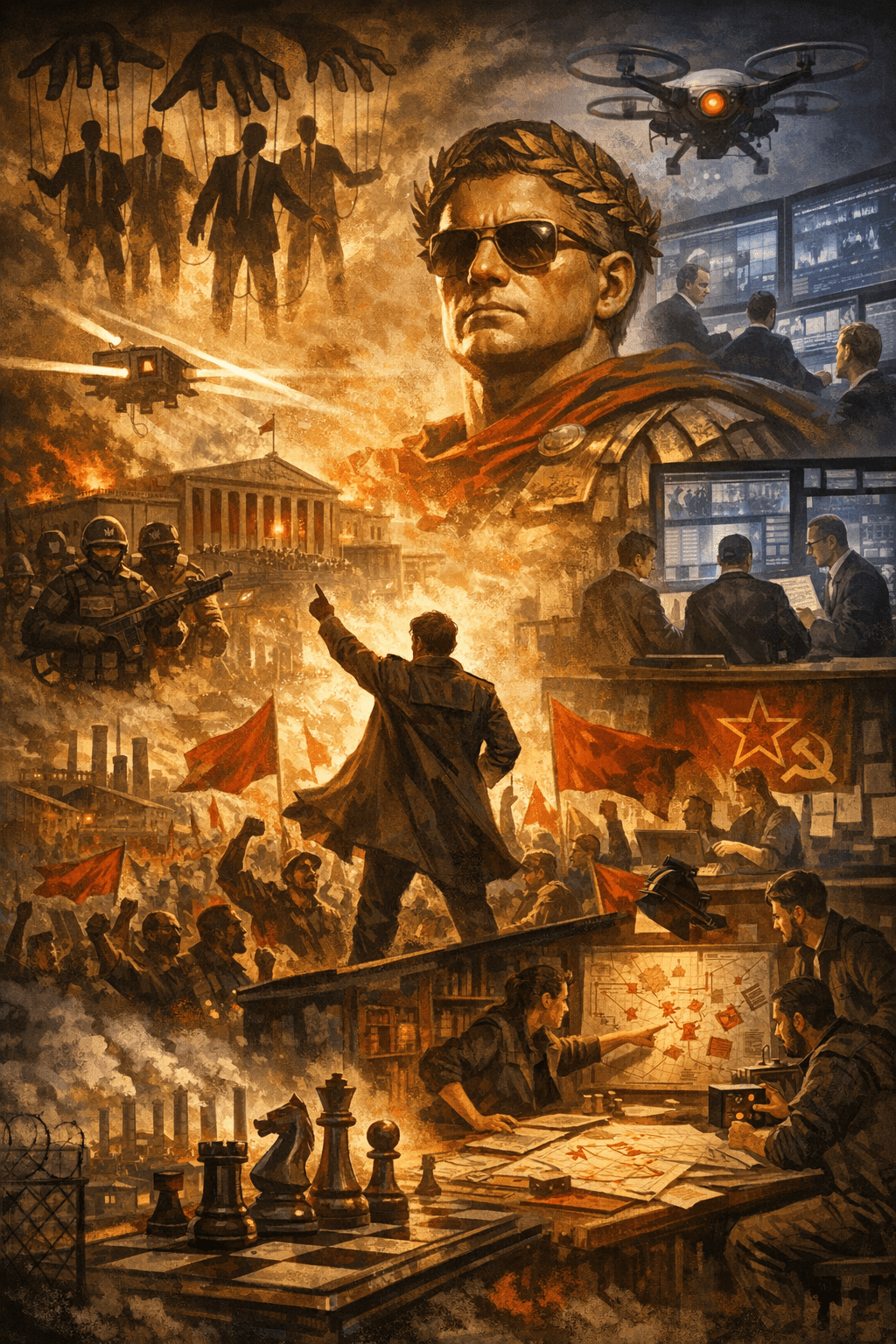
This review excavates “The Modern Prince” as Gramsci’s prison-forged answer to the West’s revolutionary stall: why fortified capitalism survives crisis through consent, institutions, and “common sense.” It reconstructs his core strategic arsenal—collective will, hegemony, war of position, and the party as the organized brain of the oppressed—against the fantasies of spontaneity and the dead-end of pure commentary. It sharpens his warnings about Caesarism, party ossification, transformism, and passive revolution as the ruling class’s method of “changing everything so nothing changes.” And it brings the argument into 2026, where algorithmic governance and technocratic neutrality accelerate the old problem Gramsci named with surgical clarity: power is taken by organization, or it is taken from you.
By Prince Kapone | Weaponized Information | February 26, 2026
When a Prisoner Rewrites Machiavelli
Gramsci did not crawl back to Machiavelli because he missed Renaissance ink and candlelight. He went back because the question Machiavelli stared at—power—never stopped stalking history. Russia cracked the sky in 1917, but in the West the heavens held. The working class surged, the streets burned, the strikes erupted—and still the old order stood there, smug as a landlord, collecting rent on defeat. Why? Because the bourgeoisie in the imperial core does not rule like a naked tyrant. It rules like a teacher, a priest, a judge, a newspaper editor, a union negotiator, a “neutral” bureaucrat with clean hands and dirty functions. It rules with clubs when needed, but it prefers something cheaper: habit. It prefers the soft prison of “common sense.” “The Modern Prince” is Gramsci returning fire.
He begins by ripping Machiavelli out of the moralists’ courtroom. The bourgeois professor loves to turn The Prince into a scandal—“oooh, cynicism”—as if the ruling class does not practice Machiavelli every morning before breakfast. Gramsci refuses this theater. He reads Machiavelli as a political technician, a strategist trying to found a new order out of fragmentation. And then he makes the decisive move: the prince is not a man. The prince is a political form. A “myth” in the precise sense—an image that concentrates scattered energies into a single direction, that turns dispersed grievances into a force with spine. Not vibes. Not moral superiority. Will. Organized will. The prince is history deciding to stop asking for permission.
That is why Gramsci’s first obsession is the creation of a “collective will.” Not sentiment. Not outrage. Not the hot flash of protest that the algorithm can inflate by noon and bury by dinner. A collective will means the oppressed recognizing themselves as an actor—conscious, disciplined, strategic. It means the masses learning to move like an army and think like a class. In 2026, where social media manufactures the illusion of mass action while dissolving organization into dopamine and doomscrolling, Gramsci’s point lands like a brick through a storefront window: virality is not power. Noise is not command.
To teach this, Gramsci drags Italy onto the operating table. He treats the Italian failure to produce a “national-popular” bloc as a lesson written in blood and missed opportunities. Localism, clerical power, landed interests, bourgeois cowardice—Italy remained stuck at the “economico-corporative” level: everyone defending their narrow corner, nobody forging a nation-wide force capable of state formation. Politics reduced to bargaining, not conquest. Gramsci’s verdict is brutal: without a leadership capable of welding city and countryside, worker and peasant, into a coherent project—no modern power is born. No collective will, no new order. Just fragments and bosses.
This is why Jacobinism matters for Gramsci—not as romance, not as guillotine fetish, but as a study in how revolution becomes a state. The French bourgeoisie did not win because it had slogans. It won because it organized. It mobilized the peasantry, crushed rivals, centralized direction, built a new political reality and defended it. Machiavelli’s demand for a national militia appears here as a “precocious Jacobinism”—a glimpse of mass participation as the embryo of sovereignty. Gramsci is saying, without sentimentality: revolutions are constructed. They are not wished into existence by correct opinions.
Then he turns the knife: even collective will is not stable without an intellectual and moral reform. This is the phrase the academy turns into incense—“culture,” “discourse,” “representation”—a Gramsci safe enough for grants. Gramsci’s version is not a seminar. It is a war on the worldview that makes oppression feel natural. He is talking about replacing the old moral universe—religious resignation, bourgeois common sense, inherited obedience—with a new conception of life that can sustain rule by the oppressed. And he nails the bourgeois moralist to the wall: no moral reform without economic reform. If you don’t change how people live, don’t preach to them about how they should think. Morality without material transformation is just perfume on exploitation.
That is why hegemony in Gramsci is never a cute theory about “narratives.” Hegemony is rule. It is consent armored by coercion. Schools, churches, media, law, “expertise,” the everyday rituals that teach people to accept their place—this is the bourgeois trench system. And behind it stands the state, the final argument: courts, prisons, police, the organized violence that makes “consent” persuasive. In 2026, where “security” is the password that unlocks surveillance and austerity, Gramsci reads like a reporter from the future filing notes from inside the enemy’s headquarters.
He does not spare the party, either. He warns that organizations rot. They become “mummified and anachronistic,” reciting formulas like priests repeating prayers long after their god has died. Bureaucracies detach from the base. Leadership becomes caste. In moments of crisis, such hollow parties cannot lead, so society searches for a “divine leader” to resolve contradictions from above. And there it is—the birth canal of the strongman. Not from magic. From organizational failure. From the left’s inability to forge a coherent will before history accelerates.
Even the state, Gramsci insists, does not simply change because elections change. Armies and bureaucracies maintain the mask of constitutional neutrality while steering real power. “Neutrality” often means support for reaction. Career functionaries outlast governments; they carry continuity like a weapon. A new ruling bloc that does not understand this inherits a machine designed to serve its enemies. If you do not reorganize the apparatus, it will reorganize you.
So Part I ends not with a slogan but a method: collective will must be forged; reform must be material; civil society must be contested; the state must be studied; parties must stay alive or decay into ritual. The Modern Prince is not a metaphor for vibes. It is the organized force that can seize initiative in a world where the bourgeoisie has learned to rule without always looking like a tyrant. Gramsci wrote this in captivity, under the censor’s eye, and still the text pulses with one refusal: history does not move because it is interpreted. It moves because organized forces act. The question he leaves us with is not academic. It is a challenge: who is building the Prince?
War in the Trenches: Hegemony, Crisis, and the Long Struggle for Power
If Part I names the problem—how to forge a collective will—Part II names the battlefield. Gramsci looks at Western capitalism and laughs at the fairy tale of “one decisive uprising.” The West is not a brittle autocracy waiting for the right tweet and a heroic march. It is fortified. It has trenches. It has backup generators. It has institutions whose job is to absorb crisis, redirect rage, and convert the raw heat of rebellion into the cold paperwork of “reform.” The ruling class does not only command. It leads. It organizes consent the way a factory organizes production: systematically, continuously, with discipline.
This is where Gramsci’s famous distinction lands with its real weight: war of manoeuvre versus war of position. The manoeuvre is the decisive assault—moments when the state is exposed, legitimacy collapses, and power can be seized through rapid, centralized action. Russia in 1917 is the textbook case. But the West is different. Here civil society is dense—unions integrated into the state, parliaments that provide ritual legitimacy, churches that launder hierarchy into virtue, schools that train obedience, media that manufactures reality, and material benefits that bind sections of workers to the imperial order. In such conditions, a frontal assault can be heroic—and stupid. The trenches are deep. The fortifications are psychological as much as police.
The war of position is not surrender. It is preparation under fortified capitalism. It is the long work of building a counter-hegemonic bloc inside the very terrain where bourgeois rule reproduces itself. It means weakening the enemy where it appears most “normal”—in common sense, in institutions, in habits—and building an alternative authority capable of leading masses, not just criticizing elites. Gramsci is ruthless here: strategy is historical. There is no universal recipe. Anyone selling you a one-size-fits-all revolution is selling you a motivational poster.
Hegemony is the key. And Gramsci’s definition should be tattooed on the forehead of every NGO strategist who uses the word like a fashion accessory: hegemony is consent plus coercion. Civil society is not a neutral marketplace of ideas; it is the outer trench system of the state. Consent is manufactured through institutions, but it is backed by force. Remove coercion and consent frays. Remove consent and coercion becomes brittle. Bourgeois rule survives by fusing the two like steel welded to concrete.
In 2026, this looks almost embarrassingly obvious. The state performs neutrality while policing the boundaries of possibility. It talks about “process” while defending property. It speaks the language of law while producing the conditions of law’s violation. Gramsci notes that sometimes it is useful for armed power not to “reveal itself,” to remain within constitutional forms while determining outcomes. Neutrality becomes a mask. Procedure becomes camouflage. And behind it all stand the same armed bodies and administrative cadres, trained to preserve order even when order is dressed in new colors.
This is why state transformation cannot be reduced to swapping faces. The apparatus has weight. Bureaucracies have memory. Career functionaries outlast elections and carry continuity like an infection. If a new bloc captures office without reorganizing the machine, the machine will reorganize the bloc. This is not paranoia. It is institutional realism—Gramsci’s antidote to liberal fantasy.
But again: he turns the critique back on the revolutionaries. Parties can decay. Leadership can fossilize. Bureaucracy can detach from the base. Then crisis arrives, and the hollow organization cannot respond organically, so society reaches for a charismatic savior. That is how a Caesar is born: not because the people love chains, but because their organizations failed to forge power in time.
The remedy is the historic bloc—a unity of social forces consolidated not just by shared grievances but by a shared worldview and strategic direction. This requires disciplined translation: from economic pain to political consciousness, from consciousness to organization, from organization to leadership, from leadership to power. Without this translation, crisis produces reaction by default.
And Gramsci’s insistence on the “national-popular” is a live wire. People live inside histories, identities, communities. Reaction understands this and weaponizes it. If the left cedes that terrain, it leaves the masses to be organized by their enemies. Counter-hegemony means contesting what “nation,” “people,” and “sovereignty” mean under capitalism and empire—so that the right cannot monopolize the language of belonging.
The war of position, then, is not endless commentary. It is organizational construction under enemy fortification. It prepares manoeuvre. It builds the conditions for rupture. And Gramsci’s message is blunt: fortified capitalism demands revolutionary organization that is equally complex, equally disciplined, equally strategic. Otherwise the enemy’s strength will look like fate. It is not fate. It is history—and history can be dismantled.
Caesarism, Catastrophe, and the Crisis of Leadership
Now Gramsci steps into the storm. He describes that moment when a society reaches a terrifying midpoint: the old order cannot govern as before, but the new order cannot yet rule. The balance of forces freezes into stalemate. Everybody feels the crisis, nobody can resolve it. In this crack of history, the “Caesar” appears—not as a mythic hero, but as a symptom. Caesarism is what happens when antagonistic forces neutralize one another and an arbiter steps forward claiming to stand above the mess.
Gramsci’s diagnosis is colder than moral panic and sharper than liberal outrage. The Caesar may wear a crown or a suit, speak the language of emergency or reform, promise restoration or greatness. The costume changes. The function does not. The Caesar reorganizes the order from above, preserves the essential relations, disciplines the masses, and offers “unity” as anesthesia. Exhausted people accept arbitration because paralysis feels like drowning.
He distinguishes between progressive and reactionary Caesarism—not to rehabilitate dictators, but to insist on class analysis. The question is not personality; it is direction. Does the intervention expand popular initiative and break entrenched elites? Or does it consolidate reaction under a new banner? The Caesar is never a miracle; he is a political solution imposed when collective forces fail to become governing forces.
In 2026, you can smell Caesarism in the air the way you smell smoke before the fire becomes visible. Crisis rhetoric saturates everything—economy, borders, war, “national security,” “AI,” “crime,” “decline.” The ruling class rehearses emergency like a script. And technofascist postures parade as inevitability. Gramsci’s point is a weapon here: strongmen do not emerge because history loves theatrics. They emerge because organized opposition failed to forge a counter-leadership in time.
He extends the analysis to parliamentary masks and constitutional theater. In crisis, legality often continues while power shifts beneath it. Institutions remain; procedures march on; the illusion of normalcy is maintained. Meanwhile, military and bureaucratic strata adjust the real balance. “Neutrality” becomes fiction. Administration becomes politics by other means. The coercive core does not always announce itself with tanks; sometimes it arrives as regulations, committees, and “experts” whose job is to make domination look like common sense.
Gramsci’s lesson is unforgiving: preventing Caesarism is not primarily a matter of condemning Caesars. It is a matter of building a force capable of resolving crisis through collective initiative. That requires leadership rooted in mass participation, disciplined organization, and a historic bloc ready to rule. Without it, crisis becomes reaction’s opening.
This is the point the sentimental left refuses to learn: crisis does not automatically radicalize in the right direction. It radicalizes fear. It accelerates contradictions. It exposes organizational weakness. If you are not prepared, reaction moves faster. Caesarism is recurring because capitalist instability is recurring—and because the failure to build durable organization is also recurring.
Gramsci refuses hysteria and refuses fatalism. He asks the only question that matters: have revolutionary forces done the molecular work—cadre formation, ideological clarity, mass connection, institutional contestation—required to seize initiative when history speeds up? If not, the vacuum will be filled by those who promise unity while consolidating chains. Caesarism is the shadow cast by failed preparation. The antidote is organization—organization capable of turning catastrophe into transformation instead of submission.
From Common Sense to Good Sense: Forging the Intellectual and Moral Reform
If Caesarism is what happens when leadership fails in crisis, then the next question is deeper: how do we build a people capable of leadership at all? Gramsci returns to the slow furnace where durable power is forged: the struggle over worldview. Intellectual and moral reform is not etiquette. It is not academic culture talk. It is the construction of a new common sense—an alternative moral universe—capable of sustaining a new order. A historic bloc cannot be built on borrowed ideas handed down by the enemy like secondhand clothing. It must generate its own conception of life, rooted in lived experience but organized beyond it.
Gramsci names the enemy here as “common sense”: the sedimented, everyday philosophy that people breathe without noticing—religion, folklore, fragments of science, media clichés, inherited prejudices, half-truths that add up to obedience. Common sense stabilizes domination by making it feel natural. Poverty becomes personal failure. Exploitation becomes competition. Authority becomes inevitable. And because this is lived, not merely taught, it cannot be defeated by lectures. It must be contested through organized struggle.
But Gramsci refuses the elitist move. He does not treat the people as empty vessels waiting for a professor to fill them. He insists there is a critical nucleus inside common sense—what he calls “good sense.” Oppressed people develop real insight through struggle; the problem is that it remains fragmented, unsystematic, isolated. The task of the Modern Prince is to cultivate and organize that good sense into coherence—turning scattered experience into a worldview that can lead.
This is where Gramsci’s theory becomes revolutionary pedagogy. The party is not simply an electoral device or an insurrectionary detachment. It is an educator—organizing study, debate, culture, discipline, and strategic reflection. It fights the bourgeois division between manual and intellectual labor. It trains cadres who can think, and thinkers who can fight. Without this educational function, the party becomes administration—a shell managing routines rather than producing leadership.
And again Gramsci is mercilessly materialist: no intellectual and moral reform without economic reform. If social relations remain unchanged, moral appeals become hypocrisy. If economic change happens without ideological transformation, the masses remain disoriented and vulnerable to restoration. The dialectic must hold. Change the world people live in, and change the meaning they attach to that world. One without the other becomes rot.
In 2026 the stakes are higher because common sense is now industrially produced. The algorithm is a factory of perception. Outrage is engineered. Confusion is monetized. Consent is micro-targeted. If the oppressed do not build counter-institutions of education and communication, they remain consumers of narratives manufactured by their enemies. Gramsci’s warning is not nostalgic; it is modern: you cannot fight a modern hegemony with disorganized opinion.
Even religion enters here—not as something to sneer at, but as a social force that binds communities and supplies ethical coherence. A revolutionary movement that ignores this terrain hands it over to reaction. Gramsci’s demand is harder: if religion supplies coherence, revolution must supply a coherence stronger than resignation—a secular faith in collective emancipation rooted in material transformation, not divine waiting.
The endpoint is not immediate upheaval but the slow cracking of inevitability. As good sense spreads, what once felt “natural” becomes historical. What seemed eternal becomes contestable. This is the preparatory work that makes rupture possible without chaos. Gramsci closes this arc with a quiet demand: revolutionary organization must be both strategist and school, both leader and learner. The struggle for power is fought not only in streets and parliaments, but in the realm of meaning. To neglect that terrain is to surrender half the war before it begins.
The Party as Modern Prince: Organization or Oblivion
Now the argument tightens like a fist. Collective will is not a mood; it needs a body. War of position is not a metaphor; it needs institutions. Intellectual reform is not a sermon; it needs machinery. Gramsci’s answer is blunt: the Modern Prince is the political party. Not a brand. Not a lifestyle. Not a fundraising list. Not a rotating cast of influencers. A disciplined organization capable of welding dispersed struggles into strategy—and strategy into power.
The party is the laboratory where collective will becomes operational. It is where scattered grievances are forged into program, where theory stops being a library artifact and becomes a weapon. The party does not merely represent the class; it organizes the class into historical agency. Without organization, workers remain atomized, episodic, reactive—perfect raw material for bourgeois management. With organization, they become protagonist.
But Gramsci refuses to romanticize the party form. He dissects it into its living elements—the social group it represents, the mass of adherents, and the leadership apparatus. When leadership grows organically from the base and stays accountable to it, the party remains alive. When bureaucracy detaches, when habit replaces analysis, the party becomes “mummified”—a corpse with a nameplate. It survives as form while dying as function.
This is not a moral warning; it is a strategic alarm. In crisis, only a living party can respond with speed and discipline. If organization is hollow, the vacuum will not remain empty. Reaction enters. The Caesar appears. Gramsci refuses to blame the people for this. He blames the failure of organization to mature into leadership. A historic bloc cannot be improvised in collapse; it must be built before the tempo accelerates.
The party must therefore be a school of cadres—a factory of leadership. It must produce organizers who can analyze conditions, communicate program, and adapt tactics without abandoning objectives. It must cultivate organic intellectuals who are not detached commentators but part of the class’s practical brain. Discipline here is not fetish; it is coherence in motion—the capacity to act as one force against a class that already acts as one force through its institutions.
In 2026 the critique is savage because the spectacle has replaced organization in much of the imperial core. Movements rise like fireworks online and vanish like smoke in material life. Bureaucracies expand while ties to working people thin. Gramsci’s line cuts clean through the performance: if you cannot translate sentiment into structure, you are not a Modern Prince. You are a ghost haunting your own hashtags.
Yet the party must constantly renew itself. The same structure that enables coordination can calcify into inertia. Gramsci demands self-criticism, porosity to experience, alertness to changing social composition. Revolutionary organization is permanent struggle against entropy—against the quiet death of routinization.
And finally: the party must prepare to govern as seriously as it prepares to oppose. It must study the apparatus it intends to transform—bureaucracies, armed bodies, administrative continuity—because power is not seized only by slogans. It is seized by reorganizing the machine. A party that dreams of power without studying administration prepares its own defeat.
Gramsci offers no prophecy of automatic victory. He offers a wager: build organization capable of forging will, contesting hegemony, navigating crisis, and preparing governance—or watch indignation dissipate while reaction consolidates. The Modern Prince is not hope. It is form. It is the difference between rebellion as weather and revolution as strategy.
Passive Revolution, Transformism, and the Art of Being Defeated Without Knowing It
If the Modern Prince is the form of revolutionary conquest, passive revolution is the ruling class’s favorite magic trick: change everything that can be changed so that the one thing that must not be changed—ownership—remains untouched. Passive revolution is modernization without mass protagonism, reform from above designed to absorb pressure from below. It is the bourgeoisie installing shock absorbers on the vehicle of domination so it can keep driving through crisis without flipping over.
Gramsci studies the Risorgimento as anatomy, not anthem. Italy unified—yes—but through elite maneuver, compromise, and containment. The people did not found the new state; they were managed into it. The bourgeois order modernized the country while preventing the masses from becoming an autonomous political force. That is passive revolution: transformation carried out by elites to prevent genuine democratic rupture.
The mechanism is transformism—the absorption of oppositional leaders into the ruling bloc. Not every enemy is crushed; many are purchased. Positions are offered. Language is softened. Programs are diluted. The opposition becomes decorative, a museum exhibit of “pluralism.” The masses are told progress is happening because their spokespeople are now sitting in power’s waiting room. Meanwhile the relations of production remain intact, grinning behind the curtain.
In 2026, transformism is not antique. It is a routine function of empire. Dissident language becomes brand identity. Radical critique becomes a grant proposal. Movements become nonprofits. The system metabolizes its enemies with efficiency—turning rebellion into consultancy, resistance into content. Gramsci’s warning is brutal: without disciplined organization rooted in material transformation, insurgent energies will be captured and repackaged as “reform.”
Passive revolution thrives in crisis precisely because it offers relief without liberation. When elites feel danger but retain strength, they concede enough to stabilize dominance. Administrative reforms, constitutional adjustments, new rights declarations—while economic power remains undisturbed. People feel change, but not empowerment. The structure bends so it does not break.
Gramsci refuses the childish binary—reform bad, revolution good. He asks the real question: does the reform expand popular initiative or demobilize it? Does it build collective capacity to rule, or does it pacify unrest while strengthening elite control? A reform that improves life materially while disorganizing the masses politically may be a velvet defeat.
And here Caesarism and passive revolution converge: both are solutions from above to crises that the masses were not organized to resolve. The difference is style. Caesarism often arrives with thunder; passive revolution arrives with paperwork. Caesarism waves a sword; passive revolution offers a committee. But both can preserve domination by reorganizing it.
The Modern Prince must therefore train itself against seduction, not only repression. Incorporation is a weapon. Institutional flattery is a leash. Funding streams are quiet prisons. Without ideological clarity, organization dissolves into career ladders. Without discipline, critique becomes employment.
Gramsci’s concept exposes the core reality of the imperial core: large segments of opposition politics contest management, not ownership—distribution, not power. That is why passive revolution is so effective. The system concedes symbols and procedures while safeguarding property. The old order survives by becoming “new.”
Gramsci does not counsel despair. He gives us a diagnostic blade. Passive revolution is the art of being defeated without knowing it. The antidote is clarity about power and ownership—and the ability to measure success not by access, but by the expansion of collective capacity to rule.
The Last Question: Can a Collective Will Rule?
By the end, Gramsci has stripped the reader of comfort. Revolution is not automatic. Crisis is not salvation. Reform can be anesthesia. Parties rot. Leaders become Caesars. Elites modernize to survive. And then he leaves us with the only question that matters: can a collective will not only seize power—but hold it, transform it, and govern through it?
Governance is not an afterthought for Gramsci. It is the test of seriousness. The Modern Prince must study the state it intends to transform—the bureaucratic strata, the inertia of institutions, the loyalties embedded in armed bodies, the continuity that survives elections like a parasite. To seize office without transforming apparatus is to inherit an instrument built for your enemies. You can change the conductor; the orchestra still plays the old song.
This is where the party becomes more than opposition. It becomes the nucleus of a new historic bloc capable of leading beyond its own ranks. Leadership is not domination; it is the capacity to articulate diverse interests into a coherent direction. A class becomes ruling not only by controlling production, but by becoming intellectually and morally leading—capable of persuading, organizing, educating, and defending a new order.
Hegemony does not end after conquest; it deepens. The work of cultivating good sense continues under new conditions. A state that rules only by coercion rots from within and invites restoration. Consent must be organized—through education, culture, institutions, and material transformation that makes the new order livable and defensible. Otherwise the old worldview returns like mold in an abandoned house.
In 2026, where technocratic governance masks elite continuity and “neutral administration” functions as class rule, Gramsci’s warning cuts like a saw: those who inherit power without transforming relations become managers of decline. Those who fail to reorganize the apparatus watch it reorganize them. Victory is not the end of struggle. It is the beginning of a harsher phase—the phase where you must prove you can rule without becoming what you overthrew.
The collective will must therefore remain alive even in power. If it hardens into bureaucracy, detaches from its base, and replaces leadership with management, it invites Caesarism in new clothes. Reaction does not disappear. It waits. It studies. It infiltrates. It returns.
That is Gramsci’s final responsibility: build a durable order rooted in popular leadership, not elite substitution. Build institutions that expand collective capacity. Build cadres who can govern and continue learning. Build hegemony that does not depend on the enemy’s cultural furniture. Otherwise the revolution is not defeated by force alone—it is dissolved by inertia, captured by transformism, and restored through the back door.
Gramsci wrote “The Modern Prince” in a cell because fascism understood something liberalism still pretends not to: the greatest threat is not a bad opinion, but an organized will. He left us not with a quote for a syllabus, but a weapon for the present. In a world where empire engineers consent at scale and disciplines dissent with both algorithms and police, the question is no longer whether Gramsci is relevant. The question is whether we are serious enough to build the Prince.
 Weaponized Information
Leave a comment