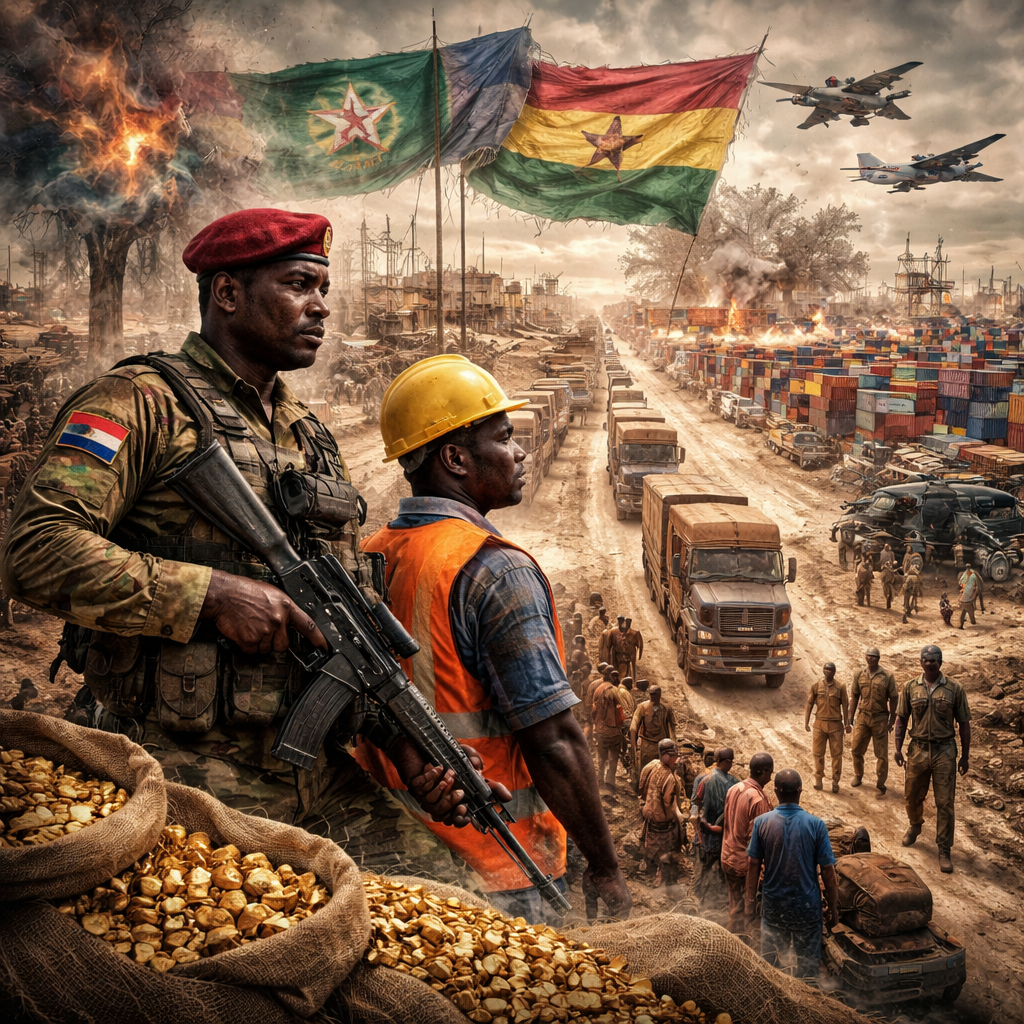
Business Insider Africa frames the Ghana–Burkina agreements as a pragmatic security and trade reset, and we begin by excavating how that cooperation is narrated. We then map the documented terrain beneath the headline: ECOWAS rupture, AES consolidation, French military withdrawal, AFRICOM continuity, gold extraction circuits, CFA monetary tether, IMF discipline, and multipolar infrastructure competition. From there we reframe the story as a contradiction between territorial sovereignty and continued insertion into global value chains. Finally, we turn toward the workers, traders, peasants, displaced communities, and anti-imperialist forces navigating this transitional and uneven multipolar order.
By Prince Kapone | Weaponized Information | February 24, 2026
Stability Spoken in Development-Speak
Segun Adeyemi’s report on Ghana and Burkina Faso signing seven agreements does not arrive with the usual Atlantic theatrics. No lecture about “democracy.” No safari of stereotypes. No NATO sermon disguised as a market update. Instead, it speaks softly—like a civil servant straightening a tie before delivering “good news” to a room full of anxious merchants. Seven deals. A “reset.” A revived commission. A corridor secured. The tone is steady, managerial, almost tender in its reassurance.
That matters. Because propaganda does not always wear enemy colors. Sometimes it wears familiar cloth. Sometimes it speaks with the voice of the region itself—its technocrats, its ministries, its development language—trying to keep the roof from collapsing while the storm keeps coming. This is what we can call fraternal propaganda: not a deliberate lie, but a partial truth told in the dialect of administration. Yet we must be honest about the contradiction: fraternal in style does not mean free in function. Development-speak can still reproduce the categories of capital—trade as salvation, security as management, stability as the highest good—without ever raising its voice.
The architecture begins with the vocabulary of restoration. Cooperation is “revived,” channels are “reopened,” the hiatus is treated as a technical pause now corrected. The story is framed as maintenance. The machine was idle. Now it runs again. But language like this quietly smuggles in a worldview: that smooth integration is the natural state, and rupture is merely an administrative malfunction. History—real history, the kind written in coups, sanctions, debt, and blood—gets folded into a memo.
Insecurity enters the text the same way: as background atmosphere. “Terrorist attacks.” “Violent extremism.” “Rising insecurity.” These are presented as shared burdens, regrettable but almost ownerless, like a bad season that has visited the Sahel. The officials condemn, sympathize, coordinate, and the reader is invited to exhale. The violence is treated as a problem to be managed, not a contradiction to be explained. Not because the author denies causality, but because the narrative remains inside the safe perimeter of statecraft.
Then comes the corridor—described as a “vital commercial artery.” That single phrase tells you what kind of story this is. When trade becomes blood flow, commerce becomes life itself. Movement must continue. Circulation must be protected. And once we accept the metaphor, the hierarchy follows quietly: those who keep goods moving appear as guardians of life, while those who question the terms of movement appear as saboteurs. It is a development frame, but it is also a discipline.
The prose is saturated with administrative comfort: “frameworks,” “mechanisms,” “harmonisation,” “joint commissions,” “periodic consultations.” Politics is translated into procedure. Borders become coordination problems. Security becomes alignment. The agreements are presented like tools in a toolbox, not like decisions made under pressure in a region being reshaped. The minister’s line that the accords “are not going to be decorative pieces” functions as the closing benediction: implementation will redeem us. Functionality will save us.
And yet, the cast of voices is narrow. The only speakers are officials. No transport workers. No border traders. No displaced families. No miners. No farmers living with the consequences of “instability” and “security frameworks.” The people appear in the background as a moral justification—those for whom stability is pursued—but not as political actors with their own analysis, demands, and power.
This is why we excavate the piece fraternally but unsentimentally. The report is not screaming. It is smoothing. It is offering the comfort of administrative order in a region where order has been torn open. It is not hostile propaganda in the classic sense—no crude demonization, no open imperial triumphalism—but it still carries an ideological load: stability through coordination, trade as lifeblood, security as management, and the corridor as the unquestioned hinge of “development.”
Our task is not to mock that horizon. It is to widen it. To recognize what the narrative can say, and what it cannot afford to say. To treat the calm tone as a clue, not a conclusion. Because corridors do not become “vital arteries” through metaphor alone, and resets do not emerge from paperwork alone. They emerge from contradictions—material, historical, and ongoing. We begin here, on the surface of the story, so we can follow the seam lines down into the ground beneath it.
The Ground Beneath the Corridor
The article tells us seven agreements were signed. It is correct.The report documents the revival of the Permanent Joint Commission for Cooperation and the signing of bilateral accords focused on security, trade facilitation, and border governance. No fabrication there. But facts, like minerals, rarely sit alone on the surface. They sit in layers.
Begin with the regional rupture. On 28 January 2024, Burkina Faso, Mali, and Niger formally announced their withdrawal from ECOWAS, citing sanctions and foreign interference. This was not a diplomatic hiccup; it was a structural break. After the statutory notice period, ECOWAS confirmed the withdrawal took effect on 29 January 2025. The corridor “reset” therefore emerges in the shadow of a regional bloc fracture.
Months before that formal exit, the three Sahel states signed the Liptako-Gourma Charter on 16 September 2023, creating the Alliance of Sahel States (AES). The Charter is annexed in a United Nations Security Council document — not rumor, not rhetoric, but record. Russian analysis has described this development as a decisive rupture in West Africa’s regional order, as reflected in policy commentary from the World & New World Journal. According to World Bank population data, the three AES states together account for more than seventy million people. That is not a marginal bloc rebelling at the edges. That is a demographic weight shifting in the Sahel.
Military realignment deepened the shift. In February 2023, Burkina Faso formally ended French military operations and approximately 400 French special forces personnel withdrew. Yet the departure of France does not equal the disappearance of Western military architecture. Ghana remains integrated into U.S. security cooperation structures, including AFRICOM-linked exercises such as Flintlock, under the broader umbrella of American counterterror programs in West Africa.
And the insecurity invoked in the article? It did not descend like rain from a neutral sky. United Nations reporting on Libya documents the diversion of weapons following the 2011 NATO intervention, a destabilization whose aftershocks rippled across the Sahel beginning in 2012. Independent conflict monitoring by ACLED situates the expansion of the Sahel insurgency from 2012 onward, with sustained levels of violence across the region. What appears in the article as “rising instability” is, in fact, part of a decade-long militarized reordering.
Now turn to the corridor itself. The metaphor of a “vital artery” suggests singular dependence. But the geography is more complex. A World Bank corridor study that interlinked corridors from Ouagadougou to Lomé, Abidjan, and Tema play major roles in Burkina Faso’s external trade, with the Lomé route handling a large share of imports and others serving key export functions.. The corridor is not a solitary lifeline but one channel within a competitive export network. Longstanding efforts to streamline these transit routes are documented in World Bank evaluations of West African transport facilitation projects.
What moves along these corridors is not merely produce and manufactured goods. It is gold. Burkina Faso ranks among Africa’s leading gold producers, and according to International Monetary Fund country data, gold constitutes the overwhelming majority of the country’s export earnings. Industrial mining is dominated by foreign firms. The mine and the corridor are not separate stories — they are one circuit: extraction at the shaft, export at the port. The artery does not simply carry goods; it carries value outward.
Monetary sovereignty remains similarly constrained. Burkina Faso continues to operate within the West African CFA franc zone. Despite reform discussions around the proposed ECO currency between 2019 and 2024, the convertibility guarantee framework remains structurally linked to French financial institutions, as outlined in Banque de France documentation on the CFA franc system. Political rupture has occurred. Monetary rupture has not.
Ghana, meanwhile, navigates its own financial discipline. In 2023, the IMF approved an Extended Credit Facility arrangement for Ghana, following a debt crisis and restructuring process. Corridor management therefore unfolds inside IMF conditionality, not outside it.
Infrastructure development also reflects broader multipolar competition. Chinese state-linked firms have participated in the expansion of Ghana’s port infrastructure, including the modernization of Tema, as reported in coverage of China Harbour Engineering Company’s role in Tema Port expansion. The corridor sits within overlapping financial and geopolitical vectors — not a single axis of alignment.
And the violence continues. Reuters reported the killing of Ghanaian traders in the Titao area in February 2026, and UNHCR estimates approximately 2.8 to 2.9 million internally displaced persons across the Sahel. Administrative harmonization proceeds alongside armed conflict and displacement.
The record, then, is layered: ECOWAS rupture, AES consolidation, French withdrawal, AFRICOM continuity, Libya blowback, gold export dependency, CFA monetary tether, IMF fiscal constraint, Chinese infrastructure participation, and persistent insurgency. The agreements are real. The cooperation is real. But they operate inside a field structured by uneven sovereignty and globalized value chains. The corridor does not float above history. It runs straight through it.
The Mine, the Corridor, and the Chain
Once the administrative fog clears, the contradiction stands upright.
Political sovereignty in the Sahel has moved. ECOWAS fractured. The Alliance of Sahel States formed. French troops withdrew. These are not cosmetic gestures; they are territorial ruptures in a regional order long stabilized through sanctions, military presence, and financial discipline. Something shifted. The perimeter changed.
But sovereignty does not travel evenly across terrain.
The gold remains embedded in global markets. According to International Monetary Fund country data, gold constitutes the overwhelming majority of Burkina Faso’s export earnings. Industrial mining remains dominated by foreign firms. The corridor ensures that what is extracted at the shaft reaches the port without friction. And from the port, it enters a value chain whose pricing power lies elsewhere.
The mine is the body. The corridor is the vein. The currency is the chain.
Burkina Faso continues to operate within the CFA franc zone, as documented in Banque de France institutional materials. Reform discussions have come and gone; the convertibility guarantee architecture remains. Political rupture has advanced faster than monetary rupture. Territorial autonomy has outpaced financial delinking.
Ghana, too, navigates constraint. The corridor agreements unfold inside an IMF Extended Credit Facility framework approved in 2023, as confirmed by the IMF Executive Board announcement. Fiscal consolidation, debt restructuring, macroeconomic conditionality — these are not abstractions. They define the operating space within which “cooperation” is negotiated.
Meanwhile, infrastructure expansion involves Chinese state-linked participation in port modernization, as reported in coverage of China Harbour Engineering Company’s role in Tema Port. Multipolarity widens the field. It does not dissolve hierarchy. Competing investors may finance the dock, but the logic of export dependence persists unless value retention shifts at the core.
And over all of this hangs the security architecture. The withdrawal of French troops in 2023 marked a visible contraction of one imperial vector. Yet Ghana remains embedded in AFRICOM-linked cooperation frameworks. The militarized arc that followed the 2011 NATO intervention in Libya and the subsequent weapons diffusion documented in UN reporting has not evaporated. It has mutated. Insurgency expanded after 2012, as shown by ACLED’s conflict monitoring. The corridor is stabilized while the wider security terrain remains volatile.
This is the core contradiction: territorial rupture confronting entrenched circuits of accumulation.
The agreements may reduce border friction. They may streamline transit procedures. They may protect traders from bureaucratic harassment. All of that matters. But efficiency inside a dependent export structure can simply mean smoother outward flow. Administrative harmonization is not the same as structural transformation.
The propaganda surface speaks of stability. The historical record speaks of hierarchy. Stability for whom? For traders, perhaps. For ministries, certainly. But unless gold revenue capture shifts, unless monetary architecture shifts, unless fiscal discipline shifts, the corridor continues to function as a conduit in a globalized value chain whose apex sits beyond Ouagadougou and Accra.
None of this negates the rupture. It situates it. The exit from ECOWAS and the formation of AES represent a break with a sanction-disciplining order. The withdrawal of French troops represents a contraction of overt military tutelage. These are meaningful developments. But multipolar transition is not emancipation; it is leverage terrain. It creates negotiation space. It opens cracks. It does not abolish global hierarchy.
The corridor, then, becomes a diagnostic site. It reveals the unevenness of sovereignty in a transitional imperial order. Political assertion has advanced. Monetary continuity persists. Extractive dependence endures. Infrastructure finance diversifies. Security realigns. The periphery manages fragmentation while still embedded in global circuits.
The question is no longer whether rupture has occurred. It has. The question is whether the rupture can travel from the border checkpoint to the mine shaft, from the mine shaft to the refinery, from the refinery to the currency, and from the currency to the structure of value itself.
Until that chain is broken at more than one link, the artery will continue to circulate wealth outward — even as flags change and alliances realign.
 Weaponized Information
Leave a comment