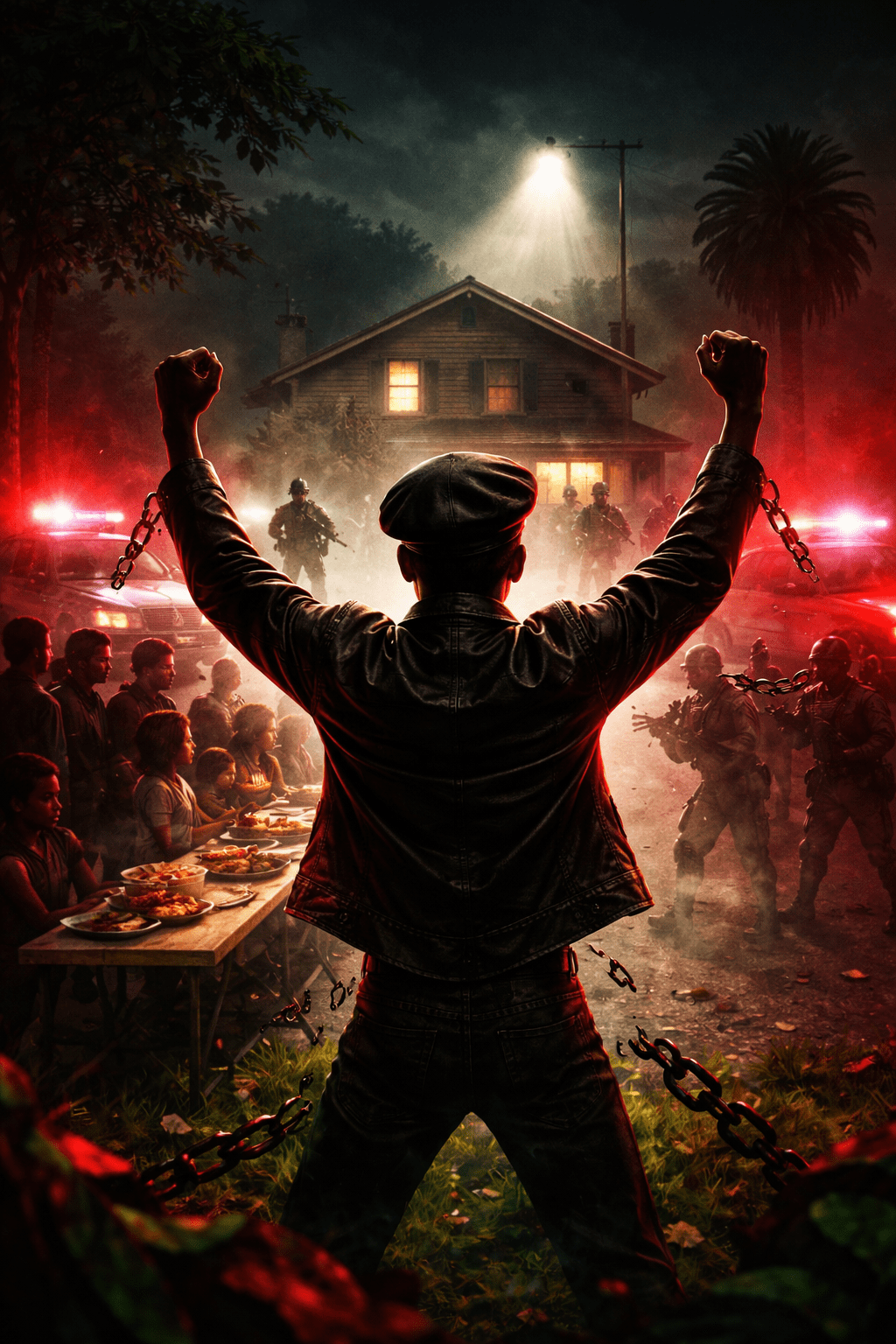
A teenage Panther whose life exposed the colonial reality inside the United States. His political awakening marked the rise of organized Black revolutionary youth. His killing revealed how the state responds when the oppressed build power.His memory remains a lesson in struggle, organization, and historical continuity.
Prince Kapone | Weaponized Information | Black History Matters Series | February 1, 2026
Memory Is a Battlefield, and History Chooses Sides
History is never just about the past. It is a struggle over meaning in the present. The ruling class remembers in a way that protects power, while the oppressed remember in a way that explains suffering and points toward liberation. This is why revolutionary memory is dangerous. It tears the mask off official stories and reveals the structure beneath the slogans. To remember Bobby Hutton is not to light a candle in a quiet room; it is to open a window and let the smoke of history clear. His life forces us to ask not whether the system failed, but whether the system functioned exactly as designed.
Hutton was not a celebrity, not a politician, not a man polished by institutions that reward obedience. He was a teenager of the Black urban working class in Oakland, formed in neighborhoods where poverty was policy, policing was occupation, and opportunity was a rumor told on television. When he joined the Black Panther Party for Self-Defense at sixteen, he was not chasing romance or rebellion for its own sake. He was stepping into an organization that offered clarity: that the conditions surrounding him were not accidental, not cultural failure, not moral weakness, but the outcome of a system that required Black communities to be contained, controlled, and economically extracted from. In other words, he was given analysis alongside purpose.
The dominant narrative prefers its Black youth either as victims without agency or as criminals without context. What it cannot tolerate is the figure of the politically conscious young revolutionary, disciplined and organized, who understands that personal suffering is tied to structural design. Hutton represented precisely that danger. His generation had watched civil rights legislation pass while police violence continued, while schools remained underfunded, while jobs disappeared, while landlords extracted rent from overcrowded apartments. They had been promised inclusion and delivered containment. The Panthers spoke to this contradiction directly. They did not beg the system to love them; they studied the system to understand it, and then organized to confront it.
To write about Hutton, then, is to confront a turning point in Black political history: the moment when a layer of youth concluded that reform without power was theater. This was the historical shift from appealing to conscience toward building capacity. The Panthers’ insistence on self-defense, political education, and community programs was not extremism born of impatience; it was strategy born of observation. They had observed that the state responded to polite requests with delay and to organized resistance with force. That observation, grounded in daily reality, produced a new political generation—one that included a teenager named Bobby Hutton.
The purpose of this essay is not to romanticize sacrifice or freeze Hutton in the amber of martyrdom. It is to understand what historical forces produced him, what political line he embodied, and why the state responded as it did. Memory, in this sense, is not nostalgia. It is a method. By studying lives like Hutton’s, we learn how colonial conditions inside the United States generate revolutionary consciousness, how youth become political actors under pressure, and how the state reveals its true character when confronted by organized movements of the oppressed. If history is a battlefield, then remembering Bobby Hutton is an act of choosing a side.
Born in the Internal Colony: Youth Under Occupation in Oakland
To understand Bobby Hutton, we have to understand the ground beneath his feet. He came of age in Oakland, California during a period when Black urban life in the United States was shaped by migration, exclusion, and containment. Families had moved west in search of industrial work and a measure of dignity, only to find that the formal end of Jim Crow did not mean the end of racialized economic control. Jobs were unstable or disappearing, housing was segregated by design and price, and entire neighborhoods were treated less like communities and more like zones to be managed. This was not social failure. It was policy expressed through geography.
Young people growing up in this environment learned early that the state did not appear in their lives as a provider of opportunity but as a force of surveillance and punishment. Schools were under-resourced, public services were thin, and police presence was constant. The lesson was not subtle: you are visible when you are suspected, invisible when you are in need. For Black youth, daily life unfolded under conditions that closely resembled occupation. The language of democracy was loud on television and quiet on the street. This contradiction produced a generation that did not need a sociology textbook to recognize structural inequality; they could see it from their front steps.
Hutton was part of this generation of the Black urban proletariat—young, materially dispossessed, and politically awakening in an environment where survival required awareness. He was not shaped by elite institutions or gradual reformist optimism. He was shaped by the lived knowledge that poverty was enforced, that mobility was blocked, and that dignity was routinely denied. In such conditions, political consciousness does not emerge as abstract theory. It grows out of daily confrontation with limits. When an entire community is treated as a problem to be controlled, its most perceptive youth begin to ask who is doing the controlling and why.
This is the material soil from which Hutton’s political development would grow. The significance of his later commitment cannot be grasped if we imagine him as an isolated radical spirit. He was one of many young people whose experiences exposed the gap between American mythology and American reality. The difference is that he encountered an organization that could translate that experience into analysis and action. But before ideology came structure, and before structure came conditions. Those conditions—segregated neighborhoods, economic marginalization, and militarized policing—were not accidental hardships. They were the predictable outcomes of a system that required Black labor but feared Black power.
When we say Hutton emerged from a “colonial” situation inside the United States, this is not metaphor. It is description. A population concentrated geographically, economically exploited, politically marginalized, and policed as a threat rather than served as a constituency lives in a relationship to the state that mirrors empire more than citizenship. Youth raised in such a relationship learn quickly that the promises of equality are not distributed evenly. They also learn, sometimes earlier than their elders, that survival alone is not enough. Dignity requires struggle. It was from this terrain—hard, unequal, and clarifying—that Bobby Hutton stepped toward revolutionary politics.
When Black Youth Found Organization, Discipline, and Direction
The mid-1960s marked a turning point not only in national politics but in the political life of Black youth in urban America. The passage of civil rights legislation had not delivered safety, jobs, or dignity to the neighborhoods where young people like Bobby Hutton were coming of age. Police brutality remained routine. Poverty remained entrenched. Segregation, though less openly defended, remained structurally intact. For many young Black people, the lesson was not abstract: the system could change its laws without changing their lives. Disillusionment did not lead to apathy—it created a search for a new path.
The emergence of the Black Panther Party answered that search with unusual clarity. The Panthers offered something that had been largely absent from the lives of many working-class Black youth: structure, political education, and collective purpose. They were not simply a protest formation but an organization that trained members to study, to serve their communities, and to understand their conditions in systemic terms. Their Ten-Point Program, their community survival initiatives, and their insistence on discipline transformed what might have remained scattered anger into organized commitment.
Bobby Hutton joined the Panthers at sixteen, becoming one of the youngest members of the organization. His early commitment reflected a broader pattern. Under conditions of sharp oppression, youth often grasp the stakes with particular clarity. With fewer investments in the promises of gradual reform and more direct exposure to daily repression, they can move quickly from frustration to political consciousness when given the tools to interpret their reality. The Panthers did not romanticize youth; they organized them. They turned energy into responsibility, militancy into discipline, and outrage into study and service.
This development signaled the birth of a new political type: the revolutionary Black youth cadre. Not a spontaneous rebel, not an isolated radical, but a young person rooted in community, educated in political theory, and accountable to an organization. Hutton embodied this shift. He was part of a generation that stopped waiting for leadership to emerge from established institutions and instead stepped forward to become the leadership their communities required. The Panthers’ growth showed that when organization meets historical pressure, youth do not have to drift toward despair or self-destruction—they can move toward collective struggle.
The key transformation of this period was not merely ideological but organizational. Black youth were no longer positioned only as victims of conditions or symbols of unrest. Through the Panthers, they became participants in structured political work—running programs, studying theory, and representing their communities in disciplined formations. This was the path that shaped Bobby Hutton. His life illustrates how quickly a young person formed under colonial conditions can become a conscious actor in history when given organization, education, and purpose.
When Faith in Reform Collapsed and Self-Determination Took Its Place
By the time Bobby Hutton entered political life, a profound ideological shift was underway inside Black America. The Civil Rights era had broken legal segregation, but it had not broken the structure that produced Black poverty, police occupation, and economic exclusion. For a time, many believed that access to voting booths, public accommodations, and federal legislation would gradually pull Black communities into full citizenship. But daily life told another story. Jobs remained scarce, housing remained segregated by price and policy, and police violence continued with routine impunity. Reform had changed the language of the system without changing its function.
This contradiction produced a political reckoning, especially among the young. The older framework had rested on moral appeal: expose injustice, awaken conscience, and the nation would correct itself. But a generation raised amid urban containment, unemployment, and constant surveillance saw little evidence that conscience governed power. They saw instead that order was preserved through force, and that poverty was administered, not accidental. The conclusion many reached was not born of impatience but of observation: a system structured to dominate could not be persuaded into equality. It would have to be confronted and transformed.
The Panthers gave this emerging outlook organizational form. Its analysis of internal colonialism, its insistence on self-defense, and its emphasis on political education marked a decisive break from integrationist expectations. The Panthers did not reject earlier struggles; they built upon them by asking the next question: if legal equality does not end material oppression, then what kind of power is actually required? For young militants like Bobby Hutton, this was the turning point. Politics was no longer about access to existing institutions but about the capacity of Black communities to govern and defend themselves.
Hutton’s generation thus embodied a historic transition—from petition to self-determination, from moral appeal to political power, from individual advancement to collective liberation. This shift unsettled the state not because it was rhetorical, but because it redefined the terrain of struggle. A community demanding better treatment can be managed. A community organizing for power presents a different challenge entirely. Hutton stood within the first wave of youth to embrace that conclusion fully. His political path was not a detour from the Civil Rights Movement, but its dialectical development under the pressure of unfulfilled promises.
April 6, 1968: When the Conflict Between Black Liberation and State Power Turned Deadly
To understand the death of Bobby Hutton, it is important to understand the atmosphere of the United States in April 1968. Just days earlier, Dr. Martin Luther King Jr. had been assassinated, and cities across the country erupted in grief, anger, and rebellion. The federal government and local authorities responded by flooding Black neighborhoods with police and National Guard troops. Streets were patrolled like war zones. Curfews were imposed. The state was not only attempting to restore order; it was demonstrating force to prevent further unrest. In this tense environment, any organized Black political activity was treated as a potential insurrection.
The Panthers, already under heavy surveillance, were viewed by law enforcement as especially dangerous. Unlike spontaneous uprisings, the Panthers were organized, armed for self-defense, and openly critical of police violence and economic exploitation. Authorities increasingly treated them not as a political organization but as an internal enemy. Encounters between Panthers and police were therefore charged with political meaning long before any shots were fired. Both sides understood that these confrontations were about more than individual incidents; they were about power and control.
On the night of April 6, a confrontation in Oakland escalated into a gun battle between police and Panthers, including Eldridge Cleaver and Bobby Hutton. The clash led to a siege of a house where the Panthers had taken cover. Police surrounded the building in overwhelming numbers, firing repeatedly and refusing safe passage. Hours passed under intense pressure, with the Panthers trapped inside. Eventually, Hutton and Cleaver decided to surrender. Hutton, only seventeen years old, emerged from the house after removing his clothes to show he was not carrying a weapon—a gesture meant to signal compliance and reduce the risk of being shot.
Despite this clear attempt to surrender, Hutton was shot and killed by police. His death made one fact painfully visible: for Black revolutionaries, the act of surrender did not guarantee safety. The event shattered the idea that the conflict between the Panthers and the state was simply about law enforcement. It revealed that the police were functioning as a force of political suppression, prepared to use lethal violence even when a young man posed no immediate threat. Hutton’s killing was not treated as a tragedy within official circles; it was treated as the elimination of an enemy.
The political meaning of that night extended far beyond the individuals involved. It demonstrated how the state responded when Black communities moved from protest to organized self-defense and political education. The message was clear: movements that sought real power would be met with repression, not negotiation. Hutton’s death exposed the limits of legal protection under conditions of racialized political conflict. It showed that the struggle had crossed an invisible line, where the state no longer claimed neutrality but acted openly to defend the existing order. For many watching, the illusion that change could occur without confrontation became harder to sustain.
Why the State Makes Martyrs and What Martyrdom Reveals
The killing of Bobby Hutton was not only an act of violence; it was a political message. States do not use lethal force against organized movements simply to remove individuals. They do so to shape the psychological terrain of entire communities. When the state kills a revolutionary, especially a young one, it is attempting to accomplish several things at once: to decapitate emerging leadership, to intimidate those who might follow, and to demonstrate that resistance carries the highest possible cost. Violence becomes a warning, a lesson written in blood: organized opposition will be met not with debate, but with destruction.
This is why repression so often intensifies precisely when movements become disciplined and effective. Protests can be tolerated. Disorder can be contained. But organization—rooted in political education, community programs, and self-defense—threatens to outlast outrage and build lasting power. When authorities moved against the Panthers, they were not responding to isolated acts; they were responding to the emergence of a structured, conscious force within Black communities. Hutton’s death must be understood within this framework. It was meant to slow or stop the growth of revolutionary capacity by instilling fear and demonstrating the consequences of defiance.
Yet repression has a dialectical character. While intended to crush movements, it often clarifies the nature of the system more effectively than any speech or pamphlet could. When a teenager who has surrendered is killed, the claim that policing is neutral law enforcement becomes harder to believe. The event forces observers to confront a deeper truth: that the state’s primary concern is not justice in the abstract, but stability for a particular social order. Martyrdom, in this sense, exposes the hidden logic of power. It strips away the language of fairness and reveals the reliance on force.
Hutton’s death therefore functioned as political education for thousands who may not have previously understood the stakes of the struggle. It illuminated the colonial character of Black existence in the United States, where political organizing could be treated as insurgency and communities as hostile territory. It also reinforced a hard lesson for movements: organization alone is not enough; preparation for repression is part of the terrain. The loss of a comrade, while devastating, can deepen resolve by clarifying what the struggle is truly up against.
Remembering Hutton as a martyr does not mean glorifying death or seeking sacrifice. It means recognizing how his killing revealed the structure of the system he opposed. His life demonstrated the possibility of rapid political development among oppressed youth; his death demonstrated the lengths to which the state would go to prevent that development from spreading. In this way, martyrdom becomes not an end point, but a historical signal—one that warns of the risks of struggle while also illuminating its necessity.
The Meaning of Bobby Hutton: Youth as a Historical Force
Over time, the image of Bobby Hutton has come to represent more than a single life cut short. He stands as a symbol of a historical moment when Black youth emerged not simply as victims of injustice or participants in protest, but as organized political actors prepared to shape the direction of struggle. This breaks sharply from the way young people are often portrayed in mainstream narratives—either as misguided, manipulated, or incapable of serious political thought. Hutton’s life contradicts those assumptions. He was disciplined, politically committed, and accountable to an organization that demanded study as well as courage.
His significance lies partly in his age. At seventeen, many young people are still treated as dependents, expected to prepare quietly for a future defined by others. Hutton belonged to a generation that did not have the luxury of waiting. Daily exposure to police harassment, economic deprivation, and social exclusion accelerated political awareness. Under such conditions, youth could see with sharp clarity that their future would be shaped by whether their communities gained power, not by whether they behaved well within existing limits. Hutton represents this shift—from youth as passive recipients of history to youth as conscious makers of it.
This transformation unsettled both the state and liberal society. It is easier to dismiss older militants as hardened or extreme than to explain why teenagers are willing to risk their lives for collective liberation. The presence of organized revolutionary youth suggests that the conditions producing resistance are deep and visible, not marginal or misunderstood. Hutton’s commitment exposed the lie that only a fringe rejects the system. When the youngest members of a community recognize its structural injustices, it signals a broader crisis of legitimacy.
Hutton also symbolizes the disciplined side of youth militancy. He was not a lone rebel acting from impulse. He was part of a formation that emphasized political education, collective responsibility, and service to the community. This matters historically. It shows that radicalization among oppressed youth does not have to lead to fragmentation or despair. With organization and ideological clarity, it can produce cadre—individuals who see their lives as tied to the liberation of their people. Hutton’s example challenges the stereotype that youth militancy is inherently chaotic or self-destructive.
As a symbol, then, Hutton represents the moment when Black urban youth stepped forward as a revolutionary force in their own right. He embodies the realization that waiting for change from above was no longer viable, and that the responsibility for shaping the future rested with those most affected by the present. His life marks a generational turning point, when young people stopped being treated as the “leaders of tomorrow” and began acting as the organizers of today.
What Bobby Hutton’s Life Teaches Movements in the Present
The life of Bobby Hutton is not preserved in history so that it can be admired from a distance. It endures because it offers lessons for those struggling under different conditions but facing familiar structures of power. The first lesson concerns youth. Hutton reminds us that young people living under sharp oppression often grasp reality with particular clarity. When given organization, political education, and meaningful responsibility, their energy can become disciplined commitment. Movements that underestimate youth or treat them only as supporters rather than leaders deprive themselves of one of their most dynamic forces.
A second lesson concerns the nature of the state. Hutton’s death demonstrates that repression is not an aberration that appears only when movements “go too far.” It is built into the system’s response to any serious challenge. The state fears organized power more than it fears protest, and it escalates its response when communities develop the capacity to act independently. Understanding this does not mean surrendering to fear; it means organizing with clear eyes. Movements must be prepared for surveillance, disruption, and attempts at intimidation. Clarity about repression allows strategy to replace surprise.
Hutton’s story also underscores the importance of combining political education with practical work. The Panthers did not rely on rhetoric alone. They built programs, studied theory, and tied daily survival to long-term liberation. This combination created a generation of activists who understood both the immediate needs of their communities and the broader structures producing those needs. For movements today, the lesson is that service without analysis risks reformism, while analysis without service risks isolation. The strength lies in their unity.
There is also a lesson about continuity. The state often hopes that repression will break the chain of struggle, leaving each generation to start from scratch. Remembering Hutton interrupts that process. It allows present movements to inherit experience rather than repeat errors blindly. Memory becomes a form of organizational strength, connecting past sacrifices to present responsibilities. To study figures like Hutton is to learn how earlier militants confronted similar contradictions, how they built, where they faced limits, and how the state responded.
Finally, Hutton’s life cautions against romanticizing sacrifice while recognizing the reality of risk. The goal of struggle is not martyrdom but transformation. Yet the possibility of repression is part of the terrain, and movements must be strong enough to continue even after loss. Hutton’s example teaches that individuals may fall, but organized struggle can endure and grow. Remembering him, then, is not about mourning alone. It is about carrying forward the work he began, with greater preparation, deeper education, and a broader collective base.
From Martyr to Movement: Carrying the Line of Struggle Forward
The life of Bobby Hutton reflects a historical moment when Black youth under conditions of internal colonialism stepped onto the stage of history as conscious political actors. His political development was not accidental, nor was it purely personal. It emerged from material conditions that made neutrality impossible and from an organization that gave structure to outrage and direction to hope. His death, in turn, revealed the true character of a state confronted by organized movements of the oppressed. When faced with disciplined demands for power and self-determination, the system responded not with dialogue, but with bullets.
To end with Hutton’s death alone would be to misunderstand the meaning of his life. Martyrdom is not the conclusion of struggle but a moment within it. The purpose of remembering him is not to dwell on loss, but to understand what historical forces he represented and how those forces continue to operate. The conditions that produced Hutton—economic marginalization, police occupation, and political exclusion—have not disappeared. They have shifted form, language, and technology, but their underlying logic remains. That means the questions his generation confronted are not relics of the past; they are living questions in the present.
The task, then, is not to imitate the past mechanically, nor to romanticize a period of open confrontation without understanding its limits. It is to study that history carefully and extract its strategic lessons. Hutton’s life shows the speed with which political consciousness can develop among youth when organizations take education seriously. His death shows the intensity of repression that follows when movements become materially threatening. Together, these truths point toward a sober but determined approach to struggle: build deeply, educate consistently, and prepare for resistance that is both political and structural.
In this way, Hutton’s legacy moves from memory into motion. He represents a link in a longer chain of struggle for collective liberation. That chain does not break when one link is struck; it is strengthened when new links are forged with clearer understanding. Remembering him is therefore not an act of nostalgia but of alignment—an affirmation that the fight against domination did not begin with us and will not end with us. Our responsibility is to carry it forward with greater organization, broader unity, and deeper clarity than before.
 Weaponized Information
Leave a comment