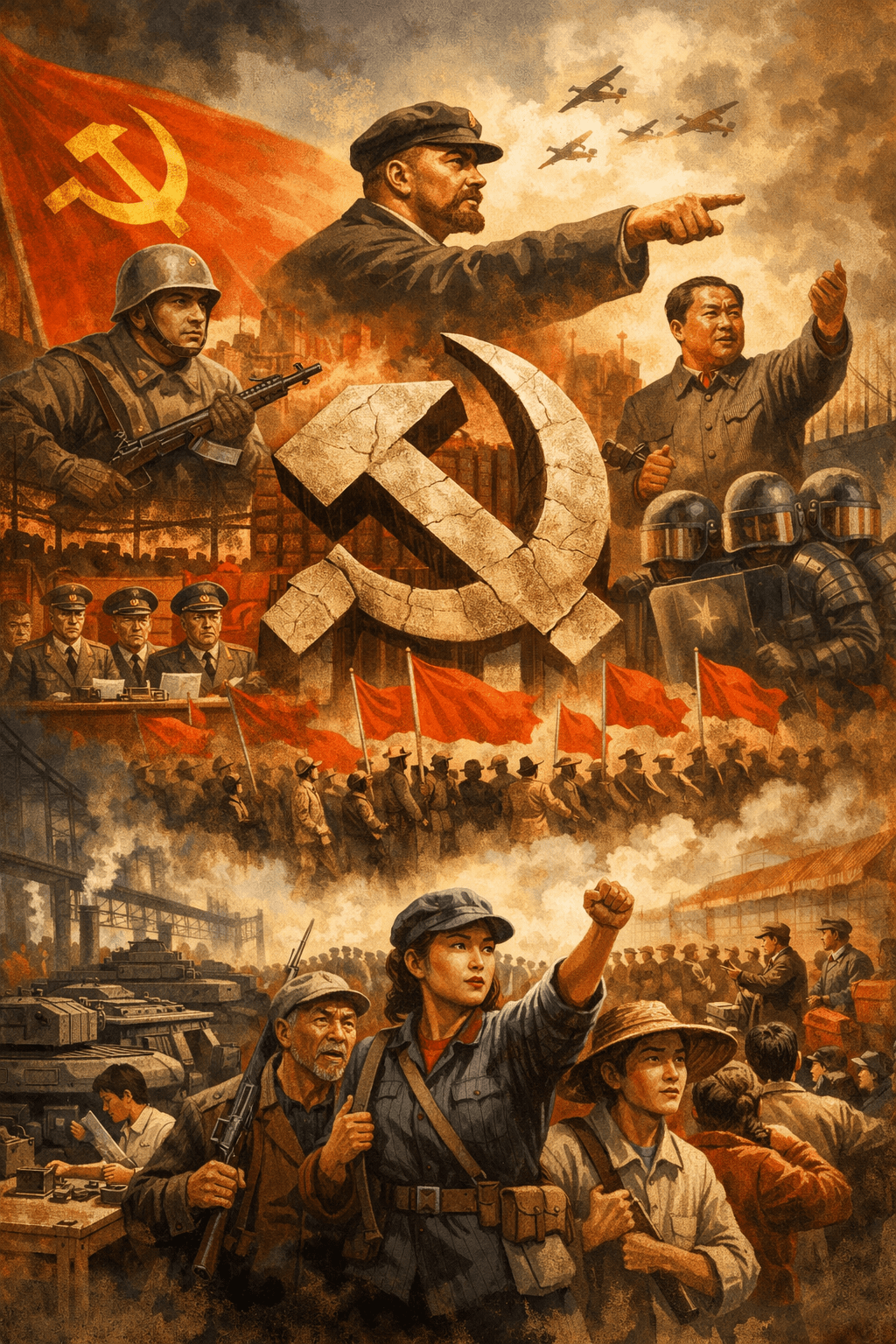
Socialism has never developed in peace. Forced to build under permanent imperial encirclement, every revolution has faced the same central contradiction: how to defend power without allowing administration to replace politics and coercion to substitute for mass legitimacy. Tracing this struggle from 1917 through Mao and into post-Mao China, this essay argues that siege is constant, degeneration is the decisive danger, and the survival of socialism depends on consciously reproducing revolutionary power in the hands of the masses.
From Siege to Strategy: What the Question of Socialism Actually Is
The most useless way to talk about socialism is to ask, yet again, whether it “worked.” That question is not naïve; it is disciplinary. It assumes a world where history unfolds under neutral conditions, where power politely steps aside so experiments can be fairly graded, and where imperialism is merely an opinionated bystander rather than an armed system that strangles alternatives in their infancy. Socialism has never existed in that world. It has existed inside siege. And any serious analysis has to begin there, not as an excuse, but as the material terrain on which all subsequent contradictions unfold.
Siege is not simply blockade or sanctions, though it includes those. It is the permanent condition imposed by a capitalist world system that cannot tolerate exits. It operates through financial isolation, technological denial, diplomatic quarantine, covert sabotage, proxy war, ideological warfare, and the constant threat of annihilation. This is not episodic hostility; it is structural pressure. From the moment socialist power appears, it is treated not as a policy deviation to be debated, but as a contagion to be contained. To pretend otherwise is to replace political economy with fairy tales.
But siege alone does not explain what has happened to socialist revolutions. If it did, all would have collapsed in the same way and at the same speed. They did not. Some survived decades of encirclement, invasion, and deprivation. Others unraveled rapidly once internal cohesion weakened. The decisive variable is not whether siege exists, but how revolutionary power governs under siege—how it resolves internal contradictions when scarcity is permanent, when delay is dangerous, and when compromise often carries the price of restoration.
This is where the real problem begins, and where liberal history politely looks away. Socialism is not a static object that can be weighed and measured after the fact. It is a process—a struggle that moves through phases, accumulates contradictions, resolves some, and generates new ones. Under siege, emergency measures become routine. Centralization hardens into habit. Administration begins to substitute for politics. What begins as the defense of proletarian power can, over time, mutate into the management of a system whose revolutionary content is quietly thinning. This process has a name, and it is not “authoritarianism.” It is degeneration.
Degeneration is not a moral failure and not a betrayal committed by bad individuals. It is a class process that emerges inside socialist societies when prolonged siege, scarcity, and administrative centralization produce new social relations within the state and the economy. Bureaucratic strata form. Decision-making separates from mass participation. Stability becomes a goal in itself rather than a means to further transformation. Coercion does not disappear, but its function changes. Instead of advancing new social relations, it increasingly compensates for the erosion of political legitimacy. The revolution still speaks in the old language, but it no longer moves with the same force.
To judge socialist power seriously, then, we need criteria that liberal moralism refuses to supply. The presence of coercion tells us nothing by itself. Every state coerces; every revolution is born in conflict. What matters is direction. Does force break the power of exploiting classes and open space for new relations of production? Or does it police stagnation once revolutionary politics has receded? Does authority rest on mass participation and shared struggle, or on administrative routine insulated from criticism? Does the system reproduce revolutionary capacity, or does it reproduce itself?
This framework allows us to make distinctions that are usually flattened into caricature. There is a difference between coercion exercised during revolutionary civil war and coercion exercised after revolutionary momentum has been administratively contained. There is a difference between stability that protects ongoing transformation and stability that exists because transformation has stalled. There is a difference between a party that leads struggle and a party that manages society. Without these distinctions, history collapses into sentiment and polemic, and socialism is judged by standards never applied to the system that besieged it.
The argument that follows proceeds from this ground. It treats socialist history not as a museum of symbols or a morality play of heroes and villains, but as a battlefield shaped by material forces, class struggle, and strategic choice. We begin with revolution as civil war, move through the unresolved agrarian question and its violent resolution, confront the emergence of degeneration once administration replaces politics, and examine the attempts—successful, failed, and unfinished—to arrest that process. Only then can we return to the contemporary moment with any clarity at all.
The question is not whether socialism was imperfect. All revolutions are. The question is whether humanity will continue to accept a world order that enforces permanent siege against any attempt to escape it, while pretending that the resulting distortions prove the impossibility of emancipation itself. If siege is permanent, then strategy becomes decisive. And the first task of strategy is to see the battlefield as it is, not as empire insists it must be.
1917 Was Not a Change of Government: Revolution as Open Civil War
The October Revolution is still too often described as if it were a clean administrative handoff: one regime exits, another enters, and history politely waits while the new order gets organized. This is liberal fantasy masquerading as chronology. In reality, 1917 did not resolve a crisis; it detonated one. The seizure of power by the Bolsheviks opened a protracted civil war in which every major class force moved to decide, by violence if necessary, who would rule, who would eat, and whose lives would be treated as expendable.
From the first days of Soviet power, the revolution existed inside siege. Landlords, industrial capitalists, former Tsarist officers, and foreign empires did not respond to the new order with debate or patience. They responded with armed resistance, sabotage, capital flight, and invasion. Fourteen imperialist armies intervened. Trade collapsed. Credit vanished. Cities starved while grain-producing regions resisted requisitioning. By 1920, industrial output had fallen to a fraction of its prewar level, and Petrograd had lost more than half its population as workers fled hunger and disease. These were not abstract policy failures. They were the material conditions of a workers’ state fighting for survival in a hostile world system.
In this environment, power was not a matter of legitimacy or consent in the liberal sense. It was an armed class relation. To hold state power meant to prevent the return of the old ruling classes and their foreign patrons. To lose it meant not a pluralistic experiment in democracy, but counterrevolution, reprisals, and the restoration of property relations already soaked in blood. There was no neutral ground between these outcomes. Civil war does not offer the luxury of ambiguity.
War Communism emerged from this reality not as an ideological blueprint, but as an emergency regime. Grain requisitioning, centralization, and coercive distribution were responses to a situation in which the alternative was not a softer socialism, but mass death and defeat. To govern a society under invasion, blockade, and internal sabotage is not to choose between freedom and authority; it is to choose between survival and collapse. Every capitalist state that later condemned these measures would have adopted far harsher ones under comparable conditions—and many have, without ever being asked to justify their moral character.
It is within this context that Kronstadt must be understood. The rebellion of March 1921 did not occur in a vacuum. It erupted after years of war, hunger, and exhaustion, at a moment when the country was bled white and the working class itself had been scattered by famine. Kronstadt was not a peripheral outpost. It was a strategic naval fortress guarding Petrograd, the revolutionary capital. Control of Kronstadt meant control of access to the city. During the height of the Civil War, it had been a key bastion of Bolshevik defense. By 1921, however, its social composition had shifted significantly. Many of the original revolutionary sailors were dead or reassigned, replaced largely by peasant conscripts drawn from a countryside already in revolt against requisitioning.
The demands raised at Kronstadt expressed real grievances born of unbearable conditions. Calls for an end to requisitioning, expanded freedoms, and “soviets without parties” reflected exhaustion with emergency governance. But political meaning is not determined by intention alone. In a besieged society without an alternative proletarian leadership, the removal of the Bolshevik Party from power would not have opened a neutral democratic space. It would have created a breach through which defeated classes and foreign powers could move immediately. Under civil-war conditions, power does not evaporate into pluralism; it is seized by whoever is organized, armed, and materially supported.
Timing matters. The Kronstadt rebellion broke out precisely as the Bolshevik leadership was already preparing to retreat from War Communism and introduce the New Economic Policy. That retreat was conceived as a controlled tactical adjustment by a state that still held power. A breach at Kronstadt would have transformed that retreat into disintegration. The issue, then, was not whether grievances existed—they clearly did—but whether the revolutionary state could survive their eruption in a form that threatened its strategic core.
The suppression of Kronstadt was therefore not the defense of a comfortable bureaucracy against popular democracy. It was the defense of a revolutionary state whose collapse would have meant the undoing of October itself. This does not abolish contradiction or sanctify every decision made under pressure. It situates them. In 1921, proletarian power still existed as a living historical force. The Bolshevik Party, despite its errors and rigidities, remained the organized expression of that power. The civil war had not yet been politically resolved, even if the guns were beginning to fall silent.
Crucially, coercion at this stage did not substitute for politics; it preserved the space in which politics could continue. The suppression of Kronstadt was immediately followed by the adoption of the New Economic Policy, an explicit acknowledgment that emergency measures could not continue indefinitely. Force was used to secure survival, and policy was adjusted to confront the material contradictions that had produced the crisis. This sequence matters. It marks the closing of the initial civil-war phase of the revolution and sets the stage for the next, more complex struggle.
The Bolsheviks emerged from this moment still in power, but facing a problem that force alone could not solve. The agrarian question remained unresolved. Small commodity production dominated the countryside. The state could command cities, but it could not yet plan society as a whole. The civil war had ended militarily, but the struggle over class power had merely shifted terrain. Its next decisive battlefield would not be a fortress or a naval base. It would be the village.
After the Guns Fell Silent: NEP, the Countryside, and the Internal Siege
The end of open civil war did not deliver peace to the Soviet revolution. It delivered exhaustion. The country the Bolsheviks governed in 1921 was shattered, depopulated, and materially drained. Industry lay in ruins. Transport barely functioned. The working class—the social base of the revolution—had been scattered by hunger and displacement. Under these conditions, the continuation of War Communism was no longer a question of revolutionary will, but of material impossibility. The New Economic Policy emerged from this reality not as a revision of socialism’s goals, but as a tactical retreat undertaken by a state that had survived civil war and needed time to breathe.
NEP stabilized a society on the brink of collapse. It restored limited market relations, revived production, and allowed the cities to be fed without perpetual emergency requisitioning. But stabilization is not resolution. What NEP preserved, and in some respects deepened, was the central contradiction that now defined Soviet power: industry had been socialized, but agriculture—the material foundation of food, labor, and accumulation—remained fragmented, private, and governed by commodity logic. The revolution had won the cities, but it had not yet transformed the countryside.
This was not a technical inconvenience. It was a problem of class power. Grain was not simply a good to be exchanged; it was leverage. Under conditions of imperial blockade and financial isolation, control over food meant control over the tempo of development itself. Richer peasants and intermediary traders could hoard in bad years, withhold in moments of political pressure, and speculate when prices moved in their favor. In a workers’ state cut off from world markets, this amounted to an internal veto over planning. The countryside functioned, in effect, as a second siege operating from within.
Liberal accounts describe this tension as a clash between efficiency and ideology, or between pragmatism and dogma. That framing dissolves the real issue. The contradiction was not between markets and plans in the abstract, but between two logics of social reproduction. On one side stood a revolutionary state attempting to subordinate production to collective need under conditions of encirclement. On the other stood millions of small commodity producers whose survival strategies, rational at the household level, collectively undermined the possibility of socialist planning. Under siege, this contradiction could not be indefinitely managed. It could only be resolved.
The imperial environment sharpened the stakes. The Soviet Union could not import grain at will, borrow capital freely, or rely on foreign investment to smooth internal tensions. Every shortage was amplified. Every delay carried political risk. To imagine a long, gradual, market-mediated transition under these conditions is to imagine a revolution unfolding in a world that did not exist. The choice confronting Soviet power was not between a humane NEP and a brutal alternative. It was between confronting the agrarian question directly or allowing it to strangle socialist development from within.
This is where many later critiques quietly change the subject. They treat NEP as if it were a stable model prematurely abandoned, rather than a temporary armistice in an unresolved class struggle. But NEP did not abolish the power of private accumulation in the countryside; it preserved it. It bought time, but it also allowed class differentiation to reassert itself. The longer this contradiction persisted, the more it threatened to reverse the gains of October not through open counterrevolution, but through economic pressure and political drift.
From a Marxist standpoint, the problem was now clear. A workers’ state cannot plan society as a whole while the decisive sector of material reproduction remains governed by commodity relations. Under conditions of siege, this is not merely inefficient; it is dangerous. The revolution had survived its military civil war, but it had entered a new phase in which class struggle would be waged over production, distribution, and the future direction of development. The battlefield had shifted from the barracks to the fields.
NEP, then, marks neither betrayal nor consolidation. It marks suspension. It reveals the limits of emergency governance and exposes the unfinished character of the revolution itself. The agrarian question stood unresolved, and with it the possibility of socialist planning remained structurally blocked. How that blockage would be addressed—whether through gradual accommodation or decisive transformation—would determine whether the revolution advanced or quietly unraveled. The next stage of struggle would answer that question, not in theory, but in practice.
Completing the Revolution Under Siege: Collectivization as Class War
By the end of the 1920s, the suspension embodied in the New Economic Policy could no longer be maintained. The contradiction it had contained now pressed forward with renewed force. Industry could not advance without secure access to grain. Planning could not function while the decisive sector of material reproduction remained fragmented and privately controlled. Under conditions of imperial encirclement, delay was not neutral. It shifted power. The agrarian question, unresolved since 1917, had become the central obstacle to socialist development—and the central opening through which restoration could occur.
Collectivization did not arrive as an administrative preference imposed on a stable society. It arrived as the continuation of revolutionary struggle by other means. What was at stake was not simply the efficiency of agriculture, but the class character of the countryside itself. As long as small commodity production dominated, richer peasants and intermediary layers retained the capacity to hoard grain, manipulate markets, and exert political pressure on the workers’ state. In a besieged system cut off from global capital and trade, this power amounted to an internal blockade mirroring the external one.
Resistance to collectivization was therefore not accidental, nor was it purely spontaneous. Grain was withheld. Livestock was slaughtered rather than surrendered. Tools were destroyed. Violence erupted in many regions. These actions expressed fear, desperation, and confusion—but they also expressed class interest. For strata that had benefited from differentiation under NEP, collectivization threatened the material basis of their power. To describe this resistance as mere misunderstanding or administrative failure is to erase the reality of class struggle in the countryside.
The state’s response was harsh and uneven, unfolding under extraordinary pressure and with real human cost. Marxist analysis does not deny suffering, nor does it transform necessity into virtue. It insists instead on historical location. In this phase, force was deployed to resolve a structural contradiction that could not be reconciled through market mediation without jeopardizing the revolution itself. The destruction of the kulak as a class was not a rhetorical excess; it was the practical abolition of a social power capable of strangling socialism from within at the very moment imperialism was attempting to do so from without.
Collectivization was therefore not simply an economic reorganization. It was the completion of the revolutionary rupture begun in 1917. The civil war had defeated the old ruling classes militarily. Collectivization defeated their reconstitution on new terrain. By integrating the countryside into a planned framework, the revolution broke the internal class blockade that had paralyzed development. Agriculture ceased to function as a veto on industrialization. Planning became materially possible at a national scale.
This transformation did not occur cleanly or uniformly. Cadres often acted crudely. Coercion sometimes outran persuasion. Contradictions between party officials and peasants intensified, revealing the dangers of administrative substitution for mass political work. These tensions matter, not as moral indictments, but as early signals of a problem that would later deepen: the tendency for state power to resolve contradiction through command rather than through conscious participation. At this stage, however, the overall direction of motion remained clear. The struggle advanced socialist relations rather than compensating for their absence.
The material consequences of collectivization were decisive. The state secured reliable access to grain. Surplus could be redirected toward heavy industry, infrastructure, and defense. Planning ceased to be an aspiration and became an operational reality. For the first time, the Soviet Union possessed the internal coherence necessary to confront the external siege on something approaching equal terms. Without this transformation, everything that followed—from rapid industrialization to survival in the coming world war—would have been impossible.
Collectivization thus marks a hinge in the history of socialism under siege. It closes the era in which revolutionary power fought to complete its foundational class tasks, and it opens an era in which the problem shifts from transformation to consolidation. The revolution emerged stronger, but also more centralized. The internal blockade had been broken, but the methods used to break it left their own imprint. The direction of motion was still forward—but the seeds of a new contradiction had already been planted.
From Rupture to Consolidation: Planning, Industrialization, and the Test of War
With the agrarian question decisively resolved, the Soviet revolution entered a new phase. The fundamental internal blockade that had mirrored imperial siege was broken, and for the first time socialist planning could operate across society as a whole. This shift did not mean the easing of pressure. It meant the transformation of survival into construction. The siege remained intact, but the revolution now possessed the material coherence necessary to confront it with something more than improvisation.
Industrialization in the 1930s unfolded under conditions that would have crippled most societies. The Soviet Union remained largely cut off from global capital markets, denied access to advanced technology, and diplomatically isolated by hostile powers. Yet surplus was systematically redirected toward heavy industry, transport infrastructure, energy, and defense. In little more than a decade, a predominantly agrarian society was transformed into an industrial power capable of producing steel, machinery, and armaments at a scale previously unimaginable. This was not the result of managerial brilliance alone. It was the material consequence of having resolved the decisive class contradictions that had earlier paralyzed development.
The character of coercion in this period shifted, though it did not disappear. Force was no longer primarily directed at dismantling old class power in the countryside. It was increasingly used to enforce plan targets, discipline production, and defend the socialist economy against sabotage and breakdown under conditions of extreme scarcity. Errors carried existential consequences. Missed targets meant shortages. Shortages meant political instability. Under siege, planning was not an abstract exercise in optimization; it was a race against time.
Liberal histories often isolate repression in this period from its material context, treating it as proof of an inherently pathological system. This move obscures more than it reveals. The Soviet state was not administering abundance; it was managing scarcity under threat of annihilation. It was not preserving a comfortable status quo; it was compressing centuries of development into a single generation without the benefit of colonial plunder. Discipline, centralization, and political rigidity emerged not as ideological preferences, but as responses to a world that offered no margin for failure.
The decisive verification of this transformation arrived in 1941. The fascist invasion was not merely a military campaign; it was an attempt to complete the counterrevolution by force, to destroy the socialist project before it could mature. The ability of the Soviet Union to absorb the initial catastrophe, relocate entire industries eastward, mobilize labor on an unprecedented scale, and sustain a prolonged war of attrition was not accidental. It was the direct outcome of collectivization, planning, and industrialization carried out under siege. Without these prior transformations, defeat would have been certain. With them, survival became possible.
Victory over fascism did not end the siege. It reconfigured it. The war left vast territories devastated and tens of millions dead, while a new imperial order rapidly took shape around the containment of socialism. Yet the Soviet Union emerged not as a failed experiment rescued by chance, but as a consolidated socialist power capable of reconstruction, strategic planning, and international influence. This mattered. It demonstrated that socialism could survive the most violent test the capitalist world system could impose.
During this period, the relationship between the party, the state, and the masses retained a degree of legitimacy forged through shared sacrifice. The socialist project was experienced not primarily as an alien imposition, but as a collective struggle against extermination and exploitation. This legitimacy did not eliminate coercion, but it gave it political meaning. Authority was anchored in survival and advance rather than in mere administrative routine. The revolution still moved.
This phase represents the high-water mark of socialist consolidation under siege. The revolution had completed its foundational class tasks, built the material basis of planning, and defeated the most extreme form of imperial aggression. Yet the very success of this consolidation altered the terrain on which contradiction would now appear. As emergency hardened into structure and planning became routine, the danger shifted. The question was no longer how to complete the revolution, but how to prevent its political content from thinning once the immediate existential threat receded.
The conditions that had demanded centralization and discipline now risked transforming them into permanent features detached from mass participation. What had once been instruments of advance could become habits of control. The siege continued, but the internal response began to change. The revolution stood at the threshold of a new contradiction—one that would not announce itself through invasion or famine, but through the quiet replacement of revolutionary politics with administrative management.
When Revolutionary Politics Gives Way to Administration
The death of Stalin did not end socialism’s siege, nor did it inaugurate a new era of peace. What it marked was a shift in how socialist power responded to permanent pressure. The external enemy remained intact, but the internal method of governance began to change. Revolutionary politics—shaped by civil war, collectivization, and total war—gradually receded, and in its place emerged a mode of rule centered on administration, stabilization, and technical management. This transition did not announce itself as betrayal. It presented itself as normalization.
The language of class struggle faded from the center of political life, replaced by the vocabulary of efficiency, expertise, and orderly development. Planning increasingly appeared not as a collective political project rooted in mass participation, but as a technical exercise managed by specialists. The party, once a vehicle for mobilizing society through struggle, increasingly governed as a supervisory apparatus tasked with maintaining equilibrium. Socialism began to be framed less as a process of transformation and more as a system to be administered indefinitely.
This shift had material consequences. Commodity relations expanded within the socialist economy, not as tactical concessions under duress, but as instruments of routine management. Incentives, differentials, and market mechanisms were deployed to discipline labor and stimulate output. These measures were often effective in the short term, but they altered the internal balance of power. Control over production and distribution drifted further from the shop floor and deeper into administrative hierarchies. Workers were increasingly managed rather than mobilized.
Under conditions of siege, this turn toward administration was not neutral. When contradictions are handled procedurally rather than politically, they do not disappear; they accumulate. Bureaucratic strata consolidated their position as intermediaries between plan and production, between state and society. Authority increasingly rested on procedural legitimacy rather than revolutionary leadership forged through struggle. Coercion did not vanish, but its function subtly changed. It was no longer clearly tethered to advancing new social relations. It began to compensate for the weakening of political connection between leadership and masses.
This is the precise meaning of degeneration. It is not the presence of a state, nor the existence of discipline, nor the absence of liberal freedoms. It is the gradual transformation of socialist power from a vehicle of mass struggle into a mechanism of social management. The state continues to speak in the name of socialism, but socialism ceases to live as a conscious project of the masses themselves. Stability becomes an end in itself. Criticism is treated as disruption. Unity is mistaken for silence.
Crucially, this process did not immediately threaten collapse. On the contrary, it produced a system that appeared durable. Material gains accumulated. Basic needs were met. Order prevailed. But durability under siege can be deceptive. A system that no longer renews itself politically may persist for long periods while hollowing out its own foundations. When legitimacy erodes quietly, force becomes the default means of preservation. The revolution survives in form while its content thins.
Property relations remained formally socialist. Planning still existed. The imperialist world continued to treat the socialist bloc as an existential threat. Yet internally, the character of power had shifted. The party-state increasingly governed over society rather than through it. The mechanisms that had once defended socialism under siege now risked becoming obstacles to its renewal. The revolution had not been reversed, but its motion had slowed, redirected from transformation toward maintenance.
This moment is critical because it reveals a danger that cannot be resolved by repression or reform alone. Administrative stability can preserve a system, but it cannot regenerate belief. Under permanent encirclement, socialism requires not only order, but political vitality—the capacity to mobilize, convince, and struggle. Once that capacity erodes, the siege no longer needs to break the system from without. It can wait, amplify contradictions, and allow degeneration to do the work from within.
The consequences of this shift would soon become visible. When accumulated contradictions finally surfaced, they did so not as measured debate within a confident revolutionary project, but as sudden eruptions of mass discontent. The first of these explosions would arrive in the mid-1950s, exposing the limits of administrative rule under siege and forcing socialists elsewhere to confront a question that could no longer be postponed: how to prevent degeneration without tearing the revolutionary project apart.
1956 and 1968: Revolt Against Degeneration Under Siege
The explosions that tore through parts of Eastern Europe in 1956 and again in 1968 did not fall from the sky, nor were they simple expressions of foreign manipulation or spontaneous liberal awakening. They were the political surfacing of contradictions that had been accumulating beneath the surface of socialist societies whose revolutionary momentum had been administratively contained. Hungary and later Czechoslovakia were not rejecting socialism as an idea. They were reacting to a form of socialist power that no longer spoke to them as participants, but governed them as objects.
By the mid-1950s, the distance between party leadership and working-class life had widened significantly across much of the socialist bloc. Planning functioned, but it functioned through bureaucratic mediation. Criticism existed, but it was tightly channeled and easily dismissed. The memory of revolutionary struggle and wartime sacrifice still lingered, yet it no longer provided a living basis for political legitimacy. In this context, grievances did not emerge gradually through internal debate. They accumulated until they erupted.
Hungary in 1956 revealed this rupture with brutal clarity. Workers formed councils, challenged factory management, and demanded control over production. These demands were not capitalist in content. They expressed a desire to reclaim socialism as a mass project rather than an administered order. At the same time, the breakdown of authority created openings that reactionary forces moved quickly to exploit. Symbols of the old regime reappeared. Calls for withdrawal from the socialist camp gained traction. Imperial powers did not invent this contradiction, but they stood ready to harvest its consequences.
The same duality reappeared in Czechoslovakia in 1968. The Prague Spring combined genuine socialist aspirations—democratization, participation, and creative planning—with political currents that underestimated the reality of imperial siege. The notion that a socialist society could step outside bloc alignment without immediately becoming a target for imperial penetration was not a theory grounded in material analysis. It was a hope sustained by exhaustion with stagnation. Under Cold War conditions, such openings could not remain neutral for long.
The interventions that followed preserved territorial alignment and short-term stability, but they did so at a steep political cost. Tanks can secure borders. They cannot regenerate legitimacy. The suppression of these uprisings froze contradictions rather than resolving them. The grievances that had fueled revolt were not addressed at their root. Instead, a message was delivered to the masses: socialism would be maintained through force even when it no longer invited their active participation. The result was not immediate collapse, but deepened alienation.
It is a mistake to read these events as referendums on socialism itself. They were referendums on degeneration under siege. To reduce them to CIA plots is to deny the reality of internal decay. To reduce them to democratic awakenings is to erase the geopolitical conditions that shaped their outcome. Both reductions serve imperial ideology by preventing a materialist analysis of how revolutionary projects lose political elasticity once administration replaces struggle.
The lesson is not that repression was unnecessary, nor that tolerance would have produced a stable socialism. The lesson is harsher and more unsettling. Once revolutionary politics recedes, force becomes a substitute rather than an extension of mass power. Stability can be preserved, but belief cannot. Socialism survives as a system, but not as a cause people are willing to defend when decisive pressure arrives.
These crises sent shockwaves through the socialist world. They demonstrated that degeneration was not an abstract danger, but a concrete political process capable of producing revolt from within. For revolutionaries elsewhere, particularly in China, Hungary and Prague were not warnings against mass participation. They were warnings against its absence. If socialism could generate such explosions once contradiction was suppressed, then the task was not to seal society tighter, but to confront degeneration before it hardened into fatal rupture.
What emerged from this reckoning was a stark choice. Socialism under siege could pursue stability through administration and risk slow hollowing, or it could attempt to keep class struggle alive within its own institutions and risk disorder. This choice would define the divergent paths taken in the decades that followed—and nowhere was it confronted more directly, or more dangerously, than in Mao’s China.
Making Contradiction Speak: Mao’s War on Degeneration
The crises of 1956 were not interpreted in China as foreign disturbances to be managed at a distance. They were treated as symptoms of a danger that could just as easily emerge at home. For Mao, Hungary and Prague did not demonstrate the excesses of mass participation, but the consequences of its suppression. They confirmed a conclusion he had been moving toward for years: that socialist power, once consolidated, does not automatically remain proletarian in content. Under conditions of siege, scarcity, and uneven development, new class forces can arise inside the party and state themselves. Degeneration is not imposed from outside; it is produced internally if contradiction is administratively buried rather than politically confronted.
Mao’s intervention begins from a hard premise that orthodox Marxism had not fully metabolized. Class struggle does not end with the seizure of state power. It changes form and location. The principal contradiction can migrate from open confrontation with old ruling classes to struggle over line, authority, and direction within socialist institutions. If this struggle is denied expression, it does not disappear. It accumulates silently until it erupts in forms that invite imperial exploitation. The task, then, was not to suppress contradiction in the name of stability, but to force it into the open while it could still be politically shaped.
The Hundred Flowers Campaign emerged from this logic. Its aim was not liberalization in the Western sense, nor a retreat from socialism, but an attempt to transform criticism into a weapon against bureaucratization. Mao called on intellectuals, cadres, and ordinary people to speak openly, to expose dogmatism, privilege, and detachment from the masses. This was an effort to prevent the formation of a self-sealing administrative layer by reactivating the mass line. Criticism was meant to function as early warning, not as heresy.
The results were destabilizing, even for those who initiated the process. Criticism ran deeper and wider than anticipated, revealing ideological confusion, resentment, and unresolved class tensions. The campaign was curtailed, and subsequent rectification was often heavy-handed. Yet the theoretical significance remains. The Hundred Flowers was one of the first conscious attempts to address degeneration politically rather than repressively—to treat contradiction as information rather than sabotage. Its partial failure did not invalidate the diagnosis. It exposed the difficulty of the cure.
The Great Leap Forward pushed this logic into the economic sphere. Faced with continued imperial encirclement and the danger of bureaucratic ossification, Mao wagered that mass mobilization could accelerate socialist transformation beyond the limits imposed by scarcity and administrative routine. Communes were intended to dissolve entrenched divisions between town and countryside, agriculture and industry, mental and manual labor. Revolutionary enthusiasm and collective organization were mobilized as substitutes for capital and technology denied by siege.
The catastrophe that followed cannot be evaded. Inflated reporting, administrative pressure, ecological limits, and policy errors combined with adverse conditions to produce famine and immense human suffering. These outcomes matter, and any analysis that treats them lightly forfeits moral seriousness. But to reduce the Great Leap to madness or cruelty is to sever it from the problem it sought to solve. Mao was not retreating into bureaucratic command. He was attempting to outrun degeneration by politicizing production itself. The failure of the Leap revealed the limits of substituting mobilization for material conditions, not the irrelevance of the underlying danger.
By the mid-1960s, Mao drew a more radical conclusion. If degeneration could not be prevented through criticism alone, and if economic mobilization could not bypass administrative consolidation, then the struggle had to be waged where the danger now resided: inside the party and state. The Cultural Revolution was born from this diagnosis. It was an attempt to prevent capitalist restoration by unleashing mass struggle against entrenched authority, to make the party itself the terrain of class conflict.
This was not a call for chaos for its own sake. It was a theoretical intervention grounded in the belief that a socialist society that cannot tolerate internal struggle is already on the road to restoration. By encouraging youth and workers to challenge officials, Mao inverted the usual direction of coercion. Here, force and pressure flowed upward rather than downward. The aim was to shatter bureaucratic complacency and re-anchor socialism in mass participation before degeneration hardened into an irreversible class structure.
The risks of this strategy were immense, and they materialized rapidly. Factional conflict, institutional paralysis, and violence tore through society. The very capacity of the state to govern was strained. In attempting to prevent socialism from ossifying into administration, the Cultural Revolution destabilized the structures that sustained socialist life. The paradox was brutal: the effort to keep socialism politically alive threatened to tear apart the institutions through which it operated.
Yet to dismiss the Cultural Revolution as irrational catastrophe is to evade the problem it confronted. Mao forced a question that neither Soviet stability nor liberal critique can answer: how does a socialist society confront internal class formation without relying on a bureaucracy whose interests increasingly diverge from those of the masses? The Cultural Revolution did not resolve this contradiction. It exposed it in its most raw and dangerous form. It demonstrated that degeneration could be fought—but at a cost no society could indefinitely sustain.
Mao’s intervention thus stands as both warning and provocation. It shows that degeneration is not inevitable, but that resisting it through permanent upheaval carries its own destructive logic. The problem he identified was real. The solution he attempted was incomplete. What remained unresolved was the need for a durable synthesis: a way to reproduce revolutionary legitimacy continuously without destroying institutional coherence. That unresolved problem would define the next divergence in socialist history.
Stability or Struggle: Two Socialist Roads Through Permanent Siege
By the late twentieth century, socialism had not encountered one singular fate but had fractured into two distinct strategic responses to the same historical condition. Siege remained constant. Imperial pressure did not abate, nor did the capitalist world system suddenly soften its hostility. What differed was how socialist power attempted to metabolize that pressure internally. The divergence was not between repression and freedom, or ideology and pragmatism, but between two ways of confronting degeneration: stability through administration, and survival through continuous struggle.
The Soviet path after Stalin increasingly treated contradiction as a technical problem to be managed rather than a political struggle to be waged. Planning became procedural. Ideology hardened into ritual. Criticism was permitted only insofar as it did not threaten administrative authority. Stability became the overriding value, not because transformation had been completed, but because the mechanisms for renewing it politically had weakened. The party governed as caretaker rather than as combatant. Under siege, this produced order—but an order increasingly detached from mass identification.
This strategy proved capable of preserving material gains for decades. Education expanded. Housing improved. Social security deepened. But durability is not the same as resilience. By insulating itself from mass pressure, the party-state also insulated itself from correction. Contradictions were postponed rather than resolved. Legitimacy thinned quietly, not through dramatic repression, but through political fatigue. When socialism ceased to appear as a collective project of struggle, it survived increasingly as an inherited system people lived within rather than fought for.
Mao’s China rejected this logic outright. Stability without struggle, in Mao’s view, was already a form of defeat. His interventions sought to keep class struggle alive inside socialism itself, to prevent administrative consolidation from crystallizing into a new ruling stratum. Where the Soviet leadership feared disorder more than stagnation, Mao feared stagnation more than disorder. The wager was that socialism could survive upheaval better than it could survive ossification.
This wager preserved revolutionary consciousness and delayed restoration, but it came at immense cost. Continuous struggle eroded institutional coherence, exhausted society, and destabilized governance. The Cultural Revolution demonstrated both the power and the danger of politicizing contradiction without durable mediating structures. It prevented degeneration from quietly consolidating, but it did not provide a stable mechanism for reproducing revolutionary legitimacy across generations.
The historical lesson is not that one path was correct and the other mistaken. It is that both paths confronted a real contradiction without fully resolving it. Stability without struggle leads to hollowing that invites restoration. Struggle without mediation risks fragmentation and exhaustion. Socialism under siege has yet to discover a durable synthesis capable of renewing itself politically while maintaining institutional coherence.
This divergence dissolves two comforting myths at once. It undermines the liberal claim that socialism collapsed because it was too coercive or too rigid. It also undermines the fatalistic claim that degeneration was inevitable. What history reveals instead is a series of strategic choices made under extreme pressure, each expanding or narrowing the space for renewal. Collapse was not written in advance. It emerged from unresolved contradictions compounded over time.
To move forward, the analysis must widen its lens. The Soviet–Chinese divergence unfolded primarily within the European and Eurasian heartlands of twentieth-century socialism. Elsewhere, socialist projects developed under different historical conditions—often harsher, but sometimes more politically elastic. To understand endurance as well as collapse, we must examine how socialism functioned where it was fused with national liberation and mass participation from the outset.
When Socialism Is Born in Liberation: Why It Endured Longer Beyond Europe
If socialism unraveled first and fastest in Eastern Europe, this was not because siege was weaker there, but because the social foundations of revolutionary legitimacy had thinned more rapidly. To understand endurance rather than collapse, we have to move beyond institutional form and examine how socialist power was experienced by the masses under conditions of permanent imperial pressure. Outside Europe, socialism often emerged not as an inherited administrative order, but as the culmination of national liberation struggles in which revolutionary power was forged directly through mass participation.
In much of Asia, Africa, and the Caribbean, socialism was inseparable from the fight against colonial domination. It was not introduced after the fact as a governing ideology, but constructed in the course of prolonged struggle—through guerrilla warfare, peasant mobilization, and direct confrontation with imperial power. The state that emerged from these struggles was experienced not as an abstract authority, but as the collective expression of survival itself. Siege did not arrive as a surprise. It was understood as the continuation of a war already being fought.
This difference mattered profoundly. Scarcity under blockade could be interpreted as failure, or it could be interpreted as the cost of independence. Where socialism was fused with liberation, hardship was politicized rather than naturalized. The masses did not simply endure deprivation; they understood its source and its stakes. This did not eliminate contradiction or error, but it altered the political meaning of suffering. Endurance became an act of resistance rather than passive compliance.
Cuba offers one of the clearest illustrations. Under a blockade designed explicitly to “make the economy scream,” the revolutionary state survived not because it achieved abundance, but because it maintained a social contract rooted in dignity, health, and education. Mass organizations, neighborhood committees, and participatory institutions embedded socialist power in daily life. The siege was experienced as external aggression, not internal betrayal. Errors were debated within a framework of collective defense rather than elite management.
Vietnam followed a similar trajectory under even more extreme conditions. Decades of war against colonial and imperial forces fused socialism with national survival at the deepest level. Reconstruction unfolded amid isolation, destruction, and ongoing hostility, yet the revolutionary project retained legitimacy forged through shared sacrifice. Even later economic reforms occurred within a political culture shaped by anti-imperialist struggle, delaying outright restoration and preserving strategic state control over development.
In places like the DPRK, Angola, Mozambique, Guinea-Bissau, and later Venezuela, socialism or socialist-oriented projects likewise emerged from wars of liberation or mass confrontation with imperial power. These societies faced immense constraints, and none were free of contradiction or repression. But their endurance cannot be understood without recognizing how deeply revolutionary legitimacy was rooted in lived struggle rather than inherited administration. Where the party remained embedded in mass organizations and collective memory, degeneration proceeded more slowly and met greater resistance.
This does not imply immunity. Revolutionary legitimacy can erode anywhere if participation withers, if bureaucratic interests harden unchecked, or if the link between hardship and collective purpose is severed. But these cases demonstrate that siege alone does not determine outcome. What matters is whether socialist power is reproduced politically—through memory, organization, and struggle—or merely maintained administratively.
The contrast with Eastern Europe is instructive. Where socialism was experienced primarily as governance, it could dissolve quietly once belief eroded. Where it was experienced as liberation under siege, it demanded defense even under extraordinary pressure. Collapse, when it threatened, encountered resistance rather than indifference. The difference was not ideology. It was social anchoring.
These histories force a reconsideration of what endurance actually means. It is not the absence of contradiction, nor the perfection of institutions. It is the capacity of a socialist project to interpret hardship as struggle rather than as senseless deprivation, and to reproduce that interpretation across generations. Without this capacity, no amount of administrative stability can prevent hollowing. With it, even the harshest siege can be survived.
To understand how such endurance can be sustained—and how it can still fail—we must move from narrative to diagnosis. The next step is to examine the concrete variables that determine whether socialist power under siege remains a living mass project or hardens into a brittle administrative shell.
Endurance Under Fire: Diagnosing Socialist Power in the Global Periphery
Endurance under siege is not a mystery and it is not a miracle. It is the outcome of specific political relationships forged between revolutionary states and the masses they claim to represent. To move beyond narrative and toward explanation, we have to ask what actually allows some socialist projects to withstand decades of sanctions, war, and isolation while others fracture once external pressure intensifies. The answer is not found in slogans or institutional labels, but in the concrete mechanisms through which power is exercised, legitimacy is reproduced, and contradiction is handled.
Across cases as varied as Cuba, Vietnam, the DPRK, and Venezuela, one pattern appears with consistency: where socialist power remains embedded in mass organization, endurance increases. This embedding does not mean the absence of hierarchy or discipline. It means that the state does not rule primarily through abstraction. Neighborhood committees, workplace organizations, communal councils, militias, and popular assemblies—however uneven or imperfect—function as conduits through which hardship is interpreted politically rather than privatized as individual failure. Siege becomes intelligible as aggression, not mismanagement.
Control over surplus is decisive here. Endurance depends less on growth rates than on whether the revolutionary state retains command over the strategic heights of the economy. Where surplus is captured by private accumulation or external capital, scarcity is experienced as humiliation and dependency. Where surplus is visibly redirected toward social reproduction—health, education, food security, infrastructure—hardship retains meaning. Even under deprivation, people can recognize their own labor reflected back at them in collective provision.
Planning, in these contexts, functions not merely as an economic technique but as a political signal. It communicates that society is not being surrendered to market anarchy or foreign discipline. This does not require rigid centralization in all spheres. Hybrid forms exist. What matters is that the commanding heights remain politically subordinated to collective purpose. Where this line holds, reform does not automatically translate into restoration. Where it breaks, reform becomes indistinguishable from retreat.
The handling of contradiction further differentiates endurance from collapse. In projects that endure, contradiction is not eliminated, but neither is it entirely suppressed. Criticism may be constrained, but it is not wholly disconnected from political life. Mass campaigns, consultative mechanisms, and ideological education function as partial correctives against bureaucratic detachment. These mechanisms are often insufficient, but their presence slows degeneration by preventing administrative insulation from becoming absolute.
External pressure magnifies every internal weakness. Sanctions reward corruption, incentivize black markets, and strain social discipline. War conditions normalize emergency measures. Under these pressures, the temptation to substitute command for persuasion intensifies. Enduring socialist projects are those that resist this temptation just enough to maintain political elasticity. They bend without snapping. They discipline without completely alienating. They centralize without entirely extinguishing participation.
Venezuela illustrates this tension in real time. Subjected to financial blockade, sanctions, covert destabilization, and open threats of regime change, the Bolivarian project has survived not through technocratic excellence, but through mass mobilization rooted in communal organization and popular identification with anti-imperialist struggle. Its contradictions are severe. Its errors are real. But collapse has been repeatedly deferred because socialism there is experienced not as an abstract ideology, but as defense against recolonization.
The DPRK represents a more extreme case, shaped by near-total isolation and permanent military threat. Its endurance cannot be understood through caricature. It rests on the fusion of state power, national survival, and collective memory of annihilation narrowly avoided. Whatever its internal contradictions, legitimacy is continuously reproduced through the framing of hardship as siege rather than failure. This framing is not propaganda alone; it is historically grounded in material experience.
These cases demonstrate that endurance is not synonymous with virtue, nor collapse with betrayal. Both are outcomes of how socialist power metabolizes siege over time. Where mass identification persists, degeneration is slowed. Where it erodes, siege becomes fatal. The decisive variable is not repression, planning, or markets in isolation, but whether the socialist project remains intelligible to the masses as their own.
This diagnostic perspective prepares us for the final turn in the analysis. If endurance depends on retaining control over development while reproducing legitimacy, then the question becomes whether such a synthesis is possible at scale, over long durations, and under intensifying global rivalry. The contemporary Chinese experience presents the most consequential attempt to answer that question.
Development Without Surrender: China’s Post-Mao Synthesis Under Siege
The Chinese revolution emerged from the Mao era facing a dilemma that had destroyed earlier socialist projects: how to escape stagnation without surrendering power, how to develop productive forces without dissolving socialist command, and how to stabilize society without allowing administration to harden into a new ruling class. This was not an abstract policy debate. It was a historical reckoning forced by decades of siege, internal upheaval, and the visible collapse of revolutionary vitality elsewhere. What followed was not abandonment of socialism, but a strategic reconfiguration of how socialist power governs development under permanent pressure.
Reform and opening were conceived not as capitulation to the capitalist world market, but as a disciplined engagement with it. China did not submit to external conditionality or allow capital to dictate social priorities. Markets were introduced as instruments, not as sovereign arbiters of social life. Foreign investment was permitted under tightly controlled conditions, technology was absorbed rather than ceded, and the commanding heights of the economy—finance, energy, infrastructure, land, and strategic industry—remained firmly under state control. This distinction matters. Where earlier socialist systems allowed market mechanisms to hollow out political command, China subordinated markets to a long-term national project.
This reconfiguration addressed the unresolved contradiction left by both Soviet administration and Maoist upheaval. Instead of attempting to keep class struggle permanently eruptive, the party sought to institutionalize renewal through development itself. Material improvement became a primary mechanism for reproducing legitimacy, not as consumer appeasement, but as visible evidence that socialist power could deliver collective advancement under siege. Hundreds of millions were lifted from poverty. Infrastructure transformed everyday life. These outcomes were not incidental. They were political achievements that reinforced mass identification with the state.
Crucially, development did not translate into the surrender of strategic control. Capital accumulation was tolerated, even encouraged, but it was not allowed to become the commanding force of society. The party retained the capacity to intervene, redirect, and discipline capital when accumulation threatened social stability or political authority. This capacity—lost early in the Soviet trajectory—proved decisive. Where degeneration elsewhere took the form of elite capture and ideological hollowing, China preserved the means to correct course.
The consolidation of this synthesis has accelerated in the current era. Under intensifying imperial rivalry, the Chinese state has reasserted party leadership over finance, technology, and strategic sectors. Anti-corruption campaigns have functioned not merely as moral theater, but as structural defenses against the crystallization of a comprador bourgeoisie. Long-term planning has been elevated through initiatives that explicitly link national development to global responsibility—climate transition, infrastructure connectivity, and South–South cooperation—without submitting to imperial tutelage.
None of this abolishes contradiction. Inequality expanded during periods of rapid growth. Technocratic tendencies persist. Bourgeois strata exist and exert pressure. These dangers are real and ongoing. But what distinguishes China’s trajectory is that degeneration has not been allowed to proceed unchecked or invisibly. The party has repeatedly demonstrated its willingness to intervene against speculative excess, reassert public control, and reframe development as a collective rather than purely private endeavor. Degeneration remains a threat, but it has not hardened into destiny.
From a historical standpoint, this represents the most advanced attempt to synthesize lessons drawn from earlier socialist experience. Stability has not replaced struggle, but struggle has been displaced from catastrophic upheaval into regulated confrontation with capital and bureaucracy. Mass mobilization has not vanished, but it has been channeled through institutional forms capable of sustaining coherence. The revolution no longer advances through permanent rupture, but it has not been frozen into administration either.
The implications extend far beyond China. This trajectory demonstrates that socialism in the twenty-first century need not choose between ossification and disintegration. It suggests that sovereignty can coexist with dynamism, that markets can be used without surrendering command, and that legitimacy can be reproduced through development without dissolving into liberal consumerism. In a world entering a new phase of systemic crisis and imperial rivalry, this synthesis reshapes what is historically imaginable.
Whether this balance can be sustained indefinitely remains an open question. History offers no guarantees. But what can already be said with confidence is that China has navigated the terrain that destroyed earlier socialist projects with a level of strategic clarity unmatched in the modern era. It has survived siege, resisted degeneration, and transformed the global balance of power without relinquishing political command. That achievement alone forces a reconsideration of what socialism is, what it can be, and what forms of human development now lie within reach.
From Strangulation to Strategy: What Socialist History Actually Teaches
When socialism is stripped of Cold War mythology, liberal moralism, and imperial amnesia, one fact becomes unavoidable: it has never been tested in peace. From the moment socialist power appeared on the world stage, it was met not with tolerance or curiosity, but with siege. Blockade, sabotage, diplomatic isolation, proxy war, financial strangulation, and ideological assault were not reactions to failure; they were preemptive strategies designed to ensure it. To speak of socialist “collapse” without naming this permanent war is not analysis. It is concealment.
But siege alone does not explain history. If it did, all socialist projects would have met identical fates. They did not. Some endured extraordinary pressure for decades. Others unraveled once internal cohesion weakened. The decisive variable is not the intensity of imperial hostility, but how socialist power confronts internal contradiction under that hostility. Revolutions are born in civil war. They consolidate through decisive class struggle. They degenerate when revolutionary politics gives way to administration. They collapse when legitimacy hollows out and force substitutes for belief.
The Soviet experience demonstrates both the heights socialism can reach and the dangers that follow once its revolutionary horizon contracts. Mao’s interventions demonstrate the courage—and the peril—of attempting to prevent degeneration through continuous mass struggle. Post-Mao China demonstrates that these problems are not insoluble. It shows that productive forces can be unleashed without surrendering sovereignty, that markets can be engaged without capitulating to capital, and that stability can be achieved without abandoning socialist command. None of these paths were free of contradiction. All were shaped by siege. What matters is how those contradictions were metabolized over time.
This reframing dissolves two illusions at once. It dismantles the liberal claim that socialism failed because it was too radical or too coercive, and it dismantles the fatalistic claim that degeneration was inevitable. What history reveals instead is a series of strategic decisions made under extreme pressure—decisions that expanded or narrowed the space for renewal. Collapse was not written in advance. It emerged when degeneration was allowed to harden unchecked, when socialist power ceased to reproduce itself politically as a mass project.
For socialists in the imperial core, these lessons impose obligations rather than comforts. The first is to dismantle the sanctions regimes, economic wars, and covert operations carried out in our name. No socialist project can be fairly judged—let alone allowed to flourish—while strangulation remains policy. The second is to abandon nostalgia and moral posturing in favor of scientific analysis. Socialism is not a symbol to be defended, but a process to be understood, renewed, and fought for under changing conditions.
The real question, then, is not whether socialism “worked.” The real question is whether humanity will continue to accept a world order so terrified of alternatives that it must suffocate them in advance—or whether we will finally learn from the victories, defeats, and contradictions of socialist history to build something stronger, more durable, and more worthy of the sacrifices already made.
Socialism has been strangled more than once. That it has survived at all is evidence not of its weakness, but of its historical necessity. Siege is permanent. Degeneration is the danger siege is designed to produce. Strategy—conscious, historical, and rooted in mass struggle—is the only answer. The next stage of human development will not arrive by accident. It will be fought for, under pressure, with clarity about what must be defended and what must be transformed.
 Weaponized Information
Leave a comment