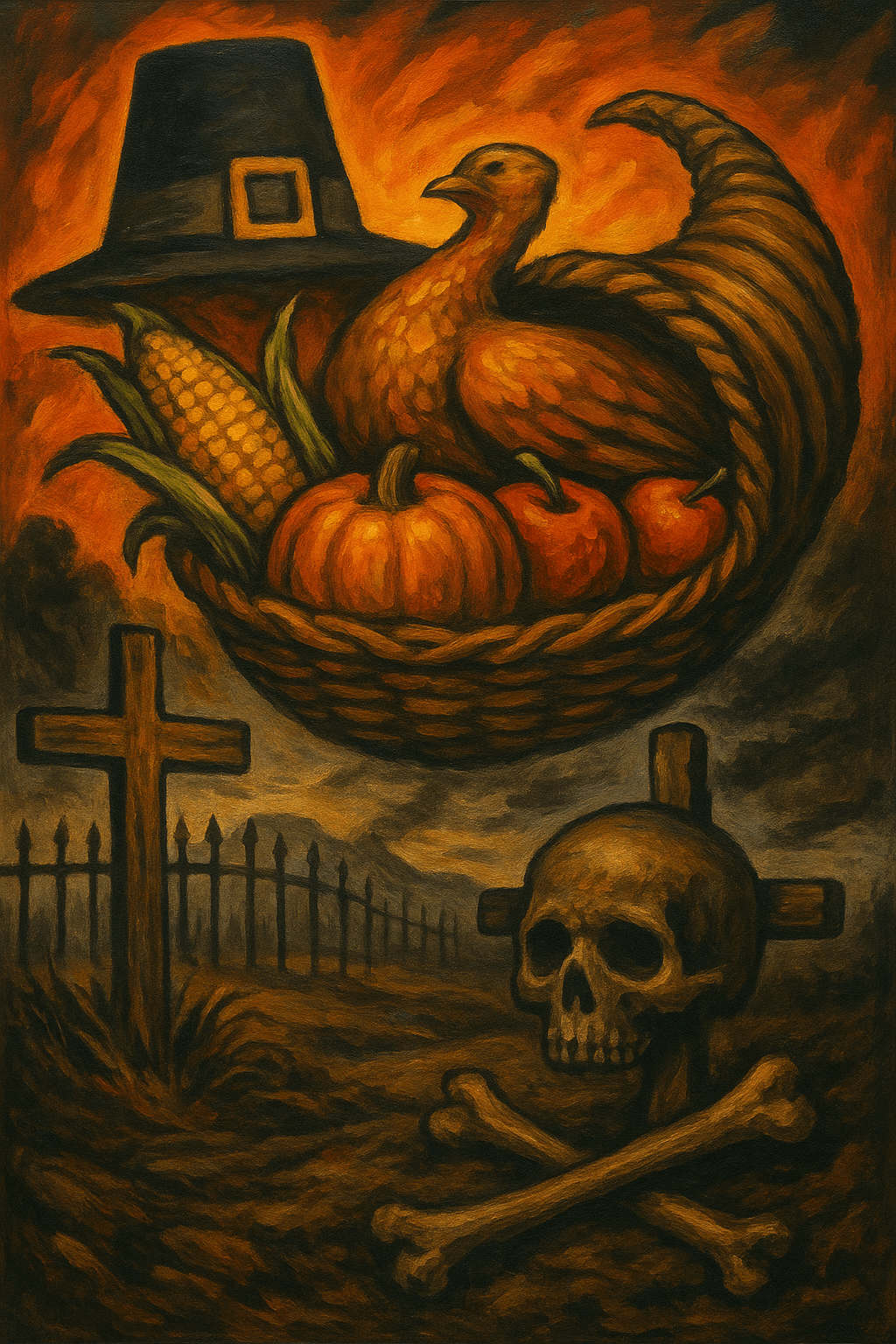
How a Settler Holiday Became a Political Weapon — and Why Indigenous Resistance Still Leads the Way
By Prince Kapone | Weaponized Information | November 27, 2025
Staging Innocence, Branding Dissent: How Fox Frames a ‘Decolonized’ Thanksgiving as a Threat
The Fox News piece “Universities, school districts nationwide call for ‘decolonizing’ Thanksgiving: ‘Day of mourning’”, written by Andrew Mark Miller and published on November 26, 2025, appears under the “Campus Radicals” banner. It announces itself as a report on universities and school districts “pushing back” on Thanksgiving’s “colonial roots,” but the real work of the article is not to inform. It is to discipline. It stages Thanksgiving as a sacred, innocent national ritual, and casts anyone who questions that ritual as a problem to be monitored, mocked, and contained.
The narrative opens with a soft-focus tableau: “As families across the U.S. gather on Thanksgiving to celebrate one of the nation’s most cherished national holidays…” That single sentence establishes the baseline: Thanksgiving is “cherished,” families across the country are united in celebration, and the holiday’s legitimacy is unquestioned. Only after this warm blanket is tucked in does the article introduce “some educators and schools” who are “lamenting the day” and “pushing back” on its “colonial roots.” The conflict is framed not as a clash between history and myth, but as a clash between wholesome national unity and a small, sour minority trying to spoil the mood. The text doesn’t need to say “ungrateful” or “anti-American”; the structure carries that accusation for it.
Andrew Mark Miller is not a random bystander who wandered into this story. He is a Fox News politics reporter whose beat runs through U.S. campaigns, culture-war skirmishes, “election integrity” narratives, and elite anxieties over China and social media. His professional role is to patrol the ideological borders of the American project, flagging anything that looks like heresy to the conservative audience Fox cultivates. In this article, he acts less like a neutral reporter and more like a hall monitor for the settler common sense, spotlighting and cataloging “decolonizing” efforts as suspicious activity.
The outlet itself matters. Fox News is not simply a news organization; it is a conservative media machine built and owned within the Murdoch family’s empire and housed under Fox Corporation. It was explicitly designed in the 1990s to capture a conservative audience and has become the dominant right-wing cable news and political commentary platform in the United States. When Fox covers “campus radicals” or “DEI,” it does so as a political actor with a clear market and ideological niche, not as a detached observer. The article operates inside that house style: selective outrage, carefully curated quotes, and a gentle but persistent insistence that any challenge to patriotic ritual is both fringe and dangerous.
The propaganda work begins with the framing. The headline strings together “universities,” “school districts,” “nationwide,” “decolonizing,” and “Day of mourning” into a single breathless claim. The scale (“nationwide”) inflates the threat; the scare quotes around “decolonizing” and “Day of mourning” distance the reader from those concepts, marking them as bizarre jargon or extremist rebranding. Throughout the piece, the word “Thanksgiving” is left unmarked and natural, while “decolonizing” is treated as alien, a foreign substance injected into the bloodstream of the holiday.
The story’s structure is a tour through a curated gallery of offenses. UC Davis hosts “Decolonizing Thanksgiving in the Classroom.” Washington University in St. Louis offers an event emphasizing different cultural understandings of the holiday. MIT students are invited to a “Thanksgiving Myth-busting” session and a trip to the National Day of Mourning rally, complete with a note that they’ll watch an episode of “Buffy the Vampire Slayer.” UMass calls the day a “Day of Mourning” on its DEI website. Albuquerque Public Schools and Berkeley Unified School District circulate memos and guides that describe Thanksgiving as a time of “mourning” for many Native people. Each example is presented briefly and then moved along, like evidence tags in a case against the idea that the holiday could mean anything other than gratitude to the United States.
Notice what the article does with language. Indigenous perspectives are mostly paraphrased at arm’s length, often in bureaucratic phrases (“update,” “teaching guide,” “announcement”), while conservative backlash gets a clear, clean voice. The one quoted authority allowed to define the meaning of Thanksgiving at the end is Paul Runko from Defending Education, who declares that Thanksgiving is “meant to bring people together, not to divide students or cast blame over heritage,” and that it is an opportunity to “celebrate America, build unity,” and honor the “blessings and abundance of our nation.” In story logic, this is the closing argument. The Indigenous and critical perspectives are scattered and administrative; the conservative activist gets the last word and the moral tone.
Emotionally, the article leans heavily on nostalgia and sentimentality. We are shown images or descriptions of a family gathered around a table, a recreated first Thanksgiving scene with Pilgrims and Indigenous people sharing a harvest. These visuals are loaded with warmth, abundance, and cooperation, but the text keeps any reference to conflict, dispossession, or violence off-screen. The reader is invited to feel that something pure and innocent is under attack by people who insist on “mourning” in the middle of a meal. The emotional arc is clear: the article doesn’t ask, “What happened that some people mourn?” It asks, “What’s wrong with these institutions that they won’t just be grateful like everyone else?”
Another device is the normalization of the Fox News universe as the center of reality. The story sits inside the “Campus Radicals” vertical and links to other pieces about “whiteness pandemics,” “rebranding DEI,” and administrators saying outrageous things. This gives the impression of an unbroken chain of campus insanity, with this Thanksgiving story just the latest in a long file. The details change—Minnesota here, Maryland there, Albuquerque and Berkeley over there—but the pattern is scripted: universities and schools are consistently portrayed as sites where ordinary American values go to be undermined.
Finally, the article deploys omission as a quiet but central technique. It mentions a National Day of Mourning rally, but does not explain what is being mourned. It quotes school memos about genocide and land theft without ever lingering on what those words refer to. It references “colonial roots” without describing them. The reader is left with the sense that there is some dark cloud of grievance hanging over a perfectly good holiday, but is given no concrete reason to reconsider the story they were taught in grade school. The effect is to make critical perspectives seem excessive and unhinged precisely because the article refuses to name the history that produced them.
Read this way, the Fox News story is not simply a report on campus events. It is a carefully staged performance: Thanksgiving as a gentle, apolitical family ritual; “decolonizing” as a weird ideological experiment; Indigenous mourning as an overreaction; and conservative activists as the only adults in the room insisting that we all just be thankful. The propaganda is not in any single sentence, but in the choreography of images, quotes, and silences that tells the reader, without ever saying it directly, which side they are supposed to be on.
From Harvest Myth to Day of Mourning: The Facts Thanksgiving Leaves Off the Table
To get out from under Fox’s mood lighting, we have to separate the raw facts from the storytelling. The article itself is straightforward on a few points. It really does report that universities and school districts across the country are hosting events that question the standard Thanksgiving script. UC Davis’s California History–Social Science Project invites educators to “decolonize Thanksgiving in the classroom.” MIT students are mentioned in the very Fox News article we’re excavating. UMass posts a notice calling Thanksgiving a “Day of Mourning” on its DEI and Accessibility site. Berkeley Unified circulates a “Rethinking Thanksgiving Teaching Guide” that asks teachers and families to grapple with the “painful legacy” of the holiday, a framing reflected as well in the district’s Indigenous Peoples’ Heritage Month communication. All of that is real, and the Fox piece is not inventing these programs out of thin air.
The “First Thanksgiving” as most people in the U.S. know it is not a direct transmission from 1621 but a nineteenth-century invention. The National Museum of the American Indian’s “Rethinking Thanksgiving Celebrations: Native Perspectives” notes that the familiar story—nameless “Indians” helping Pilgrims, everyone sitting together to give thanks, then the Indians quietly exiting history—crystallized in the mid-1800s when old English accounts of the harvest feast were dusted off and repackaged for a young nation hungry for myths. The holiday’s modern form took shape later still. After a patchwork of regional thanksgiving days, Abraham Lincoln’s 1863 proclamation, issued in the middle of the Civil War, called for a national day of “Thanksgiving and Praise” on the last Thursday of November, explicitly tying gratitude for “fruitful fields and healthful skies” to loyalty to the Union and to a Christian God, as documented in the Gilder Lehrman Institute’s publication of the proclamation. Over time, Congress and the presidency would lock in a federal holiday that taught people to see the United States as a divinely blessed project and Thanksgiving as its annual ritual of affirmation, a legal arc traced in the National Archives’ overview “Congress Establishes Thanksgiving”.
Once that calendar is in place, the next missing piece is the price of that “blessing.” The Fox article reproduces words like “genocide” and “appropriation of Native lands” only as stray quotes in school memos; it never pauses long enough for those terms to make contact with a concrete record. Yet the record exists, and it is not subtle. Recent research summarized by Science magazine shows that Indigenous nations across what is now the United States have lost nearly 99% of their historical land base over time, with what remains often located in areas with higher climate and economic risks. That headline number comes from a dataset that traces the systematic dispossession of Native territory through treaties, forced removals, allotment, and outright seizure. The Wampanoag themselves—those polite supporting characters in classroom plays—were pushed off huge portions of their homelands within a few generations of that 1621 gathering, through war, debt, fraudulent land deals, and colonial law, a trajectory echoed in regional histories and land-cession maps collected by projects like Native-Land.ca.
Land theft was paired with a long campaign to destroy Indigenous cultures and languages. Here again, the Fox article leaves only a faint footprint; it references “erasure of Indigenous cultures” in the Albuquerque memo and moves on. The details are not hard to find. The National Native American Boarding School Healing Coalition’s 2025 mapping project identifies 526 Indian boarding schools that operated across the United States from the early 1800s into the late twentieth century, many of them government-funded and church-run. Their own historical work, along with federal investigations, describes how Native children were taken from their families, sometimes by force, and shipped hundreds of miles away, where they were beaten, starved, and punished for speaking their languages. The National Museum of the American Indian’s “Boarding Schools” teaching resource explains that these institutions were explicitly designed to “suppress the languages, cultures, and identities of American Indian children” and “Americanize” them. Even federal documents today—such as House resolutions establishing a “National Week of Remembrance” for boarding school survivors—acknowledge that these policies were explicitly intended to strip Indigenous children of their identities, beliefs, and languages in the name of assimilation.
It is against this backdrop that the National Day of Mourning emerges, not as some random radical rebranding of Thanksgiving but as a political interruption of the holiday’s myth. In 1970, Wamsutta Frank James (Aquinnah Wampanoag) was invited to give a speech at an official event in Massachusetts marking the 350th anniversary of the Pilgrims’ arrival. When organizers reviewed his prepared remarks — which detailed land theft, broken treaties, and the violence endured by Native peoples — they refused to let him deliver them and proposed a toned-down version instead. James rejected the censored text. On Thanksgiving Day 1970, he and hundreds of Native people and allies gathered on Cole’s Hill in Plymouth to hold the first National Day of Mourning, an annual protest that continues every year and explicitly challenges the sanitized Pilgrim story. This history is documented in the organizing materials of United American Indians of New England (UAINE), in the full text of James’s “Suppressed Speech”, and in subsequent analyses such as Jana Weiss’s article “The National Day of Mourning: Thanksgiving, Civil Religion, and American Indians”. Today, institutional statements like the University of Massachusetts’ “National Day of Mourning” resource explicitly reference this tradition and its 1970 origin, rather than inventing a new holiday from scratch.
If we move from the 1600s and 1800s into the present, the picture doesn’t get gentler. Indigenous writers in venues like the Smithsonian’s National Museum of the American Indian describe how Thanksgiving season in U.S. schools still means children sitting through plays and lessons that flatten their nations into props, erase the aftermath of colonization, and present the Pilgrim story as harmless heritage, concerns spelled out in “Rethinking Thanksgiving Celebrations: Native Perspectives”. This is exactly what many of the “decolonizing” efforts Fox highlights are trying to interrupt. When UC Davis offers teachers resources to “rethink” Thanksgiving, when Berkeley Unified sends out a guide asking people to consider both “celebration” and “mourning,” when Albuquerque schools name genocide and land theft in their Indigenous education update, they are not launching an abstract theory exercise. They are responding to a concrete, documented history in which Indigenous land was taken, communities were shattered, children were warehoused in boarding schools, and a national holiday was built that taught generations to give thanks for the results.
Finally, there is the contemporary political setting which the Fox article never admits but quietly swims in: the wider assault on what the state now dumps into the bucket labeled “DEI.” In 2025, the administration issued Executive Order 14173, “Ending Illegal Discrimination and Restoring Merit-Based Opportunity”, which rescinded prior federal mandates requiring affirmative-action or DEI-based workforce balancing and prohibited federal contractors and agencies from using “preferences, mandates, policies, programs … related to diversity, equity, inclusion, and accessibility,” language confirmed in the official order published through the Federal Register. Civil-rights observers and legal-industry analysts have since noted that these changes are reshaping the legal environment around employer and institutional DEI programs. Reporting from Reuters outlines how the order is altering compliance expectations and creating new risks for DEI-related policies in both public and private sectors. In that context, the schools and universities described in the Fox story are not rogue actors trying to ruin a holiday — they are scattered sites where educators, under pressure, are still trying to smuggle history into a system that prefers the myth.
When we pull all of this together, the factual baseline looks very different from the article’s soft focus. There was a 1621 harvest gathering, but the feel-good Thanksgiving myth was mostly knitted together centuries later to serve a growing nation-state. The holiday was nationalized during a civil war and later solidified as a federal ritual. Indigenous nations lost almost all of their land and were subjected to assimilationist violence through boarding schools and other policies. Native activists created the National Day of Mourning in direct protest against the official Thanksgiving story. And today, Indigenous writers, educators, and students are still fighting to have that history recognized in the classroom—even as federal policy and right-wing media work overtime to make their resistance sound like an attack on gratitude itself. Those are the facts the Fox piece glances past. Section III is where we’ll ask why.
Thanksgiving as Settler Machinery: Reframing the Narrative Through History, Class, and Colonial Power
Once the facts are laid out plainly, without the soft filters and evasions that Fox drapes over them, the Thanksgiving story begins to look less like a harmless cultural ritual and more like an ideological machine. The holiday stands at the intersection of land theft, national myth-making, and the ongoing struggle of Indigenous nations to affirm that their history is not a seasonal prop. The Fox article, with its curated panic about “decolonizing classrooms” and its refusal to name the violence behind the holiday, is not an accident. It is a deliberate move in a longer historical project: to keep the settler story intact so the settler order can remain unquestioned.
Begin with the narrative architecture itself. Thanksgiving, as we now know it, was not born from a 1621 harvest. That event has been retrofitted with sentimental meaning, draped in the fantasy that colonization came into the world peacefully, as if the Pilgrims arrived with casseroles and mutual understanding instead of disease, guns, and a rapidly expanding hunger for land. The historical reconstruction in Section II reveals that the modern Thanksgiving emerged in the mid-nineteenth century, under the pressures of nation-building, civil war, and the insistence that the United States was a nation blessed by providence. Lincoln’s 1863 proclamation did not simply invite gratitude; it crafted a civic religion in which the state itself became the object of collective devotion. That is the ideological terrain Fox is defending.
From the standpoint of Indigenous nations, the story looks starkly different. The Wampanoag were not characters in a fable. They were nations grappling with catastrophic population collapse, violent geopolitical pressures, and the arrival of settlers who were guests only until they had the numbers and firepower to become landlords. When Indigenous land loss reaches 99% nationwide, as contemporary research shows, we are not dealing with a misunderstanding or unfortunate accident. We are dealing with a political program. Fox’s silence about this history is not innocent; it is a technique. If you acknowledge the land theft, the forced removals, the boarding schools, the cultural destruction, then Thanksgiving cannot remain a celebration of American virtue. It becomes a ritual of forgetting, a state-sponsored amnesia meant to ensure that the descendants of the dispossessed do not interrupt the feast with the truth.
This is where the ideological function becomes clearer. In the settler imagination, Thanksgiving is the national fairytale in which the United States rehearses its own origin myth: peaceful, generous, godly, eternally grateful for its abundance but never asked to explain how that abundance was acquired. The holiday functions as a symbolic border wall, keeping the violence of colonization safely out of view. It demands that Indigenous nations restrict their visibility to that one friendly tableau from 1621, never appearing as sovereign peoples enduring centuries of war, displacement, and cultural attack. Thanksgiving is not just nostalgia; it is political technology. It smooths the jagged edges of conquest into a children’s story.
Now place the present “decolonizing Thanksgiving” efforts inside this long struggle. When teachers at UC Davis, Berkeley, and Albuquerque attempt to correct the record—by naming genocide, by introducing Wampanoag perspectives, by acknowledging boarding schools—they are not introducing radicalism into the classroom. They are interrupting the ideological choreography that keeps colonial history suspended outside the nation’s self-image. Their work is not some academic indulgence. It is an effort to reconnect the holiday to the lived history of the people whose bodies, lands, and cultures were targeted so the United States could exist at all.
And this is where the crisis of the present meets the myth of the past. Indigenous nations and their allies have been organizing, teaching, and resisting for decades. The National Day of Mourning has existed since 1970, born from a Wampanoag refusal to let the state script their voice into a sanitized narrative. These movements have insisted, year after year, that Thanksgiving is not just a meal but a national story that rests on a foundation of erasure. If Indigenous activists return to Cole’s Hill every Thanksgiving, it is not because they hate gratitude. It is because gratitude, in the settler sense, is demanded at gunpoint: be thankful for the nation that took your land, your children, your religions, your languages, your lives.
Fox’s reaction to contemporary decolonization efforts makes sense in this context. It is the ideological reflex of a system that recognizes, perhaps more clearly than it lets on, that its myths are cracking. When Indigenous people name genocide, the myth trembles. When school districts talk about land theft, the façade warps. When students go to the National Day of Mourning instead of reenacting Pilgrim plays, the national script loses its audience. Fox steps in precisely to restore the illusion: to paint Indigenous truth-telling as extremism, to frame teachers as radicals, to reduce four hundred years of colonial violence to a “difference of perspectives.” This is not news. It is damage control.
At a deeper level, the panic around “decolonizing” anything is tied to the larger political context of the United States in 2025. This is a state engaged in an ideological counteroffensive—an attempt to reverse decades of work exposing racism, colonialism, and systemic violence. Trump’s dismantling of federal DEI programs is not merely bureaucratic pruning; it is a declaration that the U.S. intends to restore a cultural order in which whiteness remains the default and the nation’s founding stories remain sacred. In that political atmosphere, Thanksgiving becomes a battlefield. To decolonize it, even modestly, is to challenge one of the most cherished props of American innocence.
From the standpoint of the global working class, the colonized nations, and revolutionary movements inside the imperial core, the meaning of this struggle is clear. Thanksgiving is not simply a contested holiday. It is a symbol of the broader fight over historical memory, political education, and whose humanity gets to be reflected in public life. Indigenous people are not demanding an end to gratitude; they are demanding an end to a lie. And for the rest of us—for anyone fighting empire, extraction, war, or racial capitalism—their struggle is a reminder that national myths are not harmless. They are weapons. They are manufactured to justify the present order, to teach the oppressed to be grateful for their chains, and to varnish the empire’s crimes into something edible.
Seen through this lens, Thanksgiving is not a family tradition under attack. It is a political ritual being challenged by history. And when those challenges appear—in a classroom, in a rally, in a student trip to Plymouth—Fox rushes in to defend the holiday not because it is fragile but because the story it protects is essential to imperial stability. A nation that cannot face its past cannot liberate its future. The struggle over Thanksgiving, then, is not about a meal. It is about memory, power, and who gets to speak in a country built on stolen land.
From Myth to Movement: Building the Front Against Colonial Amnesia
If Section III revealed anything, it is that Thanksgiving is not an isolated argument about a holiday but a window into the living machinery of a settler empire struggling to maintain its innocence. And once we see that, the task before us becomes clearer. We cannot simply critique the myth; we have to connect ourselves to the forces already working to dismantle it. Mobilization, in this context, does not mean replacing one holiday with another. It means joining a long arc of resistance stretching from Wampanoag refusals in the seventeenth century to the National Day of Mourning in the twentieth, to the teachers, students, and organizers in 2025 who refuse to let the United States teach its children a fairy tale at the expense of Indigenous truth.
The most direct expression of this resistance remains the National Day of Mourning itself, convened every year by the United American Indians of New England on Cole’s Hill. That gathering is not symbolic; it is a living counter-archive, a ritual of historical clarity that insists the United States be confronted with the cost of its formation. The educators and students who make the trip to Plymouth—whether through MIT’s student-organized caravans or community carpools assembled every November—are not participants in a culture war; they are extensions of a movement demanding that the oppressed be the authors of their own history. To stand with them is to recognize that the struggle over Thanksgiving is inseparable from the struggle over land, sovereignty, treaty rights, and the right of Indigenous nations to define their own narrative.
Across the country, other fronts are taking shape. Indigenous education programs—in Albuquerque Public Schools, in Berkeley Unified, in tribal nations’ own curriculum councils—are pushing against the pressure to sanitize history. These educators are doing the quiet, daily work of teaching the truth where the state would prefer silence. Their lesson plans, resource guides, and classroom conversations form a decentralized network of resistance, one that deserves material support as well as political solidarity. They are often operating without institutional protection, under the shadow of Trump’s anti-DEI orders and the manufactured outrage machines of right-wing media. Strengthening their position means amplifying their work, connecting them with families and students who want honest education, and defending them when reactionaries try to turn their classrooms into battlegrounds.
At the same time, Indigenous sovereignty movements across Turtle Island continue to fight for land, language, and political power. From Wampanoag land-back efforts in Massachusetts, to Lakota resistance to pipeline encroachments, to Haudenosaunee campaigns for treaty recognition, these struggles challenge more than local violations—they challenge the foundational theft that Thanksgiving tries so hard to forget. Building links between these movements and working-class struggles inside the imperial core is crucial. The poor, the dispossessed, and the precarious have far more in common with Indigenous fights for survival than with the national mythologies that ask them to identify upward with the state.
The Global North working class, especially those who see themselves as “ordinary Americans,” have a responsibility here. They must decide whether they will cling to the myth that gratitude requires obedience to the nation, or whether they will stand with those who demand gratitude for truth. Supporting Indigenous movements does not require guilt; it requires clarity. It means showing up at Day of Mourning events, connecting with Native-led organizations, and refusing to let Fox News or any other arm of the imperial press teach their children that the United States was born of generosity rather than conquest. It means recognizing that the same state that lies about the past is the one that exploits workers in the present.
Practical action grows naturally from this understanding. Families and communities can shift their own Thanksgiving rituals, not out of shame but out of solidarity—inviting Indigenous voices into their gatherings, reading Wampanoag histories aloud, supporting Native-owned food producers and land initiatives. Students can form alliances between Indigenous groups and multiethnic working-class organizations on campus, pushing for curriculum changes and defending teachers who refuse to whitewash genocide. Workers can pressure unions to publicly back Indigenous sovereignty movements, linking struggles over wages and housing to struggles over land and treaty rights. And all of us can support Indigenous-created media, research centers, cultural collectives, and land-back campaigns with money, labor, and amplification.
In this sense, the call to mobilize is not an external command but an internal necessity. If the story of Thanksgiving is being challenged today, it is because the oppressed have made it impossible for the empire to maintain its silence. The work ahead is to link these ruptures—to connect classrooms to movements, movements to communities, communities to nations, and nations to an international front against colonization in all its forms. History does not change because a myth is debunked; history changes because people organize around what the myth was hiding.
And so we return to the simplest truth: Thanksgiving is not under attack. The attack is coming from those who refuse to let the truth breathe. Mobilization means taking that breath back. It means standing with the nations whose land we live on, the students who refuse to recite myths, the educators who insist on honesty, and the global movements struggling to liberate memory from the grip of empire. That is the work. And it begins wherever the story is being told.
 Weaponized Information
Leave a comment