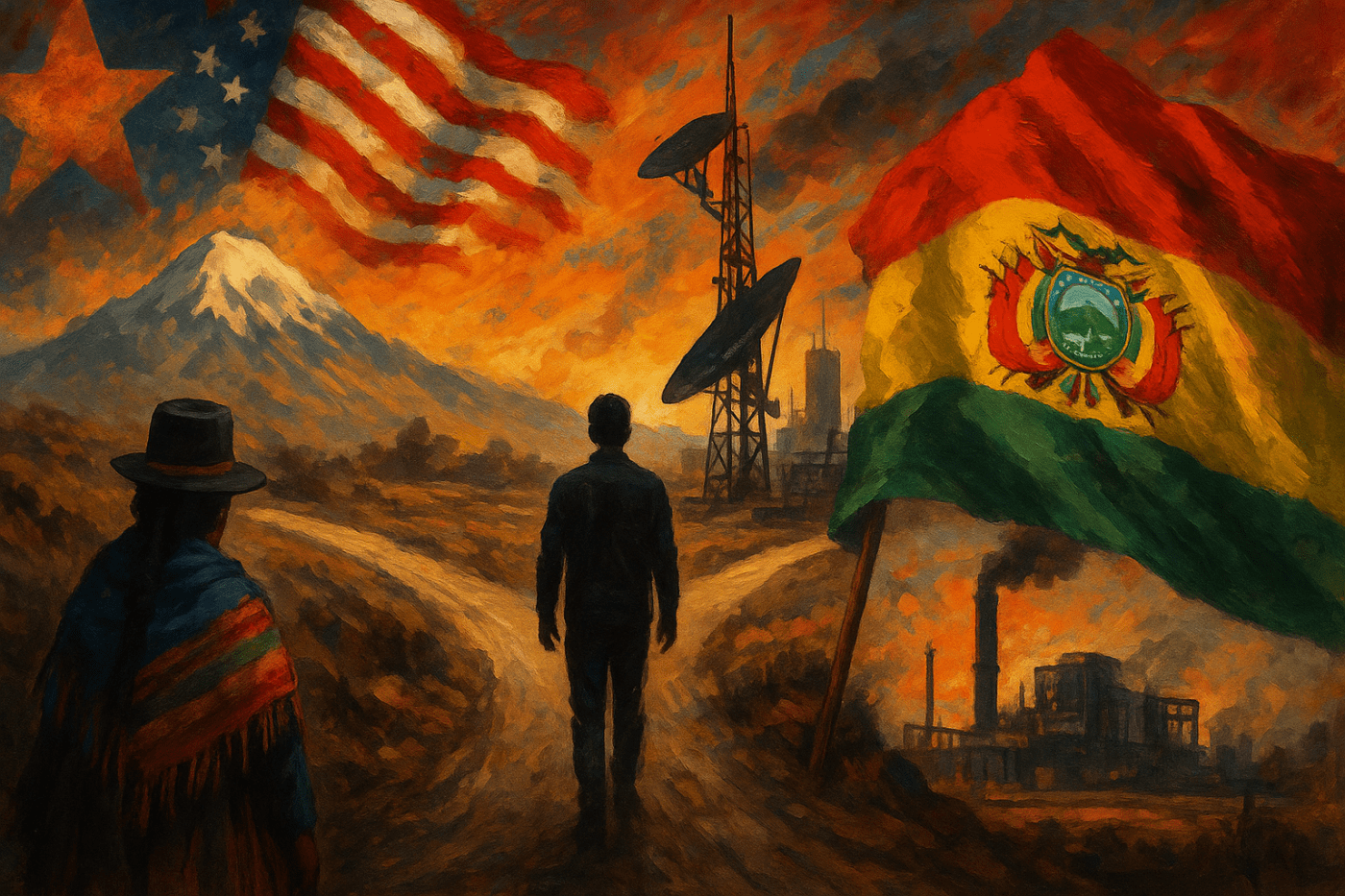
Bolivia’s new conservative regime is celebrated as a technocratic correction, but the real story is its narrative construction. Beneath the headlines lies a deeper terrain of facts: collapsing reserves, foreign penetration, and the return of suspended U.S. agencies. Placed in context, these moves reveal a comprador restoration wired directly into the architecture of the American Pole. The struggle ahead belongs to the Bolivian people, whose historic resistance now enters a new phase of confrontation.
By Prince Kapone | Weaponized Information | November 27, 2025
“The Technocrat Who Shows Up With a Chainsaw and a Smile”: AP News Tries to Sell Recolonization as Recovery
You can always tell when the empire is pleased. The journalists get this little sigh of relief in their sentences, like the household overseer just walked back into the plantation yard. That’s the tone AP strikes when it introduces Rodrigo Paz: the calm, steady hand, the “responsible” man, the one the rich can finally trust to put the poor back in their place. AP writes about him like the country’s long experiment in Indigenous self-determination was a messy party someone needs to clean up after. In three little sentences, they lay out the script: Paz brings “security,” “confidence,” and “stability.” And just like that, the political memory of millions is flattened into a bedtime story for investors. No mention of the people who fought for dignity. No mention of the social gains wrung from history by workers, campesinos, and Indigenous nations. It’s as if Bolivia were a broken appliance and the manufacturer finally sent a technician.
The propaganda is disguised as good manners. Paz says he’ll scrap taxes on the rich, kneecap public spending, and borrow billions from abroad, and AP nods along like a butler. They call this “discipline” and “fiscal responsibility,” as though the only people capable of managing money are those who already have more than they could spend in three lifetimes. When business elites clap, AP treats it like applause from the gods. When investors lick their lips, AP tells us the nation has been saved. You can practically smell the Wall Street cologne seeping off the page.
And yet, in all this, there is not a single question for the people whose backs will carry the load. No worker interviewed. No farmer quoted. No Indigenous voice anywhere. Just a parade of “experts” and embassy-friendly analysts, all lined up like a chorus of polite colonizers. The people who will lose their subsidies, their wages, their public services—those people are invisible. In AP’s universe, the Bolivian majority is background noise, the scenery, the unwashed masses who must accept whatever economists in imported suits decree.
This is how imperial journalism works. It speaks the language of neutrality while picking a side with both hands. Austerity becomes “reform.” Foreign penetration becomes “partnership.” The return of U.S. agencies notorious for destabilization becomes “renewed cooperation.” And when AP talks about warming ties with Washington, it reads like Bolivia is returning to its “rightful place” under the shadow of the eagle. No mention of why those ties were severed in the first place—because the people demanded sovereignty. Because Bolivia refused to be treated like a backyard again. Because the state chased out the very agencies now being welcomed back through the side door.
AP lists Starlink as though it were a gift from heaven instead of a surveillance infrastructure designed to place Bolivia’s digital nervous system under foreign command. It mentions U.S. nuclear cooperation as if the empire suddenly discovered a soft spot for Bolivia’s energy grid. The entire framing is engineered so the reader never sees the chains beneath the ribbon.
What AP refuses to say is the heart of the matter. Austerity in Bolivia has always meant disaster for the poor and a golden age for the oligarchs. Every U.S.-aligned “rescue plan” since the 1980s has meant privatization, repression, and the open bleeding of national wealth into foreign hands. “Security” for investors has always required insecurity for the working class. These are not footnotes. They are the architecture of the country’s suffering.
And so our excavation begins here—not with their facts, but with the story they built to hold those facts in place. AP isn’t reporting on Bolivia; it’s disciplining Bolivia. It’s training the reader to accept a world where the rich are saviors, the poor are problems, and the empire is the benevolent minder who knows what’s best for everyone. This is not journalism. It is ideological housekeeping. And like all imperial narratives, its sharpest weapon is silence—what it refuses to name, what it erases, what it buries in polite language and professional tone. That’s where the violence lives. And that is where our work begins.
The Country Behind the Curtain of Facts
If you lift the AP article by its corners and shake it, a whole other Bolivia falls out. Not the polite, investor-friendly postcard they hand to the public, but a country shaped by struggle, built by workers, battered by markets, and constantly negotiating the forcefields of empire. The facts scattered through AP’s piece are technically “accurate,” but accuracy is not the same as truth. Accuracy is what the empire boasts when it wants to appear honest. Truth is what emerges when those facts are placed back into the world that produced them.
Yes, Rodrigo Paz wants to scrap the wealth tax. That part is correct. But the wealth tax was not some symbolic annoyance—it was a direct levy on fortunes above 30 million bolivianos, the kind of fortunes that reproduce themselves through land, extraction, speculation, and old colonial privilege. It affected barely two hundred people in a country of over twelve million. Eliminating it is not “pro-investment.” It is a down payment to the aristocracy. But the real meaning comes from remembering who fought for that law and who fought against it.
Yes, Paz wants to eliminate the 0.3% Financial Transactions Tax on dollar transfers. The State Department openly documents that rate. But what AP will not say is that this tax, though small, is one of the few tools that lets a peripheral country nudge capital toward the national interest. Remove it, and the dollars will sprint even faster into Miami real estate. And at a moment when Bolivia’s foreign reserves have evaporated—from $1.7 billion in 2023 to $153 million by mid-2024—that loss of capital control becomes a national vulnerability, not a reform. You cannot defend a currency with good vibes and optimism; you need reserves, sovereignty, and a functioning state. That part is missing from AP’s smiley-face economics.
Yes, the government plans a 30 percent budget cut. AP states it plainly. But decades of history tell us what that means. When Bolivia attempted to raise fuel prices in 2010—a mere adjustment—the country erupted in mass protest so powerful the government reversed course within days. What happens, then, when you don’t just raise prices but carve out a third of the state? What happens when the axe lands on public investment, social programs, rural infrastructure, Indigenous development funds? The poor bleed first. But AP refuses to let that thought contaminate its storyline.
Yes, Paz wants to borrow billions—$3.1 billion already approved through CAF, up to $9 billion being negotiated with multilateral lenders. Reuters has documented the figures. But borrowing from CAF, the World Bank, and other “partners” is never just borrowing. It is entering a room with the IMF hiding behind the drapes. Every dollar comes with a condition. Every condition comes with a consequence. Bolivia learned this the hard way in the 1980s, when Víctor Paz Estenssoro—Rodrigo Paz’s own great-uncle—ushered in the neoliberal shock therapy that gutted wages, privatized the state, and set the table for oligarchic consolidation. AP knows this history exists; they simply choose to throw it out with the compost.
Yes, relations with the United States are warming. Yes, Washington announced nuclear cooperation and security assistance. These are factual statements. But placed into context, they are not diplomatic niceties—they are geopolitical fingerprints. Bolivia expelled the DEA in 2008 after accusations of espionage and interference. The expulsion of USAID in 2013 followed the same logic. These decisions have been analysed in depth as efforts to defend sovereignty and reject foreign aid-based influence — restoring “cooperation” now means reopening a pipeline of foreign influence into the country’s security and political apparatus.
And Starlink — AP writes it as though it were a harmless gadget dropped from orbit. But under MAS, Bolivia refused to license Starlink because communications infrastructure is an artery of sovereignty Bolivia rejects Musk’s Starlink in stand for digital sovereignty. Rest of World documented how Bolivians smuggled kits because the state insisted on maintaining control over its digital skies. Paz’s greenlight is not “modernization.” It is a surrender of the country’s digital nervous system to a U.S. defense contractor with deep ties to empire and to war.
AP mentions none of the deep historical residue that explains why these decisions matter. They do not mention Klaus Barbie, the Nazi fugitive who became a Bolivian security asset, trained paramilitaries, advised the 1980 “cocaine coup,” and embedded fascist logic into state institutions. They do not mention how the García Meza dictatorship fused cocaine money with counterinsurgency — and how under that regime paramilitary repression was used to eliminate opposition — as documented in the 1993 “Trial of Responsibilities” verdict holding García Meza and collaborators accountable. They do not mention how investigators and journalists have traced networks linking drug-trafficking, fascist escapees, and state terror — including the formation of death squads under Barbie’s direction “Nazi war criminal Barbie was big fish in drugs trade”. Nor do they mention how Bolivia was part of the hemispheric state-terror apparatus known as Operation Condor. The Guardian and decades of scholarship have established these facts. AP pretends there is no history at all.
They do not mention the U.S. “narco-terrorism” doctrine—how the Department of Justice framed Maduro and Venezuelan officials as cartel kingpins to legitimize intervention. They do not mention how “narco-terrorism” emerged from the fusion of counterinsurgency and the drug war, a doctrine exported through Plan Colombia’s intellectual architecture and baked into the hemispheric security structure. They do not mention how Ecuador’s ports became the “cocaine superhighway”, or how President Noboa declared an “internal armed conflict” to militarize society with Reuters quietly taking notes. They do not mention Petro’s speech at the UN, where he called the drug war a device that “destroyed democracy” and “devoured the jungle”. These omissions are not accidental—they are defensive maneuvers, ways to prevent the reader from seeing how similar currents are now pulling Bolivia back into the orbit of U.S. control.
Every fact AP presents floats in a vacuum. But facts do not float; they are rooted in the soil of political struggle. When we return each fact to that soil, the landscape changes. Austerity is not neutral—it is a weapon. Debt is not policy—it is leverage. U.S. security cooperation is not friendship—it is insertion. Starlink is not connectivity—it is control. In this light, Paz’s agenda is no longer the pragmatic blueprint AP celebrates. It is the opening phase of a recolonization process carried out through loans, satellites, and security doctrines rather than bayonets. And every fact in the AP article—once reconnected to the world it came from—reveals the architecture of that project.
Bolivia at the Edge of the American Pole
What AP presents as a simple “policy shift” is, in reality, a strategic reabsorption of Bolivia into the gravitational pull of the United States. You cannot understand this moment by looking only at Paz’s personality, or his talking points, or the polite noises of financial markets. You have to zoom out and see the hemisphere as Washington sees it: a fortress under construction, a defensive perimeter, a rearguard territory that must be locked down before the empire confronts its true geopolitical adversaries. This is the logic of the American Pole—the empire’s attempt to consolidate the Western Hemisphere as a single, disciplined bloc in an era where it can no longer dominate the globe.
Once you understand that framework, Paz stops looking like a reformer and starts looking like an instrument. His administration is not simply reversing MAS policy—it is repositioning Bolivia inside a hemispheric command structure. The return of the DEA is not about “fighting drugs.” The DEA has never reduced drug flow anywhere; what it has reduced is national sovereignty. In Bolivia, it functioned historically as an intelligence node, a political actor, a pressure device on governments that deviated from U.S. priorities. Morales expelled it because it was a foreign security agency embedded in domestic operations. Paz’s willingness to bring it back is the clearest sign of what is really occurring: the reactivation of counterinsurgency architecture dressed up as anti-crime coordination.
This is where U.S. “narco-terrorism” doctrine enters the picture. Since the 2000s, Washington has merged the drug war and the War on Terror into a single conceptual weapon. The DOJ’s indictment of Maduro is not an outlier—it is the blueprint. Label a government a cartel. Treat political resistance as criminal insurgency. Then justify extraterritorial policing, sanctions, surveillance, and even military operations. What was done to Colombia under Plan Colombia, what is being done to Ecuador right now—the militarized ports, the “internal armed conflict,” the fusing of policing with counterinsurgency—is the same model waiting quietly behind Paz’s smiling technocracy. AP cannot name this because naming it would expose the empire’s fingerprints.
Look at where Bolivia sits. It is not an isolated country. It is a hinge. To the north lies the U.S. hybrid-war pressure on Venezuela; to the south, the lithium fields that the U.S. military-industrial complex desperately needs for its next-generation weapons, batteries, and data infrastructure. To the west and east, the Andean and Amazonian corridors where both insurgency and extraction have historically collided. Reintegrating Bolivia into U.S. security doctrine is not an afterthought—it is a strategic imperative. The American Pole cannot afford a sovereign Bolivia in the middle of its frontier. It needs a corridor state, a compliant node, a government aligned enough to allow U.S. agencies to build the architecture of surveillance, logistics, and political influence required for a hemisphere under consolidation.
This is why Starlink enters the scene dressed as “connectivity.” In the AP article, Starlink is a harmless technology upgrade. In reality, it is a privately owned, U.S.-aligned, dual-use satellite network capable of shaping national communications, intelligence gathering, and wartime infrastructure. MAS refused it because they understood what it meant: surrendering digital sovereignty to a billionaire tied to the Pentagon. Paz approves it because the American Pole requires seamless integration of telecommunications across its subordinate territories. If the old counterinsurgency required death squads and airbases, the new one requires satellites and data flows.
And behind Paz stand the old ghosts of Bolivia’s comprador elite. MIR veterans, ex-operators from the Banzer and Quiroga years, technocrats groomed by multilateral lenders, agribusiness lords from Santa Cruz—this is not a new political class. It is the restoration of an old one. It is the same class that collaborated with the dictatorships, that tolerated Klaus Barbie’s presence in the intelligence services, that blended cocaine profits with political power during the García Meza “cocaine coup,” that integrated Bolivian security forces into Operation Condor’s transnational terror network. These are not metaphors or speculative connections; they are historical continuities. The faces age; the function remains.
AP pretends that the past is irrelevant, that history is a museum exhibit rather than a living force. But in Bolivia, the past has never died because the structures that upheld it were never dismantled. The oligarchy of Santa Cruz still wields economic power. The neoliberal officers and bureaucrats of the 1990s still know the corridors of the ministries. The U.S. embassy has never stopped watching the country like a hawk. When Paz takes office surrounded by men who once served under Banzer, Quiroga, and his own father’s deeply compromised government, we are not witnessing a technocratic refresh—we are watching the reassembly of a colonial relay system.
When you zoom out, the contradictions crystallize. Austerity in Bolivia is not an economic choice—it is a disciplinary mechanism. Debt is not financing—it is control. Security cooperation is not partnership—it is penetration. The American Pole is not a diplomatic framework—it is the geopolitical doctrine of a declining empire rearranging the hemisphere for the coming storms. And Bolivia, under Paz, is being pressed into position—lithium outpost, surveillance corridor, anti-Venezuela pressure valve, a state whose crisis becomes the empire’s opportunity.
This is why AP works so hard to present Paz as the “safe” option. Not because he is safe for Bolivia—he is not—but because he is safe for the American Pole. He is safe for the creditors, for the embassy, for the agribusiness barons, for the technocrats who dream in spreadsheets and speak in euphemisms. And AP, as always, serves as the ideological delivery mechanism, building consent where violence and dependency will do the rest. They cannot tell the truth because the truth would expose the architecture of recolonization hiding behind the language of recovery.
So our task in this section is not to add new facts but to reveal the political logic holding the facts together. Paz is not an individual phenomenon; he is a structural one. He is the shape the empire takes when it walks back into a country it once believed it had lost. He is the smile on the mask of the American Pole. And AP News, knowingly or not, is the voice whispering to the world that Bolivia is open for recolonization once again.
The Country That Will Not Bow Quietly
If you read AP’s article with no knowledge of Bolivia, you would think the country is a blank slate waiting for Rodrigo Paz’s steady managerial hand to carve order out of chaos. But Bolivia is not a laboratory. It is a living, breathing movement of peoples — Indigenous nations, workers, campesinos, mothers, students, coca growers, migrants, and barrios — who have already fought off privatizers, dictators, foreign agencies, and technocrats with better résumés than Paz’s. This country has buried empires before. Every political gesture, every decree, every foreign handshake takes place inside a society that knows how to rise.
That is why mobilization is not something that begins after an essay or after a scandal or after a law is passed. It is already happening. The COB, the backbone of Bolivia’s organized working class, has never accepted austerity quietly. They have shut down governments, blocked highways, and forced the state to negotiate with the class it tries hardest to erase. CSUTCB — the campesinos who keep the country alive — do not need lectures on what neoliberal policy means for land, water, or seed. They have lived every phase of it, resisted every phase of it, and buried more than one political project that tried to turn them into collateral damage.
CONAMAQ, the Indigenous authorities who refuse to bow to the colonial logic of “modernization,” are already sounding alarms about foreign penetration disguised as cooperation. Their struggle is older than the republic itself. The Bartolina Sisa federation — Indigenous and peasant women, the heart of the country’s moral intelligence — have carried entire cycles of resistance on their shoulders. No IMF program and no Washington-backed “reform” has ever been able to break them. AP can erase them from the page, but not from history.
And then there is the country’s nervous system — community radio stations, Indigenous broadcasters, WhatsApp networks, local digital collectives — the infrastructure the empire cannot quite get its hands around. These are not just media. They are the channels through which communities warn each other, defend each other, and mobilize. If Paz wants to import Starlink to rewire the country’s communication grid under foreign control, it is these networks that stand in the way, these networks that can build alternatives not dependent on Washington, Silicon Valley, or the agribusiness elite.
International solidarity, too, is not theoretical. It is a living relationship. Every struggle in the global North that targets DEA expansion, U.S. militarization, or the surveillance arms of the empire weakens the hold of the American Pole over the hemisphere. Every campaign against debt conditionality, every challenge to the development banks that finance recolonization-with-a-smile, directly strengthens Bolivia’s hand. It is not enough for comrades abroad to “be informed.” The task is to intervene — to expose, disrupt, and obstruct the mechanisms that make recolonization possible.
This is the moment when political education ceases to be commentary and becomes a weapon. The contradictions laid out in this essay — the dismantling of the wealth tax, the return of foreign security agencies, the erosion of digital sovereignty, the debt trap, the reactivation of old oligarchies — must be studied not as isolated events, but as an interconnected assault. Bolivia is being reconfigured to serve a geopolitical project. Understanding that project is the first step in resisting it. The second step is organization.
The struggle ahead will not be won by sentiment or by nostalgia for the MAS years. It will be won by sharpening the tools the people already possess: their unions, their ayllus, their federations, their assemblies, their radios, their marches, their barricades, their capacity to shut down the arteries of the state when the state stops listening. And it will be won by connecting those tools to the global fight against hyper-imperialism — linking the defense of Bolivia’s sovereignty to the broader movement of peoples refusing to be folded into the American Pole’s final attempt at domination.
AP News can pretend none of this exists. Paz can pretend the country is passive. Washington can pretend the hemisphere is theirs to arrange. But Bolivia has never been a place where history moves quietly. The people are not footnotes. They are the protagonists. And every attempt to recolonize them has eventually run headfirst into a wall of resistance built from the very contradictions the empire thought would break them.
The question is not whether Bolivia will fight. It is how — and how we stand with them as they do. That is the task of this moment. That is the work ahead.
 Weaponized Information
Leave a comment