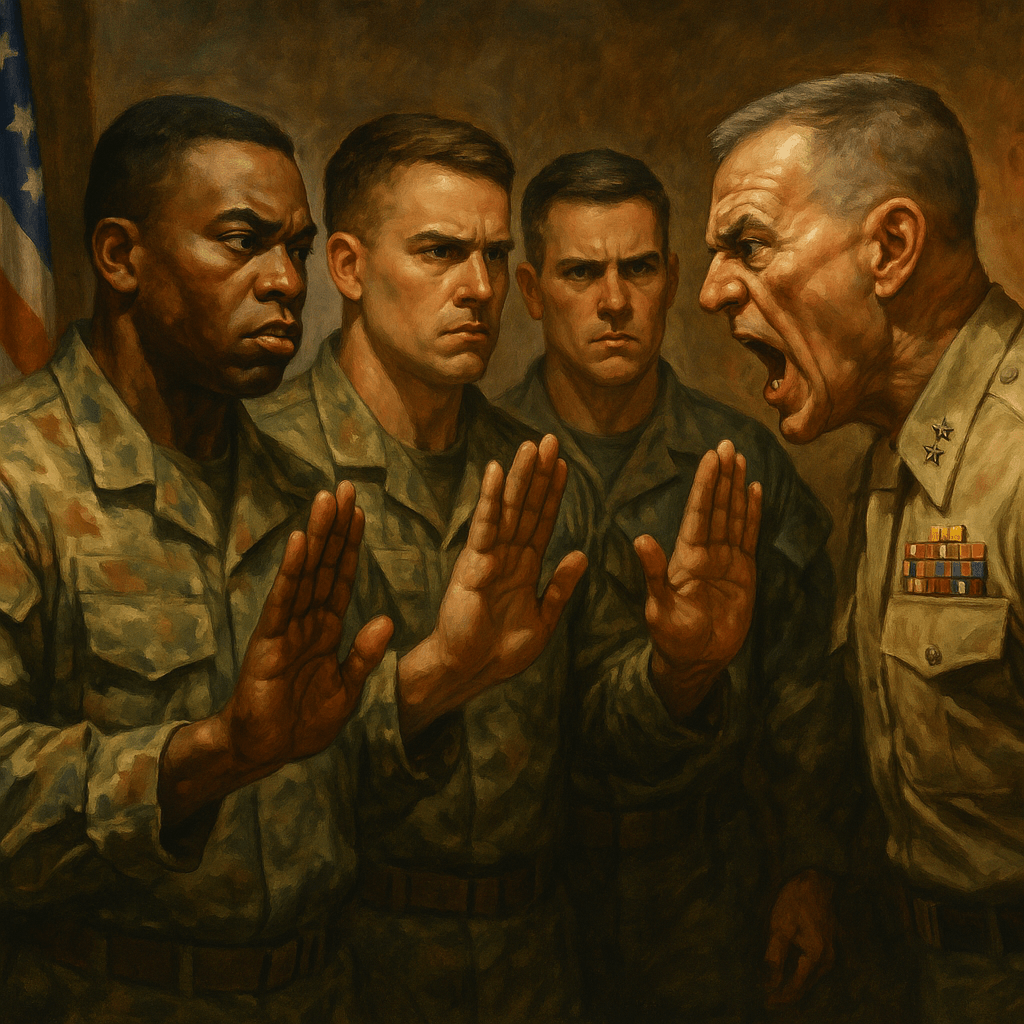
The Quiet Propaganda Behind America’s “Explainer” Journalism on Illegal Orders
By Prince Kapone | Weaponized Information |November 26, 2025
Obedience by Default: How ABC Teaches Soldiers to Trust the Chain of Command
The ABC News piece, “Explainer: Can military members refuse orders?” by Chris Boccia, arrives dressed up as neutral civic education. It pretends to be a simple explainer about the rules: when can a service member say no, what counts as an illegal order, what happens if you refuse. But from the very first lines, the article is not really asking, “How can soldiers resist unlawful commands?” It is asking, “How can we reassure the public that the machine of obedience will keep running, no matter what?” What looks like information is actually instruction: don’t think too hard, trust the lawyers, trust the chain of command, and remember that disobedience is dangerous terrain.
Boccia builds this message by returning, over and over, to one basic refrain: orders are presumed lawful. The idea is repeated like a drumbeat. If an order comes from the proper authority and relates to military duty, the default is that it is legal and must be obeyed. Only a “small subset” of “egregious” orders, the reader is told, fall outside this presumption. The structure of the article trains the reader to accept this presumption not as a contested principle, not as a political choice, but as a natural law of the universe. The more the phrase returns, the more it becomes common sense: legality lives at the top, obedience flows downward, and the rank-and-file are there to carry it out.
At the same time, the piece wraps the very idea of refusal in a thick fog. We are told about “gray zones,” about the difficulty of judging legality, about the risk a service member takes if they disobey and a judge later decides the order was actually lawful. Experts stress that “disobedience isn’t the first step.” The implication is clear: yes, in theory, soldiers can refuse orders, but in practice they would have to be either reckless or foolish to do so. By the time an order has reached them, the article insists, it has “likely” already been blessed by a military lawyer. The reader is walked gently toward one conclusion: the safest thing is to obey.
Notice how carefully the article chooses who gets to speak. The central voices are former JAG officers, current or retired officials, and legal academics whose careers orbit the military system. They speak with the authority of rank, of experience, of institutional familiarity. They are given space to explain how the law “cloaks” orders in a presumption of legality, how the “lifeblood” of the military is obedience, how service members should seek advice and then fall into line. No enlisted rank-and-file voices appear. No dissident veterans. No one who has publicly refused an order. The range of opinion is tightly patrolled: all differences are internal to the system, and all of them bend back toward compliance.
The article’s treatment of the Democratic lawmakers’ video shows the same pattern. Their message to troops – that they “can” and “must” refuse illegal orders – is immediately reframed as potentially “seditious,” as something that might “undermine” good order and discipline. The piece foregrounds Defense Secretary Pete Hegseth’s outrage and Vice President JD Vance’s claim that telling the military to defy the president is “by definition illegal” if no illegal orders have been issued. The lawmakers’ own explanation of their concerns is quoted, but it is surrounded by institutional scolding. The structure teaches the reader how to feel about the video: nervous, suspicious, wary of its impact on the chain of command.
Another device is the careful handling of examples. The article briefly references lethal strikes in the Caribbean and Eastern Pacific and the deployment of National Guard units to U.S. cities. These examples flash across the page and then vanish. They are not explored as cases where legality might genuinely be contested. Instead, they are mostly used to show that lawyers have already “wrestled” with the issues and given “legal cover.” The very mention of concrete operations is turned into an argument for trusting the system. The reader is never invited to dwell on what those strikes or deployments actually mean for the people on the receiving end or for the troops ordered to carry them out.
Throughout, the article leans on a subtle but powerful emotional framing: fear of disorder. We are told that encouraging troops to think too much about illegal orders “undermines every aspect of good order and discipline.” We are warned that members of Congress might be interfering with the chain of command. The specter of chaos hangs in the background: if soldiers pause to question legality, the whole machine might stutter. In that light, the “explainer” starts to look less like public education and more like a quiet sermon on loyalty. The message to service members is not “know your rights.” It is “remember your place.”
Taken together, these techniques – the constant presumption of legality, the fog around refusal, the narrow band of authoritative voices, the scolding of dissenting lawmakers, the fleeting treatment of real-world operations, the fear of disorder – work like gears in a single mechanism. They do not have to shout. They simply rearrange the reader’s common sense until obedience appears prudent, lawful, and patriotic, and disobedience appears risky, unclear, and suspicious. In the name of explaining the law, the article quietly trains its audience – civilian and military alike – to see the world through the eyes of the chain of command. That is the propaganda at work, hidden in plain sight behind the calm tone of an “explainer.”
The Facts Behind the Fog: What ABC Mentions, What It Hides, and What the Record Actually Shows
Before we can confront the political story beneath ABC’s “explainer,” we have to pull the facts out of the haze the article creates. That means laying the record bare: what the piece explicitly claims, what it alludes to but refuses to examine, and what the broader legal and historical context reveals when we widen the lens beyond Pentagon talking points. This section is not yet the space for interpretation or theory. It is the foundation—the empirical ground from which analysis will grow. To understand how the narrative of automatic obedience is constructed, we must first establish the factual terrain the article tiptoes around.
First, the explicit claims. The article is clear that service members may refuse unlawful orders, but they do so at their own risk. Orders are “presumed lawful” if they come from the proper authority and relate to military duty. Only “patently” unlawful commands—those universally recognizable as war crimes—must be refused. This standard, the article notes, is rooted in the Nuremberg trials. It states that military retirees remain under the Uniform Code of Military Justice (UCMJ), giving the Pentagon grounds to investigate Sen. Mark Kelly. It cites comments by Defense Secretary Pete Hegseth and Vice President JD Vance framing the lawmakers’ video as potentially illegal or seditious. And it reports, almost in passing, that 21 U.S. counter-narcotics strikes in the Caribbean and Eastern Pacific have killed 83 people, legally justified through a classified memo from the Office of Legal Counsel (OLC) that provides what experts call “legal cover.” These are the facts ABC places on the table.
But the article also gestures toward far more significant terrain that it does not explore. It references operations in the Caribbean Sea and Eastern Pacific without explaining what legal authority governs these lethal actions or how they fit within domestic and international frameworks on use of force. It mentions deployments of the National Guard to cities like Los Angeles without discussing the laws, civil liberties implications, or controversies associated with domestic military mobilization. It quotes multiple experts reassuring readers that JAG officers have already vetted the legality of such orders, but it does not present the content of these legal reviews, the standards applied, or the criticisms raised by lawyers who have challenged the Pentagon’s interpretations over the years. The article avoids the factual question of how often military orders have been later deemed illegal or how the U.S. government has historically responded when illegality becomes undeniable. These omissions are part of the factual landscape—not yet interpretation, but clear gaps in ABC’s account.
To build a real empirical baseline, we need to bring in the factual record from outside the narrow confines of ABC’s source selection. There are long-documented historical cases where U.S. personnel faced orders that led to torture and detainee abuse during the post-9/11 CIA detention and interrogation program, as documented in the U.S. Senate Select Committee on Intelligence’s 2014 torture report. There are also verified instances of warrantless and bulk surveillance by U.S. intelligence agencies that were later ruled illegal. Similarly, secret domestic-surveillance programs and metadata-dragnet collections under post-9/11 national-security policies have been challenged, exposed, and in some cases struck down or declared unlawful. For instance, the United States v. Moalin decision held that the NSA’s bulk telephone metadata collection violated the Foreign Intelligence Surveillance Act (FISA) and was likely unconstitutional under the Fourth Amendment. Legal analyses by civil-liberties groups argue and document that these dragnet programs exceeded statutory limits and lacked proper judicial or public oversight. Moreover, investigative reports show that many of these surveillance systems remained secret until public exposure compelled legal and political scrutiny. These cases demonstrate that the legality of such orders and surveillance practices is not settled or self-evident but a matter of contested law and public struggle. These examples do not interpret the article; they simply establish that the legality of military or state orders is not a settled or self-evident matter but a historically and institutionally disputed field.
Similarly, the article’s reference to “counter-narcotics strikes” must be placed in factual context. U.S. military involvement in anti-drug operations across Latin America — including the militarization of drug-control missions documented in analyses of U.S. foreign policy such as this report from the Institute for Policy Studies’ Foreign Policy in Focus — has been a decades-long practice shaped by inter-agency cooperation, defense funding, and bilateral security programs. In 2025, public reporting confirms that the U.S. military carried out 21 deadly strikes on suspected drug-smuggling vessels in the Caribbean Sea and eastern Pacific, which resulted in at least 83 deaths. Legal experts and human-rights observers have raised serious questions about these operations, including concerns over compliance with domestic and international law, as documented in Reuters’ coverage of legal challenges to the strikes. The absence of any publicly available legal rationale — including the lack of disclosed targeting criteria, evidentiary standards, or judicial review — is itself part of the empirical record, underscoring that the legality of these operations is not settled fact but a matter of ongoing contestation.
The same is true domestically. When the National Guard is deployed to U.S. cities, it is governed by a complex and contested mix of legal authorities — including state duty, Title 32 status and the historic Insurrection Act. Civil-liberties organizations such as the ACLU have warned that deploying troops in American cities “absent a real emergency” undermines civilian control, erodes democratic oversight, and places both communities and service members in danger. Recent tracking of domestic military activity confirms that, since 2017, Guard, Reserve, and Active-Duty units have been mobilized for operations beyond natural disasters or emergencies — including law-enforcement support, border operations, and crowd or protest control — often under vague or shifting legal authority and with incomplete public information about troop numbers, orders, or oversight mechanisms. For instance, in 2025 a federal judge ruled that the use of National Guard troops and Marines in Los Angeles during protests violated the law because they were deployed as a “de facto police force” engaging in crowd control, detentions, and other law-enforcement functions — in breach of the Posse Comitatus Act, as detailed in the court’s ruling and reinforced by civil-liberties legal analysis. These facts demonstrate that the terrain of domestic deployments — legal authority, chain of command, transparency, and legitimacy — is a contested and unstable one, not a neutral given.
Finally, the article’s reliance on JAG officers as neutral arbiters also needs to be placed in factual context. There have been documented occasions where senior uniformed military lawyers formally objected to proposed interrogation and detention policies — for example during the early 2000s when the top Judge Advocates General voiced serious legal concerns about definitions of torture and the legality of coercive interrogations. These objections were submitted to the Pentagon’s general counsel, and later declassified memos revealed that JAG officers warned such policies would violate both U.S. and military law and damage the institution’s integrity. The documents show the military lawyers argued against the use of “exceptional interrogation techniques” and cautioned about their legal and moral implications. More recently, in 2025, the top uniformed JAGs for the Army, Air Force, and Navy were removed — a purge that legal observers warn threatens the independence of military legal oversight. The dismissal of senior JAG leadership has sent shockwaves through the military legal community, raising questions about whether future orders will be vetted with the same impartial scrutiny. These examples are part of the historical record showing how the legality of military actions — rather than being assured by neutral institutional review — is contested, politicized, and vulnerable to erosion under pressure from command and political leadership.
What we have, then, is a factual landscape far broader than the narrow strip ABC presents. The article’s explicit claims reflect only a sliver of what is known about the legal framework surrounding military obedience, unlawful orders, extraterritorial strikes, and domestic deployments. The broader record—including historical precedents, documented controversies, and established patterns of legal ambiguity—forms the empirical backbone for any genuine analysis. ABC’s piece is not wrong about the existence of a legal framework; it is incomplete in ways that shape the reader’s understanding long before any interpretation begins. With the factual ground now established, we can turn to the deeper question: what do these facts mean when we view them in the full light of history, power, and struggle?
When Legality Serves Power: Reframing Obedience Through the History of Empire
Once the facts sit clearly on the table—no longer wrapped in the soft cotton of ABC’s institutional tone—they reveal a deeper story about the relationship between law, war, and power in the United States. What appears, on the surface, as a procedural debate about “lawful” and “unlawful” orders is actually the latest chapter in a long and global history: the history of an empire that has always demanded obedience from those who carry its rifle while reserving impunity for those who command it. The legality of orders, the murky gray zones, the classified memos, the deployment of troops abroad and at home—none of this floats in a vacuum. All of it has been shaped by centuries of imperial practice in which the law does not constrain power but is sculpted by it. The ABC article presents these patterns as neutral features of military life. But when we read the facts against the grain of history, a different landscape emerges—one in which the military rank-and-file are disciplined into obedience precisely because their obedience is the fuel that keeps the imperial project running.
Look at the gap between the presumption of legality and the historical record. Time and again, U.S. officials have insisted that controversial orders were lawful: from Vietnam’s free-fire zones to the CIA’s black sites, from the invasions justified by secret memos to the drone wars expanded far beyond congressional mandate. In each instance, the initial claim was the same—this is legal, this is vetted, this is authorized. And in each instance, the truth came later, often dragged out by whistleblowers, journalists, or international bodies: what was declared legal in the moment was later condemned as unlawful, unconstitutional, or contrary to international law. This is not an abstraction—it is a structural pattern. Legality inside the empire has always been elastic at the top and rigid at the bottom. Commanders interpret it, lawyers stretch it, presidents bend it, and soldiers obey it. When something goes wrong, the pyramid flips: responsibility snakes downward, while the architects of the policy rise above the smoke.
In this context, the article’s heavy emphasis on “risk” for disobedient service members takes on a new meaning. Yes, it is a fact that soldiers risk punishment if they refuse an order later judged lawful. But the deeper historical reality is that they also risk punishment—or moral injury, or complicity—when they obey orders later judged unlawful. The law has never protected rank-and-file soldiers from the moral and legal fallout of following the wrong command. It has protected the institution. It has protected the political class. It has protected the machinery of empire. When ABC tells soldiers they must assume their orders are legal, it is echoing a long-standing doctrine designed not to guard the law, but to guard the ability of the United States to project power without interruption.
The same logic extends to the extraterritorial strikes in the Caribbean and Eastern Pacific casually mentioned in the article. ABC reports that 21 such strikes killed 83 people, and that their legality rests on a classified OLC memo. This is the modern template for constructing legality: the executive branch drafts a secret interpretation of law, applies it to operations beyond public scrutiny, and then presents those actions as lawful simply because they were justified on paper. This is a system in which legality is manufactured inside a sealed room and then imposed downward onto troops who have no access to the reasoning, no ability to question the memo, and no role in shaping the definition of legality itself. The soldier’s “duty to obey” rests on a foundation they are forbidden to see. It is obedience without transparency—an echo of every imperial project in which the foot soldier is required to trust that the crown’s commands are righteous.
Domestic deployments follow the same pattern. Whether during uprisings, natural disasters, or political crises, the deployment of the National Guard inside the United States carries a long history of suppressing dissent, policing the poor, and protecting property during moments of social strain. The legal frameworks governing these deployments have always reflected the anxieties of the ruling class. They expand in times of upheaval, contract under scrutiny, and leave behind new precedents for the next emergency. When ABC mentions these deployments only to dismiss concerns around them, it reenacts the historical role of media in normalizing the use of military force within the country. It treats deployments as a technical matter of legality rather than a political question about who the military serves and against whom that force is used. That history speaks clearly: military power has been deployed domestically not to defend the working class but to discipline it.
Even the role of military lawyers—presented by ABC as the impartial guardians of legality—must be reframed within this broader context. JAG officers operate inside a hierarchy where their careers, promotions, and influence depend on alignment with the institution. When they dissent, the machinery moves around them. When they agree, their approval becomes the shield that protects the institution. The legal debates inside the Pentagon are not neutral; they reflect the priorities of a security state that has spent two decades expanding its interpretation of lawful force across continents. Classified legal memos, rapid reinterpretations of statutes, and shifting definitions of “imminent threat” all serve to adjust the law to fit the mission, not the mission to fit the law. This is not conspiracy—it is the imperial logic that has shaped U.S. military policy since 1945.
When we pull these threads together, a larger pattern emerges from the facts: the United States does not operate a system where legality stands above power. It operates a system where legality is produced by power, justified by expert authority, and enforced by the obedience of those at the bottom. Soldiers are told to presume legality not because the law is clear, but because the clarity of obedience is necessary for a global system built on intervention, policing, and force. The ABC article, in its soft language and calm tone, replays this pattern faithfully. It normalizes the expectation that soldiers should trust the chain of command even when they cannot see the legal foundation beneath it. It reassures the public that the machine of loyalty is still intact. And it subtly scolds those who dare to question whether the empire’s orders should be obeyed without hesitation.
When analyzed dialectically—through the facts themselves rather than slogans—the ABC article reveals the ideological role it plays: defending a system where obedience from the working class in uniform is the prerequisite for maintaining imperial dominance abroad and domestic control at home. It is not the law that requires this obedience; it is the political economy of an empire in decline, clutching ever tighter to the one thing it knows it cannot survive without: the automatic submission of those who carry out its violence. That is the real terrain on which this “explainer” stands, and it is the terrain that must be transformed if the global working class, the colonized peoples, and the forces of rising multipolarity are to break free from the shadow of U.S. imperial power.
From Obedience to Conscience: Building a Global Movement Against the Machinery of Impunity
The contradictions exposed by this narrative—the presumption of legality, the burden placed on the rank-and-file, the hidden memos that justify clandestine killings, the domestic use of soldiers to police dissent—are not merely intellectual concerns. They are living conditions imposed on millions. These contradictions already generate resistance across the world, from the barracks to the barrios, from the Caribbean coastlines targeted by U.S. strikes to the U.S. cities that have seen troops deployed against the very people they claim to protect. If we want to chart a path forward, we do not begin in abstraction. We begin from the struggles already unfolding—those building points of rupture, resilience, and refusal.
There are rank-and-file organizations inside the United States that fight for the rights of service members to refuse illegal or immoral orders—groups like the GI Rights Hotline, About Face: Veterans Against the War, and the legacy of the Courage to Resist network. These are not fringe anomalies; they represent the living memory of soldiers who have grappled with the consequences of obedience and the cost of conscience. Their work connects directly to the contradictions laid bare in the ABC article: the legal ambiguity soldiers are forced to navigate, the institutional pressures to obey, and the real-world human impact of following orders whose legality is hidden behind classified walls. To mobilize means to strengthen these channels—to make sure no soldier faces these dilemmas alone, without a community that affirms their right to question, to dissent, and to refuse when conscience and justice demand it.
Abroad, the peoples most affected by U.S. extraterritorial operations have long built their own infrastructure of resistance. Caribbean civil society networks, Latin American legal advocates, and regional human rights organizations have spent decades documenting U.S. incursions conducted under the banner of counter-narcotics or anti-terrorism. Their work has exposed the gap between what U.S. officials claim as “lawful” and the reality experienced by communities whose homes, coastlines, and families become the battlegrounds of invisible wars. Mobilization means amplifying these voices and connecting them to grassroots movements in the United States. It means building solidarity across borders—not as charity, but as a shared struggle against a legal regime that treats entire regions as sites of experiment and enforcement.
Within the multipolar world, a new front of struggle has emerged: legal and diplomatic efforts by Global South nations to challenge unilateral U.S. military actions. Countries across Latin America, Africa, and Asia are developing frameworks to assert sovereignty against clandestine operations justified by classified memos. Some are seeking regional agreements to curtail extraterritorial uses of force. Others are pursuing cases in international courts or supporting new jurisprudence that constrains militarized interpretations of self-defense. These efforts arise directly from the contradictions highlighted in the ABC narrative—the opaque authority underpinning U.S. strikes, the disregard for territorial rights, and the presumption that the United States can define legality unilaterally. Mobilization means aligning social movements in the U.S. with these international campaigns: treating the struggle for sovereignty abroad as inseparable from the struggle for democracy and accountability at home.
And here within the borders of the United States, every deployment of the National Guard against protestors, every classified memo used to justify military action, every leak revealing internal dissent inside the Pentagon has also produced its own counter-currents. Civil liberties organizations like the ACLU and the Center for Constitutional Rights are fighting ongoing battles over domestic militarization. Anti-police and abolitionist movements have challenged the use of military force in public spaces and the growing militarization of local law enforcement. These struggles are not separate from the soldiers’ dilemmas described in the ABC article. They arise from the same root: a political order that treats force as the first answer and legality as a malleable instrument. Mobilization means weaving these threads together—recognizing that a soldier asked to police a protester at home is caught in the same web as a sailor ordered to fire a missile in the Caribbean.
From this landscape, concrete proposals emerge—not prepackaged, but grown organically from the contradictions themselves. First, we strengthen the networks that support service members who question or refuse orders. This means expanding GI rights hotlines, building relationships between soldier-led dissent groups and civilian antiwar movements, and creating political education materials that demystify the legal fog surrounding military orders. Second, we deepen international solidarity by connecting U.S. grassroots organizations with Global South legal advocates fighting against extraterritorial violence. This can take the form of joint statements, cross-border teach-ins, and coordinated campaigns that challenge the legal mechanisms used to justify secret killings. Third, we reinforce domestic struggles against militarization by linking anti-police movements, civil liberties organizations, and soldier-dissent networks into a shared front against the creeping normalization of military force in civilian life.
Finally, mobilization demands that we nurture a culture of conscience inside and outside the military. A culture where legality is not something handed down from a sealed office in Washington, but something interrogated collectively. A culture where soldiers, workers, students, and communities understand that the burden of obedience is political, not natural—and that they have the right and the responsibility to challenge orders that deepen violence, extend empire, or undermine the dignity of peoples abroad and at home. The machinery of impunity cannot function without the obedience of the many. To withdraw that obedience—not through abstraction, but through organized power—is the first step toward dismantling the system that demands it.
That is the call emerging from these contradictions: not for isolated refusal, not for solitary acts of resistance, but for collective organization across borders and classes. The global working class, the colonized nations, and the revolutionary forces rising in the multipolar world have no interest in sustaining an imperial order built on secrecy and obedience. Our task is to knit together the forces already moving in this direction—so that the next time a soldier is told to obey first and understand later, they are not alone, but backed by a movement that insists that obedience to injustice is no virtue, and refusal in the name of humanity is no crime.
 Weaponized Information
Leave a comment