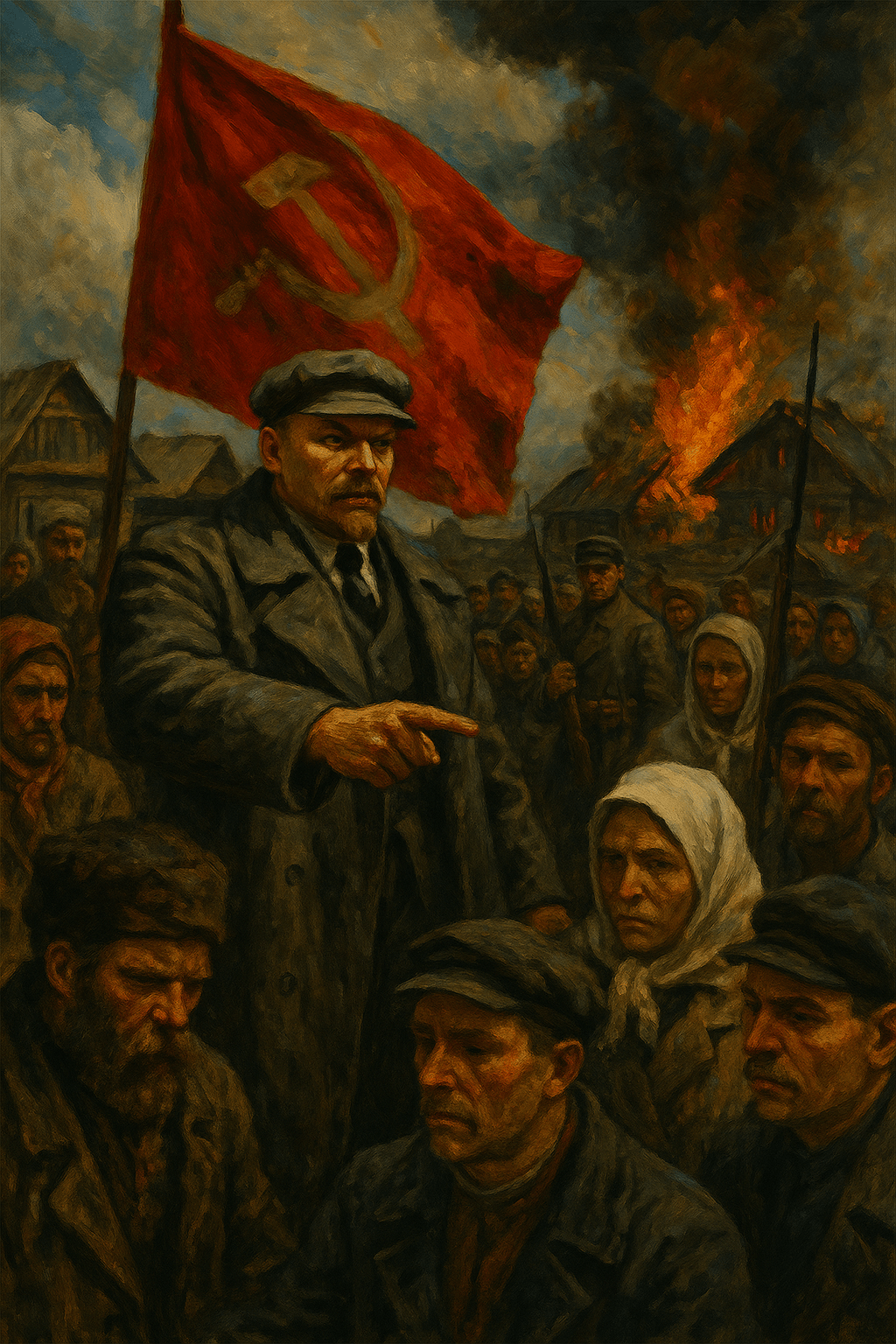
A Weaponized Intellects Book Review of James Hughes’ Stalinism in a Russian Province: A Study of Collectivization and Dekulakization in Siberia
By Prince Kapone | Weaponized Information | November 23, 2025
Where the Revolution Met Its Hardest Soil
Siberia is where the myths melt, comrade. It’s where the Western left’s soft, sentimental picture of socialism goes to die. Out here, the revolution didn’t unfold in polite debates or graduate seminars. It hit the ground—hard—on frozen earth, in villages where people still lived as if the Tsar had stepped out for a smoke break and might return any minute. If you want to know what it takes to build socialism in a world determined to strangle it in its crib, you don’t look to New York Times editorials or British historians opining from leather chairs. You look to Siberia. You look to the Siberian krai in 1929, where the class struggle wasn’t a metaphor—it was a winter storm.
James Hughes begins his book like most Western academics begin their stories about the Soviet Union—by assuming the worst. To him, Stalin’s “great breakthrough” was nothing but a reckless lurch into coercion, a bureaucratic tantrum dressed up as policy. That’s the familiar Cold War melody: socialism leaps from mistake to mistake because men like Stalin woke up angry and decided to terrorize the countryside. But even as Hughes grinds that old axe, he can’t hide what he reveals between the lines. The Soviet state wasn’t facing blank paper. It was facing a countryside that had its own ideas about power, grain, and who got to call the shots.
In 1927 and 1928, grain wasn’t simply missing—it was withheld. Peasants weren’t simply “resistant”—they were organized around a village hierarchy older than the Soviet state and far more trusted. The kulaks weren’t just productive farmers—they were rural bosses, small-time warlords of land and livestock. And the so-called “middle peasants,” the seredniaks, walked a tightrope, knowing that falling to either side—supporting the state too loudly or refusing it too boldly—could cost them everything. Siberia wasn’t a blank slate; it was a battlefield where the old order still breathed.
Hughes tries to paint all this as dysfunction—local officials dragging their feet, agronomists scolding the Party, peasants refusing to sell grain unless the price was right. But what he’s describing is class struggle, plain and simple. The state needed grain to build industry; the kulaks needed to protect their profit; the seredniaks wanted stability; and the rural bureaucrats wanted to survive long enough to retire. Everyone had their angle. And in that crowded, tense landscape, the Bolsheviks were expected to perform miracles without stepping on any toes. The Western left loves that version of the story: a revolution without enemies, without pressure, without urgency—a revolution without reality.
But out here, reality spoke louder than doctrine. The skhod—the village assembly—still commanded loyalty. Informal bosses still ran affairs. The Party, in many villages, was a guest in someone else’s home. You can’t build socialism on borrowed legitimacy. And you certainly can’t industrialize a country when a small class of wealthy farmers can shut down the state’s food supply by saying “no.”
So when Hughes frames 1929 as Stalin’s “overreach,” we have to flip the script. This wasn’t a man losing patience; this was a state running out of time. Either the countryside would be brought into a socialist framework, or the entire revolutionary project would stay chained to private grain markets and rural intermediaries who didn’t give a damn whether the Soviet Union industrialized or starved. Siberia forced the question—and the Party gave its answer.
That’s what Hughes misses, what so many Western scholars and half the Western left still miss: collectivization wasn’t a breakdown. It was a showdown. A direct clash between two economic logics, two visions of Russia’s future, two classes with incompatible goals. And Siberia, with all its distance, defiance, and frozen roads, became the harshest crucible for that fight. The story Hughes tells as bureaucratic chaos reads, from the standpoint of the oppressed of the world, as something else entirely: the moment when the Soviet project refused to bow to the old world’s power—when it started planting the seeds of a new one, even in the hardest soil.
Seizing the Village: The Struggle to Break the Peasant Grip
If the introduction showed Siberia as the hard soil where the Revolution was forced to fight for its life, Chapter 1 drops us directly into the village trenches. Hughes calls this phase “capturing the peasantry,” but what he describes is not a polite contest for hearts and minds. It is a tug-of-war between a socialist state trying to secure its food base and a peasantry—especially its wealthier layers—determined to decide for itself when and how the Revolution would proceed. The Party didn’t arrive in Siberia as some shining vanguard. It walked into districts where the kulaks practically ran their own mini-republics, the seredniaks clung nervously to the middle, and the poor peasants were often too exhausted or isolated to assert themselves. This is the landscape Hughes documents: not chaos, but a tight, unequal rural order that the Revolution had inherited and had yet to overturn.
Take the example Hughes highlights from the Kainsk district in early 1928, when Party activists called a meeting to address the grain crisis. Instead of rallying behind state procurement, the meeting turned into a kulak-led debate club where the loudest voices insisted the state had no right to set prices and that the market—not the Revolution—should decide Siberia’s future. Hughes describes agronomists and rural specialists openly contradicting Party workers, defending private farming as the only “rational” path, and mocking any talk of cooperative grain delivery. It wasn’t subtle. It was a village elite flexing its muscles in plain sight.
Or consider the infamous episode Hughes recounts from Baraba steppe villages, where local officials—charged with securing grain for the cities—found themselves literally pleading with peasants who sat back and shrugged. The harvest had been decent, but the storerooms stayed mysteriously empty. Hughes notes that when activists asked why, peasants responded with the Siberian equivalent of: “Who are you to ask?” That wasn’t passive resistance—it was a statement of ownership over the countryside itself.
Even the so-called “neutral” peasant middle layers acted with political instincts sharpened by centuries of survival. Hughes cites one case from Novonikolaevsk where seredniaks attended Party meetings, nodded politely, then went home and quietly redistributed grain among relatives to keep it off procurement ledgers. No speeches. No slogans. Just a quiet, calculated defense of family property against a state they still didn’t fully trust. Hughes interprets this as confusion or self-interest. A historical materialist reads it as the middle peasantry acting according to its own contradictory class position—leaning toward socialism when pressured from above, but clinging to market instincts when pressured from below.
And looming over all of this were the rural Soviets—the very institutions meant to anchor socialist authority in the village. Instead, Hughes shows them staggering under real, human contradictions: elected in name, captured in practice. In one Omsk district Soviet, Party representatives complained that whenever they proposed grain deliveries, the kulaks—who had quietly stacked the elections—smiled, waited for the meeting to end, and then instructed the village to ignore the Soviets altogether. The Revolution had its structures. The countryside had its loyalties. They were not the same.
What emerges in Hughes’s pages is not a state bungling policy, but a state confronting an entire world of pre-existing power. Peasants who controlled the grain. Village elders who controlled opinion. Local specialists who controlled the technical discourse. And kulaks who controlled the social temperature of the village. The Party’s authority was paper in many places; the kulaks’ influence was bone.
So when Hughes describes 1928 as a period of “mounting tension,” we can read the subtext clearly: the Revolution had reached the limits of persuasion. The countryside had not been “captured” after 1917—it had merely been left alone under NEP’s uneasy truce. The storm building in Siberia wasn’t the result of Stalin waking up with a grand plan—it was the inevitable consequence of a social order where the Revolution existed only at the edges while rural class power remained intact at the center. And as Hughes’s own examples show, the peasants were not waiting patiently for a better argument. They were already fighting, quietly and confidently, for the old world to survive.
The Battle for the Village Mind: When Ideology Met the Mud
If the first chapter showed the countryside holding the state at arm’s length, Chapter 2 shows the countryside pushing back with its whole body. Hughes calls this stage “mobilizing social influence,” but what he actually describes is a fierce ideological brawl—fought in barns, village lanes, bathhouses, and drunken night gatherings—over who had the right to name the future. And once again, Siberia does not disappoint. It gives us the raw, unvarnished scenes that every Western Marxist conveniently edits out when they argue the Revolution should have been kinder, slower, more polite. They want socialism built through tea-time resolutions; Siberia shows us socialism fighting for oxygen in rooms where the kulaks controlled the kerosene lamp.
Hughes brings us into villages where the Party was not just mistrusted—it was ridiculed. One of the more vivid examples he gives comes from a cluster of settlements near Barabinsk. When activists tried to hold a meeting to explain the procurement quotas, the kulaks arrived early, positioned themselves in the center of the room, and staged what Hughes calls a “counter-performance.” They coughed, heckled, cracked jokes about “Moscow hens clucking about grain,” and used their social status to steer the mood. By the time the Party organizer reached the front of the room, half the crowd was already leaning toward the wealthier farmers for cues on how to respond. That wasn’t propaganda—it was hegemony, rural-style.
And then there were the charivaris—village shaming rituals Siberians weaponized with remarkable creativity. Hughes describes one Siberian settlement where poor peasants, fed up with a notorious grain-hoarder, marched around his home beating pots, shouting insults, and staging a mock funeral for his “dead conscience.” The goal was simple: isolate him, break the spell of his influence. In the West, this gets read as mob psychology; in the village, it was politics from below. These peasants didn’t read Gramsci, but they understood perfectly well that power is social before it is formal, and that social power must be broken publicly or it stays intact privately.
Meanwhile, the kulaks ran their own operations. In one Krasnoyarsk district, Hughes notes how wealthy peasants organized secret nighttime gatherings—skhodki held off the books—to rehearse talking points, plan out refusals, and even assign spokesmen to derail future meetings. One kulak reportedly told his followers: “Let them talk. We will decide what happens.” Hughes reports this as “informal coordination,” but anyone with a grip on class analysis can see it for what it was: counter-organizing. A shadow leadership holding court against the Revolution.
And inside the local Soviets—the institutions meant to anchor socialism—the contradictions sharpened. Hughes describes Soviets where the elected members were, in practice, “captured” by the wealthier peasants, who used procedural games to stall grain deliveries and block resolutions. In one district, a Party member recalled that every time he raised a motion for procurement, the chairman would suddenly “remember” a crisis needing immediate attention on the other side of the village. Meetings dissolved. Votes postponed. Paper piled up. The Soviet existed; the kulak ruled.
But the most telling detail Hughes offers is not the open defiance. It is the intermediaries. The teachers, bookkeepers, livestock specialists—those educated layers who should have been natural Party allies but instead acted as ideological brokers for the old order. In one Omsk village, a livestock technician lectured the entire crowd about the “irrationality” of collective farming while Party activists sat there in stunned silence. Hughes describes him as “influential” and “trusted.” Of course he was. He was the village’s technician, the man who cured diseased cows. The Revolution needed grain, but villagers needed milk. Guess whose argument carried more weight.
What Hughes presents as “local culture” was, in truth, a series of class blocs leveraging every tool at their disposal—kinship networks, reputations, ridicule, technical authority, religious language, and even the gossip economy. And while Hughes frames these moments as evidence of state overreach or peasant spontaneity, the actual picture is clearer: the Revolution entered these villages as an outsider, and the old social order used every trick in its repertoire to hold ground.
So the question posed in this chapter is not “Why did the Bolsheviks resort to pressure?” The question is: how long could any revolution tolerate a situation where the kulaks commanded more authority in a village assembly than the elected Soviet? Where a livestock technician could derail a national industrialization plan? Where charivaris were more politically effective than Party resolutions? Siberia shows us that the Bolsheviks weren’t experimenting with tyranny—they were struggling for relevance in a social landscape where power flowed through channels older, deeper, and far more personal than the Soviet state. And in that fight, there are no clean victories, no easy dialogues, no polite disagreements. There is only the long road of wrestling a new world out of the grip of the old.
When Policy Hit the Wall: The Search for a New Method
By the time we reach what Hughes calls “the search for a new method,” the polite illusions have already dissolved. The grain crisis wasn’t easing. The kulaks weren’t compromising. And the village Soviets—those fragile institutions meant to be the bridge between the Revolution and the countryside—were buckling under pressure from all sides. This was the moment, Hughes argues, when the Soviet state began to grope for new tools, new pressures, new levers. But what he describes as improvisation looks, from the standpoint of historical materialism, like something far more concrete: a state slowly realizing that the old NEP framework had run out of road, and that the contradiction between market logic and socialist survival could no longer be papered over. Siberia made that contradiction painfully obvious.
Hughes gives us a sharp example from the Novosibirsk province in late 1928. The Party, faced with stalling procurement, issued modest pressure on wealthy grain-holders—fines, warnings, community inspections. But by the time activists arrived, the grain had already evaporated into the underground channels of the village economy. Hughes recounts how one brigade reported that every kulak household they visited smiled and delivered the same rehearsed line: “There is no excess grain in the village.” Yet the storerooms smelled of fresh rye. Tracks in the snow pointed to hidden sheds. Livestock feed bins looked fuller than usual. Even the poorest families whispered to Party workers, “Don’t try them. You will only provoke the village.”
Local officials, torn between loyalty to the state and fear of enraging powerful households, often wavered. In one district Soviet, Hughes notes a scene that captures the paralysis perfectly. A young Party representative loudly demanded that grain be requisitioned from a known hoarder. The chairman—an elected official beholden to the village mood—folded his hands, sighed, and replied: “Comrade, let us not disturb the peace.” Peace, in this case, meant surrender. The state’s authority was reduced to a suggestion. The kulak’s authority was a fact.
This is where Hughes’s chapter becomes unexpectedly revealing. He describes a wave of what he calls “institutional fatigue”—Soviet courts reducing fines for fear of backlash, local prosecutors dismissing obvious cases of hoarding, police officers “unable to locate” property that every child in the village knew existed. This wasn’t incompetence. It was political pressure, the old rural hierarchy quietly warning its intermediaries not to break rank. Lenin had once warned that the peasantry contained “two souls”—a democratic impulse and a petty-bourgeois instinct. In Siberia, at this juncture, only one soul was speaking.
What makes this chapter come alive, though, is the push from below. Hughes mentions the newspaper Molodoi rabochii, which blasted the judicial system for coddling kulaks instead of protecting the Revolution. These weren’t bureaucrats complaining—they were young workers, often barely out of adolescence, watching the villages sabotage the industrial future they were sacrificing to build. They had no patience for the local Soviet chairman’s “peace.” They wanted the grain in the warehouses, the factories built, the country electrified. For them, this wasn’t a policy dispute. It was class betrayal. And they said so—publicly.
The Party, caught between the rural elite’s quiet obstruction and the urban proletariat’s mounting frustration, was forced to consider sharper tools. Hughes describes how activists began talking openly about “extraordinary measures”—not because Stalin whispered in their ears from Moscow, but because the usual channels were so clogged with local resistance that grain flowed slower than rumor. The more the kulaks closed ranks, the more the middle peasants hedged, and the more the Soviets stalled, the more activists realized that the NEP-era legalism had reached its limits. A revolution cannot move forward when its most basic lifeline—food—is controlled by its most skeptical social class.
Hughes frames this moment as a crisis of governance, but the evidence he provides points to something far sharper: the unfolding of a political logic that no amount of persuasion or good intentions could avoid. A state trying to industrialize at breakneck speed cannot coexist indefinitely with a countryside operating on private profit. A revolution that wants to build socialism cannot permanently defer to a class that wants the market. And a Party that needs grain cannot trust institutions that answer more to local patriarchs than to national plans.
Thus, the “new method” was not a leap into madness. It was the recognition that the old method—coaxing, negotiating, waiting—was simply digging the hole deeper. The village power structure had spoken. The question was whether the Revolution would learn to speak back with equal force. Siberia was not a sideshow to Soviet history. It was the place where the Revolution hit the wall of the old world, pressed its palms against it, and began searching for the cracks.
The Ural–Siberian Method: When the State Finally Picked Up a Hammer
By the time Hughes leads us into the Ural–Siberian Method, you can feel the temperature rising. The genteel rituals of NEP-era persuasion had burned away. The polite requests, the soft warnings, the wishful thinking—all exhausted. What remained was a countryside confident in its power and a state increasingly aware that it was being played. This was the moment when the Bolsheviks stopped tapping politely on the village door and started testing how thick the wood really was. The Ural–Siberian Method—portrayed by Hughes as an administrative overreach—was, in reality, a political experiment: a rehearsal for breaking the rural bourgeoisie’s grip on the grain supply.
Hughes walks us straight into the heart of it: the piatikratniki fines. These weren’t random punishments hurled from bureaucratic hysteria. They were targeted pressures—fivefold reimbursements for deliberately hidden grain. And Hughes’s own numbers give the game away. In one district near Tobolsk, activists uncovered hidden stocks in almost half the kulak households inspected. One case Hughes cites is especially striking: a kulak who swore up and down that he had no surplus grain, only for a search brigade to discover nearly a ton of rye buried beneath his livestock shed. The man wept, begged, invoked “fairness,” and dramatically clutched at the Party representative’s coat—as if the Revolution were an unreasonable guest rifling through his personal belongings rather than a state fighting for its industrial survival.
Hughes dutifully records all this, but instead of drawing the obvious class line, he retreats into talk of “legal ambiguity.” Legal ambiguity? The state was trying to electrify the country. The kulaks were burying grain under pig slop. That wasn’t ambiguity—that was war by other means.
Contrast that with the case Hughes uncovers in Achinsk district, where a group of poor peasants, desperate for seed grain, marched to the home of a well-known grain speculator and demanded he hand over his hoarded stock. Hughes frames it as “mob pressure,” but what he describes is the rural poor asserting a moral economy that predated and, in many ways, exceeded the Revolution itself. These villagers didn’t wait for Moscow. They understood that the kulak’s hoard was a direct threat to their survival. So they acted. The Revolution had supporters in the countryside—they just weren’t the people counted as “influential” in Hughes’s archives.
Then there’s the brilliance of what activists called the “shoulder-to-shoulder campaign.” Hughes notes that in several Siberian districts, brigades paired younger, militant factory workers with local poor peasants to conduct searches and pressure wealthier households. This wasn’t simply coercion—it was political pedagogy. It brought together two classes that, under Tsarism, would never have met as equals: the urban proletariat and the rural exploited. And it terrified the kulaks precisely because it worked. One activist reported that grain deliveries spiked the day after the first joint brigade visited a notorious hoarder. As he put it, “The village suddenly remembered its obligations.”
But Hughes’s most revealing example comes from his discussion of seizures. In one Krasnoyarsk village, the brigade arrived too late—the kulaks had already slaughtered half their livestock in a desperate attempt to keep the state from collectivizing it later. Hughes quotes a district report lamenting “the senseless destruction of productive animals.” Senseless? No, comrade—calculated. The rural bourgeoisie would sooner burn down the barn than hand over the key. To them, the Revolution was a threat to property; to the state, their property was a threat to the Revolution. The Ural–Siberian Method emerged precisely in this pressure zone.
What Hughes interprets as a breakdown of the rule of law is better understood as the early stages of a new class order being born. The Revolution had finally exhausted its patience with the old rural hierarchy. And the kulaks had exhausted their patience with the Revolution. Between those two limits, history pushed forward. The Ural–Siberian Method wasn’t a random crackdown. It was the prototype of a new relationship between the countryside and the state—one where the Soviet government asserted, for the first time with real force, that the grain of the nation would not remain the private bargaining chip of a rural minority.
You can almost feel Hughes flinch at the implications. He wants this method to represent the birth of Stalinist excess. But the primary sources he digs up tell a harder truth: the old world wasn’t going to die quietly. The state wasn’t going to live quietly. And the Ural–Siberian Method showed both of them discovering, in real time, just how much pressure the situation demanded. The hammer hadn’t yet fallen. But for the first time, the state picked it up.
Volynki: When the Countryside Answered Back
If the Ural–Siberian Method was the state picking up a hammer, then the volynki—the roaring wave of peasant disturbances that Hughes details in Chapter 5—were the countryside grabbing whatever it could find and swinging back. This was no quiet disagreement over economic policy. This was the peasantry, especially its upper layers, declaring that if the Revolution insisted on dragging Siberia into the twentieth century, it would have to fight its way through smoke and broken hinges to get there. Hughes calls these outbursts “disturbances,” but they were something far closer to a rural jacquerie—localized uprisings that flickered into life whenever the state pushed too close to the sources of village wealth and authority.
Hughes gives us one unforgettable scene from the Chulym River basin. A brigade attempting to investigate hoarded grain arrived in a village just as a crowd began gathering. Within minutes, what started as a few angry men turned into a mass confrontation. The activists were surrounded. A local strongman—a kulak with a reputation for settling disputes with his fists—stepped forward and shouted, “No one will take a grain from this land!” Hughes, in his cautious academic tone, notes that the brigade “withdrew to avoid escalation.” Let’s translate: the activists were chased out by a village boss who commanded more loyalty than the Soviet state. This wasn’t a misunderstanding. It was a power check.
In another case, near the Kainsk district, Hughes describes a full-blown riot triggered by the arrest of a known grain speculator. When the OGPU carted the man away, villagers cut the harness of the sleigh, pulled him free, and formed a protective ring around him while shouting, “Our man! Not yours!” Hughes labels this “communal resistance,” but that phrase smooths over the jagged edge of what happened: the kulak class had convinced the village that their fate was tied to his. His “freedom” meant their autonomy from the state; his arrest meant the Revolution had finally crossed the threshold from persuasion to confrontation. The peasants fought because the stakes were clear.
And then there’s the incident Hughes recounts from the southern Tomsk region. A search team seized a stash of hidden grain. Before they could inventory it, the crowd surged forward, overturned the sacks, and trampled the grain into the snow. Not stolen—destroyed. Hughes calls it “symbolic.” Symbolic of what? Of a rural world that would rather ruin food than let the Revolution control it. The destruction was a message: If we cannot profit from this grain, neither will you. This wasn’t just economic sabotage; this was political theatre, performed in front of the entire village.
Hughes attempts to soften the sharpness of these conflicts by attributing them to drunkenness, rumor, or poor communication. But the examples betray him. In many villages, disturbances broke out only after backroom consultations among wealthier households. In the Baraba steppe, Hughes notes that one riot erupted after a clandestine skhod, where the kulaks agreed to “show the state its limits.” That’s not spontaneity—that’s counter-organization. It’s the rural bourgeoisie moving the village like pieces on a board.
Perhaps the most telling pattern Hughes highlights—without fully grasping its meaning—is the social geography of the volynki. They erupted most fiercely where the kulaks were strongest: where livestock herds were largest, grain surpluses widest, and informal authority deepest. In one Krasnoyarsk district, a Party worker reported that every household involved in the riot belonged to the top tier of the village’s agrarian hierarchy. The poor peasants stayed home. The middle peasants watched from the margins. This was not the peasantry rising against “state oppression.” It was the peasant elite fighting to protect a world where they remained kings.
Hughes also documents the flip side: small, scattered acts of rebellion by the rural poor—not against the state, but against the kulaks. In one village near Bolotnoe, when a wealthy farmer threatened to beat a search brigade, a poor peasant woman stepped forward and shouted, “You’ve lived off our backs long enough!” Hughes calls this “anomalous,” as if class struggle in the countryside should only flow in one direction. But these anomalies matter. They show that the village was not a unified organism. It was a battlefield with factions, tensions, and fault lines that the Revolution had only begun to expose.
What Hughes calls “volynki” were not random tempests. They were the countryside demanding to remain what it had been for centuries: a zone where the state’s reach stopped at the village boundary and private wealth set the pace of life. The disturbances were the kulaks’ last great attempt to make the Revolution blink. And for a moment, in some villages, it almost worked. But the very intensity of the resistance only convinced activists and Party leaders that the old world would not be negotiated with. It would have to be dismantled.
This chapter reveals something the Western left still refuses to accept: that collectivization was not simply the state bearing down on the peasants, but the peasants’ upper layers bearing down on the state. And it was in the smoke and shouting of these Siberian volynki that the Bolsheviks learned, with painful clarity, that they weren’t confronting an administrative problem. They were confronting a rival power. A rural power. A class power. And it intended to stay standing.
The Machinery Tightens: Repression as the Grammar of a New Order
By the time Hughes ushers us into Chapter 6—his so-called “prologue of repression”—the mask is off on all sides. The village has declared its terms. The kulaks have shown their teeth. The middle peasants are hedging like seasoned gamblers. And the poor peasants, still timid but tested by the escalating crisis, are beginning to find their voice. Into this volatile landscape steps the state, not with a whisper but with the beginnings of a new grammar—one written in decrees, penalties, brigades, and the firm realization that the “soft law” of the NEP era was now a suicide pact.
Hughes begins with Article 61, the legal tool that became a kind of rural semaphore. Under NEP, Article 61 was a dusty provision reserved mostly for petty theft or tax evasion. But in Siberia 1928–29, its meaning shifted. Hughes documents case after case where local courts—under pressure from activists, workers, and sometimes Moscow—revived this statute to prosecute hoarding, sabotage, and the most common sin of all: refusing to sell grain at state prices. In one district he examines, convictions under Article 61 jumped sixfold within a year. Hughes tries to frame this as “legal distortion,” but the context he provides betrays a different logic entirely. This wasn’t distortion—it was adaptation. The law was adjusting to the war being waged beneath it.
Even more revealing is the institutional choreography Hughes describes in Omsk province. District Soviets, once timid, now began forwarding complaints directly to OGPU investigators. The security services—long caricatured in Western historiography as Stalin’s iron fist—here appear less like a monolithic terror apparatus and more like an overworked rural fire brigade, running from village to village trying to stamp out fires lit by grain speculation and counter-organizing. In one case Hughes details, OGPU officers seized a hidden cache of grain, only to find the local Soviet pleading with them afterward: “Please, comrades, do not return here soon. The village is in a fury.” Even the state was nervous.
Then there are the fines—an entire economy of punitive pressure that Hughes catalogues with forensic precision. In Tomsk province, Hughes notes that the average fine for failing to meet delivery quotas increased nearly fourfold. One particularly instructive episode involved a group of middle peasants who collectively refused to deliver grain. When fined as a bloc, they exploded—not at the state, but at the kulak who had convinced them to hold out. Hughes quotes one of them screaming in a meeting: “You lied to us! You said they could do nothing!” That is not the voice of a peasantry united against the state. It is the voice of a class fracturing.
And while Hughes criticizes these measures as “administrative coercion,” he also documents the other half of the story: the growing impatience of urban workers with the countryside. In Novosibirsk, factory committees sent delegations demanding that the Soviets “stop capitulating” to village elites. Newspapers published columns scorning the “rural profiteers” who “eat meat while the workers tighten their belts.” Hughes notes how these articles fueled resentment, but he misses the deeper truth: the peasantry’s refusal to deliver grain wasn’t an isolated rural issue—it was a direct blow against the working class and against the entire industrial project the Revolution was trying to build.
What Hughes calls repression was, in this moment, the emergence of a new social contract—not harmonious, not gentle, but real. The state was no longer treating the villages as autonomous little kingdoms where Siberian common sense outweighed socialist necessity. It was beginning to assert that the Revolution had obligations too: to build factories, to feed cities, to electrify a continent, to break once and for all the centuries-old monopoly of rural elites over food, land, and life. And to do that, the state needed a machinery capable of resisting the informal power the kulaks and their allies exercised with such practiced ease.
This is the part the Western left always tries to skip, as if revolutions mature in a vacuum and not in the messy, contested terrain of class struggle. Hughes, to his credit, provides all the evidence—even if he draws the wrong ideological conclusions. What he calls “repression” reads, in the cold clarity of historical struggle, as the necessary articulation of state power in a countryside that had no intention of giving up its privileges without a fight. The old order had weapons: kinship, respect, fear, lineage, reputation, wealth. The new order had to develop weapons of its own.
Siberia made this brutally clear. The legal codes tightened. The OGPU stepped forward. The fines escalated. The Soviets stiffened their spines—some of them, at least. This wasn’t the onset of tyranny. It was the acknowledgment that a revolution lacking the means to protect itself is not a revolution—it is a rumor waiting to be extinguished. And in the villages of Siberia, that rumor was surrounded by enemies with long memories, full barns, and no intention of surrendering the future quietly.
Drawing the Line: Stalin’s “Final Solution” to the Kulak Question
Now we reach the pivot—the moment Hughes casts as Stalin’s plunge into brutality, but which his own evidence reveals as something far more complex and historically grounded. Chapter 7 brings us into the crucible of dekulakization, the point where the simmering conflict in Siberia finally boiled over. Hughes, true to his discipline, coats the chapter with the language of “excess,” “overreach,” and “administrative terror.” But the very cases he documents make it painfully clear that the state wasn’t acting in a vacuum or improvising cruelty for its own sake. It was responding to a level of organized, entrenched rural resistance that had made every softer instrument of policy crack like thin ice.
Let’s start with the numbers—Hughes’s numbers, not ours. In just the first three months of 1930, Siberia collectivized over 781,800 households. Hughes frames this as a sign of mania. But the archives show something else: an entire region that had spent years sidestepping the Revolution was finally brought under decisive political pressure. And with every new collective farm declared, the kulaks responded the same way: with sabotage. Hughes quotes an OGPU report listing dozens of cases of arson—barns, granaries, even collective farm offices burned to the ground in a single district. One village lost its entire seed reserve overnight. Another saw its only tractor sabotaged, its engine filled with sand. This wasn’t passive resistance. It was a rural class fighting for its life.
Hughes records one chilling example from the Chulym region: a collectivization meeting cut short after activists discovered that livestock pens had been opened in the night, releasing hundreds of animals into the forest. By dawn, wolves had done the rest. The village woke to a collective slaughter staged by human hands. The loss was enormous—not to the kulaks, who had already secured their herds, but to the poorer peasants who depended on shared stock. The sabotage wasn’t just anti-state—it was anti-poor. It was class war masked as mischief.
And then there is the violence inside the households themselves. In one case Hughes cites, a kulak patriarch slaughtered his entire herd and poured kerosene over his stored grain rather than let any of it enter the collective. His neighbors watched in shock. His defiance was so total it left the poor peasants speechless. Hughes calls this “desperation.” But to the rural poor, it looked like a confession: the kulak would rather destroy wealth than live in a world where it was shared.
Dekulakization, in Hughes’s telling, appears as an indiscriminate sweep. But the cases reveal clear political targeting. In one Tomsk district, activists compiled detailed lists of households ranked by property, influence, and past obstruction. Hughes even reproduces fragments of these lists. The names at the top weren’t random peasants—they were the same men who had led the volynki, who had hidden grain, who had packed local Soviets with their allies, and who held the village in a grip of quiet intimidation. The poor peasants, when interviewed years later, admitted that “everyone knew who the kulaks were,” but no one dared say their names until the state arrived with force behind it.
And force did arrive—clumsy, harsh, uneven. Hughes documents mistakes, abuses, overapplications. But he also documents the arc of the campaign: from confiscation and relocation to the rapid demobilization of the worst excesses when Moscow realized the scale of local distortions. A process this massive, under this much pressure, was never going to unfold with surgical precision. But to treat the entire campaign as sadism is to erase the conditions that made it inevitable. The kulak class had declared, through action and sabotage, that it would never coexist with collectivization. They had the material means, the local networks, and the social authority to derail the Revolution indefinitely. The question wasn’t whether the state would move, but how.
One of Hughes’s most telling examples involves a group of poor peasants in a Krasnoyarsk village who, after years of suffering under the local elite, helped activists identify the households with the most grain, livestock, and hired labor. Hughes frames this as “class animosity manipulated from above.” But the testimonies he cites tell another story—poor peasants finally speaking the truth they had swallowed for decades. One old woman told investigators: “The rich ones told us we were nothing. Now we speak.” History is rarely more poetic than that.
This chapter forces us to confront the hard truth that every revolution eventually meets—the moment when persuasion has run its course and the entrenched classes refuse to budge. The kulaks weren’t bargaining. They weren’t confused. They weren’t waiting for better instructions from Moscow. They had chosen resistance, sabotage, and, when necessary, blood. What Hughes calls Stalin’s “final solution” to the peasant question was, in practice, the state’s recognition that the rural bourgeoisie had already fired the first shots.
And so Siberia became the furnace in which the Revolution was forced to decide whether it would accept a future defined by the power of local elites, or whether it would risk everything to build a new world from the ashes of the old. Hughes wants this moment to demonstrate the cruelty of socialism. But his own evidence demonstrates something much more elemental: the old world was never going to step aside. It had to be pushed.
Barshchina and Maroderstvo: The Chaos of a World Being Torn Apart
By the time we reach Chapter 8, Hughes leads us into the swirl of what he calls barshchina and maroderstvo—terms he uses to capture the explosion of petty violence, theft, sabotage, and desperate improvisation that shook the Siberian countryside in the wake of dekulakization. But beneath the academic taxonomy, what he’s really chronicling is the disintegration of an old social universe under pressure. It wasn’t just the state acting on the village; it was the village acting on itself. Hughes’s own evidence paints a picture of rural life during collectivization not as a simple morality tale of oppression and victimhood, but as a chaotic battlefield of crisscrossing class pressures, where every social layer grabbed at whatever means it had left to survive, to resist, or to settle scores.
We see it clearly in the examples Hughes provides. In one district near Tara, after the first wave of dekulakization, poor peasants—long suppressed under the old hierarchy—began seizing small plots of pasture, tools, and even leftover livestock from evacuated households. Hughes labels this “maroderstvo,” lumping together class redistribution with opportunistic looting. But his sources tell a different story. One widow admitted during interrogation: “I took what they had taken from us for twenty years.” Was she stealing? Or reclaiming? Hughes refuses to ask. History, however, asks it loudly.
Then there are the retaliatory acts of the kulaks who remained. In the Baraba region, Hughes recounts a scene where a wealthy peasant who had escaped initial classification returned at night to sabotage collective plowing efforts. Villagers awoke to find that someone had loosened the harnesses on the oxen and scattered seed grain into puddles of mud. Hughes calls this “sporadic resistance.” But the pattern is unmistakable: the rural bourgeoisie, stripped of open authority, fought from the shadows, striking not only at the state but at their poorer neighbors who stood to gain from collectivization.
The middle peasants, always the weather vane of the countryside, appear in this chapter at their most conflicted. Hughes describes a case from the outskirts of Achinsk where seredniak households began quietly splitting livestock ownership on paper—half to a cousin, a quarter to a godparent, the remainder to a fictitious “co-owner”—in a desperate attempt to avoid being mistaken for kulaks. This was not counterrevolutionary. It was survival. And Hughes captures the panic perfectly: one seredniak confessed to investigators, “I hid my two calves with my uncle so they would not think I was rich.” The Revolution had exposed not only wealth but the fear of being seen as wealthy. That fear is itself a measure of class transformation.
But the most gripping material in this chapter involves the explosion of interpersonal conflict—feuds, denunciations, sudden alliances—what Hughes tries to categorize as “barshchina,” the reemergence of labor exploitation and forced assistance in new forms. In one Krasnoyarsk village, Hughes shows how the newly formed kolkhoz leadership, composed largely of poor peasants with newly elevated status, compelled middle peasants to work extra hours under the justification of “building socialism.” Hughes frames this as petty tyranny, and sometimes it was. But it also revealed something deeper: former subordinates experimenting, clumsily and sometimes cruelly, with the first taste of authority they had ever held.
And, of course, not all actions were noble. Hughes gives us a case from Tomsk where a group of young poor peasants raided an evacuated kulak home and drank themselves into a stupor on potato liquor. When interrogated, one of them told OGPU officers, “They lived good while we lived bad.” It is the kind of quote Western academics seize upon to illustrate moral decay. But to anyone with a grounding in the history of class society, it reads like something else: the dizziness of a world turned upside down. The old moral order—however unjust—had shattered. And in its place, a new one had not yet been fully built.
Where Hughes falters is in his attempt to make all these dynamics appear as evidence of state failure. But the truth is more dialectical—and far more uncomfortable for bourgeois historiography. Revolutions do not replace one neat social structure with another. They rip apart the connective tissues of everyday life. They drag buried resentments, hidden dependencies, long-simmering jealousies into the open. What Hughes calls “anarchy” is better understood as the unavoidable turbulence of class realignment. The poor peasants who seized tools were not simply looters—they were asserting, often clumsily, a new claim on the village’s resources. The middle peasants who lied about livestock were not cowards—they were navigating the crumbling edge between the old world and the new. And the kulaks who sabotaged collective efforts were not misunderstood “individualists”—they were a defeated class refusing to go quietly.
This chapter forces us to confront a truth that most historians—especially liberal ones—fear to admit: when the foundation of a society is overturned, the debris does not fall in orderly piles. It scatters. It splinters. It injures. Hughes describes the splintering with clinical detail, but he misses the meaning in the motion. These acts of barshchina and maroderstvo were not peripheral noise. They were the soundtrack of the old order dying and the new one struggling to be born.
The Great U-Turn: When the Revolution Caught Its Breath
By the time Hughes leads us into Chapter 9—what he calls “the Great U-Turn”—the countryside has been shaken, the kulak class has been broken, and the Revolution itself stands panting, bruised, and blinking through the dust. This was the moment when Moscow stepped back from the breakneck pace of collectivization and declared, in Stalin’s now-famous phrase, that the country had become “dizzy with success.” Hughes, following the mainstream Sovietological script, presents this retreat as proof that the entire collectivization drive had been misguided from the start. But the evidence he marshals tells a far deeper and far more dialectical story: the retreat was not an admission of failure, but an adjustment after a decisive victory—a recalibration after the balance of power in the countryside had fundamentally shifted.
Consider the numbers Hughes cites. Following the March 1930 decree, Siberia’s collectivization rate dropped dramatically. Kolkhoz membership plunged. Many households abandoned the collectives and reclaimed plots, livestock, and tools. Hughes takes this as proof that collectivization collapsed the instant the pressure eased. But he overlooks what had already changed. The kulak class—the one social force that had both the wealth and the will to organize mass rural resistance—was gone. A counterrevolutionary pole that had dominated Siberian rural life for generations had been removed from the chessboard. The middle peasants who left the kolkhozes in the spring did not return to the old world. They returned to a countryside where the social climate was no longer set by the wealthy few.
Hughes offers an example from Tomsk province: a collective farm where three-quarters of the members walked away during the retreat, only to rejoin a year later when the kolkhoz re-formed under more stable leadership and better planning. To Hughes, this signifies confusion. But to anyone familiar with the tempo of revolutionary struggle, it reads as the whiplash of a society in rapid transition. The peasants weren’t rejecting collectivization—they were reacting to its chaotic first draft. As one peasant told investigators: “We wanted the farm to be strong, not rushed.” The U-Turn gave them time to breathe.
And breathing was necessary. Hughes documents a host of administrative disasters that followed the initial collectivization wave: mismanaged inventories, chaotic redistribution, fields left unplowed because activists lacked basic agricultural knowledge. One brigade in Krasnoyarsk proudly reported seizing livestock only to confess later they had no idea how to feed or shelter the animals. Another collective harvested late because no one had thought to assign a tractor driver. These were not moral failures. They were the predictable missteps of a revolution trying to reorganize an entire agrarian system under conditions of speed, resistance, and limited expertise.
The U-Turn represented the moment when the state acknowledged the gap between ambition and capacity—and recalibrated without surrendering the ground it had already taken. Hughes himself notes that even after the retreat, procurement discipline remained far stronger than under NEP. Local Soviets acted with greater confidence. And crucially, the poor peasants—long overshadowed by the kulaks—began to take leadership roles in the collectives. Hughes quotes one district report observing that “activists from among the poor peasants showed initiative in reorganizing farms during the retreat.” That is not rollback. That is consolidation.
Perhaps the most revealing detail Hughes offers is the changing attitude of the middle peasants. In one Novosibirsk district, a seredniak who had loudly denounced collectivization in February was, by autumn, serving as a brigade leader. When questioned, he told investigators: “We saw that the rich ones were gone. Now we can work without fear.” Hughes cites this almost in passing, but it crystallizes the real significance of the U-Turn. The middle peasants weren’t rejecting collectivization—they were rejecting a process that had been rushed and distorted by vertical pressure and local sabotage. Once the worst distortions were removed, collectivization became something they could imagine participating in rather than just enduring.
For Hughes, the retreat is proof that the Revolution faltered. But the historical arc points to something far more profound. Revolutions are not linear. They surge, they break, they correct. The Bolsheviks had pushed hard because they had no choice—the kulaks forced the pace through their own resistance. But once the kulak power base was dismantled, the state could slow down without losing the initiative. The U-Turn wasn’t defeat. It was strategy. It was Leninist flexibility applied under crushing pressure.
Most importantly, the retreat demonstrated that the state was not a runaway machine, as Western historiography so often insists, but a political organism reacting to conditions, feedback, and contradictions. It adjusted not because the goal was wrong, but because the path was uneven. Hughes wants us to read this as confession. But the archives he cites read differently: the Revolution took one step back only because it had already taken ten steps forward.
And in Siberia—this harsh, defiant, impossible terrain—that change was unmistakable. The old rural order had been broken. The new one was still stumbling, confused, raw. But it was there. The U-Turn was the Revolution catching its breath before pushing on again. History rarely grants such moments. When it does, they are not signs of failure—they are signs of life.
Siberia After the Storm: What the Revolution Left Behind
By the time Hughes arrives at his concluding chapter, he tries to pull everything back into the calm, sober language of the academy—summaries, evaluations, balanced formulations. But the archive he has spent nearly three hundred pages excavating refuses to sit still under that polite wrapping. Siberia will not be reduced to a neat conclusion. What Hughes actually ends up showing, despite himself, is something far more powerful: collectivization in Siberia was not an episode in administrative excess but a world-historic rupture, where an entire social order was forced to reveal its true nature under pressure. And when it finally cracked, what emerged was not simply chaos. It was a new terrain of class relations—confusing, uneven, improvised, but undeniably transformed.
Hughes admits, almost reluctantly, that the traditional village elites—the men who dominated the skhod, controlled grain surpluses, commanded deference, and brokered every important decision—were shattered by 1931. Their political authority collapsed. Their economic power evaporated. Hughes frames this as tragic, as the loss of “village autonomy.” But the testimonies he includes betray another truth: for the rural poor and much of the middle, this was liberation. In one Tomsk district, a poor peasant told investigators that after dekulakization, “The village began speaking with its own voice.” Hughes cites it as evidence of “class resentment,” but buried in those words is the sound of a social horizon widening for people who had lived all their lives under the weight of men with more land, more livestock, and more power.
Hughes also notes the emergence of a new rural leadership: young activists, former farmhands, poor peasants elevated into positions of responsibility. He can’t resist calling many of them “inexperienced,” and of course they were. But they were also something the village had never seen before—leaders who didn’t owe their authority to inheritance or wealth. In one Siberian collective farm, Hughes recounts how a nineteen-year-old former shepherd became the head of a tractor brigade simply because he was the only one willing to learn the machinery. Other peasants followed him not because they feared him, but because he represented a future where knowledge—not lineage—set the terms of life.
The middle peasants, whom Hughes portrays as reluctant participants, also underwent transformation. By the early 1930s, many of them had become essential to kolkhoz management and production. Hughes notes one example from Barabinsk where a respected seredniak—initially skeptical, even hostile—became a bookkeeper for the collective because he found that “the kolkhoz protected us from the rich.” This is not the language of coerced loyalty. It is the language of a class discovering its stake in a new world.
And then there is the most inconvenient fact Hughes uncovers: Siberian agriculture recovered quickly. Despite the upheaval—despite the sabotage, the slaughter of animals, the riots, the administrative chaos—production not only stabilized but began climbing by the early 1930s. Hughes offers case after case of collectives that reorganized, replanned, and rebuilt. One kolkhoz that had nearly collapsed during the U-Turn surpassed its sowing targets the following year. Hughes frames this as the result of “improved administration,” but he misses the deeper point: once the social power of the kulaks was broken, the countryside could finally be reorganized around cooperation rather than coercive deference.
This is where Hughes tries to return to the old Cold War narrative. He warns of the “human cost,” the “disruption,” the “coercion.” All true. History at this scale is not gentle, and no revolutionary worth their salt pretends otherwise. But what Hughes cannot bring himself to conclude—though his own evidence presses him toward it—is that the human cost was inseparable from the human possibility. The Russia of 1928 could not industrialize under a grain market controlled by a hostile class. The state could not fund electrification with barns locked behind private wealth. The Revolution could not survive while its most fundamental resource—food—was governed by those who feared and despised it.
Siberia makes this brutally clear: the struggle over collectivization was not a policy dispute. It was the decisive battle over who would shape the future. A rural elite whose power stretched back centuries, or a working-class state fighting to build a new society in real time? Hughes, in his final paragraphs, tries to mourn the loss of the former. But the testimonies of the poor peasants, the emergence of new leaders, the collapse of old hierarchies, and the rapid recovery of agricultural productivity all point to a different verdict: the old world died, and something else—messy, raw, contradictory, but revolutionary—took its place.
And that is where this book, intended as a critique of Stalinist excess, becomes something else entirely. Hughes wanted to show the tragedy of collectivization. But what he ended up showing—through police reports, village minutes, OGPU files, and peasant testimonies—is that the tragedy was already there, embedded in the centuries-old rural hierarchy the Revolution confronted. Collectivization didn’t create the contradiction. It exposed it. And then, with all the force and ferocity of a state fighting for its life, it resolved it.
Siberia after collectivization was not peaceful. It was not fully formed. But it was unmistakably changed. The rich no longer ruled. The poor no longer whispered. And the Revolution, for all its wounds, had finally secured a foothold in the land itself. Hughes may not have meant to show it, but he does: collectivization in Siberia was not the collapse of the Revolution. It was its consolidation.
 Weaponized Information
Leave a comment