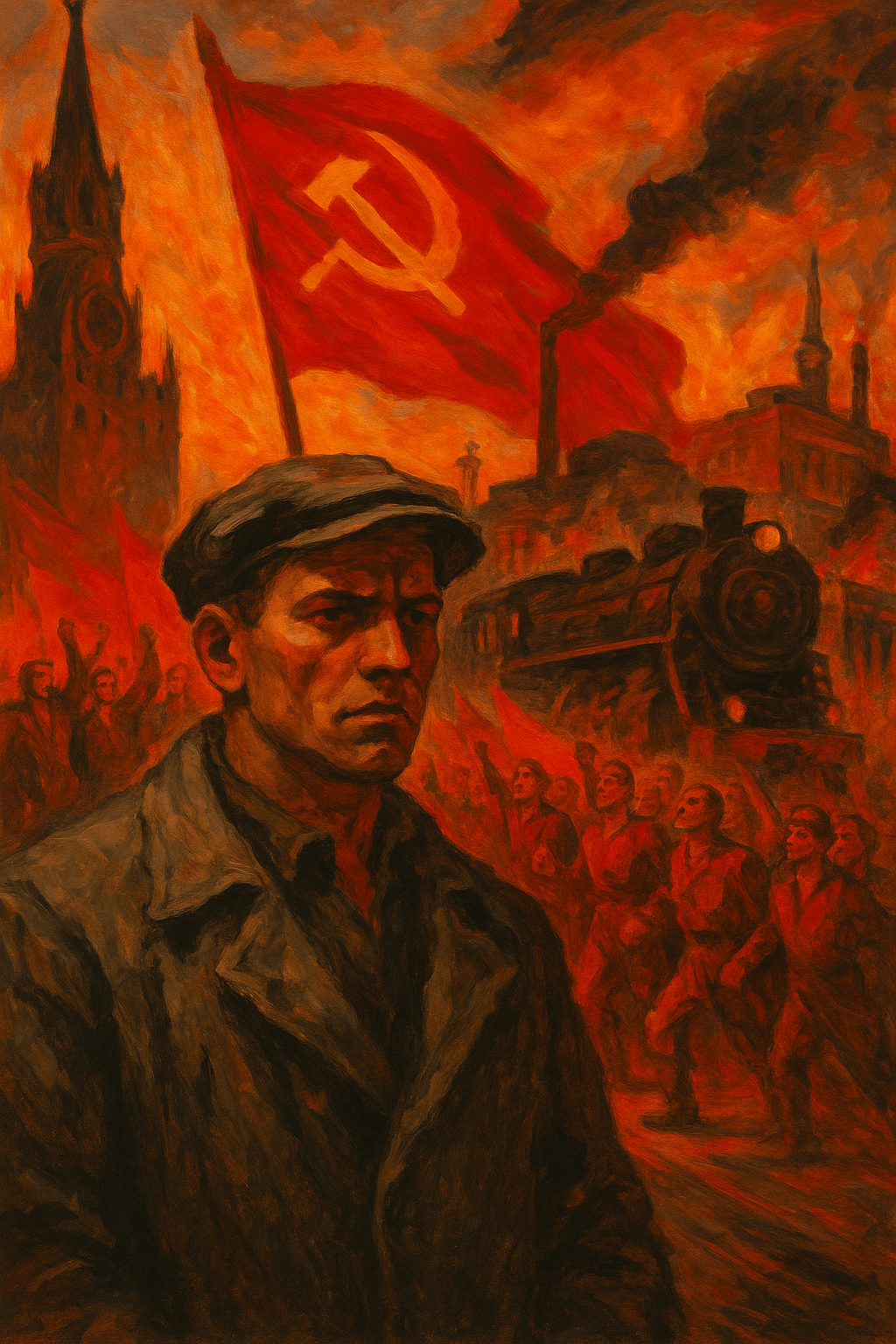
A Weaponized Intellects Book Review of Robert W. Thurston’s Life and Terror in Stalin’s Russia, 1934–1941
By Prince Kapone | Weaponized Intellects Book Review – October Revolution Series | November 22, 2025
Entering the Battlefield of Soviet History
Let’s begin with a simple truth that Western academia has spent a century trying to bury: the meaning of the Russian Revolution was never going to be settled in the archives of Yale, Harvard, or Oxford. It was always going to be settled in the lives of the workers and peasants who tore down an empire, built a new society, and stared down the capitalist world system with little more than conviction, discipline, and steel. That is the terrain into which Robert W. Thurston’s Life and Terror in Stalin’s Russia, 1934–1941 walks—hesitantly, unevenly, but with a certain revisionist courage. And that is the terrain where this review begins—not to praise the man, not to scold him, but to weaponize the contradictions he reveals and the myths he inadvertently shatters.
To be clear: Thurston is no revolutionary. He is a Western historian writing at the tail-end of the Cold War, when the United States had declared victory over the socialist world and felt emboldened to relax its more hysterical propaganda. Within that brief window, a cluster of scholars began to whisper what they would never dare shout—that perhaps the USSR was not simply a vast charnel house run by a paranoid dictator; that perhaps millions of Soviet citizens were not trembling automatons, but active participants in a world-historic project; that perhaps the whole “total terror” narrative was less history than ideological fiction, less scholarship than political warfare. Thurston doesn’t break fully with the Cold War worldview—he can’t. His academic oxygen comes from the very institutions that made careers out of demonizing the October Revolution. But he does something useful: he cracks the façade. He shows that life in Stalin’s USSR was not the monochromatic nightmare of Western mythology. And once a façade cracks, it becomes our duty to drive a wedge through it.
That is the spirit in which Weaponized Information approaches this book. We do not enter the text to rubber-stamp its conclusions or to genuflect at the altar of Western scholarship. We enter it as guerrilla intellectuals. Our task is not to admire the author’s prose; our task is to sift the evidence, expose the ideological fingerprints, and reclaim what belongs to the international working class. Thurston’s archival work—police reports, factory life accounts, wartime correspondence—provides glimpses of a society moving, experimenting, struggling, and learning. And though he lacks the conceptual tools to interpret this motion, he unintentionally reveals a truth Western Marxism has spent decades denying: the people of the Soviet Union were not merely acted upon; they acted. They were not merely victims; they were builders.
But to understand the significance of this, we must first acknowledge the ideological battlefield. The Western left—particularly the academic variety—has long treated Soviet history like an embarrassing relative: loved in theory, avoided in practice, disowned in public. They want the revolution’s romance without the revolution’s rigor. They claim Marx without Lenin, Lenin without Stalin, Stalin without industrialization, industrialization without class war. Thurston enters that battlefield and—without intending to—undermines some of the most cherished myths of this liberal priesthood. He shows that the “terror” was neither total nor omnipresent. He shows that Soviet citizens voiced grievances, pursued careers, formed associations, debated politics, sometimes supported repression, sometimes resisted it, but always navigated their world with agency. In short, he shows that Soviet society was alive.
This review is not interested in defending every action of the Soviet state, nor in adopting Thurston’s hesitations. Our task is more ambitious. We must situate his work in the long arc of the revolution; expose how the Cold War still shapes what Western historians can see and cannot; and reclaim the political meaning of the Stalin era from the clutches of anticommunist hysteria and Western Marxist distortion. We seek to understand why this period—1934 to 1941—remains the most violently contested terrain in modern historiography, and why the ruling class continues to weaponize it against any contemporary attempt at socialism.
In this spirit, the first section of our Weaponized Intellects review asserts the following line: Soviet history is not a moral drama scripted for Western consumption. It is the history of a besieged socialist experiment navigating internal contradictions, external threats, and the colossal task of remaking human life itself. Thurston provides a window—narrow, smudged, filtered through liberal anxieties—but still a window. Our job is to widen it until the whole horizon is visible.
When Western Methods Fail to Grasp a Revolution
Robert Thurston opens his study by promising a sober reassessment of Stalin’s Russia, but the tools he brings to the table are the tools of a Western liberal intellectual—fine for cataloguing facts, utterly inadequate for understanding a revolution. This is not a moral failing on his part; it is a structural feature of Western academia itself. You cannot dissect socialism with the scalpel of bourgeois social science any more than you can measure thunder with a ruler. And yet, Thurston tries—and in the process, he inadvertently reveals more than he intends.
He leans heavily on police reports, local court records, NKVD case files, factory correspondence, and regional newspapers. From a purely archival standpoint, the work is impressive. Thurston shows us a society textured with contradictions—citizens filing complaints, arguing cases, celebrating successes, and maneuvering within a state apparatus that was far from the monolithic nightmare painted by Cold War propagandists. In the debris of these documents, he finds something heretical in Western historiography: evidence of responsiveness, negotiation, even reform. The state did not simply impose itself from above; it contended with, mediated, and was shaped by the people it governed.
But here is where Thurston stops short—precisely where a revolutionary scholar must push forward. The archival fragments he collects show ordinary Soviet citizens arguing, petitioning, filing grievances, and expressing political desires not out of fear, but because they felt entitled to shape the socialist project. Yet Thurston cannot articulate this. He sees participation but cannot call it empowerment. He sees discipline but cannot call it collective responsibility. He sees belief but cannot call it revolutionary consciousness. He is boxed in by the epistemological walls of his own training; he cannot imagine people believing in socialism unless coerced. And so, again and again, he reads the evidence through a skeptical lens he never fully interrogates.
This is the core weakness of Western revisionism. Unlike the anti-communist hardliners—Conquest, Solzhenitsyn, Pipes—who simply fabricated the USSR into a cartoon of evil, the revisionists attempt nuance. But lacking the dialectical method, they cannot conceptualize motion. They cannot hold contradiction. They cannot grasp transformation. They treat society as a static field of individual behaviors rather than a living process driven by class struggle, international pressure, technological leapfrogging, and political experimentation. As a result, their analysis becomes a collection of interesting observations severed from their historical engine.
And yet, Thurston’s methodological limitations make the cracks in Western orthodoxy all the more revealing. The very fact that he has to explain why citizens were not uniformly terrified, why factories were not paralyzed by fear, why morale was high on the eve of war, why people continued to form associations and organize clubs and pursue education—all of this exposes the poverty of the dominant narrative. If terror had been total, no such explanations would be needed. If Stalin ruled through unbroken coercion, the evidence would not show anything like this degree of social vitality. By trying to correct the terror narrative, Thurston demonstrates that it was never rooted in material reality to begin with.
Here, our task becomes clear: to grasp the significance of Thurston’s findings, we must liberate them from the ideological frame that contains them. We must bring to bear the tools he lacks: historical materialism, the understanding of revolution as a process, and the recognition that the people of the USSR were not passive objects of policy but active subjects engaged in building a new world. Only then can we understand why the 1930s produced both fear and hope, hardship and exhilaration, repression and mobilization. Only then can we understand the period not as a pathology, but as a crucible—one in which the Soviet Union forged itself under the pressures of internal contradiction and global hostility.
Thurston’s method exposes the weakness of Western historiography; our method exposes the strength of the revolution it fails to comprehend. The next section will step directly into that revolution’s texture—into the reforms, experiments, and political tensions of the mid-1930s—where the limits of liberal interpretation will be laid bare, and where the dialectical motion of Soviet society will become impossible to deny.
The Quiet Storm Before the Tempest: Reforms, Contradictions, and the Pulse of a Changing Society
When Thurston turns to the years 1933 to 1936, he thinks he is describing a period of legal relaxation and procedural normalization. What he is actually documenting—without the language to name it—is a society crawling out from the wreckage of civil war, imperial encirclement, forced modernization, and internal sabotage, and beginning to breathe as something new: a workers’ state trying to stabilize itself while still surrounded by wolves. This is where the archival record begins to pulse with a kind of tension Western historians cannot quite interpret. Something is happening in these years. Something contradictory, experimental, uneven, and profoundly revolutionary.
Thurston shows that the police and courts—the dreaded organs that liberal historiography paints as omnipotent engines of terror—were not only constrained during these years but were actively subject to reform. Officials debated the appropriate use of force, curtailed arbitrary prosecution, and even reprimanded overzealous agents. People filed grievances against judges. Newspapers criticized bureaucratic abuses. Local courts reconsidered sentences. In a bourgeois democracy, this would be called “civil society.” In the USSR, Western scholars call it “unexpected.” But what is unexpected here is not the evidence—it is the collapse of the Cold War caricature when real archival data is allowed to speak.
These reforms did not happen in a vacuum. They emerged from a society whose contradictions were sharpening: the struggle against class elements displaced by collectivization; the push to rationalize production in a rapidly industrializing economy; the challenge of educating millions of newly literate peasants; the constant pressure of capitalist powers hoping to strangle the revolution in its cradle. Under these conditions, the state oscillated between consolidation and vigilance, reform and discipline. And because Thurston reads society through the narrow lens of liberal proceduralism, he sees “relaxation” where a dialectician sees something far richer: the emergence of political space within a socialist transition.
Thurston notes that citizens used this space. They filed complaints against party officials, challenged police misconduct, and demanded fair treatment. He observes that these appeals often succeeded. But instead of recognizing this as evidence of proletarian empowerment—a consequence of a state whose legitimacy rested not on abstract “rights” but on its material service to workers and peasants—he treats these actions as anomalies in an otherwise coercive system. He cannot grasp that people felt entitled to engage the state because they understood the state as theirs. Not perfect. Not classless. But theirs in a way no capitalist state has ever been.
If this period feels contradictory, it is because the Soviet project itself was contradictory. The revolution was still young; the bureaucracy still crystallizing; the economy still heaving under the weight of rapid transformation; the international situation deteriorating with each passing month as fascism grew bolder. Thurston hints at this complexity but cannot situate it within the motion of historical materialism. For him, tension is psychological. For us, tension is structural. For him, Soviet society is improvising. For us, it is struggling—struggling not in the abstract sense but in the concrete sense of class, production, ideology, and war.
What emerges from Thurston’s evidence is something the Western left has long been terrified to admit: the early-to-mid 1930s were not the prelude to a descent into madness, but the turbulent years in which the Soviet Union took its first steps toward stability. It was a society building institutions, correcting excesses, and negotiating the boundary between security and participation. The groundwork was being laid for the cataclysmic struggles that would soon erupt—struggles Western historians flatten into a morality tale because they cannot imagine that terror, vigilance, creativity, and popular support might coexist inside a revolutionary process.
This is the era before the storm. Thurston sees the contradictions but lacks the theory to understand why they matter. We, however, can see what is forming on the horizon: a tightening of political discipline, a sharpening of internal conflict, and the reconfiguration of state power as the Soviet Union prepares—consciously or not—for the convergence of internal opposition and global fascist aggression. The next section steps into that convergence, where the limits of Western interpretation meet the unforgiving logic of revolutionary survival.
Where Liberal Narratives Go to Die: Leadership Struggle, Class War, and the Gathering Storm
If the early 1930s were a contradictory rehearsal for socialist stabilization, then the years 1934 to 1937—the terrain Thurston steps into next—are the overture to a deeper clash. Western historians, clinging to their favorite melodrama, call this the moment Stalin “descended” into paranoia. But revolutions do not “descend.” They develop. They sharpen their contradictions. They encounter enemies foreign and domestic. They confront the unfinished business of power. Thurston, to his credit, senses something more complicated than the fairy tale of the mad tyrant. Yet because he lacks a dialectical compass, he cannot follow the motion to its conclusion.
Thurston emphasizes the tensions within the leadership—the jockeying between factions, the discontent simmering within the Party, the growing hostility between Stalin’s camp and the remnants of opposition currents. He points to the assassination of Sergei Kirov in 1934, not as proof of Stalin’s bloodlust, but as one of several catalysts that pushed the state into a more aggressive security posture. Yet he repeatedly frames these developments as psychological dramas, as if Soviet leaders were characters in a Tolstoy novel rather than political actors navigating a global class war.
This is where liberalism shows its absolute poverty as an analytical method. It treats political struggle as interpersonal conflict. It reduces factionalism to wounded pride. It reads assassination as court intrigue, not as evidence of internal enemies still linked—ideologically or materially—to the old order or to forces gathering beyond Soviet borders. What Thurston notes but cannot synthesize is simple: the mid-1930s were a period when the Soviet Union discovered that the counterrevolution had not vanished; it had merely gone underground. In the factories, in the Party, in the military, in the bureaucracy—everywhere the young socialist state encountered echoes of an older class that had not accepted defeat.
And this was happening at the exact moment that fascism was tightening its grip on Europe. Hitler had seized power in 1933. Mussolini had already consolidated his empire. Japan had invaded Manchuria. The bourgeois democracies of Britain and France had made their position clear: they preferred a fascist Europe to a socialist Russia. In that atmosphere, the internal tensions of the Soviet Union were no mere domestic matter—they were the domestic face of an international siege. To interpret them as “paranoia” is to reveal a dangerous innocence about how revolutions survive.
Thurston’s archival evidence shows a Party struggling to maintain unity in the face of these pressures. Debates were open, heated, and often vicious. Some officials advocated moderation, others militancy. Some acknowledged the risks of infiltration, others downplayed them. This was not the behavior of a frightened bureaucracy cowering under Stalin’s shadow; it was the behavior of a leadership trying to chart a course through an unprecedented historical moment. And yet, because Thurston reads these disagreements through the grammar of Western academia, he sees confusion where there was strategy, anxiety where there was vigilance, improvisation where there was disciplined adaptation.
Still, he observes something that cuts directly against the Cold War narrative: there was no seamless machinery of terror waiting to be unleashed. There was no unified consensus on repression. There was no omnipotent dictator issuing commands that everyone robotically obeyed. The state was contradictory because the revolution was contradictory. The leadership was fractured because the society was fractured. The tightening of political discipline was not the tantrum of a tyrant—it was the response of a besieged state confronting a convergence of internal opposition and external fascist escalation.
This is where Western Marxism usually averts its eyes. To acknowledge that the Soviet state had real enemies is to admit that revolutionary violence has political content. To admit that the purges were rooted in structural contradictions is to abandon the childish moralism that dominates the Western left. And Thurston, caught between the evidence he collects and the ideology he inherits, hovers in a murky middle ground—recognizing complexity but refusing to name its cause.
And so we name it: the mid-1930s were the crucible in which the Soviet Union confronted the unresolved contradictions of its own birth and the escalating hostility of the capitalist world system. What Thurston documents—however cautiously—are the first tremors of a political earthquake that will reshape the USSR, destroy old factions, reforge the Party, and prepare the nation for the greatest confrontation of the twentieth century. The next section steps directly into that earthquake, where terror, reform, participation, paranoia, vigilance, and popular support collide in a moment Western historians have never been able to understand without lying to themselves.
The Purges in Motion: Class Struggle, Revolutionary Survival, and the Failure of Liberal Imagination
Here we enter the territory that Western academia treats like holy ground—the years of the Great Purges, the “terror,” the moment they insist proves the moral bankruptcy of socialism itself. For decades, liberal historians have tried to turn 1936–1938 into the Auschwitz of communism, a political cudgel to shame every revolutionary movement into meekness. Thurston steps into this terrain not as a dissident, not as a defender of the USSR, but as an archivist whose findings stubbornly refuse to fit the prefabricated mythology. And this is where his book becomes most interesting—not because he solves the riddle of the purges, but because the contradictions he exposes suffocate the Cold War narrative like smoke in a locked room.
Thurston shows that the purges were not the omnipotent, centrally micromanaged death machine that Western historians fantasize about. There was chaos. There was initiative from below. There were legal formalities that still mattered. There were cases overturned, protests heard, sentences revised. There were workers who supported the purges enthusiastically and workers who resented them. There were local officials who manipulated accusations for personal gain and others who hesitated to carry out arrests. In other words, the purges were not a horror film—they were a political process, violent and contradictory, unfolding inside a society wrestling with its own unfinished revolution.
But Thurston cannot escape the gravitational pull of liberal assumption. He recognizes popular participation, yet cannot understand it as political agency. He sees workers denouncing managers, peasants challenging corrupt officials, soldiers accusing officers of sabotage—but he filters every action through the language of fear. The possibility that Soviet citizens believed in the socialist project, believed in rooting out enemies, believed that vigilance was necessary in the face of war and sabotage—that possibility never truly enters his framework. He is trapped inside a Western worldview where revolutionary commitment is inconceivable and repression is always pathological.
What the archives show—and what Thurston inadvertently reveals—is far more complex: the purges were the explosive intersection of class struggle, international encirclement, bureaucratic contradiction, and political transformation. The state was not merely hunting imaginary enemies; there were real threats. Industrial sabotage was documented. Military conspiracies existed. Foreign intelligence agencies were active. And above all, fascism was rampaging across Europe, preparing openly for war with the Soviet Union. To pretend that this context is irrelevant—as Western historians routinely do—is to abandon history for theology.
A dialectical reading does not romanticize the purges nor sanitize their brutality. It situates them. It understands that revolutions generate enemies both within and without, that counter-revolutionary elements do not vanish simply because a new government is proclaimed, and that a besieged socialist state must address contradictions that capitalist states never face. The purges were not inevitable, nor were they the product of individual madness. They were the violent political form through which the Soviet Union confronted the unresolved contradictions of its early development—and the coming catastrophe of world war.
What is remarkable is not simply the violence, but the persistence of civic life within it. Thurston documents workers debating policy, ordinary citizens challenging decisions, people organizing clubs, pursuing education, engaging in cultural life. A society in the grip of pure terror could not function this way. A population paralyzed by fear does not petition the state or criticize its agencies. Yet these actions fill the archival record. Western historians cannot explain this without contradicting their own narrative, so they ignore it. Thurston, at least, acknowledges the evidence—but lacks the framework to interpret it.
And so we return to the core failure of Western Marxism and liberal scholarship: they treat the purges as a moral aberration rather than a political moment. They cannot comprehend that mass participation can coexist with repression, that belief can coexist with fear, that revolutionary legitimacy can coexist with coercion. They demand purity from socialism while accepting barbarism from capitalism. The purges, in their eyes, invalidate the entire socialist experiment. But capitalist slavery, colonial genocide, imperialist war, and fascist collaboration never invalidate theirs.
Thurston cracks open the door. He shows us that the purges were not a single, simple phenomenon but a whirlwind of competing forces. Our task is to walk through that door, push past the liberal fog, and grasp the purges as part of the Soviet Union’s attempt—messy, contradictory, violent—to resolve class antagonisms and prepare for survival against the greatest fascist assault in human history. The next section turns toward the consciousness of the Soviet people themselves, the question no Western historian can answer without dissolving their own worldview: why did millions continue to believe in socialism even in the midst of upheaval?
Fear, Hope, and the Making of Soviet Consciousness
Western historians approach the Soviet people as if they were shadows on the wall—flat silhouettes cast by the “dictator” at the center of the frame. Thurston, to his credit, attempts something different. He listens. He sifts through letters, diaries, petitions, police reports, workplace memos, and private communications. And what he finds is a society far too alive, far too contradictory, far too human to fit inside the cardboard mythology the West has spent 80 years constructing. Yet, because he approaches these voices without a dialectical method, without a revolutionary framework, he cannot truly hear what they are saying. He hears fear. He hears compliance. He hears confusion. But he cannot hear something else entirely: belief.
This is the tragedy of liberal interpretation—its deafness to revolutionary consciousness. When a Soviet worker writes with pride about production quotas, Western scholars read it as indoctrination. When a peasant denounces a corrupt official, they call it fear. When a factory collective demands stricter discipline to root out sabotage, they call it hysteria. And when young people throw themselves into literacy campaigns, volunteer brigades, and political culture circles, they call it conformity. To the Western imagination, proletarians in motion cannot possibly be acting from conviction; they must be reacting to terror.
Thurston strains against this worldview. He admits—uneasily—that many citizens expressed genuine enthusiasm for socialist construction. He notes that people often petitioned the state not out of dread, but because they expected to be heard. He observes that Soviet workers criticized their superiors, demanded accountability, and interpreted the purges through a framework of moral and political responsibility. But because he cannot conceive of class struggle as a formative experience, he repeatedly falls back on the only vocabulary Western academia allows: fear, pressure, anxiety, insecurity. The Soviet people become emotional states rather than historical actors.
Yet the evidence he compiles paints a different picture—one the bourgeois mind cannot process. Soviet citizens lived with contradictions because they lived in a revolution. They supported harsh measures against corruption and sabotage because they saw firsthand the vulnerability of a society trying to build socialism while surrounded by capitalist hostility. They believed that industrial growth, literacy, electrification, and collectivization were not abstract policies but tangible improvements to their lives. The world was changing around them and they were a part of the change. A people who had been serfs under the Romanovs were now reading newspapers, debating politics, operating machinery, commanding factories, and helping construct the world’s first socialist state.
This is the raw material of revolutionary consciousness—not utopian clarity, but a lived understanding that the future was malleable and that their participation mattered. Western historians dismiss this as “naïveté,” but this is because they cannot imagine workers possessing political agency outside parliamentary rituals. They have no framework to understand a population that saw the Party and the state—not always, not perfectly, but fundamentally—as instruments of its own empowerment.
The liberal imagination fractures here. It cannot comprehend how belief and fear might coexist, how hope might survive repression, how ordinary people might differentiate between the coercion of a capitalist state and the often-brutal necessities of a revolutionary one. Soviet citizens possessed a clarity born of material transformation: they had come from poverty, illiteracy, landlordism, and misery. They now had land, education, employment, healthcare, collective institutions, and a sense of political importance unimaginable under Tsarism. The revolution had given them something the West could not: a future.
Thurston reaches toward this truth but never quite arrives. His evidence shows a population neither docile nor hysterical, neither blindly loyal nor uniformly terrified. It shows a population wrestling with contradictions, making sense of upheaval, and forming a consciousness molded by struggle. It shows, ultimately, the emergence of the “new Soviet person”—not as propaganda, but as a historical fact born from the effort to build socialism under siege.
And here lies the lesson the West refuses to learn: revolutionary consciousness is not created in seminar rooms or NGO workshops. It is forged in the heat of collective struggle, in the challenges of governing a society transitioning out of class domination, in the necessity of defending a revolution that the imperialist world would happily drown in blood. The Soviet people carried this consciousness into the factories, the schools, and ultimately the battlefield. In the next section, we follow them into the heart of that industrial transformation—where discipline, pride, hardship, and creativity combined to build the economic foundation that would defeat fascism and reshape the twentieth century.
Forging Steel and Consciousness: Factory Life and the Birth of Socialist Modernity
One of Thurston’s most revealing chapters—and one of the most quietly subversive to Western mythology—is his treatment of Soviet factory life. Here, in the roaring furnaces and rhythmic clatter of machines, the entire liberal narrative of “Stalinist terror” collapses under the weight of lived reality. Thurston documents a world that liberal anti-communists cannot imagine and Western Marxists cannot accept: a world where workers experienced hardship without hopelessness, discipline without despair, and struggle without surrender. A world where labor was not merely exploitation, but participation in a civilizational project. And because Thurston cannot name what he is witnessing, we must.
The Soviet factory of the 1930s was not a Dickensian warehouse of misery. It was the laboratory of a new society. It was the place where peasants became industrial workers, where illiterate villagers became skilled technicians, where women entered sectors previously reserved for men, and where entire communities learned—sometimes painfully, often triumphantly—to remake the material world. What Thurston describes is a universe infused with motion: workers debating production targets, brigades innovating new methods, managers struggling to maintain order while being held accountable by the very people they supervised. This was not capitalism, where management commands and workers obey. This was a political arena shaped by socialist norms, economic necessity, and collective aspiration.
To be sure, it was also an arena of conflict. Thurston notes the friction: absenteeism, turnover, drunkenness, shortages, accidents, disputes over quotas, conflict between old specialists and new proletarian upstarts. A liberal mind reads these tensions as proof of dysfunction. A revolutionary mind recognizes them as growing pains—contradictions emerging from the collision between an inherited capitalist workforce and the demands of socialist construction. Every factory was a battleground where old habits, new expectations, technical challenges, and class tensions intermingled. What matters is not that conflicts existed—what matters is that the workers themselves engaged them, shaped them, and in many cases, resolved them.
Thurston’s account exposes a crucial truth: Soviet industrialization was not imposed on a passive population. It was embraced by millions who understood that industrial growth was not a capitalist hunger for profit but a socialist necessity for survival. They remembered the hunger of the NEP years, the backwardness of Tsarist industry, the humiliations of dependency on foreign machinery. And they knew what awaited them if the fascist powers succeeded in their plans: extermination, enslavement, and the destruction of everything the revolution had built. Under these historical conditions, quotas were not just numbers; they were the difference between life and annihilation.
This does not romanticize the struggle. It clarifies it. The Stakhanovite movement, often derided in Western textbooks as propaganda, emerges through Thurston’s evidence as something far more complex: part incentive system, part ideological engine, part genuine worker initiative. Workers saw Stakhanovites not merely as “model laborers,” but as symbols of what socialism demanded: audacity, experimentation, creativity, and sacrifice. In a country racing against time, every innovation was a weapon, every efficiency a shield. And workers knew that the future of their society—their children, their villages, their survival—depended on mastering the factory floor.
What Thurston cannot articulate, but what his evidence screams, is that the Soviet factory was producing more than steel. It was producing a new kind of human being. A person who saw themselves as part of a collective undertaking. A person whose individuality was not extinguished but expressed through contribution. A person forged by discipline not as subjugation but as self-mastery, as participation in a world-historic struggle. This was the new Soviet person—not the caricature of propaganda posters, but the living product of a society being built at breakneck speed, under siege, and with an unprecedented commitment to social transformation.
Western Marxists have always mocked this idea because they cannot imagine transformation without catastrophe, and liberals have always feared it because it exposes the smallness of capitalist aspirations. But Thurston’s findings force an uncomfortable truth into the open: if the Stalin-era factory was a dystopia, why did workers stay? Why did so many rise to positions of authority? Why did they fight like lions when the Nazis invaded? Why did morale increase—not collapse—under wartime pressures? The answer is not hidden in the archives. It is in the lived experience of workers who believed, however imperfectly, that they were building something worth defending.
This section of the book reveals what the dominant historiography has spent a century suppressing: socialist modernity was built not only through state policy but through the consciousness, labor, and determination of ordinary workers. The hardships they endured were inseparable from the achievements they produced. And those achievements—industrial capacity, scientific advancement, mass literacy, mechanized agriculture—would soon prove decisive in a battle for the future of humanity. In the next section, the narrative shifts toward the gathering thunderclouds of global war, where the Soviet people, armed with the confidence and contradictions of the 1930s, faced the ultimate test of their society and their resolve.
Revolution in the Mirror of History: What Thurston Reveals, What He Can’t See, and What the West Refuses to Admit
Having traversed Thurston’s evidence—from the courtroom to the factory floor, from the inner Party disputes to the approach of global war—we arrive at the ideological core of his project, and of this review: what does it mean that a Western historian, working within the constraints of bourgeois academia, inadvertently dismantles some of the most cherished myths of anti-communism? And why does this matter for revolutionaries today, 108 years after the storming of the Winter Palace?
Thurston, despite his hesitations, shatters one of the central pillars of Cold War propaganda: the myth that Stalin’s Soviet Union was a society suffocated by omnipresent terror, frozen in fear, devoid of agency, stability, or popular support. His archival findings make this narrative impossible to sustain. He shows a society full of motion—sometimes chaotic, sometimes disciplined, always contradictory, and absolutely alive. He shows workers and peasants petitioning the state, arguing with officials, filing grievances, debating policy, challenging injustice. He shows Party members struggling over the direction of the revolution, not cowering before a dictator but fighting over competing visions of socialist construction. He shows courts functioning, laws being enforced unevenly, and individuals experiencing the state not as a totalizing horror but as a site of negotiation, conflict, and—astonishingly—hope.
But the political significance of Thurston’s book is not in its successes, but in its limits. He sees the evidence but not the movement beneath it. He registers contradiction but cannot theorize it. He notes the presence of popular support but cannot accept its political meaning. This is the tragedy of Western Marxism and Western scholarship: the revolution is always at their fingertips, and always inaccessible. They can touch its surface, but never grasp its logic.
For Thurston, Soviet citizens behaved as they did because they were “coping,” or “fearful,” or “confused,” or “seeking stability.” For a revolutionary—for anyone who has seen peasants seize land, workers transform factories, or colonized peoples overthrow empires—the answer is far simpler: they believed in the socialist project. Not blindly, not uncritically, not without complaint or contradiction—but with a historical clarity born of material transformation. They had lived through Tsarism, civil war, famine, and exploitation. They had seen the revolution deliver literacy, healthcare, electrification, modern industry, and a sense of collective purpose. And they understood that the alternative was not Swedish social democracy—it was fascism at the gate.
This is the truth that the Western left flees from. To acknowledge that the Soviet people believed in their revolution, even in the midst of repression, is to acknowledge that revolutions produce legitimacy not through liberal procedures but through transformative action. It is to acknowledge that history is not moved forward by polite debates, NGO roundtables, or academic journals, but by the masses—messy, creative, disciplined, contradictory, and often harsh in their pursuit of liberation. It is to acknowledge that violence is not the exclusive child of tyranny, but the midwife of historical transition.
That is why the Great Purges occupy such a pathological place in Western discourse. They are not simply a chapter of Soviet history—they are a mirror in which the West cannot bear to see its own reflection. For if the purges were part of a political process shaped by class struggle, not merely the whims of a tyrant, then liberal morality collapses. If participation in repression reflected belief rather than terror, then the Western monopoly on “rational politics” dissolves. And if the Soviet Union’s harshest years helped forge the industrial, social, and political strength that would defeat Nazism, then the entire edifice of bourgeois historical superiority crumbles to dust.
Thurston flirts with these implications but cannot embrace them. He stops at the ledge of historical materialism, unwilling or unable to take the final step. But his archival work still points to a conclusion he never articulates: the Soviet Union of 1934–1941 was not a terror-state spiraling into madness. It was a revolutionary society, besieged and contradictory, building and purging, consolidating and transforming, preparing—consciously or not—for the greatest battle ever waged against fascism. It was a society where repression and participation were not opposites, but intertwined moments of an unfolding revolutionary process.
And this is why Thurston’s book matters. Not because it is flawless—it isn’t. Not because it is Marxist—it isn’t. But because it forces the cracks in the Western narrative to widen. It demands that even the skeptical reader confront the possibility that the Cold War version of Soviet history is not a historical record but an ideological weapon. It demands that we revisit the revolution with new eyes—not the frightened eyes of the liberal intellectual, but the discerning eyes of the colonized, the workers, the peasants, and the revolutionaries who know in their bones that liberation is never clean, never simple, and never granted by the ruling class.
In the final section, we will draw these threads to their necessary conclusion. We will reclaim the political meaning of the Stalin years—not to romanticize them, but to understand them as part of the living history of anti-imperialist struggle. We will assess what Thurston’s work contributes to that understanding, what it obscures, and what remains to be done by those of us who take revolutionary history not as an academic puzzle but as a guide to future battles.
Reclaiming the Revolution: What the 1930s Teach Us About Power, Survival, and the Future We Must Build
We arrive now at the end of this review, but not at the end of the struggle—because the debate over the Stalin years has never been about the past. It has always been about the future. Western historians do not obsess over 1937 because they care about Soviet citizens of eighty years ago; they obsess because they fear what the October Revolution still represents: the possibility that ordinary people can overthrow the ruling class, seize the means of production, and reorganize society on a foundation other than profit and empire. The battle over memory is a battle over the horizon of liberation. And that is why Robert Thurston’s book—despite its limitations—matters.
His archival work forces the reader to confront an uncomfortable truth: the USSR was not the dystopian nightmare that Cold War mythology requires it to be. It was a revolutionary society, wounded by its birth, encircled by enemies, riddled with contradictions, and yet moving—always moving—toward industrial transformation, mass literacy, social equality, and political empowerment. It was not a paradise, but it was not the hell the bourgeoisie needs it to be. And for that reason alone, Thurston’s evidence is a threat to the ideological order of the West.
But a revolutionary review cannot stop at exposing the cracks. Our task is to push the contradictions into the open and ask what they demand of us today. The Stalin era was a crucible in which the Soviet Union confronted the limits of its own development while preparing for a war that would determine the fate of humanity. It reveals the ferocity of class struggle, the costs of rapid transformation, the dangers of bureaucratic distortion, and the staggering power of collective mobilization. It shows how revolutions must defend themselves—not in abstract moral terms, but in material, strategic, and historical ones.
For the Western left, the lesson is simple but devastating: revolutions are not polite affairs. They are not managed by NGOs. They are not guided by the fantasies of postmodern academics who fear discipline and worship process. Revolutions are made of steel and soil, factories and trenches, literacy drives and mass campaigns, victories and errors, courage and contradiction. They are made by workers and peasants, not by the professional-managerial class. And they survive only when their people believe in them deeply enough to fight for them.
Thurston’s work helps us peel back the propaganda, but it is up to us to supply the analysis he cannot. The Soviet Union of 1934–1941 was not simply repressing; it was building. It was not simply purging; it was transforming. It was not simply afraid; it was preparing. It was not drifting into madness; it was arming itself for a war unleashed by the capitalist powers that had encircled it from birth. And when that war arrived, the Soviet people fought with a level of unity, ferocity, and sacrifice unmatched in modern history—not because they were coerced, but because they were committed. This commitment is what Western historians cannot explain and what Western Marxists cannot accept.
The Cold War required a narrative in which the Stalin era is irredeemable, the Soviet project illegitimate, and revolutionary struggle inherently doomed. Thurston’s book complicates that narrative; our review destroys it. For revolutionaries, the meaning of this history is not academic. It is operational. It tells us that socialism is not built through ideal conditions; it is built through contradiction. It tells us that a besieged workers’ state must navigate threats internal and external. It tells us that political vigilance and mass participation can coexist. It tells us that repression alone cannot explain the endurance of a revolutionary project—and that the legitimacy of such a project emerges not from moral perfection, but from material transformation.
And what does this mean for us, living in a world where fascism rises again, where the American empire teeters on the edge of a technofascist renewal, where the Global South stretches toward multipolarity, and where the ruling class seeks to bury revolutionary memory once more? It means the October Revolution is not a relic. It is a roadmap. It is a warning. It is a promise. It is the living inheritance of all who struggle against imperialism and exploitation. The task before us is not to sanitize the past or replicate it mechanically, but to extract from it the iron lessons of survival, transformation, and power.
Robert Thurston opened the door. We have walked through it. And on the other side, the Soviet 1930s do not appear as a tragedy or a horror story, but as a chapter in the global struggle for human emancipation—one marked by discipline, sacrifice, contradiction, and the stubborn belief of millions that another world could be built. That belief carried them through famine, purges, industrial upheaval, and the deadliest war in human history. It carried them to Stalingrad. It carried them to Berlin. It carried them into the dreams of revolutionaries across the Global South.
Now it must carry us.
 Weaponized Information
Leave a comment