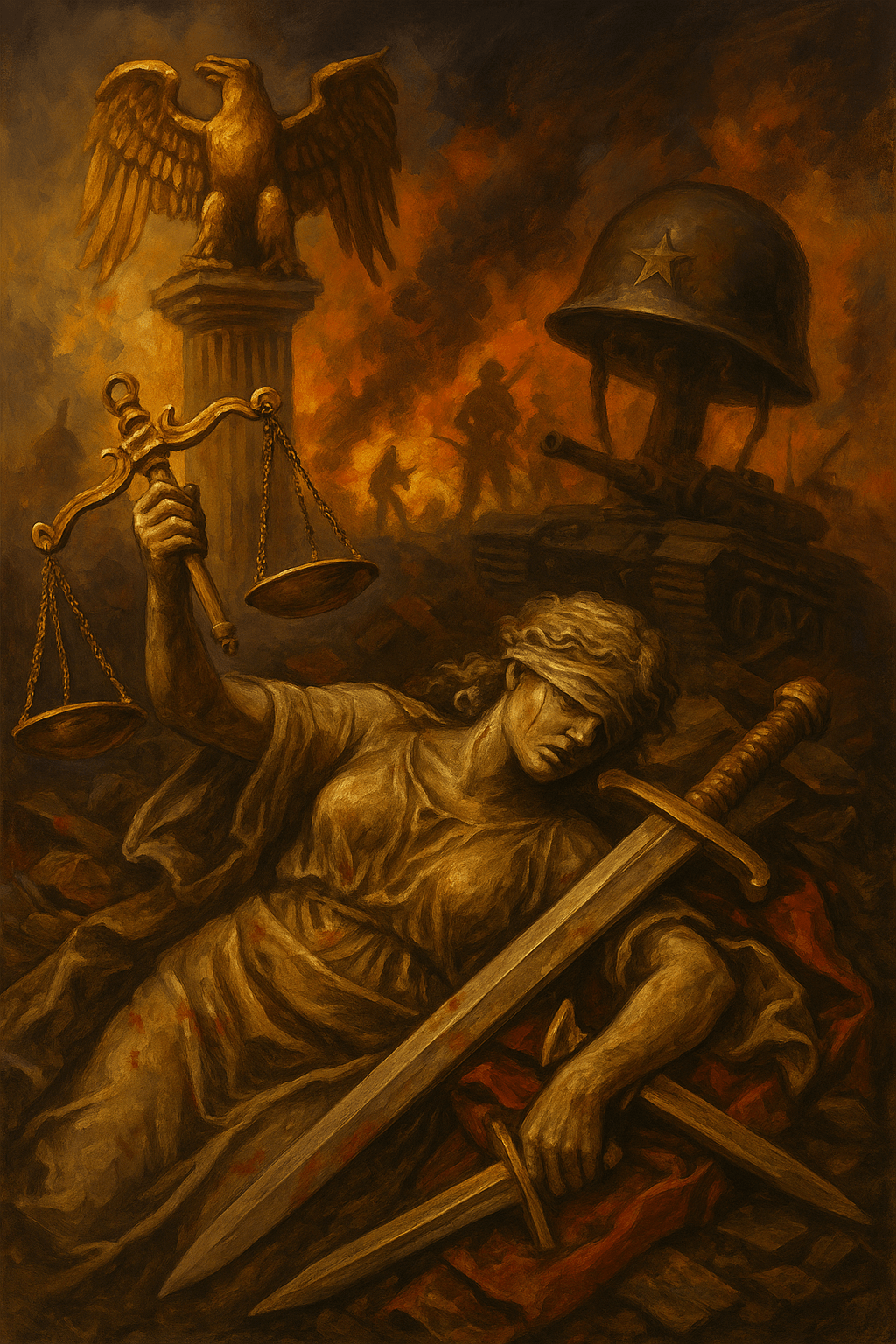
The Guardian’s defense of “international legality” masks a deeper truth: the old legal order was never about justice, only the management of global inequality. Its collapse is not chaos—it is liberation struggling to be born.
By Prince Kapone | Weaponized Information | November 12, 2025
The Law of Empire and the Empire of Law
The Guardian article, “Willing states must act to save international legal order, warns top academic”, presents itself as a sober warning from a scholar of conscience. Its author, Yale Law professor and former Pentagon counsel Oona Hathaway, laments the unraveling of what she calls the “foundational norm” of the international legal system: the prohibition of conquest by force. She argues that Russia’s invasion of Ukraine, China’s maritime claims in the South China Sea, and Donald Trump’s threats to invade Greenland all signify the disintegration of a moral architecture painstakingly built since 1945. The reader is invited to mourn this decay and rally behind the “willing states” still loyal to the law. But beneath this legalistic elegy lies a more familiar melody—the melody of empire singing its own eulogy while pretending to be its victim.
The text is a masterclass in how liberal imperial discourse disguises itself as moral concern. It begins by collapsing three vastly different historical realities into a single moral continuum: Russian aggression, Chinese sovereignty claims, and Trumpian buffoonery are presented as interchangeable symptoms of a world gone lawless. By compressing complex geopolitical contradictions into a moral binary—civilization versus chaos—the author evacuates history and material context. The reader is left not with understanding, but with outrage neatly packaged for export.
The article’s central rhetorical pivot is the personalization of systemic decay. Rather than interrogating the imperial structure that has used international law as a weapon since its inception, Hathaway assigns blame to the latest pantomime villain of the American stage: Donald Trump. He becomes the convenient embodiment of barbarism, a man allegedly incapable of respecting rules that restrain self-interest. This personalization transforms the crisis of empire into the pathology of a single man, allowing liberal elites to lament his crudity while preserving the illusion that their own hands are clean.
Throughout the piece, the law itself speaks in a tone of paternal lamentation. The “civilized world,” personified by Europe, appears as the weary adult forced to step in now that America has gone rogue. This is not analysis—it is nostalgia. It is the fantasy of the old colonial family restored, the European parent reclaiming discipline over its wayward settler child. Such language does not defend the law; it defends the hierarchy upon which that law was built.
Emotional manipulation runs through the text like a watermark. The specter of chaos is invoked to provoke anxiety: “the international legal order is crumbling,” “the protections for civilians are eroding,” “the world is becoming less peaceful.” These phrases conjure an apocalyptic moral vacuum, as if the bombing of hospitals or the targeting of civilians were recent innovations rather than long-standing practices of empire. The appeal to fear replaces any material analysis of why such atrocities occur, or who profits from them.
The prose itself performs what it preaches. Hathaway’s juridical diction—“baseline norm,” “foundational prohibition,” “long-term arrangement”—creates a sterile distance between the reader and the violence under discussion. It is technocratic language designed to depoliticize. In this way, the text reproduces the very ideological function of international law: to translate imperial domination into neutral procedure, to convert crimes into case studies.
When civilians are mentioned, they appear as tragic props in the theater of legality. Their suffering is used to underscore the need to defend “the system,” never to indict the system itself. The victims of Ukraine and Gaza appear briefly, not as subjects of history, but as moral evidence that the West must once again assume its parental role in policing the world. This is empathy as spectacle—feeling without accountability.
In its conclusion, the article performs its final act of self-deception. Hathaway insists that international law has made the world “much more peaceful,” that it deserves our gratitude even as it falters. Yet the peace she mourns is the peace of managed inequality, the calm of an order built on the corpses of the colonized. Her appeal is not for justice, but for the restoration of control. The Guardian, ever the ventriloquist of liberal power, amplifies this lament as though it were prophecy. But when an empire weeps for the law, it is not justice that is dying—it is hegemony.
The Facts Buried Beneath the Law
Once we strip away the sentimental rhetoric, the Guardian article leaves us with several verifiable claims and an ocean of omissions. The facts it presents are not false; they are incomplete, carefully arranged to reproduce a moral hierarchy of nations. Hathaway insists that the prohibition on conquest is the “foundational norm” of the international legal system, that compliance with international court rulings has dropped, that civilian protections have eroded since the war on terror, and that U.S. politicians—particularly Trump—cannot be trusted to respect international law. Each of these claims is true in isolation. But their truth has been amputated from the body of history that gives them meaning.
The United Nations Charter of 1945 did outlaw aggressive war, but it also preserved the economic and military supremacy of the colonial powers that drafted it. The very states that claimed to ban conquest went on to wage hundreds of wars in the name of “security,” “stability,” and “freedom.” Since World War II, the United States alone has launched overt or covert military interventions in more than seventy countries across Asia, Africa, Latin America, and the Middle East—by the count of the Congressional Research Service and independent scholars such as William Blum. From Korea and Vietnam to Iraq, Afghanistan, Libya, Syria, and beyond, these wars have killed, directly or indirectly, an estimated 20 to 30 million people worldwide. The figures vary depending on methodology, but the scale of devastation remains staggering. If international law made the world “more peaceful,” it did so by redefining war as “peacekeeping.”
The Guardian’s omission of this record is not oversight—it is design. To mention it would collapse the fragile moral scaffolding on which the entire article rests. The problem is not that law has failed to restrain the barbarians outside the gates, but that the law itself was written to enclose the world for imperial management. The United States is not an errant pupil of legality; it is the headmaster who wrote the rules and exempts himself from their punishment.
The International Court of Justice (ICJ) and the International Criminal Court (ICC) are invoked by Hathaway as the twin pillars of civilization, but their history tells another story. The ICJ’s rulings bind only those willing to be bound. The United States withdrew its compulsory jurisdiction after the 1985 Nicaragua case, where it was found guilty of unlawful aggression. The ICC, meanwhile, has prosecuted almost exclusively African defendants while ignoring Western officials responsible for Iraq, Afghanistan, or drone assassinations in the Global South. When the ICC dared to open investigations into U.S. war crimes in Afghanistan, Washington responded not with compliance but with sanctions against the Court’s own judges. This is not the collapse of the rule of law—it is its normalization as selective impunity.
The supposed erosion of civilian protection did not begin with Putin or Netanyahu. It was institutionalized by NATO’s “humanitarian interventions,” from Yugoslavia in 1999 to Libya in 2011. Under doctrines like “collateral damage” and “dual-use targeting,” entire populations became expendable so long as their deaths were accompanied by legalistic paperwork. Hospitals, power plants, and schools were reclassified as legitimate targets if they “contributed” to enemy operations. This is the bureaucratic evolution of mass murder—the transformation of ethics into Excel.
Nor does Hathaway’s article acknowledge that the very governments she praises as guardians of international law have long treated that law as optional. In 1986, the International Court of Justice ruled in Nicaragua v. United States that Washington had violated international law by mining Nicaraguan harbors and financing the Contras—a decision the U.S. simply ignored before withdrawing its acceptance of the Court’s compulsory jurisdiction to avoid future judgments. The pattern persists: when the ICJ or ICC moves against Western interests, the law evaporates. Britain, for instance, lobbied to block an ICJ advisory opinion on the legality of Israel’s occupation of Palestine, arguing that such scrutiny would “inflame tensions” rather than uphold justice. Germany was hauled before the ICJ in 2024 over its arms exports to Israel yet continued to ship weapons as Gaza burned, declaring that its commitments to Israel outweighed any provisional measures. France has played its own part, using its Security Council veto to shield allies and corporations from accountability, transforming the Court’s supposed universality into selective impunity. Even Washington’s think tanks quietly concede that great powers comply with international law only when it serves them. What Hathaway calls Europe’s “renewed awareness” of U.S. unreliability is therefore not a moral awakening but a crisis of dependency: an anxious realization that the empire’s enforcer may no longer have the strength—or legitimacy—to enforce.
Historically, international law has never been neutral. From its inception in the age of empire, jurists like Francisco de Vitoria and Hugo Grotius drafted the legal grammar of conquest, codifying domination under the guise of civilization. The modern law of nations was born not in resistance to colonialism but in service of it, providing the doctrines of “terra nullius,” “sovereignty,” and “trusteeship” that legitimized dispossession across Africa, Asia, and the Americas. After 1945, the so-called liberal order merely changed instruments: the gunboat was replaced by the bond market, the colony by the client state, and the flag by the investment treaty. Institutions such as the IMF and World Bank enforced a new imperialism of debt, compelling nations to open their economies while preaching “development.” When Hathaway describes the law as a voluntary arrangement “for everyone’s long-term interest,” she repeats the moral vocabulary once used to defend the “civilizing mission” of European colonial powers. The structure of domination remains; only its vocabulary has changed—a transformation documented by scholars who trace how legal universalism still reproduces the colonial relationship between North and South.
</p
The contradiction at the heart of Hathaway’s argument is therefore plain. The crisis of legality she laments is not the product of rogue actors tearing down the rules, but of the imperial powers who wrote them finally losing the ability to impose them universally. The unipolar moment has ended. The rise of China, Russia, and the Global South has exposed the fiction that one bloc can monopolize morality. Yet in the Guardian’s account, this historic transformation appears only as a threat, never as a reckoning. The facts omitted tell the real story: the law of empire is collapsing not because the world has turned violent, but because the world is refusing to die quietly.
When the Empire Writes the Law
What The Guardian calls the “international legal order” is not an impartial shield protecting the weak—it is the invisible architecture of empire itself. The law’s crisis is not a fall from grace, but a homecoming: the system revealing its true face after decades of pretending to be universal. The facts laid bare in Section II show that the rules were never broken—they were built to break unevenly. The same nations that drafted the UN Charter have always reserved for themselves the right to violate it. This is not hypocrisy; it is the law functioning as designed.
After 1945, the United States emerged from the war not as a participant in a global community but as its self-appointed custodian. The prohibition on conquest did not end imperialism—it modernized it. Territorial annexation gave way to financial occupation, military bases replaced colonies, and trade law became the new colonial charter. Washington wrapped its dominance in the robes of legality, calling it “international order.” Through NATO treaties, the IMF, the World Bank, and the WTO, conquest was converted into contract. The sword was hidden behind the signature.
This is why Hathaway’s nostalgia for the “foundational norm” of peace through law sounds less like idealism than like the lament of a class losing its privilege. For eighty years, the “rules-based order” has ensured that Western capital could penetrate every market under the banner of legality. When she mourns its decline, she is not mourning for the world—she is mourning for the empire’s eroding monopoly on what counts as law. What she calls disorder is, from another angle, the birth of a new historical order: the world refusing to live forever on its knees.
The deterioration of civilian protection, which Hathaway rightly decries, is not the work of barbaric outsiders—it is the logical consequence of the system she defends. The line between combatant and civilian collapsed not because the enemy blurred it, but because capital did. When war becomes an industry and civilians become labor inputs, there are no innocents left to protect. Hospitals, schools, and homes become “dual-use” not by accident, but by economic design: in a militarized world economy, every space of life doubles as a space of production. The law follows profit, not principle.
The United States’ countless interventions since World War II—over seventy nations bombed, invaded, or subverted—were all accompanied by the same juridical sleight of hand. Each aggression came wrapped in the rhetoric of law: defending democracy, restoring order, stopping terror. The architects of empire learned long ago that legitimacy is cheaper than occupation. Better to draft the rules than to break them. This is how law became empire’s most sophisticated weapon—because the oppressed are told to obey it while the powerful are told they are it.
Yet, history moves. The unipolar order is collapsing under the weight of its contradictions. The same legal instruments that once disciplined the periphery are now losing their coercive power as multipolarity emerges. In Latin America, Africa, and Asia, nations are beginning to draft their own treaties, form their own courts, and define their own concepts of sovereignty. The very act of refusing the old law is the embryo of a new legality. The empire calls this defiance “lawlessness.” The colonized call it justice.
From the standpoint of the global working class and peasantry, the crisis of international law is an opportunity to break the legal chains of dependency. For the first time since 1945, the world’s majority can reimagine law not as a tool of containment but as a weapon of liberation. The call for “willing states” to defend the old order should therefore be read as a counterrevolutionary demand—a last attempt to conscript the colonies into saving their former masters. The real willing states today are those willing to resist, to delink, to build systems of accountability rooted in solidarity rather than subordination.
The Guardian’s narrative fails because it confuses legality with morality, order with justice, peace with submission. International law did not civilize capitalism; capitalism legalized barbarism. Its collapse is not a tragedy—it is a necessity. When the empire can no longer write the law, humanity can finally begin to draft its own.
From Legal Order to People’s Justice
The Guardian’s panic over the crumbling of the “international legal order” tells us something crucial: the ruling class is losing control over the narrative of legitimacy. But the story does not end with elite despair. The vacuum left by imperial legality is already being filled by popular movements, people’s tribunals, and regional initiatives rising from the Global South. Around the world, the colonized, the working class, and the peasantry are not waiting for permission to write new laws—they are doing it in the streets, the fields, and the factories.
In Palestine, grassroots organizations like Al-Haq and the Palestinian Centre for Human Rights have forced the language of genocide into international courts despite Western obstruction. In Latin America, the ALBA bloc continues to defend regional sovereignty through legal cooperation, while the Pan-African Payment and Settlement System breaks the stranglehold of dollar dependence. South Africa’s case against Israel at the ICJ, though still constrained by the colonial framework of that institution, represents something more than litigation—it is a popular demand for accountability that transcends state diplomacy. The emergence of BRICS+, the Shanghai Cooperation Organization, and the Bolivarian Alliance signals a world beginning to legislate for itself.
Workers, peasants, and students in the Global North also have a role to play. The same imperial laws that bomb villages abroad are the ones that criminalize dissent and strip away labor rights at home. The police baton and the drone missile are written in the same legal ink. To fight empire abroad requires dismantling its legal and ideological foundations domestically. Every strike against austerity, every rent protest, every movement to defend refugees from deportation is a blow against the machinery that calls itself “law and order.”
The task, then, is not to “save” the international legal system, but to organize for a new one born from below. This means connecting with the movements already advancing that horizon. Support the people’s tribunals on colonial reparations and environmental destruction. Build solidarity committees linking workers in the North with unions in the South who face the same corporate giants. Fund and amplify the independent media outlets and legal defense collectives that expose the crimes Western courts refuse to try. These are not gestures of charity—they are acts of historical responsibility.
The world’s ruling elites may have written the first draft of international law, but they will not write the last. The power to define legality belongs to those who produce and sustain life, not those who profit from its destruction. From the streets of Gaza to the fields of Chiapas, from the factories of Johannesburg to the classrooms of Paris, new laws are already being written in the language of resistance. The role of revolutionaries, intellectuals, and workers in the imperial core is to ensure these voices are amplified, defended, and materially supported.
The old order calls itself “rules-based.” The new order will be life-based. Its rules will not come from charters drafted in imperial capitals but from assemblies of the people themselves—farmers deciding the fate of land, workers deciding the use of industry, communities deciding the meaning of justice. The struggle for that world is not theoretical; it is underway. The law of empire is dying, and the law of liberation is being born. Our task is to hasten its birth.
 Weaponized Information
Leave a comment