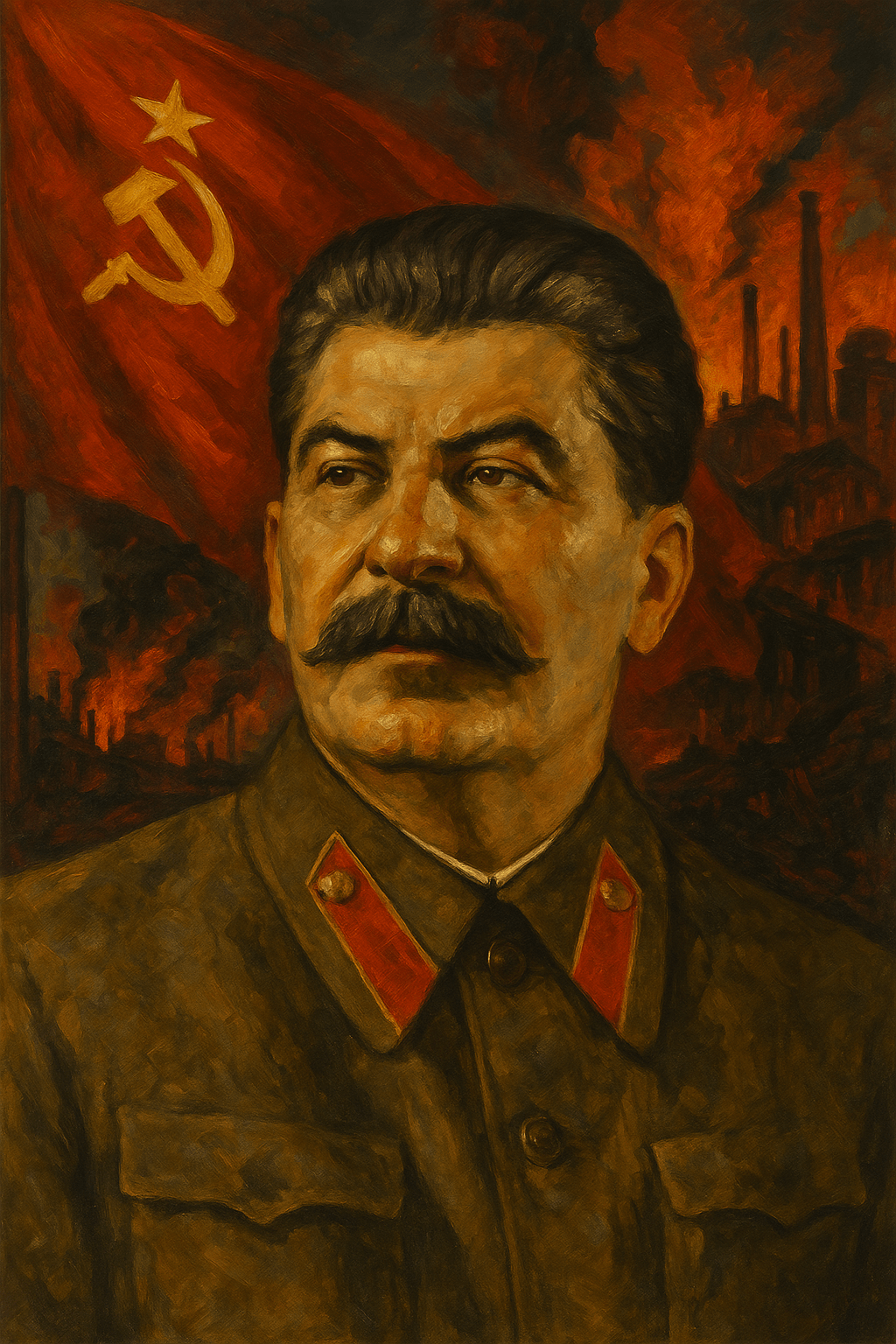
A Weaponized Intellects review of Erik van Ree’sThe Political Thought of Joseph Stalin: A Study in Twentieth-Century Revolutionary Patriotism —
exploring how van Ree’s attempt to reclaim Stalin for the Western tradition instead exposes the end of Europe’s monopoly on Marxism and the birth of a global, anti-imperialist modernity.
By Prince Kapone | Weaponized Intellects Book Review — October Revolution Series | November 9, 2025
Europe’s Bastard Child: Stalin and the Broken Promise of Enlightenment
Erik van Ree begins his study of Stalin with a provocation that exposes more than he intends. He does not see Stalin as a monster who crashed into history from some Asiatic abyss, but as a product of Europe’s own Enlightenment — its faith in reason, progress, and the perfectibility of man through violence. In this reading, Stalin becomes the illegitimate child of Voltaire and Robespierre, raised on Rousseau’s social contract and Hegel’s dialectic, baptized by Marx, and orphaned by Lenin. The argument seems, at first, almost sympathetic: Stalin as a rational inheritor of the Western revolutionary tradition. But van Ree’s sympathy is only a disguise — a method of disarmament. He seeks to absorb Stalin back into the liberal family of Europe, to make him safe for polite academic company, to turn revolution into reform and terror into theory. It is the ideological equivalent of embalming a body to make it less frightening to the living.
The strength of van Ree’s book lies precisely in its unwillingness to repeat the Cold War catechism that Stalinism was an Oriental infection of an otherwise humane Marxism. He correctly insists that the seeds of dictatorship, discipline, and revolutionary centralization already existed in the soil of Western radicalism — in the Jacobins’ Committee of Public Safety, in Blanqui’s conspiratorial vanguard, even in Marx’s own defense of the Paris Commune’s “dictatorship of the proletariat.” But where van Ree sees an unbroken line of European rationalism culminating in the bureaucratic nightmare of the Soviet state, we see something else: the forced maturation of socialism under siege, the birth of proletarian power in a world of imperial predators. What he calls “Stalin’s authoritarianism” was in fact the historical realism of a revolution that had survived the white armies, starvation, blockade, and encirclement. It was the discipline of a people who had learned that liberty without power is just another form of defeat.
Van Ree’s thesis that Stalinism was an extension of Western modernity contains a bitter truth. The October Revolution was indeed a child of Europe — but it was a child that turned against its parent. It seized the tools of Enlightenment — science, planning, reason — and used them to abolish the social order that had birthed them. The horror of Stalin for the West was not his brutality but his betrayal of lineage: he made the Enlightenment proletarian. He placed reason in the service of collective emancipation rather than private accumulation. He made the bourgeois dream of progress into the nightmare of its own obsolescence. In short, Stalin universalized what Europe had claimed but never intended — equality through power.
The liberal mind recoils from this because it recognizes itself in the mirror. When van Ree says that Stalin fulfilled rather than betrayed the logic of modernity, he means to indict him. But from our vantage, this is the highest praise: Stalin exposed the hypocrisy of a civilization that built concentration camps in Africa while preaching freedom in Paris. He proved that the machinery of the modern state — its rational bureaucracy, its planned economy, its capacity for total mobilization — could serve not only capital but also the working class, not only empire but revolution. For this crime, he will never be forgiven.
To treat Stalin as a “Western Marxist” — as van Ree effectively does — is to misunderstand the rupture that occurred after 1917. Lenin and Stalin did not extend the Enlightenment; they buried it. They replaced its abstract universalism with the concrete universality of the oppressed, its empty rationalism with a dialectic grounded in production, class, and survival. The Bolshevik project was not to perfect Europe but to transcend it — to free socialism from its colonial and philosophical inheritance. If Stalin’s Marxism bears traces of the Jacobin or the Hegelian, it is because revolutions inherit what they must destroy.
This is the historical fault line van Ree tiptoes around: that the Soviet Union was not Europe’s continuation but its negation. To admit this would mean admitting that the working class of a “backward” peasant empire did what the industrial proletariat of Europe never could — seize power, expropriate capital, and hold it. It would mean that socialism had escaped the custody of the West. Van Ree, like all European humanists before him, cannot abide that thought. So he reclaims Stalin for the family — the disobedient son of Reason, yes, but still a son. Our task is the opposite: to show that he was the first post-European Marxist, the man who transformed Marxism from an abstract doctrine of industrial progress into a weapon of anti-imperialist survival.
Stalin, in van Ree’s account, represents the dark culmination of Western rationalism. In ours, he represents its overthrow — the moment when reason ceased to serve the market and began to serve the masses. The question that van Ree never asks, and that we must: who was more faithful to the Enlightenment’s promise — the bourgeois who enslaved the world in the name of progress, or the revolutionary who built socialism in one country under the guns of a hostile planet? History has already answered. The lights of Paris dimmed, and the lamps of Moscow were lit. Europe gave birth to the Revolution — and then tried to kill it. Stalin made sure it survived.
Revolution Without Illusions: Marxism Confronts History
By the time van Ree turns to what he calls the “problem of Marxism,” the philosophical fog of Western humanism begins to clear. The question is no longer whether Stalin was the heir of the Enlightenment, but what it means to make revolution in the ruins of its promises. For van Ree, Marxism’s tragedy is that it inherited the Enlightenment’s faith in progress but abandoned its conscience. For us, that “tragedy” is simply history without illusions — the collision between theory and necessity, between a starving people and a hostile world.
Marx had already warned that the bourgeois revolutions solved none of the contradictions they exposed. They replaced feudal privilege with property, the divine right of kings with the divine right of capital. When Lenin and Stalin faced the task of building socialism in a semi-feudal empire surrounded by imperialist powers, they discovered what Marxism meant in practice: not debate in the academy, but survival under siege. The dictatorship of the proletariat was not a metaphor; it was a state form carved from crisis. The Western left, insulated by imperial comfort, has never forgiven them for forcing Marx’s abstractions into history’s dirt and blood.
Van Ree senses this but draws the wrong conclusion. He sees the Bolshevik project as the degeneration of Western reason into totalitarian logic — the guillotine perfected by the plan. But in truth, it was the opposite: reason liberated from the marketplace, planning freed from profit, power wrested from the hands of the few and entrusted, for the first time, to the many. What terrified Europe was not Stalin’s cruelty, but his success. He made socialism work. He took a country the West dismissed as backward and turned it into an industrial power capable of defeating fascism and launching satellites into space. The cost was immense, but so was the victory. The West’s moral outrage only began when it realized history could now be made without it.
This is the real “problem of Marxism”: not its alleged brutality, but its ability to function outside the liberal order — to prove that civilization does not need capitalism. That is why every serious revolution must eventually pass through what the bourgeois calls tyranny: the moment when the old world stops negotiating and starts fighting. Stalin understood that revolutions do not survive by persuasion; they survive by production, discipline, and control over the means of both. Where the Western left sought comfort in critique, the Soviets built factories, schools, and armies. One made theories; the other made history.
Van Ree cannot accept this. Like every liberal chronicler of revolution, he mourns the loss of innocence. But innocence was a luxury of empire, not of the colonized or the hungry. In Russia, Marxism ceased to be a philosophy and became a mode of existence. The revolution had no time for sentiment; it had to build socialism before it was devoured. The terror of necessity replaced the poetry of ideals, and from that crucible came a system that — for all its contradictions — broke the spine of European fascism and inspired the colonized world to stand. That is not the death of Marxism. It is its incarnation.
If van Ree’s first chapters expose Stalin’s European inheritance, this one inadvertently reveals his historical vindication. Stalin forced Marxism to confront the real world — and the real world, for the first time, had to answer. The problem of Marxism was never that it went too far, but that it finally arrived.
The Making of a Revolutionary Mind: From the Margins of Empire to the Center of History
Van Ree’s next movement takes us from philosophy to formation, from Stalin’s relation to Western thought to the crucible that forged his revolutionary mind. To understand Stalin’s political thought, one must return to the world that made him: the periphery of empire, where industrial modernity arrived as subjugation and revolution meant survival. The Georgia of Stalin’s youth was a microcosm of the global contradiction—colonial extraction, feudal backwardness, and capitalist intrusion all existing in the same breath. To the liberal historian, this environment produced fanaticism; to the dialectician, it produced clarity. Here, Stalin saw that theory without power is sermon, and that socialism without statehood is suicide.
It is from this soil, not the drawing rooms of Europe, that Stalin’s Marxism took shape. His early writings and clandestine organizing in the Caucasus were not intellectual exercises—they were acts of class war. He studied Marx, Engels, and Lenin, not as philosophers of human progress, but as strategists of material transformation. Revolution was not a matter of ideals but of infrastructure: the seizure of railways, factories, and fields, the conquest of literacy and logistics. When Lenin argued that the vanguard party must serve as the “general staff” of the proletariat, Stalin grasped it instinctively. The party was not an association of thinkers; it was a weapon, and weapons must be disciplined.
Van Ree recognizes this, but again interprets it through Western eyes. He calls Stalin a “pragmatist of power,” as if pragmatism were betrayal. But for a revolutionary operating in the world’s colonial hinterlands, power was not a moral choice—it was the only condition for existence. The early Bolshevik movement, besieged by Tsarist police, infiltrated by provocateurs, and derided by Western social democrats, did not have the luxury of liberal virtue. Its members learned organization the way a people under occupation learn silence: through necessity. What Western Marxism later condemned as “bureaucratic centralism” was, in its origin, the rationality of the oppressed.
By the time of 1917, Stalin’s thinking had already diverged from that of the émigré intellectuals who populated the cafés of Zurich and Paris. He did not see revolution as a philosophical event but as a logistical one—a transfer of material power, not just moral legitimacy. In this, he was perhaps the first to intuit that Marxism would only survive in the periphery. Europe had grown old on its own contradictions; its proletariat had been bought off by empire. The real revolutionary subject would emerge from the underdeveloped world, where capitalism’s violence was still raw and visible. Long before the Bandung Conference or the rise of Mao’s China, Stalin’s experience in a semi-colonial Russia had already announced this shift in the geography of revolution.
Lenin gave that vision theory; Stalin gave it form. It was Stalin who translated the universalism of Marx into the practical language of a backward agrarian state. He understood that socialism could not wait for the most advanced nations to awaken—it had to be built where it was needed most. In this sense, Stalin’s “heresy” of socialism in one country was less an innovation than a recognition of geography: revolutions happen where the contradictions are sharpest, not where philosophers are most fluent. The West accused him of provincialism, but it was he who provincialized the West.
Van Ree calls this turn “revolutionary patriotism,” as if it were a betrayal of internationalism. Yet there is no contradiction between loving the homeland and serving the world proletariat when both are under imperial assault. Stalin’s patriotism was not nationalism but sovereignty—the insistence that socialism could only exist if defended by those who built it. His generation learned that the flag of the working class, if not guarded, would be trampled beneath the boots of foreign capital. That is not chauvinism; that is history speaking through the wreckage of war.
In tracing Stalin’s intellectual trajectory, van Ree unwittingly reveals the very transformation that Western Marxism refuses to face: Marxism’s center of gravity shifted from the European metropolis to the colonial periphery. The Bolsheviks did not imitate Europe—they broke from it. The dialectic that produced the Soviet state was the same dialectic that would later animate China, Vietnam, Cuba, and Africa. It was the realization that revolution could no longer wait for theory to mature; theory had to be rewritten by those fighting to eat. Stalin, the son of a shoemaker from the Caucasus, became the first statesman of this new world, a bridge between the industrial proletariat of Europe and the peasant masses of the Global South.
Van Ree ends this section by calling Stalin a “continuator” of Marx and Lenin. That is true—but not in the way he imagines. Stalin did not merely continue their work; he relocated it. He moved the axis of Marxism from the West to the rest, from abstraction to construction, from critique to power. In that transition, Marxism ceased to be a European philosophy and became a global weapon. That is why the West calls him a tyrant. It was not the gulag that terrified them; it was the realization that the world no longer needed their permission to change.
Revolution in a Backward Land: The Soviet Experiment and the Laws of Necessity
Having traced Stalin’s formation from the periphery of empire to the heart of revolution, van Ree turns to the question that haunted every Marxist of the twentieth century: how can socialism be built in a land condemned as “backward”? This is not an academic inquiry. It is the crucible where theory met hunger, sabotage, and invasion—where the contradictions of global capitalism made their first great counter-attack. Van Ree treats this as a philosophical tension between determinism and voluntarism, as if the fate of the Soviet Union were a matter of faith. But the Bolsheviks were not priests. They were mechanics in history’s workshop, improvising with rusted tools, surrounded by wolves. The “problem” of backwardness was not theoretical; it was logistical. And Stalin, more than any of his contemporaries, understood that survival itself had to become a science.
Marx had foreseen that socialism would first arise in the most advanced capitalist nations, where the productive forces had matured under the lash of industry. But the world did not move in straight lines. Imperialism had drained the colonies and semi-peripheries, creating islands of industrial might and oceans of destitution. Russia was one such ocean. When Lenin led the October Revolution, he knew the Bolsheviks were seizing power in the weakest link of the global chain. He expected the revolution to spread westward. It did not. Germany fell to reaction, Hungary to intervention, and the rest of Europe to fear. The young Soviet Republic found itself isolated, encircled, and starving. What followed was not deviation but adaptation—the transformation of Marxism from a philosophy of inevitability into a practice of survival. Stalin was the theoretician of that transformation.
Van Ree acknowledges that Stalin’s doctrine of “socialism in one country” emerged from this crisis, yet he interprets it as a nationalist retreat from Marx’s internationalism. In truth, it was the only way to defend the revolution’s universality. A world revolution that never came had to be replaced by a world that could be built. Industrialization was not a fetish; it was a shield. Collectivization was not cruelty; it was consolidation. The Soviet Union’s five-year plans were not blueprints for tyranny but a declaration of war against dependency itself. Under Stalin, Russia ceased to be the raw-material supplier of European capitalism and became its greatest strategic threat. That shift—economic, political, and psychological—shook the foundations of empire more than any pamphlet or manifesto could.
The bourgeois historian cannot grasp this, because he mistakes development for cruelty and discipline for dogma. To him, the factory whistle and the commissar’s decree are evidence of oppression. To us, they are the sounds of a people learning to make history without masters. Every ton of steel, every kilowatt of electricity, every harvested acre was an act of defiance. The Revolution had survived the White armies; now it had to survive the market. Stalin’s “authoritarianism,” stripped of its Cold War mystique, was simply the organization of labor in the absence of capital. What liberals call coercion was, for millions, the first taste of collective agency—imperfect, painful, but real.
Van Ree grudgingly admits that Stalin’s achievements “rescued Russia from the margins of civilization,” but he frames this as irony—the barbarian mastering the tools of the civilized. He misses the dialectic entirely. Civilization, in this context, was imperial domination; barbarism was the refusal to die by its logic. The Five-Year Plans, for all their contradictions, proved that industrialization did not require colonial exploitation. The Soviet Union’s rapid ascent shattered the racist doctrine that only the West could modernize. It demonstrated, materially and irrefutably, that human progress was not the private property of Europe. That was Stalin’s unforgivable sin.
The Western Marxists, meanwhile, denounced these measures as “state capitalism,” mistaking the forms of administration for the content of class power. They failed to understand that the bureaucracy was not a new ruling class but a temporary scaffolding erected in a storm. The dictatorship of the proletariat had to plan production, defend borders, educate millions, and reorganize life from top to bottom—tasks no revolutionary romantic could complete by discussion alone. The socialist state did not mimic the bourgeois state; it inverted it. It centralized power not to preserve privilege but to extinguish it. History is messy; revolutions even more so. But from that mess emerged literacy, electrification, public health, and a society where labor, not birth, defined worth. That is not tyranny—it is transformation.
Van Ree closes this discussion by returning to his theme of “rationalism without conscience.” In his view, Stalin’s drive to industrialize and collectivize reveals the moral bankruptcy of Marxist materialism—the dream of building heaven through statistics. Yet this critique says more about the West than it does about Stalin. It is the West, after all, that built its wealth through slavery, its modernity through genocide, its “humanism” through empire. The Soviet experiment, for all its flaws, tried to build a new world without colonies, landlords, or kings. That it failed in part does not erase that it succeeded in kind. The Revolution proved that backwardness was not destiny but design, and that the oppressed could design differently. Stalin did not abolish contradiction; he forced it to work for socialism. And for a time—against all odds—it did.
Socialism in One Country: The Geometry of Revolutionary Survival
From the ruins of intervention and famine arose a question that would define the twentieth century: could socialism live, even for a moment, on a single island in a capitalist sea? For van Ree, Stalin’s answer—“yes, it must”—marked a betrayal of Marx’s internationalism and Lenin’s expectation of world revolution. But this reading mistakes endurance for isolation. Stalin did not abandon the world; he refused to wait for it. “Socialism in one country” was less an ideological heresy than a geometry of survival: a state constructing its own orbit when the rest of the planet had turned hostile. History had closed every other path. The Revolution could perish nobly in the name of orthodoxy, or it could live defiantly in the name of necessity. Stalin chose life.
Van Ree concedes that Marx and Engels, under different circumstances, had entertained the possibility of a solitary socialist state, but he regards Stalin’s formulation as an opportunistic retreat. Yet what choice did the Bolsheviks have after the failure of revolutions in Germany, Hungary, and beyond? Lenin himself had already begun to theorize continuity under siege—an understanding that the global revolution would unfold unevenly, in stages, across the fractures of imperialism. Stalin merely formalized this reality. He took what was once a temporary tactic and turned it into doctrine, not because he loved isolation, but because he saw that isolation was now the battlefield.
The idea scandalized Western Marxists because it revealed their own impotence. They could critique, but they could not build. They demanded theoretical purity while living off imperial wages. For them, socialism was a seminar; for the Soviets, it was a daily act of construction against famine, espionage, and invasion. “Socialism in one country” was a declaration that the revolution would no longer depend on the moral awakening of Europe. The world proletariat was real, but it was divided; the Soviet state would be its vanguard in material form. From this principle emerged the Comintern, the Five-Year Plans, and the mobilization of an entire civilization for production, education, and defense. Stalin transformed the notion of internationalism from sentiment into infrastructure.
Van Ree depicts this as a distortion of Marx’s vision—a turn from dialectical history to dogmatic statism. But in practice, it was dialectics itself applied to geopolitics. The universal could only survive through the particular; socialism could only become global if it first became sovereign somewhere. The state, that supposed relic destined to “wither away,” had to be revived as the fortress of the proletariat. Its purpose was no longer to mediate class conflict but to prevent capitalist restoration. In the age of imperial encirclement, socialism without sovereignty would have been like a heart without a body: pure, but lifeless. Stalin understood that the dictatorship of the proletariat must have borders if it was to have breath.
What bourgeois scholars condemn as autarky was, in fact, a rehearsal for decolonization. The Soviet experience taught the colonized world that development did not require dependence. When Nkrumah spoke of “political independence as the precondition for economic independence,” he was echoing Stalin’s logic. Mao’s self-reliance, Castro’s blockade socialism, Nyerere’s ujamaa—all carried the same DNA. The Revolution in Russia had rewritten the global coordinates of socialism, proving that it could emerge from backwardness and survive without Western tutelage. The cry of “socialism in one country” became the war chant of the Third World: we will build with what we have.
Van Ree, ever the European, calls this “revolutionary patriotism,” as if patriotism were an embarrassment. But what he derides as nationalism was in truth the moral geography of self-determination. To defend the revolution’s homeland was to defend the possibility of any revolution at all. The survival of the Soviet Union was not a Russian project; it was a proletarian necessity. It kept alive the belief that history could still be steered by those who work rather than those who own. The flag that flew over the Kremlin after 1945 was not merely national—it was planetary. It signaled to the colonized that empire could be defeated, that the West was not destiny.
Van Ree ends this section by calling Stalin’s doctrine “a paradox of isolationism that bred global ambition.” He misses the dialectic once again. It was precisely by learning to stand alone that the Soviet Union could stand for others. Isolation became the seed of universality; sovereignty became the foundation of solidarity. Stalin’s theory, forged in the desperate 1920s, outlived him by decades in the movements it inspired. It was not an abandonment of internationalism—it was its material beginning. And when the guns of fascism finally turned east, it was that same “socialism in one country” that saved the world from its own annihilation.
In the geometry of revolutionary survival, the Soviet Union became the proof that the circle of history could be redrawn from the margins. What began as necessity became a method, and what began in Russia became a map for the oppressed of every continent. The West calls that Stalinism. The world knows it as endurance.
The State as a Weapon: Power, Terror, and Revolutionary Morality
By the middle chapters of van Ree’s study, the question of power—its form, its ethics, its limits—moves to the center. Here the liberal historian’s pulse quickens. Stalin’s conviction that the state must be both sword and shield, that terror could serve justice, that coercion could be moral—these are ideas that terrify Western thought, precisely because they expose the hypocrisy of its own foundations. Every empire practices violence while preaching virtue. Stalin made the violence visible and claimed it openly for the oppressed. In his hands, the state was not a bureaucratic machine to be dismantled after victory, but a living weapon, a conscious tool of class war. This was not betrayal of Marxism; it was its materialization.
Van Ree reads Stalin’s marginalia on Lenin’s State and Revolution as evidence of a philosophical corruption: where Lenin envisioned the state withering away, Stalin insisted on its permanence. But what van Ree calls dogma was dialectics in motion. The proletarian state could not wither while surrounded by predators. It could not relax its vigilance while the world’s capital still armed itself for intervention. The coercive apparatus of the revolution was not a moral failing—it was the immune system of socialism under siege. History forced the Bolsheviks to choose between purity and persistence. They chose to persist. The tragedy is not that they wielded power, but that they had to wield it so long.
In van Ree’s eyes, Stalin’s morality collapses into cold utilitarianism: ends justify means, production over compassion, order over life. But this is only shocking to those who have never faced annihilation. To the generation that lived through famine, blockade, and war, morality was not an abstraction—it was survival. A grain quota was not a statistic but a guarantee that a factory could run, that a city could eat, that a child could learn to read. The revolution’s cruelty was the mirror image of the cruelty it inherited. Capitalism had starved continents for profit; the Soviet Union rationed bread for survival. The difference was not in suffering, but in purpose.
Western critics of Stalinism often speak of “moral decay,” yet they ignore the moral arithmetic of empire. They call collectivization barbaric while celebrating the enclosures that created capitalism. They condemn show trials but forget colonial massacres. They weep for the kulak while ignoring the Congolese miner. What frightened them was not the blood—it was who was spilling it, and for what. The violence that sustains property they call law; the violence that destroys it they call terror. Stalin refused the euphemism. He stripped power of its disguise and forced the world to look directly at the cost of change.
To reduce this to cynicism is to misunderstand the dialectical relationship between necessity and ethics. Stalin’s concept of revolutionary morality—though van Ree mocks it as hollow—was rooted in collectivism. Right and wrong were measured not by individual conscience but by the advance or retreat of the working class. The moral universe shifted from the private to the social. “One death is a tragedy,” the West loves to quote; but for Stalin, tragedy was measured in the extinction of a class, a nation, a future. His was not a morality without feeling—it was a morality of scale. The liberal, trapped in the sentimentality of individualism, could not comprehend that in a world divided by classes, neutrality itself was cruelty.
Van Ree grudgingly acknowledges that this ethos built the industrial base that crushed Nazism. He notes the paradox: that the same state which terrorized its citizens also saved humanity from fascism. But the paradox dissolves when viewed through the lens of history’s material conditions. The Soviet Union’s steel, coal, and discipline were not abstract virtues; they were the infrastructure of survival. Without them, Auschwitz would have spread eastward and the world might never have recovered. If socialism had to become iron to defeat iron, it was because the enemy left no other metal available.
In his closing remarks on this theme, van Ree writes of Stalin’s “rationalism without conscience,” yet his accusation lands squarely on the civilization that taught it to him. The Enlightenment gave humanity the guillotine before it gave it equality. The British built workhouses before they abolished slavery. Stalin’s state was the inheritor of that same machinery—but turned against its original owners. That, not the purges or the prisons, is what the bourgeois world cannot forgive. He took the methods of empire and used them to build an empire of labor. The factories that once made chains now made tractors; the army that once protected property now defended socialism. In that reversal lies the moral heart of the Soviet experiment.
Van Ree sees in Stalin the cold perfection of Western rationalism. We see something else: the transformation of reason itself. The revolution stripped Enlightenment of its hypocrisy and placed its tools in the hands of those it once enslaved. The state, for Stalin, was not the end of freedom—it was its precondition. And though it bent history with iron, it bent it toward a world where the oppressed could finally stand upright. That, more than anything, is why the ruling class will never absolve him.
The Cultural and National Question: Van Ree’s Stalin Between Orthodoxy and Autonomy
When van Ree arrives at Stalin’s writings on culture and nationality, his tone shifts from analysis to suspicion. He has spent hundreds of pages insisting that Stalin was not an Asiatic despot but a product of Europe’s revolutionary reason. Now, faced with the Stalin of the 1930s and 1940s—the man who codified socialist realism, theorized the nation, and oversaw the “anti-cosmopolitan” turn—van Ree reads apostasy. To him, the universalist Marxist became a Russian prophet, and revolutionary humanism hardened into state orthodoxy. His claim is bold: Stalin rescued Marxism from liberal sentiment only to imprison it within the myth of the nation.
The charge rests on a narrow textual foundation. Van Ree draws heavily from Stalin’s 1913 essay Marxism and the National Question, his wartime speeches, and the 1950 Marxism and Problems of Linguistics. He reads these works through a Western lens that equates nationalism with reaction and cosmopolitanism with freedom. Thus, when Stalin argues that every nation is “a historically constituted, stable community of people,” van Ree sees essentialism. When Stalin insists that language is shaped by social life rather than class struggle alone, van Ree hears metaphysics. Yet the logic of these texts is materialist: they attempt to translate Marxism into the lived reality of a multiethnic state under siege. For Stalin, to speak of the nation was not to worship it but to organize it—to bind the fragments of empire into a socialist whole without erasing their particularity.
Van Ree interprets this as “revolutionary patriotism”: a fusion of Jacobin civic virtue and Russian state continuity. His evidence—state promotion of classical literature, appeals to Russian history during the war, rehabilitation of national heroes—becomes, in his reading, proof that Marxism had capitulated to cultural traditionalism. But what he mistakes for nostalgia was, in practice, the Soviet strategy of legitimacy. A revolution cannot reproduce itself through decrees alone. It must educate its children, narrate its origins, and construct a collective memory that makes socialism intelligible in everyday life. Stalin understood that culture was the long-duration front of class struggle: whoever defined the nation’s story would define its future.
The tension van Ree identifies—between socialist internationalism and national form—is real. His error lies in assuming it was resolved through betrayal rather than dialectic. In Stalin’s cultural policy, the universal and the particular are not opposites but stages. Internationalism required a base of coherent nations freed from imperial domination. The struggle against “rootless cosmopolitanism,” which van Ree denounces as xenophobic, was directed less at foreigners than at an emerging class of Soviet intellectuals who looked westward for validation. The critique was crude at times, often repressive, but its political content was anti-imperialist: a refusal to let Western bourgeois culture re-enter the socialist world disguised as “objectivity.” Van Ree’s failure to historicize this context turns ideology into pathology.
To his credit, van Ree notes the paradox that Stalin’s nationalism coincided with global expansion of socialist influence. Yet he draws the wrong conclusion. He writes that Stalin “universalized Russia,” turning Marxism into a civilization-state. The opposite is true: Stalin provincialized Europe. By grounding socialism in the material and linguistic diversity of the Soviet Union, he proved that Marxism could be spoken in many tongues. The Revolution ceased to be a European export and became a planetary experiment. Van Ree’s discomfort stems not from Stalin’s alleged betrayal of internationalism, but from his success in freeing it from the West’s monopoly.
The book’s treatment of culture reveals its core contradiction. Van Ree cannot decide whether to mourn Stalin as a fallen Marxist or condemn him as a Western rationalist gone mad. His argument oscillates between moral disappointment and anthropological fascination. What never appears is a recognition that the USSR’s cultural line was part of a larger geopolitical realignment: the creation of a self-sufficient socialist world system with its own symbols, aesthetics, and languages. When van Ree calls this “ideological enclosure,” he is describing decolonization without knowing it. Stalin’s policies on art, history, and nationality were the prototype of a post-imperial modernity—flawed, bureaucratic, but undeniably sovereign.
The merit of van Ree’s book is that it unintentionally documents this transition. His “revolutionary patriotism” is not a concept Stalin theorized; it is a projection of Western unease onto the first state that escaped Western tutelage. Van Ree’s Stalin stands between two mirrors: one reflecting the European revolutionary tradition, the other reflecting its negation. In the cracks between those mirrors lies the real historical phenomenon—the Soviet attempt to build a socialist consciousness that could survive both fascism and cultural dependency. To call that attempt reactionary, as van Ree does, is to demand that revolutions remain cosmopolitan until they die.
By grounding culture in the material needs of sovereignty, Stalin exposed the Achilles’ heel of liberal Marxism: its dependence on moral approval from the very societies it claims to oppose. Van Ree’s discomfort is therefore not with Stalin’s nationalism but with his independence. In the cultural question, as in every other, Stalin’s heresy was to take Marxism at its word—to make it a lived practice rather than a seminar topic. That, in the end, is the unspoken argument of van Ree’s book, and the one it most struggles to contain.
The Western Mirror: When Rationalism Met Its Shadow
Van Ree closes his study with a philosophical gesture. Having traced Stalin from the young Georgian Marxist to the architect of a global socialist empire, he arrives at a final verdict: Stalin was not the negation of the Enlightenment but its consummation. The machinery of rationalism, van Ree claims, simply ran to its logical conclusion in Stalin’s hands. Planning became domination, progress became coercion, reason became totality. The gulag, in this reading, is not an aberration from modernity but its mirror. Stalin, the disciple of Marx, emerges as the final child of Europe’s secular faith in the perfectibility of man through reason. Here, van Ree’s humanism turns tragic. He wants to rescue the Enlightenment from its consequences, to separate the light of universal reason from the smoke of the factories that powered it. But his own argument makes that impossible: the blood on Stalin’s hands is also on the hands of the civilization that produced him.
This is the point where a dialectical critique must intervene. For van Ree, the problem is metaphysical—reason unmoored from liberty. For us, it is material—reason constrained by class. Enlightenment rationalism, in its bourgeois form, was never neutral; it was the ideological grammar of capitalism’s expansion. It produced the calculus of profit and the map of empire. When Stalin appropriated its instruments—science, planning, the cult of progress—he stripped them of their owners. He did not “pervert” the Enlightenment; he expropriated it. He took its tools of domination and repurposed them for survival. What van Ree calls totalitarianism was, in practice, the first attempt to wield modernity without capital.
Van Ree’s conclusion, that Stalinism fulfilled the Enlightenment’s logic, is thus half true but inverted. It is true that Stalin realized the potentials embedded in Western rationalism—bureaucratic planning, secular faith in progress, the dream of order—but he redirected their telos. Under capitalism, rationality serves accumulation; under socialism, it serves reproduction. The same techniques—statistical management, industrial discipline, the language of “efficiency”—were turned from private profit toward collective endurance. In van Ree’s schema, this shift cannot be recognized, because his frame of morality is unchanged. He measures socialism by liberal ethics, not by material emancipation. The moment revolution ceases to imitate Europe, he declares it barbaric.
The irony is that van Ree’s own historical evidence undermines his thesis. He documents how Stalin’s “rationalist state” eradicated illiteracy, industrialized a continent, and mobilized against fascism—all feats of collective will that the Enlightenment promised but capitalism never delivered. Yet he calls them deformations because they emerged without bourgeois liberty. He sees the Soviet experiment as proof that rationality without conscience leads to catastrophe. But whose conscience? The conscience of Voltaire, who defended colonial slavery? Of Mill, who justified imperial rule as pedagogy? The Enlightenment’s moral lexicon was written in the language of property. Stalin’s sin was to rewrite it in the language of labor.
What van Ree names as the “totalitarian” impulse in Stalin—the unity of politics, economy, and culture under a single plan—was in fact the logical inversion of capitalist totality. The bourgeoisie had long achieved its own integrated order, fusing production, consumption, and ideology into a seamless system of profit. The Soviet model exposed that hidden universality by building its own. The West called it tyranny because it could no longer monopolize the future. When van Ree accuses Stalin of embodying modernity’s dark side, he unknowingly concedes that socialism had seized modernity itself. The proletariat had inherited the world the bourgeoisie built—and used it to build something new.
In this final section, van Ree abandons history for moral allegory. Stalin becomes the ghost of the West’s bad conscience, the rational monster it must exorcise to recover innocence. Yet there is no innocence left to recover. Hiroshima and Dresden, the Congo and Vietnam, are not less rational than the Five-Year Plan; they are simply rational in the service of a different class. Van Ree’s tragedy is that he can describe this continuity but not name its cause. He sees reason corrupted, but not property preserved. His Stalin is the specter of modernity devouring itself. Ours is the proletariat’s revenge upon a world that mistook conquest for civilization.
To read van Ree’s conclusion dialectically is to see that his “Western mirror” reflects in both directions. Stalin does indeed mirror the West—but as its negation, not its fulfillment. He exposes the violence hidden inside its civility, the labor buried beneath its freedom, the plan concealed within its markets. The mirror is shattered, and through its fragments we glimpse the truth that van Ree cannot admit: that the Soviet project, for all its contradictions, represented the first post-Western rationality, the first attempt to use modernity against its makers. The Enlightenment, finally, had met its dialectical end.
Final Assessment — Stalin as the First Post-Western Marxist
By the end of van Ree’s book, the argument circles back to its starting question: was Stalin the last European revolutionary or the first of something new? Van Ree answers cautiously—Stalin, he writes, was “Europe’s child gone rogue.” He cannot quite decide whether the Soviet project stands inside the Western tradition or outside it. His ambivalence is the key to understanding the book’s ideological function: it tries to reconcile Stalin’s historical reality with the moral horizon of liberal humanism. But history does not obey conscience. The Revolution did not ask Europe for permission to exist, and Stalin’s political thought—whatever its flaws—marks the point at which Marxism ceased to be a Western discourse and became a global one.
The text that van Ree constructs is therefore double. On one side, Stalin the rationalist: planner, empiricist, engineer of society, heir to Enlightenment reason. On the other, Stalin the heretic: destroyer of the very civilization that produced him. Van Ree cannot synthesize these opposites because the synthesis lies beyond the limits of his framework. What he calls paradox is, in fact, dialectic. The Bolshevik Revolution was not Europe’s continuation but its rupture. Stalin’s contribution was to institutionalize that rupture—to transform Marxism from a philosophy of critique into a state power capable of defending itself. In doing so, he re-rooted socialism in geography, not utopia; in sovereignty, not sympathy. The center of the world revolution shifted from London and Paris to Moscow, then to Beijing, Havana, and Hanoi. The world system began to speak in accents the West could no longer translate.
Van Ree admits this transformation but treats it as tragedy. “The European idea of freedom,” he laments, “did not survive its realization.” Yet the question is freedom for whom. The freedoms of the Enlightenment were built on the colonies, on wage labor, on the unpaid reproduction of women and peasants. The Soviet experiment, whatever its errors, attempted to universalize freedom by abolishing its economic condition: exploitation. It extended the logic of liberation beyond the metropole to the periphery. That is why, from Accra to Algiers, revolutionaries in the mid-twentieth century read Stalin alongside Marx and Lenin. They recognized in the Soviet experience the grammar of their own struggles: the need for planning, for party discipline, for defense against imperial sabotage. For them, “socialism in one country” was not retreat but precedent.
Van Ree’s moral vocabulary collapses before this reality. He speaks of “totalitarian closure,” “moral indifference,” “the cult of the state,” but these are the categories of a world that had never known subjugation. The peasant who first learned to read under Soviet power, the woman who entered the factory, the worker who no longer bowed to the landlord—all existed outside his frame. The Revolution’s violence terrifies him because it exposes the quiet violence of his own civilization: the plantation, the trench, the market. He calls Stalinism a catastrophe of reason; we call it the moment reason changed sides.
The lasting value of van Ree’s study, despite itself, is that it demonstrates the limits of Western Marxism. His archival precision and intellectual honesty bring him to the edge of a truth he cannot cross: that Marxism’s future was never European. The Soviet Union, in its contradictions, became the prototype of a post-Western socialism—a system born from underdevelopment, built against empire, and measured not by moral abstraction but by material transformation. Stalin’s thought, with all its roughness, represents the first coherent attempt to govern that transition: to make the revolution durable in a hostile world, to translate theory into infrastructure.
This is why the ruling class still drags his name through the mud. For them, Stalin’s greatest crime was not the purges or the camps—it was the proof that capitalism was neither eternal nor global. He demonstrated that modernity could be reorganized without profit and that sovereignty could belong to the exploited. Every Western denunciation since has been an act of ideological self-defense, an attempt to bury the evidence. Van Ree’s book, in its learned discomfort, preserves that evidence inadvertently. It shows that the Enlightenment did not die in Stalin’s Russia; it was overthrown there, replaced by something that frightened Europe more than any tyranny could: a rival modernity.
To call Stalin the first post-Western Marxist is not to canonize him but to locate him. His political thought, as van Ree documents and as history confirms, carried Marxism through its first great migration—from critique to power, from the European proletariat to the colonized masses, from the language of philosophy to the grammar of development. What emerged was not perfection but possibility. The socialist world system that followed—Soviet, Chinese, Cuban, Vietnamese, Angolan—was built on that foundation. Its contradictions remain our inheritance. But so does its proof: that humanity can think, build, and organize beyond the West.
Van Ree ends his book by urging readers to recover “the humanist spirit of Marx.” We end ours by insisting that Marx’s spirit survived precisely because it left Europe. In the figure of Stalin—its most vilified practitioner—the world saw the birth of a new political species: modernity without empire, reason without capital, science without colonization. It was imperfect, provisional, and mortal, like every revolution. But it was real. And because it was real, it remains unforgivable to those who still live off the illusion that history began, and must end, in the West.
 Weaponized Information
Leave a comment