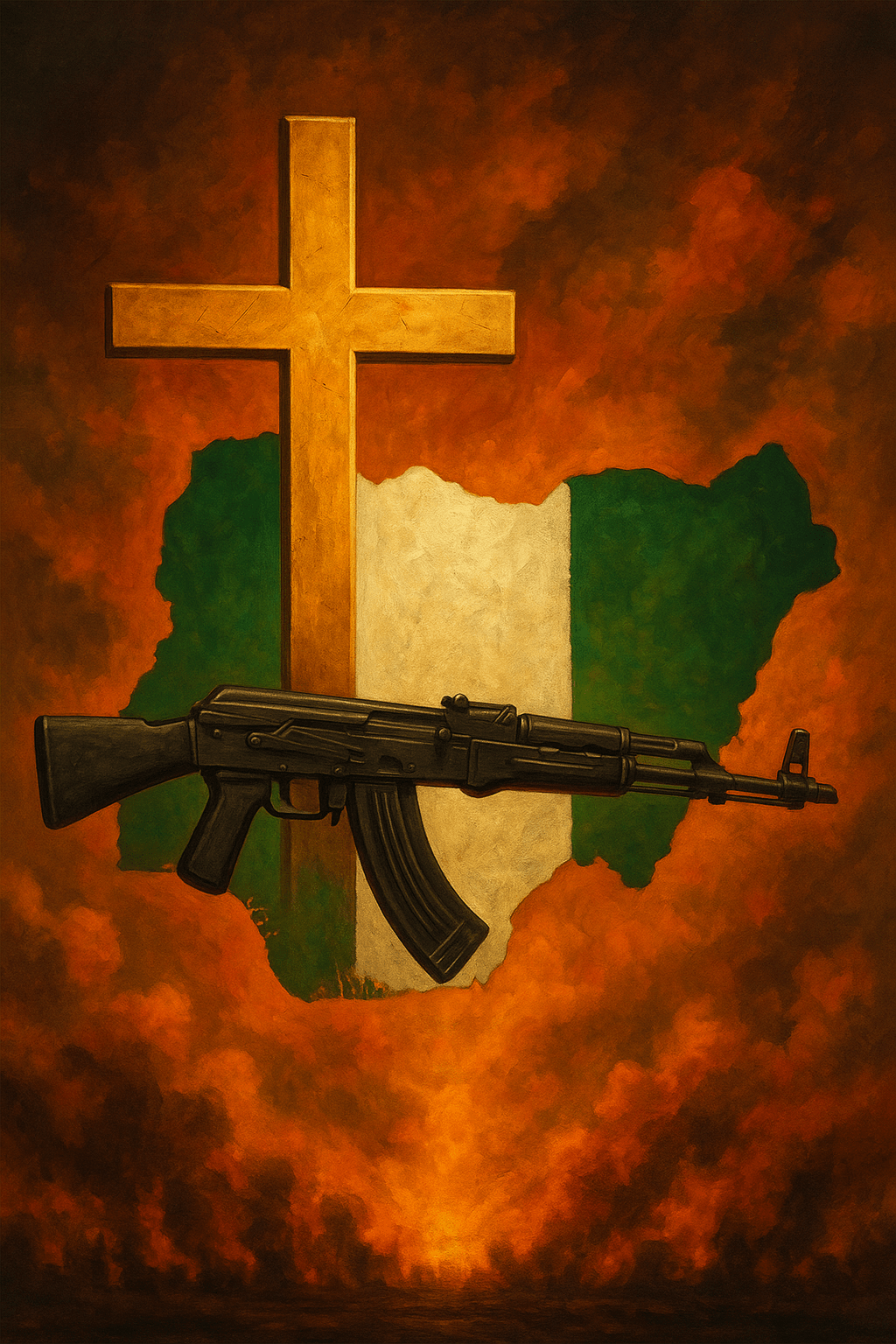
Religion is the costume. Sovereignty is the crime. Empire is the objective.
By Prince Kapone | Weaponized Information | Novermber 6, 2025
The Drumbeat Wrapped in the Cross
They always come with a hymn on their lips and a payload in their hands. The latest refrain from the Trump regime is dressed in the language of “protecting Christians” in Nigeria, as if the Pentagon were a choir and AFRICOM a traveling ministry. We know this melody by heart. It is the old colonial chorus that turns a complex society into a morality play and a military target in the same breath. Violence that is born of land theft, organized banditry, austerity, and the slow grind of underdevelopment is repackaged as a civilizational crisis, and the solution, conveniently, becomes airstrikes, bases, sanctions, and leverage. The cross, in this script, is a stage prop; the policy is the gun behind the curtain.
In this moment, the question is not whether Nigerian Christians, Muslims, or anyone else face danger—ordinary people do, every day, because the political economy has been rigged against them for generations. The question is why Washington suddenly claims a shepherd’s concern precisely when West Africa is slipping the leash. France has been pushed out of its old hunting grounds; the Alliance of Sahel States is consolidating sovereignty; Russia and China are writing new pages in the regional ledger. With the old colonial gatekeepers out, empire adjusts its aim. Nigeria—population giant, energy pivot, industrial hope—becomes the drum at the center of the circle. And so the beat begins: hearings, designations, headlines, the usual fog of “concern,” all to prepare consent for what is, at base, a struggle over routes, resources, and rule.
Strip the sermon from the strategy and the pattern appears. The persecuted are invoked to license new forms of domination; “freedom” is invoked to secure markets; “stability” is invoked to reinstall the same external hands on the same internal levers. It is not piety but logistics that moves an aircraft carrier. It is not compassion but contracts that greenlights a drone. This is how the colonial contradiction presents itself in our century: a humanitarian mask pressed over an imperial face, demanding that Africa be governable for someone else’s accumulation. We refuse the mask. We look at the hand holding it. And we name, from the outset, what this story is and is not. It is not a rescue mission. It is a bid to reimpose the terms of extraction on a continent that is beginning, painfully and heroically, to write its own.
Sovereignty as Rebellion
Once we recognize that the hymnbook is only camouflage, the next layer becomes unavoidable: if the cross is the costume, then sovereignty is the crime. The call to “protect Christians” is not about theology; it is about jurisdiction. It is about who gets to decide how Nigeria organizes its society, its land, its energy, its alliances, and its future. Because in the imperial worldview, Africa may suffer, bleed, or endure — but it may never choose for itself. Self-determination is treated not as a right, but as a provocation.
The truth is this: Nigeria today is not being disciplined for chaos, but for disobedience. Disobedience in the form of exploring alternatives to Western capital. Disobedience in strengthening ties with countries outside of the U.S.-European orbit. Disobedience in refusing to reduce itself to a forward-operating base for someone else’s interests. And the moment a nation like Nigeria steps off-script, the narrative machine reboots into place — overnight, the world’s most complicated social terrain becomes a morality play with two characters: victims to be saved and villains to be bombed.
To the empire, stability has never meant safety for the people who live in a place; it has meant the uninterrupted flow of value out of that place. Stability means pipelines that run where Washington decides. It means contracts denominated in currencies controlled from across the ocean. It means ports and refineries and mineral belts wired into the circuitry of global capital without the interference of local democratic will. When a nation interrupts that circuitry — when it seeks to refine its own oil, process its own minerals, manage its own currency, or control its own security — the alarm sounds: “crisis.”
So let us state the matter clearly and without the fog of diplomatic courtesy: the United States is not preparing intervention because Nigeria is unstable. It is preparing intervention because Nigeria is becoming less governable by imperial design. Because the region around it is forming new alignments — the Alliance of Sahel States rejecting foreign tutelage, popular movements demanding the exit of French troops, and new security and development partnerships emerging beyond the reach of Washington’s command. A horizon is opening that does not require empire to authorize it.
And that is the unspoken threat: not violence, not chaos, not terrorism, but a future in which Africa does not ask permission. A future in which the space between Lagos and Bamako and Niamey and Accra is linked not by pipelines for export and bases for surveillance, but by shared development and common dignity. A future in which sovereignty is not the exception, but the rule. And to the architects of empire, that is the greatest danger of all.
After the Fall of the Overseer
The anxiety radiating from Washington does not come from Nigeria alone; it comes from the shifting ground beneath the entire region. For decades, West Africa was managed through a chain of custody — France as the overseer, the United States as the guarantor, and local elites as the intermediaries. This was not “security cooperation.” It was supervision. It was the quiet, everyday reproduction of dependence. But over the past several years, that arrangement has begun to collapse in real time. The old overseer has been thrown out of the house.
In Mali, in Burkina Faso, in Niger — the people did not simply change governments, they changed direction. They expelled French forces; they shut down Western military operations; they formed the Alliance of Sahel States not as a symbolic coalition but as a declaration that the era of foreign custodianship had ended. These were not coups, as Western newspapers call them. These were breakages in the colonial circuitry — ruptures in the wiring that once allowed Europe and the United States to speak through African states. A quiet revolution is unfolding in the Sahel, carried not by speeches, but by the removal of bases.
And when Niger told the United States to dismantle its drone operations and vacate its airfields — including the billion-dollar surveillance runway built to monitor the entire region — that was the moment the imperial heart skipped a beat. The empire lost its aerial eyes, its rapid-response reach, its ability to strike and surveil with impunity. Overnight, the center of gravity shifted south. If the U.S. cannot reinsert itself through Niger, it must find another anchor, another host, another keystone state. And all roads lead to Nigeria.
Nigeria is not just the most populous country in Africa — it is the hinge between the Sahel’s insurgent sovereignty and coastal West Africa’s economic weight. If Nigeria aligns with the new continental current, the entire region can reorganize itself on different terms. But if Nigeria is disciplined back into the imperial fold, then the Sahel’s experiment can be contained, isolated, and slowly strangled. That is why the sermon comes wrapped in the language of salvation. That is why the threat of airstrikes is paired with the performance of humanitarian grief.
The empire senses something slipping — not territory, but obedience. Not geography, but the belief that foreign power is inevitable. What is being contested now is not merely who patrols a border or trains a battalion. What is being contested is whether Africans will continue to wake each day inside a world built by someone else’s priorities. The fall of France in the Sahel did not just remove a military presence — it removed a presumption. And once a people understand they can remove one overseer, they begin to understand they can remove all of them.
Where the Veins of the World Converge
Once we understand why Nigeria has become the empire’s new fixation, we must step directly into the terrain the sermon was meant to conceal: the material bloodstream of the region. The language of “saving souls” hides a far more familiar mission — securing flows of oil, gas, refined fuel, lithium, and strategic minerals that are now slipping beyond Western management. The empire’s interest is never where it claims to be; it is always where value moves. And in West Africa today, value is moving in ways that threaten to redraw the global map.
Start with oil. For decades, Nigeria pumped crude only to buy back refined fuel at a premium, a colonial absurdity engineered to ensure dependency. But the Dangote refinery — whether celebrated or criticized — marks a break in that chain. If Nigeria refines at scale, then West and Central Africa can source fuel without passing through Western intermediaries. That is not just an economic adjustment; it is a political earthquake. It means control over energy pricing. It means weakened leverage from the IMF’s austerity machinery. It means the possibility — however contested — of development guided by internal priorities rather than external extraction. And to Washington, this looks less like progress and more like defection.
Then consider gas. Two massive pipeline projects now hover on the horizon: the Trans-Saharan route linking Nigeria to Algeria through Niger, and the Atlantic route linking Nigeria to Morocco and then Europe by sea. Both would transform the energy geography of the continent — and either could unfold outside U.S. strategic supervision. If gas flows to Europe without passing through Western-controlled corridors, the balance of power shifts. Russia gains diplomatic space. China gains industrial supply security. Africa gains bargaining leverage over the very markets that once dictated its fate. To the empire, this is crisis disguised as cooperation.
And beneath the soil lies the next battlefield: lithium and rare minerals, the building blocks of the so-called green transition. Chinese firms are not only extracting Nigerian lithium — they are building refining and processing capacity in Nigeria. Not shipping it to Shenzhen. Not funneling it through Dubai. Processing it on African soil, with African labor, for African and global markets. This is the nightmare scenario for U.S. planners. Because once the continent moves from raw extraction to industrialization — from exporter of rocks to producer of batteries — the colonial economic architecture begins to crack.
So when Washington speaks of faith, we must speak of supply chains. When it speaks of humanitarian anguish, we must speak of pipelines, refining capacity, shipping lanes, mineral concessions, and the global fight to determine who will live in the future and who will labor for it. The tragedy is not that empire lies — lying is its native language. The tragedy is that it expects the oppressed to forget what they already know: that every resource Africa possesses has been used as a justification to deny Africa the right to possess itself.
The Machinery That Manufactures Permission
Once the material stakes are visible, the moral theater surrounding Nigeria begins to take its true shape. No empire announces itself as an empire. It arrives cloaked in concern, fluent in the language of sorrow, fluent in the language of rescue. The work of domination begins long before the drones lift off. It begins in the production of a story that makes intervention feel not only acceptable, but necessary, righteous, even compassionate. And the United States has perfected this craft to the point of ritual.
The chain is predictable. First, a humanitarian frame is selected — in this case, the specter of “persecuted Christians.” It is a ready-made emotional trigger for a domestic audience conditioned to see Africa as both spiritually tragic and politically incapable. Then comes the machinery: congressional hearings stacked with ideological NGOs, State Department designations like the “Country of Particular Concern” label, think-tank panels that flatten centuries of history into the simple arithmetic of good and evil. News desks, obedient as ever, render the violence in Nigeria as primordial and irrational — something that arises from religion itself rather than from land dispossession, climate crisis, corruption, and the long afterlife of colonial borders drawn to ensure permanent fracture.
In this script, complexity is the enemy. Context is sabotage. Historical causality is treason. The story must be simple enough to fit into a 90-second segment on cable news or a fundraising sermon in an evangelical megachurch. The oppressed must be helpless; the oppressor must appear absent; the savior must appear inevitable. And so the machinery grinds, smoothing everything it touches. The pastor becomes the protagonist, the general becomes the shepherd, and AFRICOM becomes a traveling ministry of deliverance — though its gospel is the Hellfire missile.
None of this is accidental. Misrepresentation is not an error in the imperial script — it is the central device. The United States cannot intervene if Nigeria is recognized as a sovereign nation pursuing its own strategic interests. It can only intervene if Nigeria is imagined as a failing ward in need of guardianship. The people must be rendered voiceless; the state must be rendered incompetent; the land must be rendered available. And once the narrative is secured, the rest is procedural: sanctions, military advisors, joint trainings, counterterrorism partnerships, drone basing rights, naval patrols, and finally, the steady normalization of force.
The tragedy is not that this machinery functions — it is that the world has been made to watch this production too many times to mistake it. Iraq was rescued into ruin. Libya was liberated into open-air slave markets. Haiti was stabilized into starvation. The vocabulary shifts, the hymn changes key, but the choreography remains the same. The United States does not build peace. It builds compliance. And it is preparing, once again, to call that compliance salvation.
Rebuilding the Fortress
Now the purpose behind the sermon comes fully into view. The talk of intervention in Nigeria is not only about disciplining a single nation — it is about rebuilding the imperial architecture that has begun to collapse across West Africa. When Niger expelled U.S. and French troops, when Mali and Burkina Faso formed the Alliance of Sahel States, when Russian and Chinese partnerships gained legitimacy on the continent, the old security lattice that allowed the United States to surveil, shape, and strike the region began to unravel. The empire lost not just territory, but certainty. Control is the core of imperial stability, and control requires infrastructure: bases, airfields, drone corridors, naval access, intelligence stations, training missions — the hard architecture of hegemony. Nigeria is where that architecture can be rebuilt, or where it can finally fail.
Intervention — whether through advisors, drones, sanctions, or full military deployment — is designed to accomplish several strategic objectives at once. First, it would reestablish a forward-operating platform for U.S. surveillance and counterinsurgency across the Sahel, restoring the aerial and logistical reach that was lost with the expulsion from Niger. Second, it would pressure Nigeria to act as a regional enforcer against the AES bloc, isolating and containing the sovereign experiments now emerging in Mali and Burkina Faso. Third, it would disrupt the accelerating pivot toward Chinese financing and Russian security partnerships that threaten to replace Western oversight with multipolar negotiation. And finally, it would secure the flow of hydrocarbons, refined fuels, and minerals by ensuring that the corridors of movement — pipelines, ports, highways, and digital networks — remain embedded in U.S.-aligned systems of trade and surveillance.
The language of “intervention” therefore conceals something far more structural: the restoration of an imperial operating system. This operating system does not need to govern directly. It simply needs to ensure that no African government can make large-scale economic or security decisions without passing through Western approval. It is less a flag and more a firewall. Less occupation than oversight. Less a presence than a permission structure. And Nigeria, as the demographic and economic hinge of the region, is the keystone without which the entire architecture collapses.
But we must be clear: an attack on Nigerian sovereignty is not simply an attack on Nigeria. It is a message to the whole of West Africa — a warning that the consequences of stepping beyond the boundaries of imperial management will be severe. It is an attempt to make an example. To teach a lesson. To restore fear where courage has begun to take root. Because the most terrifying thing to empire is not the rifle or the riot — it is the quiet, steady realization spreading across the continent that the overseer can be expelled, and the sky does not fall.
The attempt to rebuild the fortress is therefore not a sign of strength. It is a sign of desperation. A global order accustomed to commanding obedience is discovering that obedience is no longer guaranteed. The empire is not expanding — it is trying to prevent its own retreat. And like all retreating powers, it grows most dangerous when its authority is no longer assumed.
The Risks of a Dying Empire
There is nothing more volatile than an empire in decline. When power was uncontested, the United States could afford subtlety: development loans with strings, proxy training, carefully staged elections, a military base disguised as partnership. But when legitimacy begins to rot, when the colonized stop believing that the empire’s presence is inevitable, the empire’s methods grow blunt, hurried, reckless. And this is where we are now. Washington is not speaking from confidence — it is speaking from panic. Panic that Africa is turning toward itself.
The risks of intervention in Nigeria are not theoretical. They are immediate, structural, and historical. To strike or destabilize Nigeria would be to drag a region of hundreds of millions into crisis. It would inflame insurgencies in the northeast, empower secessionists in the southeast, and provide new ideological oxygen to bandit economies in the northwest. It would ignite, not resolve. And every militant faction, every dispossessed youth, every alienated community would suddenly be able to name the enemy that has too often been kept invisible: the foreign hand behind the suffering. Nothing produces unity like invasion. Empire knows this — it simply believes Africans will not remember it.
There is also the geopolitical blowback. To assault Nigeria now would accelerate precisely the outcomes Washington fears: stronger Russian military partnerships, deeper Chinese industrial investment, and a rapid political consolidation of the Alliance of Sahel States with coastal governments. It would turn the Sahel from a region breaking toward sovereignty into a region forged by anti-imperial necessity. And in the global south — from Latin America to West Asia to South Asia — the spectacle would be unmistakable: the United States is no neutral arbiter of democracy; it is a colonial power unable to accept a world that no longer bends.
But the deepest risk is not military or diplomatic — it is ideological. If West Africa can build a path independent of Western capital and Western command, then the myth of dependency dies. And when that myth dies, so does the moral universe that has justified five centuries of extraction. The United States does not fear Nigeria because of its oil, or its gas, or even its lithium. It fears Nigeria because Nigeria has the demographic, cultural, and political weight to normalize African autonomy. To make sovereignty ordinary. To turn independence into expectation rather than exception.
And once sovereignty becomes ordinary in Nigeria, it becomes ordinary in Ghana, in Senegal, in Congo, in Angola, in Kenya, in South Africa. The world rearranges itself. The core and the periphery trade places. The South does not rise by storm — it simply stands up. And the empire, which has convinced itself for generations that it is gravity, discovers that gravity was never on its side to begin with.
A Future Made by Our Own Hands
If the empire fears the normalization of African sovereignty, then it is here — in the quiet labor of building what comes next — that our attention must turn. The story unfolding in West Africa is not just a struggle against intervention; it is a struggle toward something. Toward a horizon where development does not mean dependency, where security does not mean occupation, where prosperity is not measured by how efficiently value is extracted and sent abroad. The fight against imperial intervention is inseparable from the fight to construct the material foundation for autonomy. It is not enough to shout “no” to the empire — we must build the “yes” to ourselves.
The Alliance of Sahel States is not a finished project; it is a beginning, an opening in historical time. The possibility it signals is not merely military coordination, but political imagination: that African nations can align not as rivals for foreign favor but as co-authors of a shared destiny. A Nigeria that stands on its feet, with control over its energy, its industries, and its mineral wealth, does not merely defend itself — it changes the gravitational field of the entire continent. The question is not whether Nigeria will lead, but how it will do so: as a steward of collective emancipation or as a broker of foreign interests.
What is required now is deliberate continental planning, not improvisation. Coordination of refinery output to break fuel dependency. Public and cooperatively owned mineral processing corridors to prevent the return of the colonial raw-export trap. Shared agricultural and ecological restoration initiatives to heal lands broken by extraction and drought. A communications sphere that does not rely on Western media to explain Africa to Africa. A political education renaissance that reminds our people that liberation is not a slogan — it is infrastructure.
And this work does not fall solely on governments. It belongs to the workers who keep the ports alive, the farmers who feed the cities, the market women whose labor holds the economy together, the youth who will inherit the continent being shaped now, the diaspora whose remittances and knowledge are themselves forms of resistance. The people who make Africa run must also make Africa free. No administration can substitute for mass participation. No elite can build sovereignty in the absence of the masses who breathe life into it.
The empire is not eternal. It is not immovable. It is simply old. And like all old systems whose legitimacy has expired, it can be undone — not by miracle, not by charity, but by the accumulation of intentional decisions made by the people it once presumed to rule. The horizon is open. The future is not waiting for permission. What comes next depends on whether we claim what is already ours: the right to build a world where Africa is not a battleground or a quarry, but a home. A place where we do not measure our value by how much wealth we export, but by how much life we nourish.
Africa is not asking to be saved. Africa is asking to be left standing. And in that standing, a new world begins.
 Weaponized Information
Leave a comment