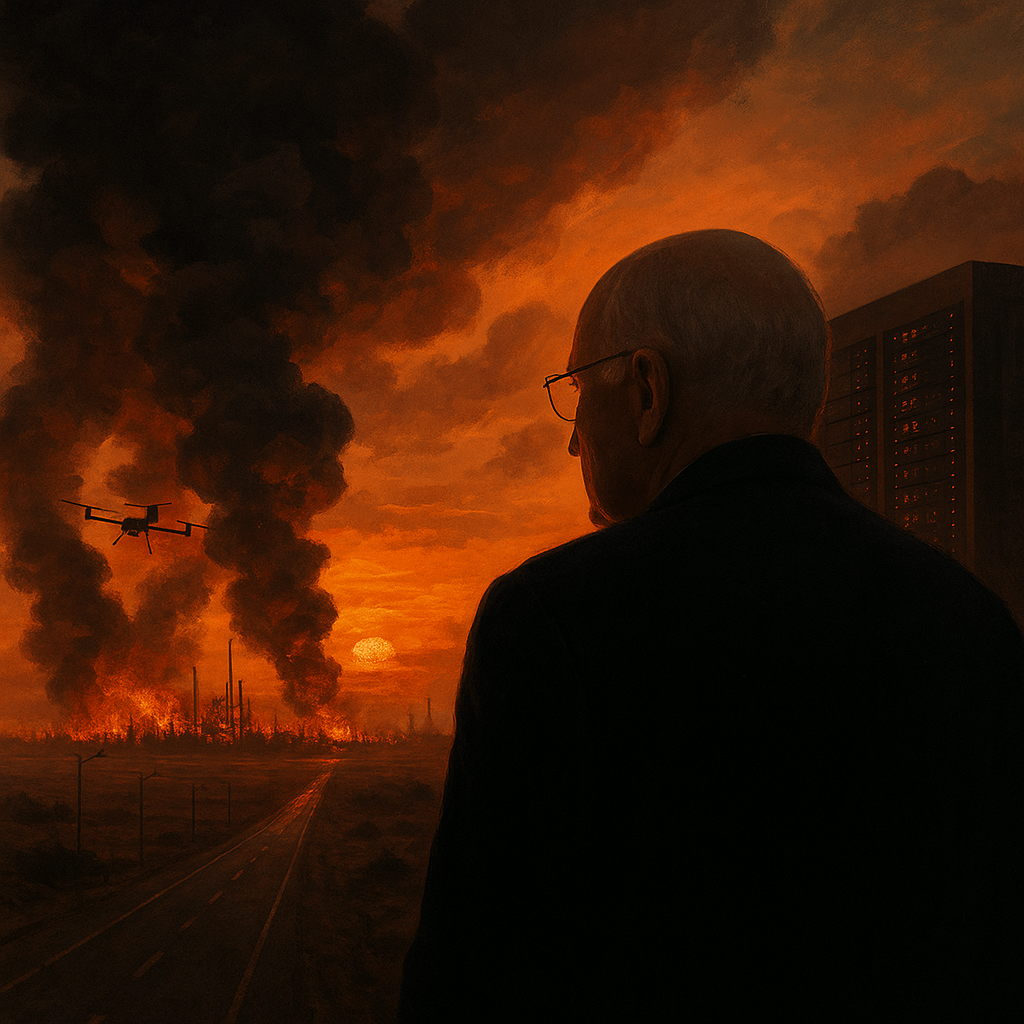
The architect of torture, endless war, and the U.S. surveillance state is gone — but the empire he built remains.
By Prince Kapone | Weaponized Information | November 4, 2025
Death of a Statesman, Survival of a System
Dick Cheney died, and the newspapers called him a patriot. The television anchors tightened their faces into the appropriate funeral expressions. Former presidents mouthed familiar clichés about “service,” “integrity,” and “duty.” The ruling class knows how to bury its own. It knows how to seal a legacy inside a marble sarcophagus of euphemism, platitude, and selective memory. It knows how to turn blood into myth.
But we are not obligated to forget.
We remember that Dick Cheney was not simply a politician, nor even merely a conservative. Cheney was a mechanic of empire. He was one of the principal engineers of the modern U.S. national security state: a system of total surveillance, privatized warfare, energy imperialism, secret law, and permanent emergency. He did not simply make policy; he helped design the architecture of a new era of authoritarian capitalist rule. If George W. Bush was the face of the post-9/11 order, Cheney was its hands — steady, calloused, methodical, and entirely without remorse.
The Associated Press tells us he was a “serious man.” Yes — serious in the way an executioner is serious. Serious in the way a man must be when he has convinced himself that the world is a battlefield, that law is an inconvenience, that entire nations must be remade by fire, and that history itself is a weapon to be wielded by those with enough power to use it.
Cheney believed in America as empire, not as metaphor. He believed that the world should be arranged so that the U.S. could act without restraint — economically, militarily, and technologically. He believed that oil was not merely fuel but destiny. He believed that secrecy was the highest form of democracy. And when the opportunity arrived on September 11, 2001, he did not hesitate: he reorganized the American state around fear, war, and the quiet machinery of internal control.
This is why we begin here, at the moment of his passing. Not to celebrate death. Not to taunt a ghost. But to clarify the living. Because the system Cheney helped refine did not die with him. It is the air we breathe, the border we cross, the screen we stare into, the police camera on the corner, the corporate defense contractor filing another invoice for another war whose purpose we are trained not to question. The empire is automated now — digitized, privatized, algorithmically assisted. Its architects can die. The building stands.
And so we write not an obituary, but an inquiry. Not into the character of Dick Cheney, but into the project of Dick Cheney — the long arc of his rise, his networks, his mentors, his corporatization of war, his legal reengineering of the state, his conversion of the vice presidency into a shadow executive, his shaping of the torture apparatus, his role in the destruction of Iraq, and his pioneering of domestic mass surveillance. We are not here to ask whether he was good or bad. We are here to trace the machinery he helped construct — because that machinery is still in motion.
Cheney is dead. The order he served remains. To understand the empire that governs us today — the empire that starves, bombs, monitors, extracts, censors, and calculates — we must understand the man who helped weld its gears into place. His biography is not just a story. It is a blueprint.
The Apprenticeship of a Shadow Operator
Before Dick Cheney ever held national office, before the war contracts and the torture memos and the bunker under the White House, he learned something far more important than policy. He learned where power actually lives. Not in elections, not in speeches, not in the stirring myths offered to the public as the “American story.” Power lives in the corridors behind the stage, in the committees without cameras, in the private dinners, in the think-tank briefing rooms, in the networks of men who answer to no electorate and no constitution. Power lives in the class that never has to explain itself.
Cheney’s rise was not the tale of a brilliant statesman. He was not charming, not poetic, not inspiring, not even particularly charismatic. He was quiet, methodical, and uninterested in visibility — a bureaucrat of exceptional loyalty to the people who already ruled. It was this quality — his reliability as a functionary of elite consensus — that drew the attention of Donald Rumsfeld. Rumsfeld did not discover a visionary; he discovered a man who knew how to follow orders even as he shaped them. A man who understood hierarchy without needing to ask where it came from.
By 34, Cheney was White House Chief of Staff under Gerald Ford — the youngest to ever hold the position. This is not the result of grit or genius. It is the result of selection. Cheney was chosen because he understood the first law of imperial governance: the public can be entertained, the presidency can be staged, Congress can be managed — but real decisions are made by those who control the security apparatus and the economic arteries of the nation. He showed no desire to lead the public; he wanted to manage the state.
It was during this period that Cheney entered the lodges of the American ruling class. His stints at the Council on Foreign Relations were not simply “policy roles,” but initiation into the club of strategic continuity — the part of the U.S. government that does not leave office when elections end. At private gatherings like Bohemian Grove, he learned the grammar of imperial fraternity: the understanding that empire is not governed by ideology, but by shared material interests enforced by discretion and silence.
Cheney internalized what many politicians never understand: to wield power in the United States, you do not speak in the language of the masses — you speak in the dialect of capital, energy strategy, logistics, and force projection. You speak to oil executives, defense planners, bankers, intelligence liaison officers, and the permanent national security bureaucracy. You speak to those whose jurisdiction is not the public, but the planet.
This was the apprenticeship. The education in political realism that does not appear in textbooks. Cheney learned to treat the state as an instrument of class domination, not a site of democratic negotiation. He learned that secrecy is not a byproduct of governance — it is the operational condition of imperial rule. He learned that empire requires not merely armies, but administrators of violence who are willing to make decisions the public must never be permitted to see.
So when the time came — when wars needed to be sold, when torture needed to be justified, when surveillance needed to be legalized, when entire nations needed to be broken and rebuilt in the image of U.S. capital — Cheney already knew exactly how to move. He had trained for decades for a role that most of the public did not even know existed.
This was not a rise to power. It was an induction.
Cold Warrior of the Homeland
When Dick Cheney entered Congress in 1979, he did not arrive as a fresh thinker or an idealist. He entered as a man already shaped by the logic of American empire: the belief that the United States had the right — the obligation — to impose its will on the world, and that any movement challenging this order, whether abroad or at home, must be crushed. His decade in the House of Representatives is remembered as “conservative,” but the term is too polite. Cheney was not conserving anything. He was defending a global system of racialized capitalist rule.
In the late 1970s and 1980s, the world was alive with liberation movements. From southern Africa to Central America to the Caribbean, colonized and oppressed peoples were struggling to seize land, dignity, and control over their own lives from the governments and corporations that had dominated them for generations. But for Cheney — like for the American state as a whole — these movements were not expressions of democracy or self-determination. They were threats. And threats were to be neutralized.
So when apartheid South Africa was being condemned by the world for its system of racial dictatorship, Cheney opposed sanctions. When Nicaraguans overthrew the U.S.-backed Somoza regime, Cheney supported the Contras — death squads armed, trained, and funded by Washington. When the CIA sponsored right-wing paramilitaries in El Salvador who massacred peasants and students and union organizers, Cheney backed the policy with the calm of a man approving a budget line. The constancy here is not ideological rigidity — it is class allegiance. He sided with the colonial ruling class every single time.
This is the period when Cheney clarified his worldview: justice is irrelevant, sovereignty is negotiable, and violence is a legitimate instrument of political economy. The point was never to persuade the oppressed of the virtues of American freedom. The point was to discipline the international working class into remaining cheap labor under a global system of extraction centered in Washington, Wall Street, and Houston.
Domestically, Cheney also understood something many liberals still refuse to see: the U.S. state has always been willing to deploy imperial methods inward, against its own population, when necessary. The police militarization that today arms domestic departments with battlefield weaponry was seeded in the same era that Cheney defended counterinsurgency abroad. The line between the CIA and the FBI, between foreign policy and internal policing, was already beginning to dissolve. The empire was learning to treat the U.S. itself as a zone of occupation.
Cheney’s congressional years are often treated as a footnote, but they are the key to understanding him. He was not a reactionary by temperament. He was a reactionary by function: an operator working to maintain the racial-capitalist world order at a time when it was being challenged from all sides. He learned how to talk about markets while he meant force, how to speak the language of “national interest” while securing corporate expansion, how to normalize repression by calling it security.
By the time he left Congress in 1989 to become Secretary of Defense, Cheney had already become what he would remain until the end: a man who believed that the world belonged to the United States, and that dissent — whether from liberation movements abroad or from working people at home — was a problem to be solved by power, not politics.
He did not represent Wyoming. He represented empire.
The First Draft of the Forever War
When George H.W. Bush appointed Dick Cheney as Secretary of Defense in 1989, it was not because Cheney was a brilliant strategist or a military thinker. It was because Cheney was reliable. He could be trusted to coordinate the armed forces in accordance with the interests of U.S. capital — calmly, quietly, and without hesitation. And when Iraq invaded Kuwait in 1990, Cheney saw not a crisis, but an opportunity: a chance to demonstrate how U.S. military power could be used to reassert global hierarchy in the post-Soviet world.
The Gulf War is often remembered as a swift and “clean” conflict — a war of precision, efficiency, and decisive force. But the myth of bloodless victory hides its real significance. The Gulf War was the prototype for a new model of imperial warfare. No longer the sprawling mass mobilizations of Korea or Vietnam, this was war as logistics, war as infrastructure, war as a coordinated supply chain of violence and contracting. The United States did not simply deploy troops — it deployed a network of private corporations integrated directly into the military’s operational core.
At the center of this new architecture was KBR (Kellogg, Brown & Root), which provided meals, fuel, base construction, port operations, transport convoys, and the invisible labor required to maintain a war machine on foreign soil. Under Cheney’s direction, the Pentagon began to externalize the work of war to private companies, turning conflict into a stable revenue stream and transforming the military into a platform for corporate profit extraction. The battlefield was no longer just a site of combat — it was a market.
This shift was not about efficiency. It was about class power. By outsourcing war, Cheney ensured that the machinery of violence would no longer be accountable to democratic pressure. Congress can cut troop deployments; it cannot easily cut billions of dollars in contractual obligations to private firms, written in legal language that guarantees payment whether or not the war makes sense, succeeds, or even ends. What appeared to be “deregulation” was actually the privatization of the means of organized violence.
Meanwhile, the media celebrated the Gulf War as a triumph of American resolve — a demonstration that the United States could police the world with surgical precision. What they did not say is that this war created the very conditions for the next: the sanctions regime that starved Iraqi civilians for a decade, the bombing campaigns that destroyed infrastructure, the slow suffocation of a society while American companies negotiated future access to its oil fields. The point was never Kuwait. The point was to re-establish U.S. control over the energy arteries of the world.
By the end of Cheney’s tenure, the lesson was clear: war could be profitable, predictable, and permanent. The United States did not need justification to maintain military presence — it needed only the appearance of stability. And behind every appearance of stability lay corporations writing contracts, military planners designing force structures, and politicians assuring the public that everything was under control.
Cheney did not just lead the Pentagon. He redesigned it. He transformed the U.S. military from a national defense force into a global enforcement arm of international capital. He laid the foundation for the wars that would define the next three decades. Iraq was not his first war — it was his rehearsal.
The “forever war” did not begin in 2003. It began here, quietly, in a war that was advertised as surgical and brief. The empire had found its model.
War Becomes a Business Model
When Dick Cheney left the Pentagon and resurfaced as the CEO of Halliburton in 1995, the media treated it as a break from public service — a respectable transition from government to the private sector. But this was not retirement, nor reinvention. This was the next step in a long project: the merging of the U.S. state with the corporate architecture of war. Cheney did not leave power. He relocated to the boardroom where the future of war was already being drafted.
Halliburton was not just another oil services company. It was the nervous system of American imperial infrastructure — a corporation specializing in pipeline construction, overseas base support, energy logistics, and the engineering labor that makes military occupation function. Running Halliburton was not a job; it was command over the plumbing of empire. Cheney was now positioned at the precise intersection of oil, military force, and U.S. foreign policy.
Under Cheney, Halliburton absorbed KBR (Kellogg, Brown & Root) fully into its corporate bloodstream. KBR had already proven useful in the Gulf War, but now it was engineered into something much larger: a private logistical army capable of feeding troops, building bases, managing supply chains, and operating entire theaters of war at profit. The Pentagon no longer needed to maintain all of its own infrastructure. It could rent it from Cheney’s corporate empire.
This shift created a new kind of war economy — not fought for clear objectives or limited durations, but open-ended, recursive, self-financing. War no longer had to end; it only had to bill. And every new crisis, every destabilization, every intervention anywhere on Earth could be processed through the same machinery of contracting, invoicing, and logistical guarantee. War became a predictable revenue stream — a commodity.
Cheney understood something that most politicians never grasp: that true power lies in structural dependency. If the U.S. military became dependent on Halliburton and KBR for basic operational capacity, then the war machine itself would become privatized in practice if not in name. The Pentagon would no longer simply direct contractors — it would be indebted to them. And indebted institutions can be ruled.
This is the real meaning of Cheney’s Halliburton years. Not corruption in the petty sense — not envelopes, not kickbacks, not smoky back rooms. This was corruption as statecraft. This was the reengineering of the military-industrial complex into a single, interdependent system in which the distinction between national security and corporate profit collapsed entirely. This was the creation of a political economy where war could sustain itself without justification.
And so, when Cheney returned to government in 2001 — not as an advisor, not as a strategist, but as Vice President — he did not come alone. He brought with him a war machine that no longer belonged fully to the state. A machine that required only a spark — a crisis, a pretext — to begin printing contracts measured not in millions, but in billions.
He had spent six years preparing that machine. It was ready. It only needed the right war.
The Vice Presidency Becomes a Command Center
When George W. Bush asked Dick Cheney to lead the search committee for his running mate in 2000, the move appeared procedural. A formality. A gesture of respect from a political newcomer to a party elder. But Cheney did not conduct a search. He conducted a transfer. The committee considered candidates, vetted them, weighed their usefulness — and Cheney selected himself. It was the purest expression of the lesson he had learned decades earlier: power is not taken in public. It is allocated in private.
The Bush campaign was built on the image of the everyman scion — the ranch accent, the rolled-up sleeves, the aw-shucks Texas swagger crafted carefully by focus groups and political consultants. Cheney was the opposite: quiet, inward, uncharismatic, bureaucratic, loyal only to the machinery of the state. Where Bush was the face, Cheney was the hand. Where Bush performed legitimacy, Cheney organized power.
Once in office, Cheney reengineered the vice presidency into something the United States had never seen: a parallel executive branch. Traditionally, the vice president presides over funerals, ribbon cuttings, and Senate procedural votes. Cheney instead built an independent command center — the Office of the Vice President (OVP) — staffed not with ceremonial aides, but with national security lawyers, intelligence liaison officers, and personnel directly embedded in the interagency chain of authority.
The purpose of the OVP was not to advise the president. It was to circumvent the state. Intelligence did not need to pass through official review. Policy did not need to be debated. The OVP inserted itself between the CIA, the Pentagon, the National Security Council, and the Oval Office, functioning as a covert nerve center for decisions too consequential to be exposed to public scrutiny or congressional oversight.
Cheney did not simply expand the vice presidency. He weaponized it. He transformed it into a site of executive will, insulated from accountability by the very obscurity of its position. And Bush, comfortable in the performative role of figurehead, allowed it. “Cheney runs the government” was a Washington joke — but jokes reveal truths that polite language conceals.
Meanwhile, Cheney’s legal counsel, David Addington, quietly drafted the intellectual framework for a new constitutional order: the theory of the unitary executive. Under this doctrine, the president — and, by extension, the vice president acting in his delegated authority — was not bound by congressional limits during wartime. If the nation could be kept in a state of permanent emergency, then the executive could be permanent sovereign. War was not just a policy preference; it was the legal basis for unrestricted command authority.
This was the quiet coup of 2001. Not tanks in the streets. Not speeches from balconies. But the silent restructuring of government itself. The creation of a shadow command structure in which decisions could be made without deliberation, authorization, or law — only the presumption of necessity. A government operating behind the government.
Before the towers fell, before the Patriot Act, before Iraq, before black sites and drone kill lists and warrantless surveillance — Cheney had already positioned himself exactly where he needed to be. The architecture was in place. The machine was humming. It only awaited the moment when disaster would give it the excuse to act in the open.
That moment was coming.
The New Constitution of Fear
On the morning of September 11, 2001, while smoke poured from the Pentagon and the towers fell in Manhattan, Dick Cheney did not behave like a man caught in catastrophe. He behaved like a man who had been waiting. He was moved to the bunker — a subterranean command vault beneath the White House — and there, without consultation from Congress, without the pretense of debate, without even the theater of democratic process, he issued orders that redefined the United States government. The emergency was real, but the response was scripted. What collapsed that day was not only steel, but the fragile myth that the U.S. state answered to law.
Cheney used 9/11 to create a political condition that had no expiration date: the permanent emergency. Under this doctrine, the executive branch claimed the authority to act without oversight whenever “national security” could be invoked — which was to say, whenever it wished. Fear became a constitutional principle. The rights of the public became negotiable. The law bent to the will of the presidency, and the presidency bent to the will of the apparatus that spoke in its name.
This was not improvisation. Cheney and David Addington had spent years quietly developing a legal theory that placed the executive above all restraints during wartime — the unitary executive. But wartime had to be permanent. And so the “War on Terror” was not a war against a nation, or a government, or even a coherent organization. It was a war against an abstraction — a strategy designed to guarantee that the United States could never declare victory, because victory would dissolve the emergency that legitimized absolute power.
Under the banner of this endless war, Cheney rewired the state. The National Security Council was circumvented. Interagency deliberation was replaced with directive memos drawn up by lawyers whose names the public never learned. The CIA acquired legal immunity. The Pentagon absorbed unprecedented discretionary authority. The intelligence community was granted the right to classify not simply information, but entire operations, entire budgets, entire branches of itself. “Secrecy” ceased to be a tool of governance and became its foundation.
And the public — traumatized, afraid, unsure, overwhelmed — accepted it. Not because it trusted Cheney, but because fear reduces democracy to instinct. Fear collapses time, narrows thought, suspends judgment. Fear turns the state into a parent and the citizen into a child. And Cheney understood fear better than any American statesman of his generation. He did not calm the nation after the attacks. He instructed it to stay afraid.
This was not the work of a fanatic. Cheney was not driven by ideology, nor messianic faith, nor apocalyptic nationalism. He was driven by something colder and more durable: the belief that power should not be constrained. And so the world after 9/11 was not merely more violent. It was more manageable — for those who governed it.
The “Cheney Doctrine” is not written in any official memo, but its logic is unmistakable:
If the United States is always in danger, the executive may act without restraint.
If the executive may act without restraint, democracy is ornamental.
If democracy is ornamental, sovereignty belongs not to the people, but to the security state.
This is the constitutional order we inherited. This is the air the empire breathes. And like all foundational changes in history, it arrived not with proclamation, but with disaster — and the man who knew how to use it.
The country never returned to its former self. It could not. The old system was not simply damaged — it had been replaced.
The Bureaucracy of Pain
Once the permanent emergency was secured, the next step in Cheney’s project became inevitable: the creation of a legal, logistical, and medical infrastructure for systematic torture. The War on Terror was not designed to gather intelligence. It was designed to discipline the world into knowing what happens when a nation defies the empire. Torture was not a mistake. It was policy. And policy requires paperwork.
The Americans did not call it torture, of course. They called it enhanced interrogation — a phrase with all the moral weight of a software update. The language was engineered to make violence sound technical, to make cruelty sound procedural, to make human agony sound like a standardized service. This was not medieval sadism. It was bureaucratic sadism. The CIA did not operate chambers of horrors — it operated compliance facilities.
Cheney’s counsel David Addington led the legalization of the unspeakable. Working with John Yoo and Jay Bybee at the Office of Legal Counsel, he helped craft memos that redefined torture in terms so narrow that virtually nothing qualified. Pain had to be “equivalent to organ failure or death.” Anything less was permissible. And once law is hollowed out to its corpse, violence no longer needs to hide. It can become a function of government.
The CIA built black sites in Thailand, Poland, Morocco, Afghanistan — spaces outside sovereignty, outside time, outside the public’s right to know. Bodies were hooded, shackled, deprived of sleep, submerged, suspended, humiliated, broken. Doctors were present not to heal, but to monitor. Psychologists helped design the methods. Every step was documented. Every injury was logged. A nation that claims to be the champion of human rights ran a global torture assembly line, complete with forms, charts, standard operating procedures, and quarterly oversight reviews.
The purpose of this apparatus was not intelligence collection. Torture produces confusion, not clarity; panic, not truth. But Cheney understood torture’s real function: to teach the world that American power does not negotiate. To make resistance synonymous with suffering. To replace the idea of democracy with the memory of a scream. Torture was spectacle — not for the public, but for the global ruling order. It was a message written on the bodies of the disappeared: This is the cost of defying us.
Meanwhile, the American people were told it was all being done to “keep them safe.” Television pundits framed waterboarding as a thought experiment. Politicians treated pain as philosophy. The question “Does torture work?” replaced the question “What have we become?” And when a society begins to debate the efficiency of cruelty, it is no longer debating policy. It is debating its own soul.
Even after the Senate report on torture revealed the scale of the crimes, Cheney remained unmoved. “I’d do it again,” he said. There was no remorse because there was no contradiction. Torture was the logical expression of the world he believed in: a world where fear is governance, where law is theater, where violence is strategy, where sovereignty belongs not to nations but to those who can break nations.
The torture program was not an anomaly. It was an unveiling. It showed the true face of U.S. power — not the Statue of Liberty, but a black hood and a steel table. And once shown, that face could not be concealed again.
The War Built on Maps and Lies
To understand the invasion of Iraq, one must begin not in 2003, but in the spring of 2001, months before the towers fell. Inside Cheney’s Energy Task Force, classified briefing folders were circulated containing pre-invasion maps of Iraqi oil fields, pipeline corridors, refinery networks, and lists titled “Foreign Suitors for Iraqi Oil.” In other words: the blueprint for resource seizure existed before the justification for war. The war was not launched to respond to terror. The terror was used to authorize a war already desired.
When 9/11 occurred, it was not a tragedy in Cheney’s eyes — it was a political mechanism. A shock event that could manufacture consent, suspending doubt, collapsing thought, and turning grief into the raw material of imperial mobilization. The “intelligence” connecting Saddam Hussein to al-Qaeda was not an error, not a misunderstanding, not a failure of assessment. It was a fabrication. It was the product of stovepiped reports funneled directly to Cheney’s Office of the Vice President, bypassing the CIA’s analytical vetting entirely.
Weapons of Mass Destruction were never discovered because they never existed. But the claim had performed its purpose: it had provided the civilization-scripted moral alibi for conquest. The invasion proceeded not because the evidence was believed, but because the evidence was made irrelevant. Imperial war does not require proof. It requires narrative.
And once the U.S. military entered Iraq, the real operation began. Not “liberation.” Not “democracy-building.” But the transformation of a sovereign nation into a corporate colony. Halliburton and KBR — Cheney’s creation — received multi-billion-dollar, no-bid logistical contracts. Private mercenary firms like Blackwater were authorized to use lethal force with legal immunity. Entire sectors of Iraq’s economy were privatized by decree. Oil infrastructure, telecommunications networks, and port authorities were overseen by American firms and “advisors.” Iraq was not reconstructed. It was restructured — into an extension of U.S. capital.
Meanwhile, the human cost was treated as collateral accounting. More than one million Iraqis killed. Millions more displaced. Cities like Fallujah bombed, irradiated, poisoned. A society dismembered. A civilization hollowed. A people forced to breathe dust from the ruins of their own homes while American engineers installed pipeline valves stamped with corporate logos.
Cheney was wrong about everything and still believed he was right — because his goals were not the ones stated publicly. The purpose of the war was not stability. It was penetration. The purpose was not regime change. It was resource control. The purpose was not liberation. It was the reassertion of American imperial supremacy in the oil heartland of the planet.
To call Iraq a failure is to misunderstand the metrics of empire. Iraq was a success for those it was designed to enrich. A devastated nation cannot resist. A privatized economy cannot self-govern. A traumatized population cannot build resistance networks easily. War is not a blunt tool of destruction. It is a precision instrument of political-economic reordering.
Cheney did not lose Iraq. He achieved his objective. A nation was broken. A region was destabilized. Oil was secured. The Middle East was pushed into a cycle of sectarian fragmentation that made unified resistance nearly impossible for a generation. And through it all, the contractors continued to invoice.
The war in Iraq was not a mistake. It was a message:
The empire does not ask permission.
The empire does not negotiate the price.
The empire does not apologize.
And when the lie becomes obvious, the empire simply moves on to the next.
The Digital Plantation
While the world watched Iraq burn, Cheney was building something even more enduring than a war: he was constructing the internal architecture of social control. The invasion was visible, televised, debated. But the transformation of the United States into a surveillance state happened in the shadows, in legal footnotes and classified briefings, in signatures on documents the public wasn’t allowed to know existed. If Iraq was the external theater of the War on Terror, the American population itself became the internal one.
The foundation was a program called Stellar Wind. It authorized the NSA to intercept emails, phone calls, text messages, search histories, bank transfers — not from foreign enemies, but from everyone. No warrants. No probable cause. No public record. What was once legally impossible became quietly routine. Entire streams of civilian life were diverted through the intelligence services and stored in data centers whose size dwarfed the imagination of the average citizen.
The genius of the operation was not simply its scale, but its invisibility. Cheney understood that the most effective form of power is the one that can deny its own existence. The surveillance state did not need to announce itself. It needed only to ensure that its reach was total. The United States government did not need to listen to every call. It needed every citizen to know that it could. Fear is cheaper than enforcement. Suspicion is more efficient than policing. People who believe they are being watched volunteer their own obedience.
This new intelligence state did not remain inside the state. It fused with the private sector. Telecommunications companies were granted immunity for cooperating with warrantless surveillance. Silicon Valley corporations — from search engines to social media platforms — built entire business models around extracting behavioral data. What began as a national security apparatus became the economic engine of a new mode of capitalism: surveillance capitalism. A system in which, as one analyst put it, “human experience became raw material for prediction and control.”
Domestic police departments received Iraq War surplus equipment: armored vehicles, battlefield rifles, night-vision systems, signal interception gear. The line between soldier and officer dissolved. The ghettos and barrios — the internally colonized zones of the United States — were treated as counterinsurgency environments. The techniques used in Fallujah were refined in Ferguson. The logic of occupation traveled home.
What emerged was not merely a surveillance system. It was a new social order. A system in which:
• The economy requires insecurity.
• The state requires fear.
• The police require enemies.
• Technology requires the harvesting of life itself.
This is what we mean when we use the term technofascism. Not the old fascism of marching crowds and charismatic dictators, but a quieter, smoother, more automated form of domination. A fascism managed by databases, enforced by drones, normalized through entertainment, personalized by algorithm, and justified by the endless invocation of threat. Not a politics of spectacle, but a politics of administration.
Cheney did not invent this system. He accelerated it. He gave it legal form. He built the infrastructure. He consolidated the agencies. He pushed the boundary between policing and war until the distinction disappeared. And he did so with the calm discipline of a man tightening a bolt.
The Iraq War will one day be remembered as a disaster. The surveillance state will be remembered as the real victory.
Cheney didn’t just conquer territory. He conquered time — the future in which everyone is watched, everyone is categorized, everyone is managed. The digital plantation is not the world he feared; it is the world he wanted.
The System That Survived Him
Dick Cheney’s life is now over, but the political order he helped forge has outlived him. This is the true mark of power: not the influence one wields in the moment, but the institutions, infrastructures, and logics that remain after the hand that built them is gone. Cheney did not merely make decisions; he altered the operating system of American governance. He helped construct a state that does not need public consent, only public compliance. A state that does not persuade, but monitors. A state that does not govern through dialogue, but through data, force projection, energy control, and economic coercion.
The torture chambers were exposed; the wars were questioned; the lies were eventually acknowledged even in the halls of polite journalism. And yet the structure endured. The surveillance apparatus was not dismantled; it was expanded and integrated with corporate technology platforms. The Pentagon budget did not contract; it ballooned to historic levels. The idea that the United States has the right to intervene anywhere on Earth has not faded; it has deepened into bipartisan doctrine. The emergency never ended. It simply became normal.
Presidents change. Parties rotate. Speeches shift. But the machinery Cheney helped assemble is constant. It moves beneath the surface of everyday life: fusion centers coordinating federal and local police surveillance; predictive algorithms assigning risk scores to entire communities; drones patrolling foreign airspace in rotational permanence; private military contractors recruiting the economically discarded to fight wars that are never declared; energy corporations mapping pipelines across continents; intelligence agencies collecting biometric identifiers from millions of people who have never been charged with a crime.
This is not democracy. It is not even the pretense of democracy. It is administration at scale: a society governed not by popular will, but by the imperatives of capital, extraction, and stability management. A society where dissent is tolerated as spectacle but suppressed when it becomes strategy. A society where rights exist only insofar as they do not interfere with profit or order. A society where the citizen has been quietly reclassified as a subject — monitored, modeled, tracked, and directed.
Cheney did not achieve this alone. He was a node in a network: the energy executives who saw the world as a series of resource basins; the defense contractors who saw war as a recurring revenue stream; the intelligence bureaucrats who saw privacy as an obstacle to efficiency; the think tank strategists who saw democracy as a vulnerability to be managed. But Cheney was the one who understood how to align these forces into a coherent political economy of permanent control.
And so his legacy is not a memory. It is the world we inhabit. It is the police drone above the protest. The algorithm that flags you for an extra airport search. The news article shaped by a security briefing you will never see. The pipeline that passes through land seized by eminent domain. The military base built on the other side of an ocean you will never visit. The server farm that stores your private messages indefinitely. The quiet voice in the back of your mind that wonders if your phone is listening.
Empires once ruled through spectacle. Now they rule through infrastructure. Cheney helped design that infrastructure. He did not need applause. He needed obedience. And obedience, once engineered at the institutional level, does not require the architect to remain alive.
Cheney is gone. The system remains. The question now is not how to judge him, but how to confront the world he left behind.
The Architect Is Gone. The Blueprint Remains.
Dick Cheney did not simply occupy positions of power. He engineered the conditions under which power is now exercised. He left behind no manifesto, no school of thought, no stirring speeches to be quoted by future generations. His legacy is not ideological; it is infrastructural. It is a network of institutions, doctrines, contracts, surveillance systems, intelligence protocols, and global supply chains of violence that continue to function without him. This is how the modern empire survives its leaders — by ensuring that its logic becomes automatic.
We do not measure Cheney’s impact by whether he won debates or elections. We measure it by the fact that:
• The United States still claims the right to strike any nation, anywhere.
• Surveillance is no longer exceptional — it is ambient.
• War is no longer declared — it is continuous.
• Democracy is no longer a process — it is a performance.
• The global economy is still anchored in petroleum, extraction, and military logistics.
This is not the aftermath of Cheney’s political career. It is the structure of the world we live in.
When we examine the present — the armored police vehicle parked outside a high school, the drone that circles above Sanaa, the biometric scanner at the airport, the pipeline running through Indigenous land, the counterterror legislation used to criminalize protest — we are looking at Cheney’s fingerprints. His genius was not in strategy. It was in normalization. He made the unacceptable appear inevitable. He made the extraordinary become routine. He ensured that the next generation would inherit a security state that no longer needed to justify itself.
And now the question falls to us — not as citizens appealing to a government that does not answer to us, but as human beings forced to decide whether we will accept the world we have been given. The machine that Cheney helped build cannot be reformed. It cannot be politely persuaded to grant back the freedoms it has consumed. It must be dismantled — not in an act of revenge, but in the name of life. Because the system Cheney left behind is not designed to sustain life. It is designed to manage it, extract from it, monitor it, discipline it, and, when necessary, extinguish it.
To oppose this system is not to oppose a man. It is to oppose the worldview that shaped him:
The world is terrain.
People are variables.
Nations are assets.
Violence is management.
Fear is governance.
We reject this. Not as a gesture of morality, but as a condition of survival. Because the future belongs not to the managers of death, but to those who refuse the machinery that makes death profitable.
History will not remember Dick Cheney for what he said. It will remember what he normalized. And it will remember those who refused to live in the world he designed — who recognized that empire is not a destiny, but a structure that can be dismantled by the hands of those who refuse to obey it.
Cheney is gone. The empire remains. And now the question is ours:
Do we accept the world he built?
Or do we build another?
 Weaponized Information
Leave a comment