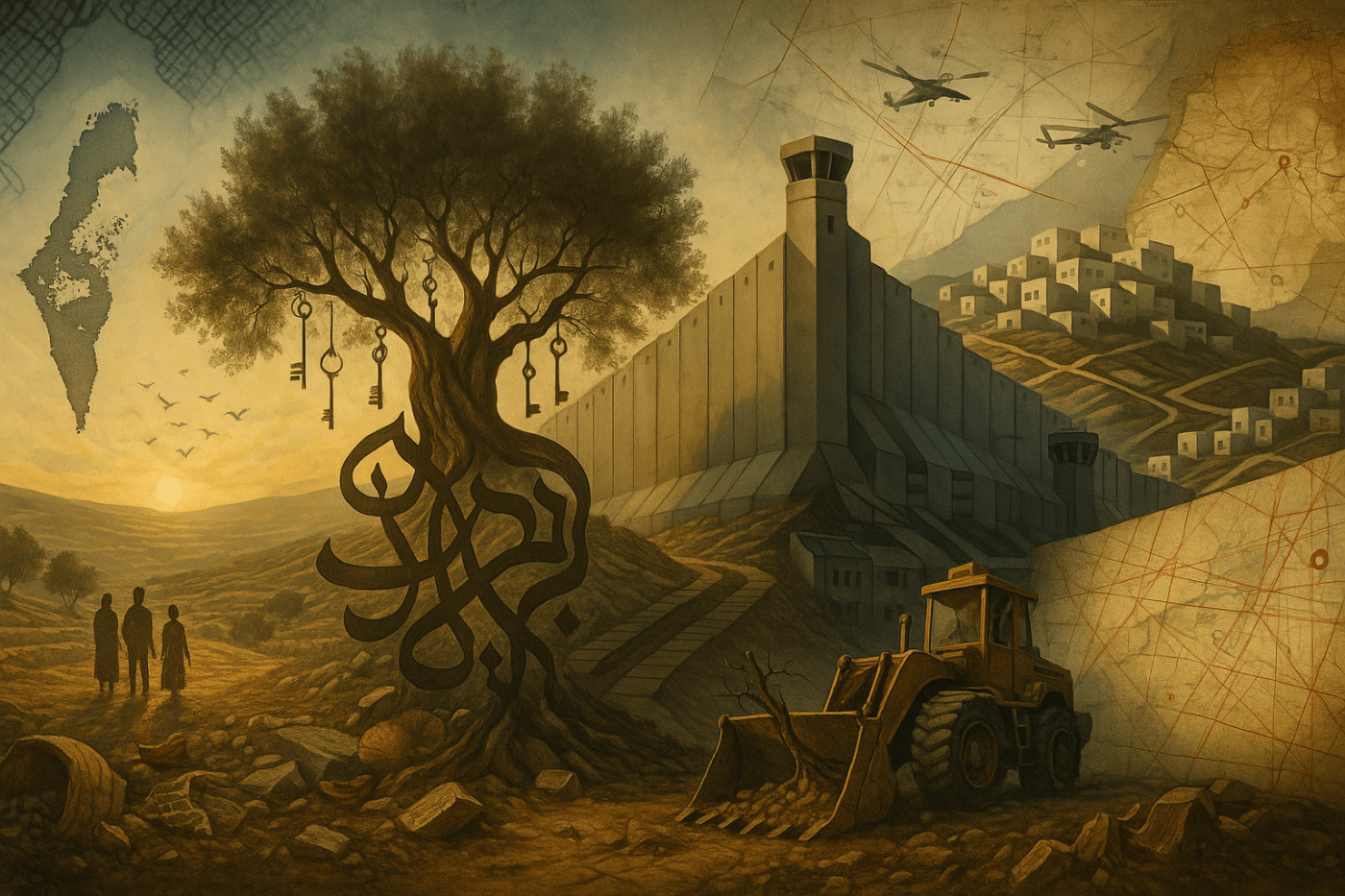
A forensic indictment of Zionism as a modern settler project—born in Europe, built on Palestinian land, and sustained by U.S. imperial power.
By Prince Kapone | Weaponized Information | October 18, 2025
A People, a Faith, and a Myth Recast
For nearly two millennia after the fall of the Second Temple, Judaism existed not as a territorial nation-state but as a diasporic religious-civilizational community. Its continuity rested on memory, law, liturgy, and communal life—not on sovereignty, borders, or armies. Jewish identity was expressed through halakha, Torah study, ritual practice, and collective institutions scattered across continents. Wherever Jewish communities lived—from Baghdad to Salonica, from Vilna to Fez—they developed languages, cultures, and intellectual traditions rooted in place while bound to a shared religious inheritance. They were not a single ethnic nation with a territorial claim, but a global people of faith whose homeland lived in scripture, ritual time, and collective imagination—not in a functioning state.
This history matters, because it exposes what Zionism later attempted to overwrite. Judaism endured precisely because it was not dependent on sovereignty to survive. For centuries, rabbinic authorities explicitly rejected the idea of prematurely reclaiming the land by force, understanding exile as a spiritual and historical condition, not a political problem to be solved through conquest. Jewish communities sought protection, autonomy, and dignity where they lived, not the displacement of another people somewhere else. Their rights—human, cultural, and religious—were universal, not territorial. They asked to live without persecution, not to rule as a nation over others.
Zionism, emerging in 19th-century Europe, broke from this entire historical and ethical trajectory. It was not an organic expression of Jewish tradition, but a modern nationalist project born in the same ideological furnace that produced German, Italian, and other European racial nationalisms. It reimagined Jews as an ethnic nation in the modern sense—one blood, one land, one state—and retroactively projected that nationalism backward onto ancient texts and symbols. By converting a religion into a nation and a people into a geopolitical claim, Zionism transformed Jewish identity from a diasporic civilization into a colonial project.
We must be clear on the principle: Jews, like any people, possess full collective human and cultural rights. They have the right to live in safety, dignity, and continuity. But those rights do not include the right to colonize another people’s homeland or build a state through displacement and domination. Cultural continuity does not equal territorial entitlement. Judaism as a faith does not grant sovereignty over a land already inhabited by another nation. The attempt to convert religious memory into statehood at the expense of the indigenous Palestinians marks the decisive rupture: it is here that Zionism departs not only from Jewish history, but from universal ethics.
By restoring this historical truth at the outset, we strip away Zionism’s greatest illusion—that the modern State of Israel is the natural, eternal, or inevitable expression of Jewish existence. It is not. It is a political project, not a civilizational destiny. It emerged from the logic of empire, not the covenant of a people. And the cost of this myth, as the rest of this essay will show, has been paid in Palestinian land, Palestinian lives, and the erasure of a nation that never volunteered to bear the burden of Europe’s crimes.
From Exile to Empire: Zionism and the European Idea of the Nation
The nineteenth century did not rediscover an ancient Israel; it invented the modern nation and then demanded everyone find a flag to match. Steam and steel were busy redrawing the world: empires stitched railways across continents, factories ate villages, and professors in new departments measured skulls and ranked civilizations. In this atmosphere, “the people” became a technical term—blood, language, soil—an engineer’s blueprint for belonging. The old Jewish grammar of covenant and community did not fit the new machine. In parlors and parliaments from Vienna to Warsaw, a question hardened into policy jargon: the “Jewish Question.” It was less a query than an ultimatum—assimilate into the national mold or be cast as permanent foreigner. When pogroms tore through the Pale and the Dreyfus Affair dragged the French republic through its own mud, the lesson felt universal: even the Enlightenment had a door marked “Not for you.”
Zionism was born in this climate, not in the desert wind of prophecy but in the cigar smoke of congress halls. Its founders were talented European moderns—journalists, chemists, doctors, organizers—fluent in liberal grammar and conversant with imperial strategy. They did not open ancient scrolls and find a state blueprint; they opened the morning papers and read the obituaries of Jewish emancipation. Their conclusion was harsh and modern: if Europe is organizing itself into nations, the Jew must become a nation or remain a problem. Where the diasporic tradition had made law portable and home internal, the nationalist era made home an external border guarded by soldiers. Zionism took that template off the European shelf and stamped “Jewish” on it.
The formula was as elegant as it was dangerous: one people, one blood, one land, one state. The trouble is obvious to anyone who has ever lived in a city—people are messy. Jews were already a tapestry of tongues and customs, from Arabic-speaking Cairenes to Yiddish poets and Ladino traders. But nationalism dislikes textured histories; it prefers clean lines. So a new story had to be drafted where “the Jewish people” appeared as a coherent biological subject with a continuous will waiting, through millennia, for a border to be restored. The covenant became a title deed; the prayer of return became a logistics plan. A civilization of commentary was recoded into a race with a destination.
Europe provided more than the idea; it provided the method. The same century that standardized national anthems also standardized empire. Algeria was being settled, Ireland disciplined, India extracted, and Africa carved by conference table. Colonization was not a moral scandal in this world; it was a management style. When Zionists sought a location for national rebirth, they shopped within an imperial marketplace where “vacant” lands were produced by cartography and force. The pitch to the powers was practical: a modern outpost, European in culture, loyal in outlook, positioned at a crossroads of empire. The Balfour Declaration would later translate that pitch into policy prose, but the logic predated the letter.
Inside the movement, arguments raged over language, labor, and the soul of the project. Some dreamed of garden colonies and Hebrew revival, others of socialist communes with orange groves for barricades. Yet beneath the quarrels lay a shared assumption learned from Europe’s hard school: security would come not from tolerance, but from sovereignty; not from neighbors, but from numbers and force. When the liberal promise of citizenship failed, the nationalist promise of separation looked like a lifeboat. The tragedy is that lifeboats built to European specifications are rarely rowed without oars of exclusion. A politics scripted around rescue can pivot, with very little friction, into a politics of removal.
In pamphlets and speeches the mask slipped often enough to read the program. If the nation is a biological unit requiring territorial majority, then demography is destiny and land is the instrument. Immigration became the sacred rite; purchase and settlement the liturgy of return. The “new Jew” must work the soil, police the boundary, displace middleman trades, and become legible to the modern state as farmer and fighter. Redemption, rewritten in the language of the era, was less a moral transformation than a cadastral one: draw the line, fill it with your people, let the census do the rest.
None of this was an inevitable sequel to mourning by the rivers of Babylon. It was a decision within European modernity’s narrow hallway, where the doors were labeled with the same few options: assimilation, expulsion, revolution, nationalism. The revolutionary road—solidarity with the oppressed as such—existed; Jewish workers and intellectuals took it, built parties, organized strike funds, wrote poems that smelled of bread. But the nationalist path offered a different seduction: become what Europe respects—become a nation among nations, with a rifle and a port. To frightened families and ambitious elites alike, that bargain felt like history’s shortcut.
Here the critique tightens. Zionism did not merely answer European persecution; it internalized European categories. It accepted that true humanity is stamped by passport, that safety is a geometry of borders, that dignity is a uniform well-worn. It treated the Jewish future as a project in statecraft rather than a wager on justice. And once you accept the national form as salvation, you inherit its cruelties. Nations are made by drawing lines; modern lines are drawn with surveyors, bankers, and, when necessary, bayonets. The migratory ethics of the diaspora—argue, adapt, care for the poor, survive without mastering others—could not survive that translation intact.
To say this is not to trivialize the terror that pushed the movement forward. Pogroms are not debating points; they are funerals. But fear is a poor architect of freedom. The Europe that taught Jews to be a problem also taught them the technical solution called the nation-state. Zionism chose that solution and promised it would turn humiliation into honor. In the ledger of modernity, honor is written in acreage and arms. By the time the Basel resolutions spoke of “a publicly recognized, legally secured home,” the vocabulary of empire had fully colonized the dream: public recognition by whom, legal security from which sovereign, and at whose expense would the home be secured?
Thus the hinge is set for what follows. When a diasporic civilization is refit to the chassis of European nationalism, the search for land is not metaphysical; it is administrative. “Return” is translated into permits, purchases, and police powers. A people who carried their law in books are instructed to carry it in rifles. And once the project is staged in a land already lived in by others, the European idea of the nation meets its colonial method on the ground. That encounter will be called many things by its authors—rebirth, liberation, development—but the technique has a simpler name we already know from other frontiers. The next section names it plainly.
A Land With a People: Zionism Meets the Reality of Palestine
When the Zionist project left the conference halls of Europe and set foot in Palestine, it collided with a stubborn fact: the land was not waiting. It was not empty, barren, or suspended in time, longing passively for a European return. It was lived in—worked, sung over, planted, inherited, irrigated, traded across borders, named in countless ways by the tongues of its people. From Jaffa’s orange groves to the olive terraces of the Galilee, from the port merchants and citrus workers to the peasants of the interior, Palestine was a society with villages, professions, social classes, political movements, and memory. The Zionist myth of “a land without a people for a people without a land” was not a poetic misunderstanding; it was a colonial precondition. Settler projects do not begin with ignorance. They begin with erasure.
In this moment, Zionism’s transformation from nationalist aspiration to colonial practice became irreversible. European nationalism had given Zionism its engine, but settler colonialism supplied the road map. The formula was familiar: enter a land, claim a historical or civilizational title, minimize or deny the existence of the native population, and then create demographic “facts on the ground” until power sanctifies possession. The United States called it Manifest Destiny, France called it Algeria, Britain called it Rhodesia, Australia called it Federation. Zionism would call it “redemption of the land”—but the technique was the same. Colonization, in its modern form, does not merely conquer territory; it rearranges reality until the native becomes trespasser and the settler becomes heir.
Land, in this calculus, is not merely soil. It is a total social fact: water, movement, inheritance, harvest, horizon. To acquire land in a place already inhabited, the Zionist movement relied on legal instruments, purchases through absentee landlords, and later outright force. But the goal was not coexistence; it was sovereignty. And sovereignty, in the settler imagination, requires demographic engineering. You do not build a Jewish nation-state on Arab-majority land without changing the ratios. Immigration became the sacred engine, but immigration alone could not fulfill the nationalist arithmetic. Settlement had to be paired with displacement. A homeland, once recoded as a nation-state, demands not just presence but dominance.
To justify this, ideology had to work overtime. Biblical nostalgia was repurposed as political title deed. Orientalist racism—absorbed from Europe’s imperial bloodstream—cast Palestinians as backwards tenants, unfit for modern stewardship. The desert, once depicted as lifeless, became a stage prop for a civilizing mission. “Making the desert bloom” was not a gardening slogan; it was a colonial insult. A society with agriculture older than Europe’s parliaments was rhetorically stripped of agency to make room for a newcomer who arrived with blueprints and bayonets. Zionism, like every settler project, needed to believe that the native was either nonexistent or deficient. One cannot dispossess those one fully recognizes as equals.
Palestinian society, for its part, was not static or voiceless. Workers organized, newspapers circulated, farmers resisted eviction, armed revolts erupted, political committees petitioned, poets warned, and mothers refused to leave ancestral soil. But empire has excellent hearing and selective comprehension. Britain, holding the Mandate, acted as midwife to the settler project, regulating borders, policing rebellion, and treating Palestinian resistance as an inconvenience rather than a right. The Zionist movement understood something essential about the age: you do not need justice when you have an empire as sponsor. And so the frontier advanced—outpost by outpost, kibbutz by kibbutz, title deed by title deed, rifle by rifle—until the question was no longer whether Palestine would be colonized, but how completely.
By the 1930s, the structure was already visible to anyone willing to describe it honestly. This was not a refugee colony seeking space to breathe alongside neighbors. It was a frontier movement aiming to replace one population with another, reborn in Europe’s image but applied on Palestinian soil. The Zionist leadership did not hide this in private correspondence: demographic majority, labor exclusivity, and territorial continuity were the governing objectives. When a movement seeks majority, exclusion, and control of the land from river to sea, it is not participating in benign return; it is executing a settler program.
The catastrophe of 1948—al-Nakba—did not come from nowhere. It was not a tragic detour or an unforeseeable rupture. It was the culmination of a structure already in motion, an endpoint inscribed in the colonial method itself. Settler colonialism is not content with coexistence; it aims at elimination, whether by removal, containment, or erasure. Patrick Wolfe’s maxim holds: “settler colonialism is a structure, not an event.” In Palestine, that structure revealed its skeleton early. What would later be known as checkpoints, expulsions, walled enclaves, and apartheid began as ideas of mastery, entitlement, and demographic salvation. Once land is salvation, the neighbor becomes obstacle. Once the nation requires ethnic homogeneity, pluralism becomes existential threat.
By naming the structure clearly, we strip the story of its alibis. This was a colonization project, not a reunion. Palestine was a land with a people. Their existence was not a footnote to someone else’s prophecy, nor an inconvenience for someone else’s trauma. They were farmers, teachers, dockworkers, lovers, elders, children—a people with society and sovereignty of their own. To build a Jewish nation-state in their place would require their diminishment, displacement, or disappearance. Zionism, having accepted the European nation-state as emancipation, accepted the colonial method as instrument. The result was set in motion long before 1948. Its consequences continue. And its logic, once seen clearly, cannot be disguised as destiny.
Blood, Myth, and Genealogy: The Invention of a “People”
If nationalism needs a myth of blood to sanctify its borders, Zionism required a story of biological return. The ancient Hebrews had to be not only spiritual ancestors, but genetic forefathers; Judaism had to be not merely a faith, but a bloodstream. Yet when the tools of modern genetics finally peered into the double helix, they did not return a tale of racial purity awaiting restoration. They returned a mosaic. Ashkenazi Jews, the demographic backbone of the Zionist project, emerged not as the unbroken biological continuation of ancient Israelites, but as a diasporic population shaped by migrations, conversions, and centuries of intermixture across the Mediterranean and Europe. Their paternal lines carry partial traces of Levantine ancestry, but their maternal lines—the very lines Judaism uses to define identity—are overwhelmingly European. In this scientific mirror, Zionism’s racial claim does not gaze back. It blinks.
This is not a scandal to anyone who understands history as movement rather than monument. People wander, marry, flee, convert, adapt. Diasporas create new lineages as naturally as rivers branch. But for a settler project built on the premise of ethnic return, hybridity is an inconvenience. Modern Israel needed the Jew to be not just a member of a religious civilization, but a distinct biological nation with a hereditary title to territory. National myth demanded a straight line through time, unbroken by geography or genealogy: ancient Israelite begets medieval exile begets European ghetto begets modern Israeli. The DNA does not cooperate. It wanders.
The contradiction deepens when one recalls that halakha—the definitive code of Jewish belonging—is matrilineal. If Jewishness is inherited from the mother, and if the mothers in question are largely of European descent, then even by the religion’s own standard, the core of Jewish identity is not anchored in Levantine bloodlines. Zionism, however, prefers paternal lineage when speaking of “return,” because the nationalist script requires a patriarch—Abraham, Isaac, Jacob—to sanctify possession. Thus, religion and nationalism pull in opposite genetic directions: halakha points to Europe, while Zionism points to Canaan. Science merely confirms what history already knew: identities are constructed, not carved into bone.
But we must be clear: the purpose of exposing this myth is not to replace one racial narrative with another. It is to break the spine of racialism itself. If a people’s worth and rights are not grounded in DNA—and they are not—then the entire biological justification for a Jewish state in Palestine collapses. A Palestinian farmer does not lose title to his land because someone else’s Y-chromosome mutates in heroic ways. A refugee in Haifa does not vanish because Herzl dreamt in biblical tones. Genetics cannot evict, and ancestry cannot annex. To invoke blood as deed is to confess the bankruptcy of law, morality, and political imagination.
The genetic record, then, is not a weapon of exclusion but a mirror of human truth: peoples are mixtures, civilizations are dialogues, and purity is a laboratory fantasy that has paved more roads to death than to dignity. The settler project in Palestine, however, depended on purity to justify replacement. If the Jew was the original owner, biologically ordained, then the Palestinian becomes a squatter, an interloper, a demographic error. This is why Zionism clings to racial mythology even as evidence dissolves it. The myth is not about history. It is about power. It transforms colonization into “return,” domination into “destiny,” and apartheid into “survival.”
When we strip away the biological veil, what remains is the naked structure of a colonial project that cannot legitimize itself through ancestry, religion, or science. It must rely instead on force, lawfare, and imperial sponsorship. The story of blood, crafted in Europe and exported to Palestine, was always a mask. Beneath it lies the oldest political technology of empire: invent a people, invent a homeland, and invent a past that makes the future inevitable. But inevitability is a myth, too. What has been invented can be dismantled. What has been justified by blood can be delegitimized by truth.
Anti-Semitism as Cudgel: The Linguistic Shield of a Settler State
No colonial project survives on force alone. Bayonets can seize land, but they cannot manufacture innocence. For that, language is required. In the case of Zionism, the masterstroke was the capture and redeployment of a single word: anti-Semitism. Once a term describing the violent persecution of Jews in Europe, it has been re-engineered into a political bludgeon, a shield for a state, and a gag for the colonized. Today, to accuse Israel or Zionism of wrongdoing is to invite the ritual denunciation: anti-Semite. The charge lands not as argument, but as excommunication. It ends discussion, delegitimizes dissent, and casts the critic outside the circle of the human. The brilliance—if we can use that word for something so cynical—lies in the shift from describing hatred of Jews as a people to describing opposition to a settler state as hatred itself.
This maneuver rests on an absurd sleight of hand. “Semitic” refers to a language group, not a race or a tribe. Arabic, Hebrew, and Aramaic are Semitic tongues; Palestinians, Syrians, Iraqis, and countless others are Semitic peoples. Yet the Zionist narrative compresses “Semitic” until it refers exclusively to Jews, and then fuses “Jews” to “Israel,” and finally “Israel” to “Zionism.” By the end of this linguistic funnel, the world is left with a weaponized equivalence: to oppose Zionism is to hate Jews. This is propaganda by definition: a lie repeated until it governs emotion. And like all colonial rhetoric, it functions to erase native presence. If only Jews are Semites, then Palestinians—the indigenous Semitic people of the land—vanish from the semantic field before they are removed from the physical one.
The stakes are not academic. Language becomes law, and law becomes violence. In Europe and North America, anti-BDS legislation, university speech codes, social media censorship, and NGO blacklists serve the same purpose as the old colonial doctrines of “incitement” and “sedition”: they criminalize resistance and sanctify domination. The colonizer, through linguistic enchantment, becomes the eternal victim; the colonized, by refusing erasure, becomes the hateful aggressor. Even Jewish voices who reject Zionism are condemned as “self-hating,” because the spell allows no deviation. Once the state merges with identity, and identity merges with trauma, the state gains unlimited moral credit—and endless license to kill in the name of preventing its own victimhood.
This is not accidental. Zionism, like every settler ideology, requires a moral alibi to conceal its material project. The United States had “civilizing the savage”; France had “the mission civilisatrice”; Israel has “security” and “survival,” wrapped in the aura of eternal persecution. Anti-Semitism, genuine and monstrous in European history, is repurposed into a diplomatic sword. The accusation becomes unanswerable because it is designed not to be engaged but to be feared. And so journalists self-censor, politicians vote in lockstep, academics bite their tongues, and entire media ecosystems treat one state on earth as beyond critique. When the colonizer monopolizes morality, massacre can be renamed self-defense, apartheid can be called democracy, and genocide can pass itself off as grief management.
Meanwhile, irony stands in full view: the people most frequently slandered as “anti-Semitic” for defending Palestine are themselves Arabic-speaking Semites. To stand with the Palestinian people is, in the most literal linguistic sense, to stand with Semitic humanity against erasure. But imperial language is not interested in accuracy; it is interested in obedience. The semantic coup accomplished by Zionism transformed a real historical trauma into a permanent veto power over truth. It rewrote the dictionary so that history must apologize to conquest.
To break the spell, one must perform a simple act of clarity: a state is not a people, a people is not a religion, and a religion is not a race. No political ideology—Zionism included—is entitled to theological immunity or historical exemption. Anti-Semitism is hatred of Jews. Anti-Zionism is opposition to a colonial ideology and an apartheid regime. The two are no more identical than opposition to the Vatican is hatred of Catholics, or denunciation of Jim Crow was hatred of white Southerners. If the Zionist project must hide behind the corpse of European anti-Semitism to justify its own colonial crimes, then it confesses its illegitimacy with every accusation it makes.
Language, once returned to honesty, exposes the truth: Israel’s shield is not vulnerability but narrative domination. The word “anti-Semitism” has been conscripted into empire’s army. Our task is to liberate it—and in doing so, liberate speech, memory, and the possibility of justice in Palestine. When the spell breaks, the conversation can begin again, this time with both feet on the ground of history, and not on the quicksand of propaganda.
The Structure of Conquest: Zionism as Settler-Colonial Apartheid
By the time the Zionist project matured into state power in 1948, the structure was already visible to anyone willing to describe reality without euphemism. This was not a state born from thin air, nor a nation “restored” by metaphysical right. It was a colonial formation assembled through the textbook methods of settlement and elimination. Patrick Wolfe’s axiom is the clearest lens: “settler colonialism is a structure, not an event.” Its aim is not exploitation of native labor, but the removal of native presence. Its goal is not diversity under domination, but replacement under sovereignty. In this system, the settler does not seek the native’s obedience; he seeks the native’s disappearance—from the land registry, from the census, from the map, from the future. Israel, built atop Palestine, follows this logic with unbroken consistency.
The Nakba of 1948 was not a tragic birth pang of nationhood—it was the foundational act of a settler regime. Over 400 villages erased, 700,000 Palestinians expelled, archives burned, properties seized, and laws erected to turn absence into legality. The Absentee Property Law, the Law of Return, and the Jewish National Fund’s land regime together formed the legal tripod of Zionist sovereignty: the native has no right to return, the settler has every right to arrive, and the land belongs exclusively to the newcomer’s nation. This is not democracy; it is demographic engineering enforced by statute and rifle. Where Palestinians remained within the new state, they were placed under military rule until 1966—governing the native as an internal enemy is, after all, another hallmark of settler rule.
After 1967, the structure expanded from what became Israel’s interior to the rest of historic Palestine. Settlement outposts multiplied like colonial seeds, guarded by soldiers and subsidized by the state. Roads were segregated, water was rationed by ethnicity, movement became a privilege rather than a right, and the West Bank was carved into zones of control that mimic South Africa’s Bantustans with chilling precision. Gaza, blockaded and bombarded, became the reservation of the 21st century—a containment zone where surplus natives are managed through siege, surveillance, and periodic slaughter. The wall, the checkpoint, the permit, the curfew, the bulldozer, the drone—these are not “security measures.” They are the infrastructure of a system that cannot coexist with the people it has conquered.
Comparisons to South Africa are not rhetorical flourishes; they are structural diagnoses. South Africa had group-area laws; Israel has zoning, closed military zones, settlement blocs, and “state land” designations that reserve territory for one ethnonational group. South Africa had passbooks; Israel has permits, checkpoints, and population registries that govern Palestinian life down to the intimate rhythms of birth, marriage, work, and burial. South Africa had Bantustans; Israel has Areas A, B, and C, a cartographic absurdity in which autonomy is a patchwork fiction supervised by the very army that claims to be a neutral arbiter. And yet, in one sense, Israel’s system is more totalizing: South African apartheid wanted Black labor. Zionist apartheid wants Palestinian absence.
The propaganda that masks this reality leans on a single word: “security.” But security for whom, and from what? A settler colony always defines the existence of the native as the primary threat. Palestinian resistance—whether armed, diplomatic, journalistic, or symbolic—is cast as terrorism because in the settler imagination, the native is not allowed to persist, let alone resist. The “peace process” has functioned as the diplomatic wing of this structure: endless negotiations that never question Jewish sovereignty over stolen land, never restore the right of return, and never dismantle the architecture of domination. Peace, in this lexicon, means pacification. Coexistence means surrender. “Two states” means permanent enclosure with a border guard.
What makes the system apartheid is not only its separation, but its principle. Israel is defined as a state for one ethnonational group, with citizenship, territory, and sovereignty organized around racialized belonging. One group has freedom of movement, access to land, rights over resources, and power over borders; the other has identification numbers, zones, permits, and walls. This is not a distortion of Zionism—it is Zionism rendered as state. Settler colonialism becomes apartheid when the conquest hardens into law. Apartheid becomes normalization when the world is trained to speak of “conflict” rather than conquest, “clashes” rather than colonial policing, and “security dilemmas” rather than structural domination.
The conclusion is unavoidable: Israel is not a flawed democracy, a conflict zone, or a tragic anomaly. It is a settler-colonial apartheid regime whose continuity depends on the suppression, fragmentation, and removal of the indigenous people of Palestine. That structure has endured not because it is just, but because it is armed, funded, and shielded by empire. The task of analysis is to say this plainly. The task of history—and of the future—is to end it.
The Fusion of Faith, Blood, and Flag: Zionism’s Ideological Weapon
A settler project cannot endure on rifles and real estate alone. It needs a story that binds the newcomers, immunizes them from scrutiny, and translates conquest into destiny. Zionism engineered that story by welding three different registers of identity—religion, race, and nation—into one indivisible political subject. For nearly two millennia, Judaism had cohered as a diasporic religious–civilizational tradition; Zionism recoded it as a biological nation seeking territorial sovereignty. The move was not an organic unfolding of Jewish history. It was a modern reprogramming designed to turn a community of faith into a claimant of someone else’s land.
Religion supplied the emotional archive: exile, covenant, longing, return. In rabbinic memory these are ethical and liturgical coordinates; in the nationalist refit they became a chain of title. Devotion was repurposed as deed, prayer as policy, grief as geography. This did not expand Judaism’s ethics—it instrumentalized them. Jewish collective rights are real; a colonial right to rule Palestinians is not.
The second ingredient was race, smuggled in from Europe’s laboratory. Nineteenth-century nationalism demanded a biological people whose shared blood authorized shared rule. Zionism obliged: “one people” became an ethnobiological assertion, drafted to anchor sovereignty in bodies rather than laws. But peoples are mixtures, not pedigrees; rights do not travel in chromosomes. The racial idiom did not describe Jewish life so much as license exclusion—turning Palestinians, a Semitic people rooted in the land, into interlopers in a myth where blood outranks presence, history, and consent.
The final instrument was the modern nation-state, the vessel that converts myth into machinery. Without the state, the fusion would remain sentiment; with the state, it becomes a system. Statutes could naturalize distant newcomers while denaturalizing nearby natives; administrations could militarize memory, police belonging, and map theology onto borders and permits. The flag completed the trinity: faith for meaning, race for belonging, state for force.
The payoff of this fusion is strategic. Critique the state and you are told you attack the people; critique the ideology and you are told you attack the religion. The syllogism coerces allegiance and criminalizes dissent. Internally, it disciplines world Jewry to identify safety with a state that neither represents their diversity nor asks their consent. Externally, it armors colonial violence in the aura of historical victimhood.
None of this was inevitable. Diasporic Judaism survived precisely by refusing to hinge existence on territory or supremacy. Zionism reversed that ethic. By welding faith to blood and blood to flag, it produced a total identity in the service of replacement. The settler project cannot tolerate ambiguity; it requires a singular “we” and a permanent “they.” The fusion manufactures the first and guarantees the second. What follows—lawfare, settlement, partition, and apartheid—is not a betrayal of Zionism. It is Zionism rendered as state.
Empire’s Outpost: The U.S.–Israel Strategic Partnership
Israel does not stand on its own. It stands on the shoulders of empire. From the moment the Zionist project sought not merely to settle land but to command it, it required a sponsor strong enough to shield its ambitions from the consequences of reality. Britain played midwife, but it was the United States that became the enduring imperial parent. The language of “shared values” and “democratic friendship” is window dressing for a colder logic: the Middle East is the crossroads of empire, and Israel is the West’s garrison, its unsinkable base in a region that has refused to kneel. The alliance is not sentimental—it is strategic. It is not moral—it is material. And it has nothing to do with biblical yearning or civilizational destiny. It is the partnership between a global hegemon and a settler state that assists in the management of a rebellious geography.
For the United States, Israel is a force multiplier. Sitting at the hinge between Asia, Africa, and Europe, watching the Suez chokepoint and the Eastern Mediterranean, Israel serves as the imperial tripwire against regional independence. Its military edge, financed and guaranteed by Washington, allows it to intimidate, fragment, and pre-empt the rise of any power bloc that might challenge U.S. control over the oil routes and trade corridors that sustain Western capitalism. Pan-Arabism, Ba’athism, Nasserism, the PLO, the Iranian Revolution—every movement that attempted to unify the region or assert sovereignty against imperial command found Israel waiting as the armed wing of Western order. The point was never Jewish safety. The point was imperial stability.
The economic dimension of the relationship exposes the depth of this arrangement. The billions in U.S. military aid to Israel are less “assistance” than subsidy—public funds routed through the Pentagon into the coffers of Lockheed, Boeing, Raytheon, and Northrop Grumman. Israel is both a guaranteed customer and a live-fire testing ground for U.S. weapons systems. The flow of capital is circular: Washington sends aid that must be spent on U.S. arms, Israel deploys those arms in occupation and war, and the results are marketed to other governments as “battle-proven.” Violence becomes product development, occupation becomes advertisement. Meanwhile, Israel’s booming security sector—cyberweapons, spyware, biometric systems, predictive policing tech—feeds intelligence and counterinsurgency tools back into U.S. agencies and police departments. The colony and the metropole upgrade one another in an endless feedback loop of repression.
The political machinery that maintains this alliance is equally structural. AIPAC and its orbit of think tanks, donor networks, and media allies act as the domestic enforcement arm of a foreign policy consensus that no mainstream U.S. politician dares cross. Billions of dollars, editorial lines, campaign funding, and institutional pressure ensure that Israel remains above critique in Washington. But the lobby is not the cause—it is the lubricant. Empire supports Israel because Israel performs a function, and the lobby ensures the function is never discussed in public as empire. The fiction of moral alliance is easier to sustain than the truth of imperial utility.
Cultural mythmaking seals the contract. The invention of “Judeo-Christian civilization” during the Cold War recast Israel not as an outpost but as a sibling. This ideological move baptized the alliance in the language of shared heritage while burying the settler-colonial kinship that actually binds the two states. The United States and Israel are not joined by the Ten Commandments—they are joined by the frontier. Both are settler regimes built on removal and erasure, both mythologize their conquests as manifest or divine, and both react to indigenous resistance with the same vocabulary: “terrorist,” “savage,” “security threat,” “human animal.” It is recognition, not compassion, that holds them together. The empire sees itself in its outpost.
Underneath every speech about “security” lies the real strategic principle: Israel must ensure that West Asia remains disunified, dependent, and penetrable by Western capital and military power. If the region were ever to unify, control its own resources, and align with the Global South, the entire axis of U.S. imperial strategy—from the petrodollar system to NATO logistics—would be shaken. Israel’s role is to prevent that world from being born. It is the spike in the map, the watchdog at the chokehold, the garrison that guarantees that liberation will always be costly.
The result is a partnership of necessity. Israel cannot survive without the imperial shield, and the United States cannot easily manage the Middle East without its settler enforcer. One bombs, the other vetoes. One occupies, the other bankrolls. One polices the frontier, the other patrols the oceans. The colony and the empire function as a single apparatus of domination, each stabilizing the other’s mythology and material power. To understand the violence in Palestine is to understand this alliance. Israel is not an aberration—it is an instrument. And empire never puts down a tool it still finds useful.
Zionism Is Not Judaism: The Jewish Anti-Zionist Legacy
The greatest threat to Zionism has never been Palestinian resistance, international law, or global solidarity movements. Its most dangerous adversary has always been the Jewish conscience. For over a century, some of the sharpest critics of Zionism have been Jews who understood that transforming Judaism into a colonial nationalism would corrupt its ethics, endanger its people, and weaponize its history in the service of domination. Zionism insists that it speaks for all Jews. History replies with a resounding no.
Long before the State of Israel was declared, leading rabbis across Europe denounced the Zionist project as a heresy. In their view, exile was not a political inconvenience to be cured through settlement, but a spiritual condition intertwined with humility, patience, and repentance. To seize sovereignty by force, they argued, was to violate divine will. Judaism, for centuries, had survived as a covenantal civilization—not a territorial state—and rabbinic authorities rejected the idea that the Messiah could be replaced by a militia. Even today, Haredi communities such as Neturei Karta maintain this stance: that Zionism is a rebellion against Torah, a desecration of Judaism’s universal ethics, and a betrayal of the very tradition it claims to restore.
Secular Jewish anti-Zionism emerged from an entirely different starting point, yet reached the same conclusion. The Jewish socialists and communists of the late 19th and early 20th centuries—most famously the Bund—condemned Zionism as a retreat from universal emancipation. “Where we live, that is our homeland,” they declared, rejecting the notion that Jews must abandon their neighbors and abandon the fight for justice wherever they stood. For these revolutionaries, Jewish freedom would not be won by building an ethnonational refuge on someone else’s land, but through solidarity with the oppressed of all nations, against the ruling classes of all nations. To them, Zionism was not liberation—it was capitulation to the nationalist and racial logic of Europe.
Jewish humanists and intellectuals carried this critique forward. Hannah Arendt warned that a Jewish state built on ethnic supremacy would become “a Sparta” and invited permanent war. Albert Einstein refused to endorse the Zionist militias and condemned their methods as indistinguishable from fascism. Later historians, scholars, and dissidents—such as Ilan Pappé, Norman Finkelstein, and Eric Hobsbawm—continued the tradition, exposing the Nakba, documenting apartheid, and defending the proposition that Jewish identity does not require domination, erasure, or exceptionalism. They stand in a long lineage stretching from prophetic ethics to radical universalism: the insistence that “Never Again” means never again for anyone, not never again for Jews alone.
The very existence of this anti-Zionist tradition dismantles the core propaganda claim of the Israeli state. If Jews themselves have always rejected Zionism—from rabbis in Jerusalem to workers in Warsaw, from intellectuals in London to activists in Brooklyn—then criticism of Zionism cannot, by definition, be reduced to hatred of Jews. What Zionism calls “Jewish unity” has always been political coercion masquerading as consensus. The Jewish people are not a monolith, and their history contains multitudes—including those who resisted, loudly and bravely, the transformation of Judaism into a colonial weapon.
This matters not only for accuracy, but for liberation. Zionism seeks to fuse the fate of all Jews with the fate of its settler state so that Israel’s crimes become uncriticizable and Israel’s enemies become the enemies of Judaism itself. Jewish anti-Zionists blow a hole in that shield. They prove that another Jewish future exists—one rooted in solidarity, justice, and coexistence, rather than supremacy, expulsion, and permanent war. They remind the world that Judaism’s ethical core, from the prophets to the radicals, aligns not with bulldozers and checkpoints but with the oppressed who cry for freedom.
To recognize this legacy is to rip away Zionism’s final mask. The Israeli state does not represent world Jewry, and its atrocities do not speak in the name of an ancient faith. Zionism is a political project—a modern, colonial, nationalist invention. Judaism is a civilization, a culture, a memory, a people, a philosophy, a moral tradition. The two are not the same. They never were. And as the struggle for Palestinian liberation continues, the Jewish anti-Zionist legacy stands as living proof that opposing Zionism is not an attack on Judaism—it is an act of fidelity to humanity, and, for many Jews, an act of fidelity to Judaism itself.
Conclusion: The Verdict of History
The record is clear. Zionism is not the continuation of ancient Judaism; it is the offspring of European nationalism and colonial ambition. It forged a nation out of myth, a race out of religion, and a state out of another people’s homeland. It arrived in Palestine not as return, but as conquest, armed with the ideological tools of a continent that perfected dispossession, partition, and racial control. Its apologists invoke theology, trauma, and exceptionalism. Its structure reveals something far simpler: a settler-colonial regime sustained by displacement, maintained by apartheid, and shielded by imperial power.
Every pillar of Zionist legitimacy collapses under scrutiny. The religious claim cannot supersede the rights of those who live on the land. The genetic claim dissolves into the reality of diasporic mixture. The linguistic claim erases the very Semitic peoples it pretends to defend. The democratic claim disintegrates under the weight of segregated law, segregated land, segregated movement, and segregated life. What remains is the naked architecture of domination: a state that grants sovereignty to one ethnonational group and subjugates another in perpetuity. This is apartheid. This is conquest. This is not a misunderstanding to be negotiated—it is a structure to be dismantled.
The alliance with the United States does not soften this judgment; it confirms it. Israel functions as an outpost of empire, projecting Western power into a region that refuses to submit. Its survival strategy is not peace, but pacification; not coexistence, but control; not security, but supremacy. Empire calls this stability. History calls it what it is: colonial violence extended by modern machinery. No amount of lobbying, censorship, or semantic warfare can convert domination into justice or mythology into title deed. Power can enforce a narrative. It cannot make it true.
Jewish history itself delivers the final contradiction. A people who endured expulsions, ghettos, pogroms, and genocide know—more intimately than any other—that oppression does not become legitimate when the oppressed inherit the apparatus. The existence of a profound Jewish anti-Zionist tradition proves that Zionism is not Judaism and that Jewish identity does not require subjugation of another nation. The claim that Israel speaks for all Jews is not a truth; it is a tactic.
Palestine exposes the core of the question. If a state can only survive by walls, military rule, demographic engineering, and routine massacre, then its crisis is not insecurity—it is illegitimacy. Settler colonial projects do not fall because they are persuaded. They fall because they are structurally unsustainable, morally indefensible, and historically outmatched by the persistence of the people they attempt to erase. The future in Palestine will not be decided by Zionist mythology or imperial vetoes. It will be decided by the same principle that has ended every colonial regime of the modern age: the unwillingness of the colonized to disappear.
The verdict, then, is not rhetorical. Zionism is a colonial system, and colonial systems do not reform—they unravel. Palestine is not a question to be solved. It is a nation that will outlast the structure built to contain it. History has already rendered its judgment. All that remains is the timetable.
 Weaponized Information
Leave a comment