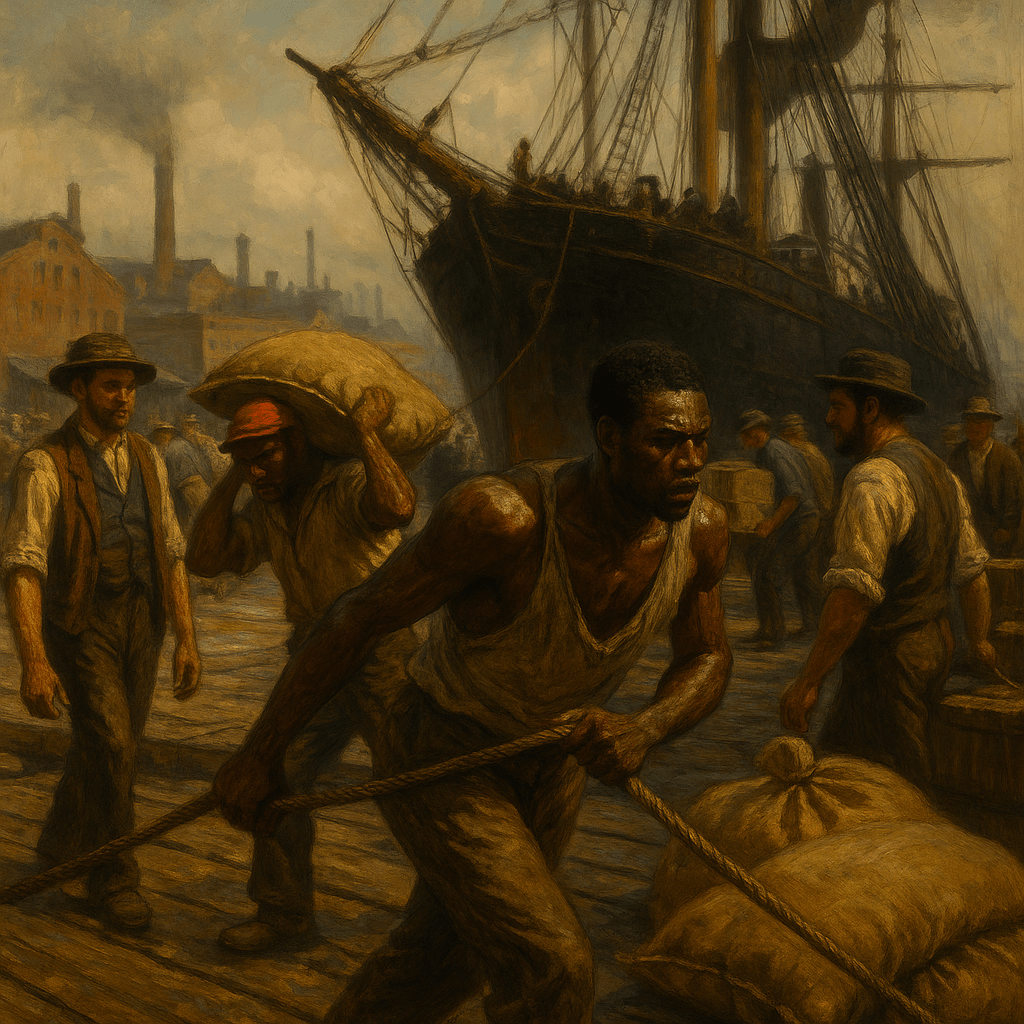
Organizing Workers in the Shadow of Slavery: Global Inequality, Racial Boundaries, and the Rise of Unions in American and British Capitalism, 1870–1929
By Prince Kapone | Weaponized Intellects Book Review | Weaponized Information | October 18, 2025
Introduction: Labor’s Long Shadow
Rudi Batzell, a historian of capitalism and labor at the University of Chicago, has written one of the most penetrating studies of the racial foundations of the modern working class in his 2025 book Organizing Workers in the Shadow of Slavery: Global Inequality, Racial Boundaries, and the Rise of Unions in American and British Capitalism, 1870–1929. Drawing on archives that stretch from the docks of Baltimore to the shipyards of Liverpool, Batzell unearths the uncomfortable truth that the modern labor movement was never simply born from industrial exploitation—it was shaped, constrained, and defined by slavery’s afterlife.
His argument cuts against the grain of conventional Marxist and liberal labor histories alike. Where orthodox narratives portray the rise of trade unions as the triumph of working-class organization over capital, Batzell insists that these unions emerged from—and were structurally limited by—the global color line that slavery built. The “shadow of slavery,” in his analysis, was not a cultural remnant but the material condition of labor markets on both sides of the Atlantic: a system that allowed employers to weaponize racial divisions and “reserve armies” of cheap, coerced, and colonial labor to break strikes and discipline wage demands.
By comparing the evolution of unionism in the United States and Britain, Batzell shows how racial and imperial hierarchies shaped the very architecture of working-class organization. In America, the legacy of plantation slavery hardened into Jim Crow and exclusionary craft unions; in Britain, the empire’s vast colonial periphery absorbed the contradictions of “inclusive” labor solidarity at home. The result, Batzell concludes, is a global working class forged in uneven development—a class whose unity was never betrayed, but built on division.
More than a history of unions, Organizing Workers in the Shadow of Slavery is an x-ray of capitalism’s racial core. It invites us to see labor not as a victim of empire, but as one of its instruments—and to recognize that the struggle for socialism must begin with the dismantling of the world that slavery made.
Where the Color Line Meets the Cargo Line
The book opens on a Baltimore pier in 1912, and that choice is not just scenery. It’s the whole argument in motion. Longshore workers have finally pulled the emergency brake on exploitation; ships idle, bosses panic, and for a brief, bright minute the port belongs to labor. Then the employers do what empire always does: they reach into the reserve tanks built by slavery and dispossession and pull out a new crew to break the strike. Black workers—locked out of decent jobs by white unions for years—are hired as “replacements,” paraded under police protection through jeering crowds who chant class slogans with a racial edge. It isn’t a morality play. It’s a diagram. The dock is where two histories collide: the hunger for wages and the longer hunger for freedom; the craft card and the plantation brand; the union line and the color line. Rudi Batzell calls it the “shadow of slavery.” On that pier you can see the shadow is not behind us; it’s cast forward, over the entire terrain of American labor.
Western Marxism loves to start in the factory—clean lines, rational plans, universal man. Batzell starts at the waterline and refuses to look away from the mud. He doesn’t treat race as a stubborn superstition floating above “real” class relations; he shows how class is manufactured with racial parts: who gets counted as skilled, who gets a card, who is available at the whistle to work cheaper, who gets escorted by police through hostile streets. The color line is not a distraction from wages; it is how wages were stabilized for some and depressed for others. If you listen closely on that Baltimore dock, you can hear the trade union contract whispering its secret: the wage is worth more when someone else is kept out.
This is not an American oddity, and Batzell will not let Britain off with sentimental hymns to “inclusive unionism.” He pairs the U.S. South with Ireland, two “near peripheries” that supplied cheap labor and strikebreakers to the industrial core. Different geographies, same function: a standing army of the dispossessed, organized by empire to appear on cue. Britain could afford certain solidarities at home because it outsourced the most brutal divisions to its colonies; the United States internalized the colony and called it a region. Either way, capital won the same prize: a labor supply that could be toggled by race, nation, and border to discipline anyone who got ideas above their station. That is the quiet mechanics behind all the loud speeches about “fair competition.”
Batzell’s craft is archival, but his target is ideological. He dismantles the Western Marxist habit of treating racism like fog that will burn off when “real” class politics begins at noon. Noon never comes. Ships have schedules, bosses have timetables, and the state has patrol wagons. On the ground, workers do not meet as abstract equals but as people positioned by centuries of land theft, forced migration, policing, and law. The Knights of Labor briefly tried to step over that chasm, and the scene at the docks shows why they fell in: the boss didn’t “confuse” the workers; he used the world as it was made—by slavery, debt peonage, vagrancy laws, and segregated skill ladders—to make solidarity expensive and betrayal affordable. When a Black worker takes a struck job that was long denied to him, is that treachery or the return on white labor’s earlier investment in exclusion? When a white striker spits the word “scab,” is he naming a class act or masking a racial boundary? On the pier, the slogans don’t land cleanly. That is the point.
We will not pretend, with academic neutrality, that everyone just misunderstood each other in the heat of struggle. The employers understood perfectly: hire from the population you’ve kept desperate; use police to move the labor where you need it; let the mob take care of the rest. The city understands, too—one day escorting Black men through a sea of fists, the next day arresting a foreman to cool things down—always managing motion so that freight moves and wages don’t. The union leadership understands in its bones even when it denies it in its bylaws: you cannot build a durable wage floor on a racial trapdoor. But Western Marxism refuses to learn that lesson, because learning it would require admitting that the “model” of the proletariat it celebrates was subsidized by colonial extraction and racial exclusion. The class subject wasn’t born pure; it was born graded.
So we begin, as Batzell begins, on that Baltimore dock—not to replay the tragedy, but to fix our instruments. From here forward, we read labor history as the management of borders: between skilled and unskilled, citizen and alien, white and Black, metropole and colony, “craft” and the rest of us. We read “strikebreaker” not as a moral category but as a logistical role made possible by a world the ruling class has already sorted for its own use. We also read the desperate choices of working people for what they are: responses to structures built at their expense. If you ignore those structures, you end up scolding the hungry and flattering the unions that fed off the color line while calling it “craft.”
This is the ground the next movement must take. The 1890s did not merely happen; they were engineered. The Knights’ fragile multiracial experiments gave way to an AFL that wrote whiteness into the definition of skill, and the state learned to seal the deal with immigration bars and Jim Crow law. That story is not a detour—it is the blueprint. From the plantation to the port, from the port to the contract, the shadow lengthens. We follow it, not to wallow in defeat, but to map power as it really functions so we can break it where it actually lives.
The Wage as a Border: How Whiteness Became a Union Card
By the time the 1890s arrived, the great experiment in multiracial solidarity that flickered across America’s docks and mines was already being buried under the weight of its own contradictions. The bosses didn’t have to crush it; the unions did it for them. What began as a movement to unite the exploited had calcified into a fortress for white labor. This is the moment Rudi Batzell calls the “pivot,” and he’s right—it’s when the U.S. working class stopped trying to overthrow the color line and started managing it.
The Knights of Labor—those ragged dreamers who once organized Black freedmen, women, immigrants, and even convict laborers—had tried to build an army of the dispossessed. But dreams like that don’t survive long in a settler colony. The panic of 1893, the crushing of the Pullman Strike, and the growing cult of “craft” all pushed labor toward respectability, away from revolution. The American Federation of Labor rose from that wreckage preaching “pure and simple unionism,” which meant pure and simple whiteness. Craft by craft, industry by industry, the union card became a passport into the racialized republic.
Batzell doesn’t waste time with moral outrage. He traces the cold mechanics of it. The AFL wasn’t simply racist because its members were white men raised on prejudice—it was racist because capitalism demanded a system that could reward a layer of the working class for policing the rest. The factory became a miniature empire, divided between those who worked with tools and those who worked with hands, between “skilled” and “unskilled,” “native” and “foreign,” “white” and “colored.” And these weren’t just categories—they were wages. The bosses didn’t need an overseer with a whip; they had the craft union and the immigration inspector.
The new order was enforced by a racial logic dressed in technical language. “Skill” was no longer about what you could do—it was about who you were. The white worker’s craft certificate was worth more than any Black worker’s lifetime of labor, because it came stamped with the approval of the state and the union hall. This is how whiteness became a form of property: an invisible wage supplement that cost the ruling class nothing and paid the worker just enough to keep him loyal. Du Bois called it the “psychological wage.” Batzell shows us its machinery—the hiring hall, the exclusion clause, the immigration bar, the police detail guarding the picket line.
But this story wasn’t confined to the United States. Across the Atlantic, British workers were discovering that their “inclusiveness” at home rested on exclusion abroad. The same empire that taught London’s dockers to chant “solidarity forever” was busy starving Indian weavers, forcing Africans into the mines, and deporting Irish laborers to every corner of the world. When Batzell turns his lens to Liverpool, the illusion cracks. The city’s unions preached brotherhood while its ships ferried sugar, cotton, and human cargo between colonies. The British working class could afford to act inclusive precisely because the empire did its exclusion for them. Their unity was built on a global division of labor, where solidarity stopped at the port and hierarchy began on the shore.
Here Batzell’s comparison bites deepest. The American laborer inherited the plantation; the British laborer inherited the empire. Both built their movements within systems that had already divided the working class before the first strike was ever called. That’s the historical trap Western Marxism refuses to see. It keeps trying to find the “pure” proletariat underneath all this blood and geography, as if class could ever exist outside of race, gender, and conquest. The idea that workers might first have to confront their own position in an imperial system, that their own wage might depend on another’s poverty—this is heresy in the temples of Western theory. But on the ground, it’s obvious.
By the turn of the century, the wage had become a border. Crossing it required papers, lineage, or skin tone. To be white was to belong to the republic of labor; to be Black, Asian, Indigenous, or foreign was to live outside its laws. The immigration restriction acts, the Chinese Exclusion Act, the literacy tests, and the segregation statutes—all these were labor policy by another name. They weren’t designed to protect “national workers” from outsiders; they were designed to keep the hierarchy stable inside the working class itself. Empire had simply gone domestic.
Batzell’s prose, like his evidence, is cautious; but read between the lines and the indictment is clear. The American labor movement’s failure wasn’t an accident of bigotry—it was the political form of a settler economy. A movement born in a colonial society will reproduce colonial relations unless it actively revolts against them. The white craftsman, the union bureaucrat, the AFL official—these weren’t just workers with bad ideas. They were beneficiaries of an internal empire that granted them small privileges in exchange for their loyalty. The tragedy isn’t that they were fooled. It’s that they came to believe their little slice of power was the revolution itself.
By the end of the 1890s, the lines were drawn. The color line, the border, the job line—they had fused into one continuous frontier running through every workshop and union hall. The strikebreaker, once a figure of scorn, had become the system’s permanent fixture: the immigrant, the woman, the Black worker, the colonial subject—always available, always blamed. The bosses could sit back and watch the workers fight among themselves, each defending their place in the hierarchy. The AFL called this “organization.” History calls it what it was: class war turned inward.
This is where Batzell leaves us at the close of his pivot: a movement split against itself, still mouthing the slogans of unity while guarding the gates of its own fortress. But we cannot stop here. Because while the unions were drawing lines in the factories and ports, something else was happening in the streets and neighborhoods—a quieter, more cultural war for the soul of the working class. The next battle would not be fought over who could join the union, but over who could live where, who could play where, who could belong. And that is where the story turns next: from the shop floor to the street, from solidarity to segregation, from the wage to the world it built around it.
Homes, Games, and Ghettos: How Solidarity Was Segregated
By the early 20th century, the battlefield of class struggle had shifted. The factory was no longer the only arena where the ruling class managed labor’s divisions—it had seeped into every corner of life. Wages followed workers home; the color line did too. What Rudi Batzell calls “workers’ social worlds” were not refuges from exploitation but extensions of it. The tenement, the neighborhood, the pub, the football field—all became laboratories for reproducing the same racial boundaries that unions had already written into their bylaws. The boss didn’t have to stand at every door; ideology did the job for him.
This was the age of the industrial suburb, a physical architecture of class and color. In cities like Baltimore, Pittsburgh, Sheffield, and Liverpool, the working class built new communities on the outskirts of the mills. But those communities didn’t rise from collective strength—they were organized by segregation and debt. The white craftsman bought a modest house in a segregated suburb, escaping both the smoke of the factory and the proximity of the Black worker. Homeownership became the new frontier of racial privilege: a plot of land secured by a union wage and guaranteed by a racist housing market. The Black worker, meanwhile, was corralled into “the slum”—a term invented to moralize poverty while hiding its political cause. What the landlord called a “blighted district” was simply the geography of exclusion, the place where solidarity had been priced out.
Batzell shows how these spaces didn’t just reflect inequality—they produced it. The white worker who defended his neighborhood line was defending more than his house; he was defending the social value of his whiteness, now anchored in brick and mortgage. This was the domestic counterpart of the craft union’s exclusivity: both operated by restricting access to security, both required an “other” to sustain their stability. Western Marxists would later talk about “alienation,” but rarely about eviction; they analyzed the loss of meaning at work but not the racialized geography that made work possible. In that silence, the terrain of class struggle was surrendered to real estate agents and police.
Even recreation—what Marx once called the “realm of freedom”—was conscripted into empire. Batzell’s account of sports bureaucracies in the early 20th century reads like a manual in social engineering. The rise of organized sport within the labor movement, especially in Britain, was sold as proof of “working-class respectability.” But beneath the medals and leagues, something else was happening: a new model of masculine discipline was being built, one that fused nationalism, gender, and racial hierarchy. The same worker who shouted solidarity on the picket line shouted abuse at the Black athlete or immigrant opponent on the field. The stadium became a training ground for hierarchy—orderly crowds, regulated emotions, patriotic songs. The bourgeoisie didn’t invent that culture; the labor bureaucracy did, to show the ruling class that workers could govern themselves without revolution.
That is Batzell’s quiet revelation: that solidarity and segregation were not opposites but companions. The unions and labor councils that built sports leagues and mutual-aid societies also built color bars and residency rules. They didn’t just fight for a wage—they fought to define who counted as “decent” labor. The moral vocabulary of the early 20th-century worker—respectability, thrift, temperance, family—was a social technology designed to separate the “responsible” white laborer from the “degenerate” racialized poor. And it worked. While the bosses consolidated ownership at the top, the workers learned to police one another at the bottom.
Batzell’s chapters on “Fordist masculinity” reveal this new order with painful precision. The factory had given rise to a new kind of worker-citizen—disciplined, patriotic, male, and white. He identified not with the collective class but with the family he was meant to protect, the house he was paying off, the team he cheered for, and the nation that called him “producer.” The patriarch replaced the proletarian as the model of virtue. In this transformation, the ruling class achieved something the Pinkertons never could: they convinced the worker to see his own domination as order, his own subordination as manhood.
And yet, Batzell does not let us imagine that this was only a story of defeat. Within those segregated worlds, new forms of life also emerged—forms that hinted at another future. The same tenements that held Black workers captive became incubators of collective consciousness; the same “slums” where immigrants were herded became multilingual classrooms of resistance. In the cracks of segregation, people built networks that didn’t need union approval. Women organized rent strikes, mutual aid, and community defense. Black workers built their own unions, sometimes explicitly revolutionary, tied to anti-colonial movements abroad. If the official labor movement was busy guarding its racial borders, the unofficial one was learning to cross them.
Still, the tragedy of this period is how much energy was spent defending small privileges instead of dismantling the system that made them possible. The white working-class home became a bunker, the sports field a parade ground, the neighborhood a gated republic. By the 1920s, the American and British labor movements had both internalized the imperial logic so deeply that they no longer recognized it. Even their attempts at reform—higher wages, housing programs, social insurance—were built on maintaining the racialized order that made those benefits affordable. The empire had moved inside the metropolis, and the working class had become its local manager.
What Batzell leaves unsaid, but what any revolutionary reader must see, is that this process is still with us. The modern suburbs, the gated communities, the union halls that still talk about “our jobs” while ignoring the undocumented, the police unions defending brutality in the name of “law and order”—these are not deviations from the labor tradition. They are its afterlife. The shadow of slavery that shaped the docks and factories of 1912 now shapes the logistics hubs and warehouses of our own time. The form has changed; the structure remains.
As we leave this stage of Batzell’s analysis, we can see where the road leads. The social world of the worker has become the architecture of the empire itself. To break it, we have to understand not just who owns the factory but who owns the neighborhood, who sets the rent, who profits from segregation disguised as “choice.” The struggle for a new world begins not with nostalgia for lost solidarities, but with the recognition that the solidarities we lost were already compromised. What comes next will have to be built from the ground up, without the color line, without the wage border, without the chains of respectability that kept the working class obedient.
The Bureaucrats of Betrayal: How Reform Replaced Revolution
By the time the guns of Europe thundered in 1914, the working class on both sides of the Atlantic had already been disarmed—not militarily, but politically. The unions that once threatened capital’s supremacy had turned into its administrative partners. The militants who spoke of expropriation were replaced by functionaries who spoke of arbitration. Class struggle was professionalized, nationalized, and sterilized. The spirit that once demanded the impossible was now busy negotiating the terms of the inevitable. What had once been the movement of the masses was becoming the management of misery.
Rudi Batzell doesn’t romanticize the old rebellions, but he shows what happens when the barricade is traded for the boardroom. In both Britain and the United States, a new species of labor leader emerged—the labor bureaucrat—who learned to speak the language of the state while keeping the rhythm of the shop floor. These men were not villains in the classic sense. They were products of the era’s pressures: wars to be fought, empires to maintain, industries too vast to leave uncoordinated. But the outcome was the same: the union ceased to be a weapon and became an office. What had once been a social movement turned into a human resources department for industrial capitalism.
The “politics of redistribution,” as Batzell calls it, became the polite name for managing the crisis of empire. The bureaucrats sought not to end exploitation but to make it sustainable—to redistribute just enough to keep the peace. Social democracy was born out of this compromise: the working class would get a share of the spoils in exchange for loyalty to the system that produced them. In the U.S., this bargain took the shape of the New Deal; in Britain, the welfare state. But both rested on the same foundation: the wealth extracted from colonized nations, the cheap labor of racialized workers, the unpaid labor of women. Redistribution at home was financed by exploitation abroad.
Western Marxism loves to treat this moment as the high point of “class consciousness,” when labor parties governed and union density peaked. Batzell’s evidence exposes the illusion. The so-called victories of the early twentieth century were victories for one side of the working class against the other. White male labor in the metropole was incorporated into the political order, while Black, brown, and colonial workers were left outside its gates. The “citizen-worker” was invented precisely to draw that boundary. The bureaucrat’s handshake with the minister was the political equivalent of the overseer’s whip—it enforced hierarchy under the banner of progress.
Even in Britain, where labor’s ascent appeared triumphant, the pattern held. The same trade union officials who bargained for higher wages in Sheffield and Liverpool were writing reports justifying imperial rule in India and Africa. They spoke of “civilization” and “development” in the colonies the way they spoke of “efficiency” and “productivity” at home. For them, the empire was not a moral question but an economic one: a means to sustain full employment and low prices for the British consumer-worker. Their internationalism ended at the horizon of imperial interest. In that sense, the British working class did not simply benefit from empire—it became one of its administrative organs.
Across the Atlantic, the American variant of labor reform took a more provincial form. The AFL and later the CIO fashioned themselves as patriotic institutions, pillars of the republic. They pledged loyalty during both world wars, helped enforce anti-communist purges after 1917 and 1945, and fought bitterly against any insurgent tendency that linked class struggle to anti-colonial or Black liberation movements. The logic was simple: better to rule a smaller, safer world of “American workers” than to join a global struggle that might abolish ruling altogether. The state rewarded this obedience with labor laws, pensions, and a seat at the table—benefits reserved for those who stayed in line.
The result was a working class divided not just by color or skill but by ideology. The bureaucrats internalized the managerial rationality of the bourgeoisie. They began to think in spreadsheets and schedules, not in slogans and strikes. The goal shifted from liberation to productivity; the enemy was no longer the boss but “inefficiency.” Union offices filled with men who looked and sounded like small businessmen. They talked about “wage stability,” “labor peace,” and “partnership.” The language of revolution was exiled to pamphlets and prisons. The labor bureaucrat became what Gramsci once called “the new functionary of capital,” a class in itself that managed dissent the way the state managed debt.
Batzell’s understated style leaves space for us to draw the political conclusion he avoids: this bureaucratization wasn’t just a tactical detour—it was counterrevolution dressed in reformist clothing. By accepting the permanence of capitalism, labor surrendered its autonomy. The unions became tools for disciplining the rank and file, channeling energy away from confrontation and toward procedure. Collective bargaining turned into a ritual of containment, a way to translate rebellion into paperwork. The more “successful” the union became in negotiating contracts, the less capable it was of imagining a world without them.
The tragedy of this transformation is that it was celebrated as progress. Social democracy mistook incorporation for power, mistook access for control. But as Batzell shows, what the working class gained in benefits, it lost in sovereignty. Once labor accepted the logic of the imperial economy, it could no longer challenge its foundations. The reformers who preached stability helped stabilize the very system that was destroying their own future. The moral of this history isn’t that the workers were naïve—it’s that the institutions they built were captured from within by a class of managers who learned to speak in the language of liberation while administering its opposite.
And yet, buried beneath the bureaucratic crust, another current persisted. Every strike that broke through union control, every wildcat action, every rent riot and colonial uprising was a reminder that history was not finished. Even as the reformers declared victory, the colonized world was preparing its own revolution. The 1919 uprisings, the Russian Revolution, the Pan-African Congresses, the Irish rebellion—all were warning signs that the system’s global balance could not hold. The same forces that built the welfare state would eventually tear it apart. The shadow of slavery, once confined to the dock, was now haunting the entire edifice of modern capitalism.
This is where Batzell leaves us, and where our task begins. The lesson is not to reject reform outright but to understand what it is: a ceasefire in a war that never ended. The real question is how to turn the machinery of reform against itself—how to use the bureaucrat’s tools to dismantle the bureaucracy, how to turn the wage into a weapon instead of a leash. Because the empire that fed the old labor movement has collapsed, but the system it served is still alive, now automated and globalized, running on algorithms instead of overseers. The bureaucrats of betrayal have new names—HR managers, union consultants, diversity officers—but their function is the same: to make injustice manageable.
What comes next must break that cycle entirely. We cannot reform our way out of empire; we must abolish its social relations wherever they appear—in the workplace, in the neighborhood, in the mind. The next labor movement will not be a return to the old solidarities but their completion. It will have to be anti-imperialist, decolonial, and revolutionary, or it will be nothing at all.
The Shadow Still Stretches: Labor, Empire, and the Future We Inherit
By the time Batzell reaches his conclusion, the geography of the working class has changed beyond recognition—but the logic that shaped it remains painfully familiar. The factory floor has gone global. The plantation has been digitized. The same shadow that once fell over the docks of Baltimore now covers the warehouses of Amazon, the mines of Congo, the maquiladoras of Mexico, and the call centers of Manila. The “shadow of slavery,” as he calls it, was never a metaphor for the past—it’s the blueprint of the present. Capitalism didn’t escape its origins in forced labor; it scaled them up.
Batzell closes his book with cautious hope, gesturing toward the possibility of “new inclusive unionisms” for a globalized world. But hope without confrontation becomes nostalgia. Inclusion, under capitalism, is a velvet form of exclusion—it invites you into a burning house and calls it progress. The problem isn’t that today’s unions forgot how to include; it’s that inclusion was always conditional, always built on someone else’s exclusion. The “future of labor,” if we want to use that phrase, will depend not on whether workers can join the old organizations, but whether they can destroy the systems those organizations were designed to protect.
Still, Batzell’s archive gives us something invaluable: a historical map of how those systems reproduced themselves. From the plantation to the port, from the port to the factory, from the factory to the suburb, each generation of workers has inherited a slightly updated version of the same arrangement: a small wage, a distant enemy, and a ready scapegoat. Western Marxism, with its sterile vocabulary of “production” and “distribution,” has never known what to do with this reality. It speaks of capital as if it were a neutral engine, ignoring that the fuel has always been human bodies—Black bodies, colonized bodies, feminized bodies, rendered cheap by design.
If there is a great silence in the Marxism of the West, it is the silence about the plantation. The European labor theorists built their entire architecture of value and surplus around the factory system, while the real engine of accumulation—the global system of slavery, land theft, and imperial conquest—was treated as a historical prelude. Batzell forces that prelude back into the main score. He doesn’t romanticize the colonized worker, but he refuses to treat them as an afterthought. In that refusal lies the seed of a new historical materialism, one born not in the mills of Manchester but in the sugar fields of the Caribbean and the cotton fields of Mississippi.
The brilliance of Organizing Workers in the Shadow of Slavery is that it quietly exposes how “modern” capitalism was never modern at all. Its infrastructure—the contract, the border, the police, the mortgage, the union card—are all descendants of the plantation ledger. The system that claimed to have abolished slavery simply outsourced its techniques: control of mobility, surveillance of behavior, calculated dependency. Even the concept of “freedom,” that sacred word of liberal and labor politics alike, is still defined negatively—freedom from the whip, freedom to sell oneself. The form changes, the relation remains.
For Batzell, this legacy is a structural fact. For us, it’s a call to arms. The modern worker cannot simply reclaim the institutions of the old labor movement; those institutions were built in the image of empire. A decolonized labor movement will look nothing like the AFL or the TUC. It will not define itself by the factory or the craft, but by the shared condition of dispossession. It will not be national but planetary, not masculine but collective, not white but multiracial in both composition and consciousness. And it will not beg inclusion in a decaying system—it will organize its funeral.
The “shadow” then, is not a curse—it’s an inheritance. To live under it is to live with the truth that capitalism’s history is not linear but recursive, always returning to its colonial origins. The global working class of the twenty-first century stands in the same contradiction that the Baltimore dockers faced in 1912: how to build solidarity across the boundaries that define the system itself. The difference is that now the battlefield is total. Supply chains replace empires, algorithms replace overseers, but the relationship remains: a minority lives off the forced exhaustion of the majority. What Batzell calls “global inequality” is not the byproduct of the market—it is the market.
To confront this reality, we have to strip Western Marxism of its blinders and recover the revolutionary tradition it abandoned—the anti-colonial Marxism of the Global South, the Marxism of the colonized who never had the luxury to separate class from color. That means learning not from the parliamentarian but from the guerrilla, not from the union bureaucrat but from the prison intellectual, not from the European theorist but from the Third World worker. Batzell doesn’t go that far, but his research points us in that direction. He leaves us standing at the edge of the dock again, staring into the same abyss of inequality that began with the slave ship. The difference is that now we know its coordinates.
So where do we go from here? We start by accepting that the “shadow” is not behind us—it’s cast by the system we still live under. We start by refusing to treat the history of slavery as a moral horror safely contained in the past, and recognizing it as a living relation that structures every paycheck, every rent payment, every border checkpoint, every algorithm that decides who eats and who starves. We start by understanding that revolution is not the creation of something new, but the interruption of something very old.
Batzell ends his study with a question: can the working class escape the shadow of slavery? The answer depends on whether we can finally recognize that the shadow is not the past—it’s the system itself. To escape it, we don’t need a new labor movement. We need a new humanity—one that refuses to build freedom on someone else’s chains. That will be the true end of slavery, and the true beginning of socialism.
The Long Memory of Chains: Toward a Decolonized Proletariat
History, as the ruling class tells it, is a sequence of breakthroughs—abolition, suffrage, industrial democracy, globalization—as if every century were a step closer to freedom. But Rudi Batzell’s work reminds us that the movement of history under capitalism is not progress; it’s rotation. The forms change, the relations remain. The wage replaces the whip; the factory replaces the plantation; the suburb replaces the slave quarters. The same logic endures—control of labor through division, accumulation through dispossession. The “shadow of slavery” stretches because it was never a remnant; it’s the horizon.
When we look back from our vantage point—the age of algorithms and supply chains—we see how the old strategies of racial management have simply been automated. The plantation ledger has become the global database. The overseer has been replaced by predictive policing and workplace surveillance. Amazon warehouses are the new sugar estates, each worker tracked by the second, each body calibrated to machinery. The subcontracted migrant worker, the gig driver, the prison laborer—all are tethered to the same global engine that once moved ships between Liverpool and Lagos, Charleston and Havana. If Marx called slavery “the pedestal of modern industry,” then our century is its digital afterlife.
Batzell’s quiet conclusion—that the working class cannot escape the structures built in slavery’s image—carries a deeper message than he states outright: emancipation cannot be achieved through the same institutions that were built to contain it. The union, the state, the nation—these are not neutral tools. They are the instruments by which empire organizes consent. The Western Left’s tragedy has been its faith in reforming these tools, rather than destroying them. That faith built parliaments instead of communes, NGOs instead of liberation fronts, think tanks instead of movements. It built a “Left” fluent in human rights and allergic to revolution.
But in the ruins of that betrayal, a new consciousness is emerging—one that begins where the Western labor movement ended. It starts in the peripheries, where the line between worker and colonized has always been thin. It takes shape in the militancy of logistics workers in South Africa, the uprisings of garment workers in Bangladesh, the mass strikes in India, the land occupations in Brazil, the indigenous resistances in the Americas. These are not “local struggles.” They are the return of the colonized to the stage of history—the very agents Western Marxism pretended did not exist. The world’s factory has begun to revolt against its owners, not in the language of the old proletariat, but in its own.
The lessons of Batzell’s history make their way into this new terrain with unsettling clarity. The white labor aristocracy that once formed the backbone of “civilized” unionism now finds itself redundant, stripped of privilege by the same global capital it helped expand. In the imperial core, workers face austerity, automation, and debt—their old bargains broken, their bureaucrats powerless. What we are witnessing is not the death of labor, but the decolonization of the working class. The shadow of slavery, which once divided the proletariat along lines of race and empire, now returns as the field upon which a new internationalism must be built.
That internationalism will not emerge from theory seminars in London or New York; it will come from the practical intelligence of struggle. It will be born of the same clarity that guided the Maroons in the mountains of Jamaica, the Vietnamese peasants in the Mekong, the Algerian workers in the Casbah, the Black Panthers in Oakland. It will understand that solidarity is not moral sympathy but material alignment—the recognition that one’s liberation is bound to another’s. It will be organized not through party congresses but through shared logistics: ports, warehouses, digital networks, global supply lines turned against their masters. The new revolutionary subject will not be the white industrial worker of European imagination, but the colonized worker of the global economy—the one who produces the world and owns none of it.
To read Batzell through this lens is to realize that the history of the labor movement is not a closed book but an unfinished trial. The question is not whether the working class can overcome racism, but whether it can abolish the conditions that make racism profitable. The answer cannot come from within the imperial core alone, because the core itself is the problem. Western Marxism keeps looking for redemption in the mirror of its own institutions; the real proletariat has already walked out of the room. It’s organizing under new banners: land back, reparations, self-determination, climate justice, abolition. These are not “identity” movements—they are class struggle in its most concrete and global form.
The task for revolutionaries in the imperial centers is not to lead but to defect—to break with the privileges that tie them to empire and to align with the global majority that sustains it. The role of the white worker, as it always was, is not to “support” liberation but to sabotage imperialism from within—to refuse to serve as its police, its settler, or its beneficiary. This is not moral guilt but material clarity. To stand with the colonized is not to pity them but to recognize the only path toward universal freedom.
Batzell’s history, read through the lens of struggle, becomes more than an academic chronicle—it becomes a manual for political rebirth. It teaches us that every labor movement that ignored the colonial contradiction was doomed to collapse, and every revolution that confronted it transformed the world. The Paris Commune died in isolation; the Cuban Revolution survived by joining the Third World. The AFL decayed into bureaucracy; the Black Panthers, for all their defeat, remain the model of militant humanism. The pattern is clear: when labor aligns with empire, it becomes an administrator of exploitation; when it aligns with the colonized, it becomes a weapon of liberation.
So here, at the end of Batzell’s shadow, we begin again. The task is not to write new manifestos but to complete the old one—to make good on Marx’s unfinished promise that “the emancipation of the working class must be the act of the workers themselves.” But now we know who those workers really are: not the abstract European proletarian, but the global working class in all its color, languages, and insurgent traditions. To abolish the shadow of slavery is not to escape it, but to step into its full light—to face the history we inherited and turn it into a weapon against the system that created it.
Only then will the proletariat cease to be an object of history and become its author once more. Only then will the long memory of chains finally serve its purpose—not as lament, but as strategy. The future will not be won by forgetting the shadow, but by organizing within it, together, until it disappears.
 Weaponized Information
Leave a comment