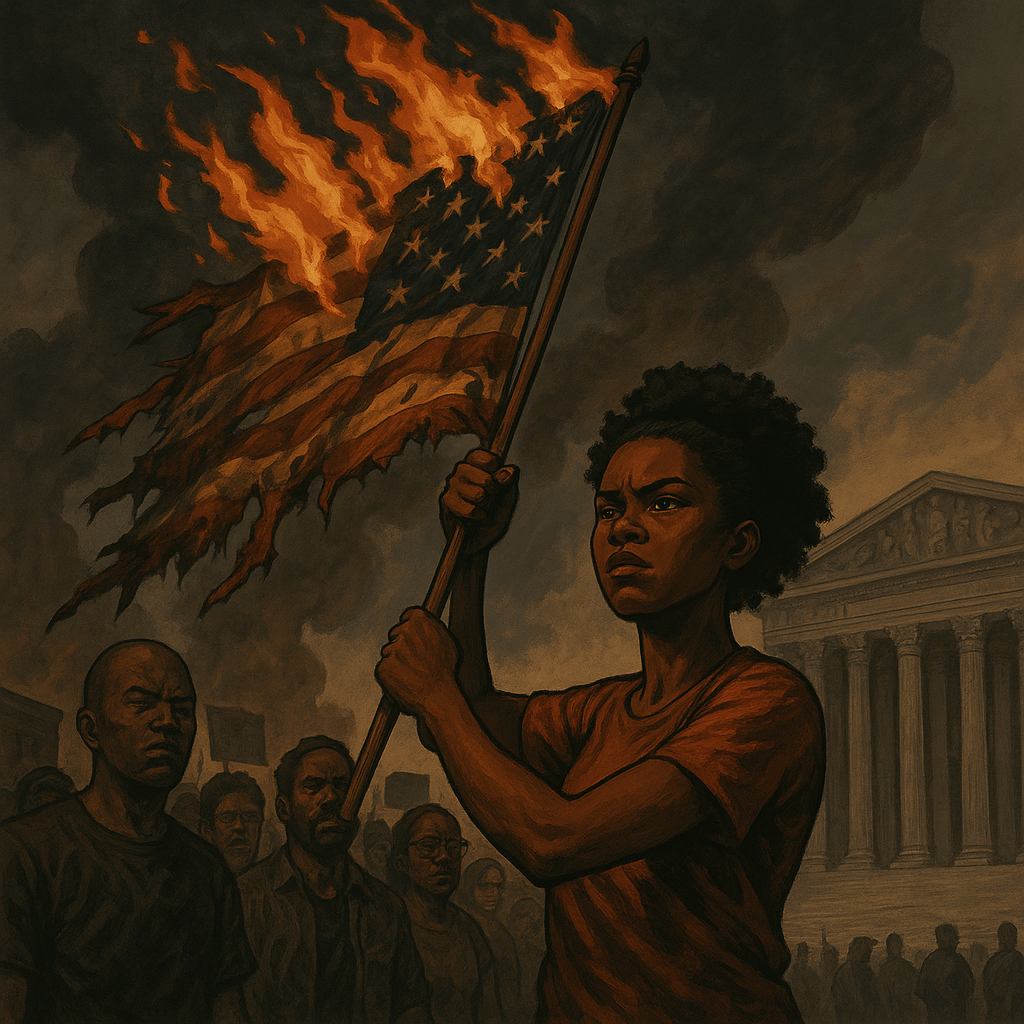
How CNN’s Supreme Court coverage buries the counterrevolution of voting rights under the language of legality — and what it reveals about the racial state of empire in decline.
By Prince Kapone | Weaponized Information | October 16, 2025
The Civil Rights Obituary as Liberal Theater
On October 14, 2025, CNN’s Chief Supreme Court Analyst Joan Biskupic published a piece titled “Supreme Court conservatives poised to further gut the Voting Rights Act.” To the untrained eye, it reads as a straightforward report: the Supreme Court is preparing to weaken one of the last remaining legal shields against racial disenfranchisement. But beneath the calm cadence of institutional reportage lies an obituary written in advance—a requiem for the right to vote, staged as impartial analysis. It is the art of eulogizing democracy while insisting that nothing can be done to save it.
Biskupic occupies a curious position in the media food chain. She is not a propagandist in the cartoonish sense—no MAGA flag waving in her cubicle—but a court stenographer of empire’s liberal wing. Her long career at CNN, Reuters, and USA Today has been dedicated to translating the theology of the Supreme Court into the secular faith of the “rule of law.” She writes not for the people who bleed on the picket lines or the streets of Baton Rouge, but for the professional-managerial class that believes the judiciary is a temple above politics. In this ritual, the robes of the justices are the vestments of authority, and her task is to make their decrees sound inevitable.
CNN itself is not a neutral vessel for these sermons. Owned by Warner Bros Discovery and tethered to the fortunes of tech monopolies, defense contractors, and Wall Street advertisers, it functions as a pulpit for the ideology of managed decay. When empire unravels, the job of its media clergy is to narrate the decline as order, to make regression sound like reform. Biskupic’s article does exactly that: it reframes the evisceration of the Voting Rights Act as an arcane legal debate, rather than the continuation of America’s oldest war—the war to keep Black people from governing their own destiny.
The ensemble of “experts” she assembles—law professors, election analysts, former officials—form the Greek chorus of elite consensus. They speak with the monotone of reason while erasing the noise of revolt. Not a single organizer, voter, or community leader appears in her narrative. The people who will bear the consequences are absent, replaced by technocrats who assure readers that this, too, is democracy functioning as designed. And perhaps they are right. Democracy in the United States has always functioned precisely as designed—to filter power upward, to grant the masses the illusion of participation while the property-owning class decides their fate behind closed doors.
Every line of Biskupic’s article performs a specific ideological labor. She normalizes regression by describing the rollback of Black voting rights as a “potential reversal,” a tidy euphemism for counterrevolution. She invokes “equal protection” to flatten history, pretending that laws created to remedy centuries of racial terror are equivalent to the bigotry they were meant to abolish. She fetishizes the institution itself, treating the Supreme Court’s re-argument schedule like the second coming of jurisprudence, as though procedure were a substitute for justice. Her nod to “Bloody Sunday” in Selma serves not as historical continuity but as a sanitized reference point—safe for commemoration, stripped of its revolutionary content. And the tone throughout is one of emotional anesthesia: the bureaucratic calm of a scribe who can describe a political lynching without ever raising her voice.
This is what propaganda looks like in the liberal age. It does not shout or sneer; it soothes. It teaches resignation by calling it realism. It buries rebellion under the etiquette of civility. The reader is guided to mourn what has been lost without ever questioning who took it or why. In this way, the media becomes the quiet undertaker of history, embalming the corpse of democracy for public viewing, assuring us that the system is still alive even as the blood drains from its veins. CNN’s narrative discipline is not accidental—it is the performance of power adapting to decay. The empire writes its own autopsy, and calls it news.
Stripping the Mask: The Material Facts of Disenfranchisement
Every omission in Biskupic’s article tells on itself. The story isn’t what she writes—it’s what she dares not to mention. The calm tone, the procedural framing, the legal jargon: all of it functions to bury the living contradictions of U.S. democracy under layers of institutional fog. Where she narrates a courtroom drama of “re-arguments” and “equal protection,” the real plot is happening outside those marble walls—in the Black Belt counties where polling stations have vanished, in the prisons where millions remain stripped of the franchise, and in the statehouses where maps are drawn like shackles. Propaganda doesn’t just distort facts; it hides the world in which those facts breathe.
When CNN describes the Voting Rights Act’s dismemberment as a “legal evolution,” it conceals a decade-long campaign that began with the 2013 Shelby County v. Holder decision. That ruling gutted the federal oversight that once prevented states with histories of racial discrimination from changing voting laws without approval. In the years since, more than two dozen states—most across the South—have enacted new restrictions on registration, early voting, and mail-in ballots. These were not bureaucratic tweaks; they were class war in legislative form. According to the Leadership Conference Education Fund, these laws have closed hundreds of polling places, many in majority-Black or Latinx precincts. Biskupic’s silence on this history is no accident; it’s the erasure that keeps empire’s story coherent.
Her invocation of “equal protection” performs another sleight of hand—turning remedial justice into alleged racial favoritism. What’s missing is the asymmetry of power that produced Section 2 of the Voting Rights Act in the first place. The pattern is visible in how modern poll closures, ID barriers, and gerrymanders map onto the same racial geography the law was meant to confront. The difference is technological: digital mapping tools now replace literacy tests, and algorithms do the work of the old Dixiecrats. When a state like Louisiana defends a snake-shaped district as “fair representation,” it’s not ignorance—it’s precision targeting refined by partisan data firms and advanced GIS.
The fetishism of the institution hides the class architecture beneath the Court’s marble façade. The Roberts Court is not an impartial referee but a political weapon forged in the workshops of the Federalist Society—a network of corporate lawyers and ideologues that supplied a large share of Trump’s judicial nominees. Investigations confirm that the majority of Trump’s judges had ties to the Society, whose influence over the courts has been decades in the making. This network was bankrolled through hundreds of millions in dark-money contributions funneled through tax-exempt nonprofits and donor-advised funds. Key figures such as Leonard Leo built the infrastructure linking these donors to judicial campaigns, using groups like the Judicial Crisis Network and the Concord Fund to shape nominations and media narratives. When CNN reports that the Trump administration “wants to curb the power of Section 2,” it omits that these same donor networks financed the white papers, advocacy groups, and influence campaigns that produced the judges now dismantling the law they claim to interpret.
Historical amnesia also masks the continuum of racial control stretching from Reconstruction to mass incarceration. The Sentencing Project’s “Locked Out 2024” report documents that over 4 million Americans are disenfranchised due to felony convictions—disproportionately Black Americans, concentrated in the Deep South. In states such as Florida, Mississippi, Alabama, and Louisiana—the very regions once forced to comply with the Voting Rights Act—tens of thousands remain legally excluded through lifetime bans or financial barriers that condition the right to vote on wealth. This exclusion operates in tandem with the exploitative regime of prison labor, which compels incarcerated people—disproportionately Black—to work for cents per hour. As the Guardian and Economic Policy Institute have shown, this system extends the racialized labor regime born on the plantation and codified through the 13th Amendment’s exception clause. Prison labor and voter suppression thus represent two sides of the same structure: one extracts surplus value, the other erases political agency. Together they sustain the economic order that has evolved—but never truly departed—from the plantation economy.
And then there’s the human element—the lives omitted under the banner of “technocratic expertise.” CNN quotes professors, not the people fighting every day to defend the right to vote. Grassroots organizations such as the Black Voters Matter Fund and the Southern Movement Assembly rarely appear in mainstream coverage, yet they remain central to the struggle for political power in the Deep South. As The Guardian has reported, Black Voters Matter organizers in Georgia go door to door and town to town, building relationships and registering voters long before election season begins. The Southern Movement Assembly likewise unites dozens of grassroots collectives across the region to confront voter suppression, police militarization, and economic displacement. These are the democracy workers whose hands rebuild the infrastructure of participation even as elites work to dismantle it.
Finally, Biskupic’s emotional detachment erases the human cost of this repression. Studies show that the South’s poorest and most racially marginalized communities face the steepest barriers to political participation. The Oxfam America inequality reports document how systemic poverty and racial exploitation remain deeply entrenched in the U.S. South, where wages, healthcare access, and political power are systematically suppressed. The Brennan Center for Justice has likewise shown that restrictive ID laws, polling-place closures, and purges of voter rolls fall most heavily on low-income and majority-Black counties. It is no coincidence: political exclusion protects economic extraction. The plantation may wear a new suit, but it still runs on the same principle—keep the hands working and the mouths quiet.
Seen in full, the omissions of CNN’s report are not random oversights but ideological necessities. To preserve the illusion of legitimacy, empire must hide the evidence of its decay. The Voting Rights Act was never just a law—it was a truce line in a centuries-long war. Its erosion marks not only the return of the old racial order but its modernization for the digital age. Behind every neutral paragraph of “balanced reporting” lies a strategy of silence—one designed to make the disenfranchised invisible, and the powerful untouchable.
Yet this silence can’t hold forever. The crisis that drives the judicial counterrevolution is larger than the courtroom—it is geopolitical, economic, and historical all at once. As U.S. imperial legitimacy collapses abroad, domestic legitimacy must be reconstructed through racial control rather than inclusion. Hence the spectacle of National Guard deployments into urban centers with high concentrations of Black lumpen and working-class populations, framed as “crime prevention” but functioning as counterinsurgency. The crisis of overaccumulation and austerity has tightened its grip on the state, producing a ruling class desperate for a politically disciplined electorate—one easier to police than to persuade. And the Voting Rights Act itself, stripped to a legal carcass, reminds us of its true origin: it was not a gift from benevolent elites but a concession extracted by mass struggle. Its dismantling today is not reform; it is counter-revolution in law—a signal that the system can no longer afford even the appearance of democracy.
From Law to Counterinsurgency: The Anatomy of Technofascist Consolidation
The so-called “evolution” of voting rights is not a natural legal progression—it is the juridical face of a counterinsurgency. Beneath the marble austerity of the Supreme Court lies the pulse of the colonial contradiction: the ongoing struggle between a settler state built on racial hierarchy and the colonized peoples whose labor, land, and bodies made that state possible. From the Black Codes to the modern prison, from poll taxes to voter ID laws, the U.S. legal order has always been a mechanism for restoring equilibrium to a system shaken by resistance. What Biskupic calls “equal protection” is merely the latest mask for that equilibrium—the guarantee that white property and capitalist control remain untouched, no matter how the laws are rewritten.
This is the logic of lawfare: the use of law as a weapon of class rule. Every judicial decision that narrows the franchise, every procedural ruling that “balances interests,” every appeal to “states’ rights” is part of a long counterrevolution waged through the courts rather than the streets. Lawfare replaces open terror with procedural violence. It speaks the language of neutrality while enforcing the color line by algorithm. Section 2 of the Voting Rights Act was born out of mass insurgency—it was written in the blood of Selma, not the ink of lawyers. Its dismantling, then, is not a legal correction but a political revenge. Through lawfare, the ruling class cloaks racial domination in the robes of constitutional virtue.
What drives this legal regression is not simply racism but settler revanchism—the desperate effort of a declining settler elite to reclaim total control after decades of perceived losses. The Civil Rights era fractured the old order but never destroyed it. Each expansion of democracy was met with new instruments of containment: redistricting, felony disenfranchisement, welfare austerity, mass incarceration. Today’s reactionary movement recasts that old project in modern form, calling it “color-blindness,” “election integrity,” and “originalism.” The Trump-appointed judiciary and its Federalist Society architects are merely the institutional engineers of that revenge, tasked with restoring the colonial contract that guaranteed white rule under the guise of national unity.
But this is not merely a Southern story—it is a global process. The same forces dismantling the Voting Rights Act are restructuring empire itself. The domestic rollback of civil rights mirrors the international rollback of sovereignty. As U.S. imperial legitimacy decays, the state consolidates internally through what can only be called technofascist consolidation: the fusion of monopoly capital, digital surveillance, and reactionary politics into a new mode of governance. Big Tech corporations refine the tools of algorithmic suppression at home while exporting them abroad; the same databases that purge voters from registration rolls feed predictive policing models in Black and immigrant communities. The court’s jurisprudence and Silicon Valley’s algorithms serve the same master—order, obedience, and the unimpeded flow of capital.
For the global working class and the colonized nations, this fusion of lawfare and technofascism represents the next phase of imperial warfare. It is not merely the decline of democracy but the recalibration of domination. The plantation, the prison, and the platform have merged into a single architecture of control. The Voting Rights Act’s dismemberment is thus more than domestic reaction; it is the legal codification of empire’s retreat into authoritarian discipline. Every polling place closed in Alabama, every incarcerated worker in Louisiana, every algorithm that decides who is “eligible” to vote or to work or to live—all are nodes in a planetary system of racialized accumulation. The resistance to it, likewise, must be planetary: the unity of Black, Indigenous, immigrant, and working-class struggles across borders and digital frontiers alike.
To see clearly is already to resist. The propaganda of “judicial balance” dissolves when we name the system for what it is—a global regime of technofascist restoration built on centuries of colonial theft. Against this, the task of the revolutionary press is not to report from above but to excavate from below: to unearth the buried connections between empire’s courtrooms and the world’s plantations, between Silicon Valley’s data mines and the chain gangs of the South. The law may no longer wear its hood, but it still carries the whip. And until the colonized and the working class reclaim the power to write their own laws, the court’s language of “equal protection” will remain the poetry of oppression.
Reclaim the Franchise, Dismantle the Empire
The struggle now returns to where it began—not in the courts, not in the halls of Congress, but in the streets, fields, prisons, and neighborhoods of the oppressed. The Supreme Court may imagine itself as the final arbiter of democracy, but history belongs to those who refuse to be ruled. The dismantling of the Voting Rights Act is not a death sentence for democracy; it is a call to arms for a new one. If the ruling class insists on narrowing the political field to a plantation, the people will have to build their own commons beyond the fence.
Across the South and across the world, the fire has not gone out. Organizations such as the Black Voters Matter Fund, the Southern Movement Assembly, and the Poor People’s Campaign are doing the daily work of resurrecting democracy from the ground up. They organize voter defense, community power, and mutual aid in the same regions where the empire once enforced slavery and now enforces austerity. Their struggle mirrors that of movements across the Global South—workers in Argentina resisting IMF diktats, farmers in India fighting corporate land grabs, Palestinians and Haitians confronting occupation. The geography differs, but the enemy is one and the same.
In Mississippi, the Jackson People’s Assembly continues to construct participatory structures of governance outside the bourgeois order—proof that power can be exercised without permission from the ruling class. The Red Nation links Indigenous liberation to anti-imperialist struggle across the hemisphere, while the Black Alliance for Peace exposes the colonial nature of U.S. policing at home and abroad. These are not “interest groups” but nodes of an emerging counterpower, rooted in the same soil that birthed every past revolution. They are living proof that the fight for the vote, when stripped of its liberal trappings, becomes the fight for sovereignty.
The tactics must evolve accordingly. First, strike where the money hides. The same hedge funds and private equity firms that bankroll the Federalist Society also own stakes in Warner Bros Discovery, CNN’s parent conglomerate. Targeted divestment campaigns can expose the corporate lifelines behind judicial counterinsurgency. Second, defend the vote as direct community action, not a spectator sport. Local mutual-aid defense hubs—offering transportation to polls, legal assistance for the arrested, and digital security for organizers—can transform elections into training grounds for solidarity. Third, build a proletarian cyber-resistance to counter the algorithmic suppression of dissent: open-source platforms, encrypted networks, and independent media must replace the pipelines of corporate censorship. And finally, spread political education like wildfire. Study circles, teach-ins, and street schools can unmask the judiciary as what it truly is: a class instrument of empire.
Every social advance in this country has been won not through pleading but through organization. The right to unionize, to strike, to live free of chains—none of it was granted; it was seized. The defense of the ballot must follow the same principle. The courts can void laws, but they cannot void the people. From the rural South to the industrial North, from the colonized reservations to the urban barrios, a new political consciousness is germinating: the understanding that representation without power is bondage by another name. The people must not only reclaim the franchise; they must reclaim the very capacity to govern themselves.
This is the threshold of a new epoch. As the empire’s mask slips, those who have suffered the longest see most clearly what must be done. The task before the global working class and the colonized nations is not to patch the machinery of liberal democracy but to build a new architecture of freedom altogether—a structure rooted in cooperation, solidarity, and self-determination. The struggle for the vote is the seed; the struggle for liberation is the harvest. What is collapsing before us is not democracy but domination. And when the dust settles, the choice will not be between left or right, red or blue, Court or Congress—it will be between empire and humanity.
 Weaponized Information
Leave a comment